


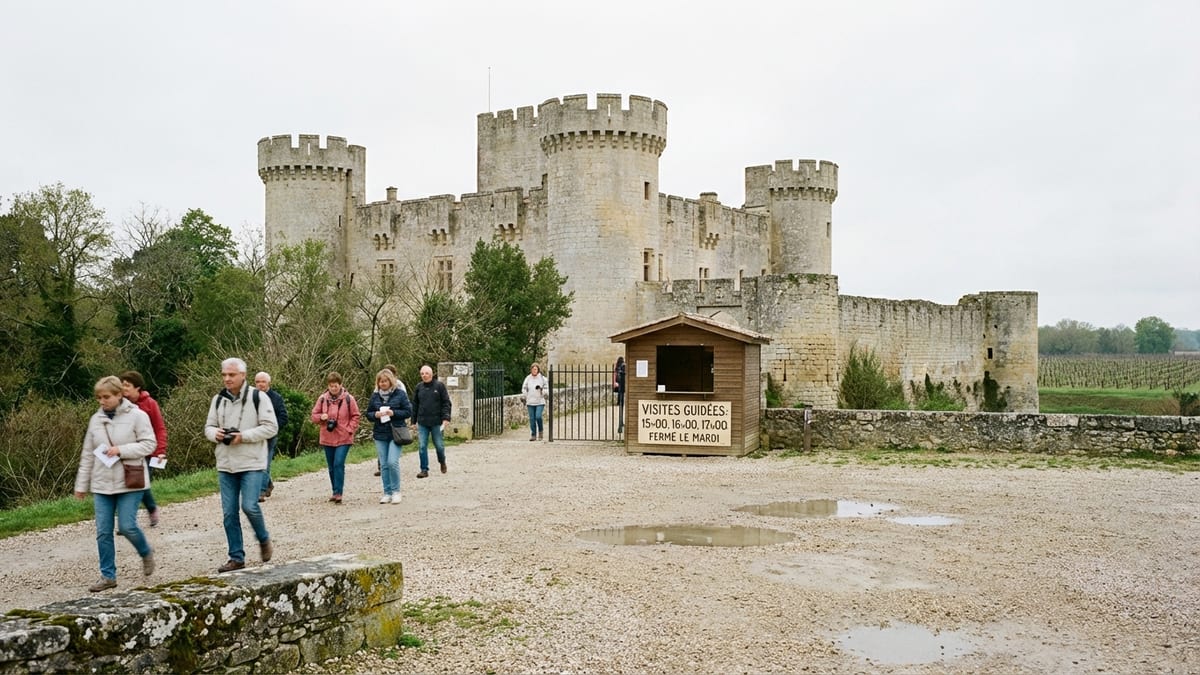
I had been circling Château de Roquetaillade on my map of southwestern France for a while before I finally went. Every time I drove down the A62 from Bordeaux toward the Landes or the Pyrenees, the signs teasing a fortified castle near Mazères tempted me. On my last trip through the Gironde, I finally built a stop there into my itinerary and structured a whole afternoon around it.
What I found was a place that is atmospheric, genuinely historic and visually striking, but also surprisingly constrained as a visitor experience: tightly scheduled guided tours, no wandering indoors on your own, minimal facilities and some awkward information gaps if you do not speak French. Whether it is worth the detour depends very much on your expectations, your timing and your tolerance for a slower, old-school style of heritage visit.
First Impressions: Getting There and Arriving
Roquetaillade is close enough to Bordeaux to be an easy half-day trip, but it is not a place you casually stumble into on foot or by public transport. I drove there from Bordeaux in a rental car, taking the A62 toward Toulouse and exiting near Langon, then following small departmental roads through wine country. On paper, it is roughly a 40 minute drive from Bordeaux and that matched my experience, traffic permitting. The last stretch passes through quiet countryside and vineyards, then the fortified silhouette of the castle suddenly appears over the trees, which is an undeniably dramatic first glimpse.
Parking was straightforward; there is a free car park just below the castle site. It is not particularly pretty, more of a functional gravel lot, but I could find a space without stress even in shoulder season. From there, a short uphill walk brings you to the entrance gate. The transition from car park to castle is not especially choreographed or romantic. There is no grand allee or long approach. One moment you are by your car, the next you are at a small ticket booth with a simple signboard listing the tour times and prices. The setting itself, however, immediately reads as rural and somewhat wild, with fields, woodland and a sense of isolation that fits a medieval fortress.
What threw me slightly on arrival was how crucial timing is. Roquetaillade is not one of those estates where you can just show up at any time and wander around the interiors. Guided tours are the only way into the castle, and they run at fixed hours that vary by season. According to the official information when I visited, in high season (July and August) tours run continuously from late morning to late afternoon, with the last visit at 5 p.m. For the rest of the main season from Easter to 1 November, there are usually two visits a day at 3 p.m. and 4 p.m. In the quieter months, it shrinks down to Sunday and holiday afternoons only, again at 3 p.m. and 4 p.m., with a single 3 p.m. visit during the Christmas holidays apart from Christmas Day. I arrived deliberately around half an hour before the 3 p.m. slot, which turned out to be wise; people who showed up later had to wait around with very little to do.
Tickets, Tours and Language Realities
Buying a ticket is refreshingly simple and old fashioned, which is both charming and mildly frustrating. Prices when I went were in the ballpark of 10.50 euros for adults and 8 euros for children and students for the castle visit, in line with the posted tariffs. There was no online booking, no timed ticketing system and no dynamic pricing. You pay at the counter in cash or by card (cards were accepted when I visited, but the signage still leaned heavily on cash and checks), get a paper ticket and that is it. For individual visitors there was no reservation needed; groups of 20 or more are asked to book in advance.
The tours are always guided and, crucially, in French. That is clearly stated in the official information, but it still caught a few visitors off guard. If your French is rusty, you are not entirely abandoned. The staff provide free printed translations of the tour in several languages if you ask. I was given an English leaflet that broadly followed the structure of the visit and summarized the key points in each room. That helped, but it is not the same as having the nuances and anecdotes in your own language. My French is functional enough that I could follow most of the guide’s commentary, but I watched other non-French speakers struggle to stay engaged while juggling the leaflet, listening, and snapping photos within the time allowed in each space.
The guide I had was clearly knowledgeable and personally invested in the place. Roquetaillade is still a family home, and the tone of the tour reflects that. It is less about sweeping national history and more about the story of one family and one building over centuries, with a particular emphasis on the 19th-century restoration by the architect Viollet-le-Duc. At times that intimacy is a strength; you feel you are getting insider details rather than polished textbook facts. At other times it can feel slightly insular and unstructured, especially if you are trying to connect the narrative to a broader understanding of French history or architecture.
The Atmosphere: A Lived-In Castle, Not a Museum
What sets Roquetaillade apart from many castles I have visited is the combination of severe medieval exteriors and richly eccentric 19th-century interiors, all layered over a life that is still ongoing. The guide stressed that this is not a museum but a private residence open to visitors part of the year. Walking through the rooms, that claim feels credible. You see modern family photos on side tables, contemporary art mixed with historic furnishings and the inevitable signs of everyday life that have not been fully “museumified.” I liked that; it gave the place a sense of continuity rather than freezing it in a single era.
The interiors designed or reworked by Viollet-le-Duc are the star of the show. If you only know him from his work on the exterior of Carcassonne or Notre Dame de Paris, Roquetaillade is a chance to see his decorative side up close. The chapel with its Moresque-inspired decor is both ornate and slightly unexpected in rural Gironde. The dining hall and living spaces are full of carved woodwork, painted ceilings and stylistic flourishes that foreshadow elements of Art Nouveau. The tour spends a lot of time pointing out these details, and rightly so. This is where Roquetaillade earns its reputation among architecture enthusiasts.
At the same time, the lived-in quality has downsides. Some rooms feel cluttered and a bit tired, with furnishings that have clearly been patched and repatched over decades. Conservation work is ongoing, and parts of the castle showed scaffolding or partially restored areas when I visited. That is normal for a historic monument, but it does mean that the photographic perfection you might be imagining from postcards is not always what you get in person. Personally, I prefer seeing a place that is genuinely mid-restoration rather than cosmetically flawless, but travelers expecting a polished chateau interior might be surprised or even disappointed.
The Visit Itself: Route, Pace and Frustrations
The visit follows a fairly standard route: exterior orientation in the courtyard, then a sequence of interior rooms, the chapel, and finally an opportunity to explore the park on your own. The guided interior portion lasts about an hour, as advertised, and is quite tightly paced. The guide controls the flow and there is limited time for lingering in each room. That is perfectly understandable with fragile historic interiors and consecutive groups, but I found myself sometimes wanting five more minutes in a space that we had to leave almost as soon as I had framed a couple of photos and skimmed the translation sheet.
Photographs are allowed without flash, which is a big plus, but the combination of dim lighting in some rooms and a moving group made photography a little tricky. The guide’s commentary was dense enough that stopping to take pictures often meant missing some of what was said. If you are very photography-driven or like to study details at your own pace, this guided-only format will probably frustrate you. If you are used to French historic sites, you may find it entirely normal.
Once outside, you are free to wander the surrounding park and remnants of the “old” castle. The site actually contains two castles and a chapel within the same enclosure. The fortified silhouette is striking up close, with thick curtain walls and towers that retain a sense of defensive purpose, unlike some chateaux that have morphed fully into palaces. However, the park is not a manicured landscape in the Versailles sense. It feels more like a lightly managed rural estate, with some viewpoints, open lawns and trees but not a clear path system or interpretive signage. I enjoyed the slightly wild character, but in practical terms, there is not a huge amount to do in the park if you have already taken your photos and the weather is not particularly inviting.
Facilities, Practicalities and Accessibility
In terms of visitor facilities, Roquetaillade is minimalistic. When I visited, there was a small ticket booth and basic restrooms. There was mention of a shop and occasional catering for events, but on an ordinary visit do not expect a full restaurant, a stylish cafe or extensive visitor center. There may be simple snacks and drinks in high season, but I would not plan my lunch around it. If you are used to larger French chateaux with big visitor infrastructures, this feels almost bare bones. Depending on your travel style, that might be a positive or a negative. I found it refreshing not to be funneled through a large commercial machine, but it does mean you need to think ahead about food, especially with kids.
Accessibility is another area where expectations need to be realistic. This is a medieval fortified structure with uneven floors, narrow stairs and some tight doorways. I did not see lifts or alternative routes for visitors with significant mobility impairments. The park and courtyard are relatively accessible for those able to handle a gravel surface, but the interiors would be challenging for anyone who cannot manage stairs. The official information does not oversell accessibility, and in practice I saw visitors with strollers struggle on the steps and in tight corridors. If you have mobility concerns, I would contact the castle in advance to see what is realistically possible for your situation.
One other practical note: pets are not allowed in the park or the castle. That is clearly stated in the site’s own information, and it was enforced at the entrance. I saw one couple turned away with a dog and trying to juggle turns on the tour while the other waited outside. Given the rural setting, it is easy to assume you can bring a dog along, but Roquetaillade is firm about this, so plan accordingly.
Seasonality, Crowds and How Long to Stay
The experience at Roquetaillade is heavily shaped by when you go. In peak summer, the castle operates almost all day with visits starting from 10:30 a.m. and running until the last tour at 5 p.m. In that period you have more flexibility: if you miss one tour, you can usually catch another without spending your whole afternoon waiting. You also benefit from longer opening hours for the park and potentially more on-site services. The trade-off is that you share the rooms with larger groups. I visited just outside the busiest weeks, and my group was big enough that some rooms felt cramped but not unbearable.
Outside summer, the narrow band of visit times becomes much more constraining. From Easter to November 1, you basically have two chances a day, at 3 p.m. and 4 p.m., and in the low season only on Sundays, holidays and local school vacations. If you arrive in the late morning or early afternoon hoping for an interior visit, you will be left to kill time in the park or nearby villages until the next slot. The official tourism information for 2026 even lists very specific windows in winter where Sunday-only or daily openings apply between set dates. It is the sort of place where checking the schedule the week before you go is not optional.
As for how long to stay, the interior tour is about an hour, and I spent another 45 minutes or so wandering the exterior and park, taking photos and just enjoying the atmosphere. If you are very hurried, you could compress it all into 90 minutes. Realistically, between parking, buying tickets, waiting for the tour to start and then exploring outside afterward, this is a solid two to three hour stop. It fits nicely as a half-day trip from Bordeaux or as a long break in a drive between Bordeaux and the southwest, but it is not a full-day destination in itself unless you combine it with winery visits or other local attractions.
Context: How It Compares to Other Castles and Wine Country Stops
In a region overflowing with castles and wine estates, it is fair to ask what makes Roquetaillade stand out, and where it falls short. Architecturally, it occupies an interesting niche. It is not a delicate Loire-style pleasure palace, nor a ruined hilltop stronghold. It is a substantial, mostly intact fortified castle with a unique 19th-century decorative layer. If you are specifically interested in Viollet-le-Duc or in the evolution of medieval fortresses into more comfortable residences, this is a very rewarding stop.
Compared to blockbuster sites like the chateaux of the Loire or Carcassonne, Roquetaillade feels much more intimate and less polished. There is no carefully curated multimedia experience, no battery of interpretive panels, no children’s trail. That can be a relief if you are tired of overdeveloped heritage attractions, but it also means you get much less guidance if you arrive with only a vague sense of its significance. I left with strong impressions of certain rooms and the personality of the place, but less clear overall framing than I have had at more interpretive-heavy sites.
In the context of the Bordeaux vineyards region, Roquetaillade offers something different from the usual vineyard and barrel cellar tours. There is a small winery linked to the estate, producing Graves wines, and you can combine a castle visit with a wine tasting nearby if you plan ahead. The tourism board lists Roquetaillade La Grange as offering tastings during business hours, typically on weekdays, for a small fee per person. On my visit the castle itself did not push wine tourism aggressively; it remains primarily a historic monument with a discreet agricultural side, not a slick wine chateau experience. If your priority is wine, there are more specialized estates. If your priority is history with a wine-country backdrop, Roquetaillade is a good fit.
Things That Disappointed Me (And How I Would Do It Differently Next Time)
I left Roquetaillade broadly satisfied but with a few clear frustrations. The first was the rigidity of the visiting structure. I understand why a lived-in historic castle cannot simply open its doors for free roaming, yet the strict guided-only model left little room for my own curiosity. I would have loved an option for an extended visit that combined the guided element with some free time in the interiors, even if only in selected rooms, or at least a bit more time in each space. As it stands, the visit is very much one-size-fits-all.
The second disappointment was the thinness of information in languages other than French. The printed English leaflet was better than nothing, but it felt like a bare minimum solution rather than a thoughtful adaptation. Important details clearly present in the spoken commentary never made it to the translation sheet, and there was no audio guide, QR-based content or even a simple bilingual summary in each room. For a site that actively welcomes international visitors, this felt like a missed opportunity. If my French were non-existent, I suspect I would have come away with a far shallower understanding and more frustration.
I was also slightly underwhelmed by the exterior park as a standalone attraction. The rural setting is pleasant and the castle’s profile is photogenic, but beyond the main vantage points there is limited structure to the landscape. No clear walking circuit, little interpretive signage and few spots that invite you to linger beyond a bench or two. It is absolutely not a landscaped garden in the classical sense that you might expect from other famous French estates. Next time, I would probably treat the park as a short add-on to the interior visit rather than something to build a long stroll around, unless I simply wanted a quiet place to sit for a while.
If I were to repeat the experience, I would plan even more carefully around the schedule, aim for a quieter midweek slot in shoulder season to minimize crowding, and deliberately brush up my French historical vocabulary beforehand. I would also combine Roquetaillade with at least one nearby stop, perhaps a lunch in Bazas or a visit to a Graves winery, to make it part of a fuller day rather than a single-purpose detour.
The Takeaway: Who It Is For and When It Is Worth It
So, is Château de Roquetaillade worth visiting? For me, the answer is yes, but with specific caveats. It is not an all-purpose crowd pleaser. It is not a playground for young children, nor a polished, information-rich mega-site. It is a slightly eccentric, deeply personal historic house that happens to occupy a formidable fortified shell, still in the hands of a family navigating the complexities of preserving a protected monument while living in it and financing its restoration partly through visitor fees.
If you are an architecture enthusiast, a medieval history nerd or someone who follows the work of Viollet-le-Duc, Roquetaillade is almost a must. The chance to see his interior decorative program in situ, in a castle that still feels like a home, is rare and valuable. If you appreciate places that show their age and the reality of restoration rather than polished perfection, you will find it atmospheric and honest. The guided tour, while imperfect, gives enough access and context to make the trip worthwhile.
If you are traveling with small children who need space to run and hands-on distractions, or if you rely heavily on English-language interpretation and prefer self-guided exploration at your own pace, you may find Roquetaillade more effort than reward. In that case, I would still consider stopping if you happen to be passing close by and can align with a tour time, but I would not bend an entire itinerary around it.
In practical terms, it is worth it if you can check three boxes: you have your own transport, you can time your arrival for one of the scheduled tours, and you are comfortable with a French-guided visit supported by a translation sheet. Meet those conditions, and Roquetaillade offers an evocative, somewhat offbeat window into centuries of life in the Gironde. I walked away feeling that I had stepped into a living chapter of regional history rather than a polished set-piece. It was not perfect, but it stayed with me, which in the end is what I want from this kind of place.
FAQ
Q1. How do I get to Château de Roquetaillade from Bordeaux?
By car it takes roughly 40 minutes from Bordeaux via the A62 motorway toward Toulouse, exiting near Langon and following local roads to Mazères. Public transport options are limited and involve a train to Langon and then a taxi, so having a car makes the visit far easier.
Q2. Do I need to book tickets in advance?
For individual visitors, you generally do not need to book in advance and tickets are sold on-site before each tour. Groups of 20 or more are expected to reserve ahead. Because visits are at fixed times, it is still smart to arrive at least 20 to 30 minutes before a scheduled tour, especially in high season.
Q3. What are the opening hours and tour times?
The castle runs guided tours only, at fixed times that vary by season. In July and August, visits usually run every day from late morning to late afternoon, with the last tour at 5 p.m. From Easter to early November, tours are typically at 3 p.m. and 4 p.m. daily. In low season, they are mostly on Sunday and holiday afternoons, with a single 3 p.m. visit on most Christmas holiday days. Always check the current schedule shortly before you go because exact dates and times can shift.
Q4. Are the tours available in English?
The spoken tours are in French, but free printed translations in English and other languages are available if you ask at the ticket desk. These leaflets summarize the key points of each room, but they do not capture every detail of the guide’s commentary, so some understanding of French is an advantage.
Q5. How long should I plan for the visit?
The guided interior tour lasts about one hour. Including time to buy tickets, wait for your tour to start and wander the park and exterior afterward, a realistic visit lasts around two to three hours. It works well as a half-day trip from Bordeaux or a substantial stop on a longer driving day.
Q6. Is the castle suitable for children?
Older children who are interested in castles, knights or architecture may enjoy the visit, but younger kids might find the one-hour guided tour and restricted movement inside a bit long. There are no playgrounds or interactive exhibits, and you cannot let children run freely in the interiors, so patience and supervision are important.
Q7. How accessible is Château de Roquetaillade for visitors with limited mobility?
The castle has many stairs, uneven floors and narrow passages typical of a medieval fortress, so interior access is challenging for anyone with mobility impairments. The courtyard and parts of the park are easier to navigate on relatively level ground, but there are no lifts for the upper floors. If mobility is a concern, it is best to contact the castle before visiting to discuss what is feasible.
Q8. Can I visit the grounds without joining a guided tour?
Access to the interior of the castle is only through a guided tour. The park and exterior areas are included in your ticket and can be explored independently before or after the tour. If you arrive outside tour hours, your experience will be limited to the exteriors and park, which is pleasant but not as rich as the interior visit.
Q9. Are there food and drink options on-site?
Facilities at Roquetaillade are modest. Depending on the season, there may be a small shop and limited refreshments, but there is no full-service restaurant or cafe geared to day visitors. It is wise to eat before you arrive or plan a meal in a nearby town such as Bazas or Langon.
Q10. Is Château de Roquetaillade worth a special trip?
It is worth a dedicated visit if you enjoy architecture, medieval history or the work of Viollet-le-Duc, and if you can coordinate your arrival with the tour times. If your schedule is tight, you are traveling without a car, or you prefer more flexible, self-guided experiences, it may be better treated as an opportunistic stop when you are already in the area rather than a primary destination.