


More news on this day
Dozens of Italian holidaymakers have been left stranded in Bergen after an air traffic controllers’ strike disrupted flights across Norway, forcing some to sleep on airport floors and scramble for scarce hotel rooms.
Get the latest news straight to your inbox!
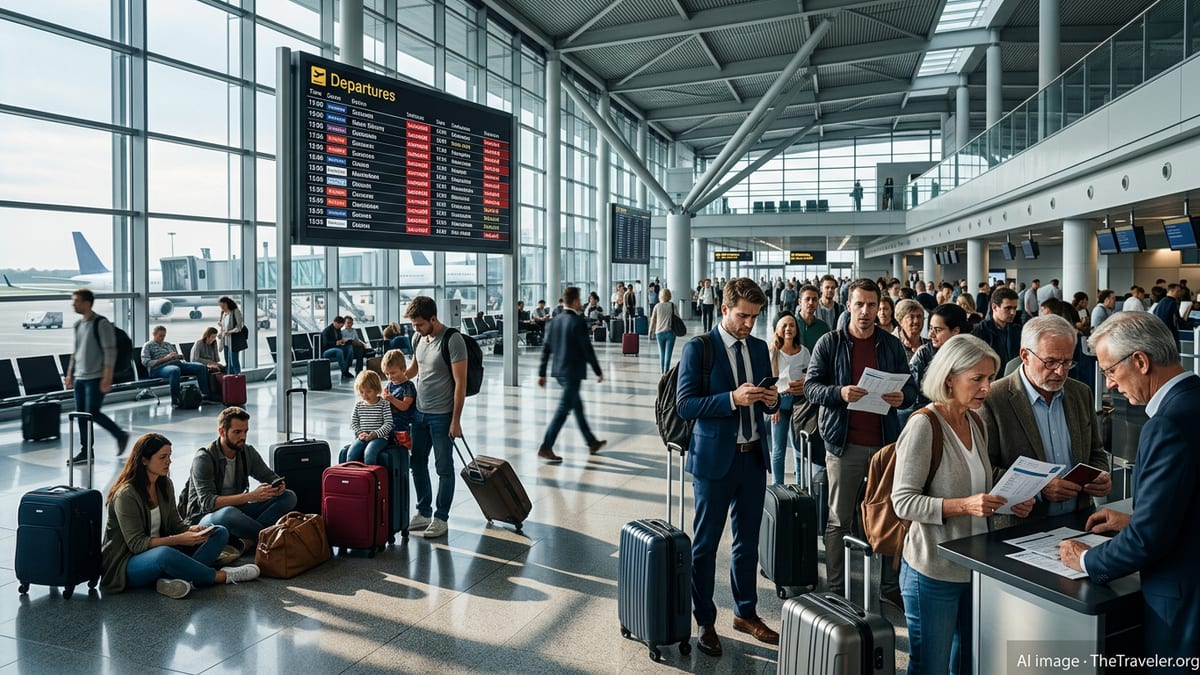
Strike Halts Traffic at Bergen Airport
Norway’s air network has faced severe disruption after a strike by air traffic controllers led to widespread cancellations and delays, with Bergen’s Flesland Airport among the hardest hit hubs. Data compiled by aviation tracking site Flytall shows that from 21 to 24 August 2026, nearly 250 flights were cancelled nationwide, including multiple departures from Bergen to major European cities and domestic hubs such as Oslo and Trondheim.
On the peak disruption days, services from Bergen to Florence and Milan Bergamo, key links for Italian leisure travelers, were among the flights listed as cancelled. The stoppage coincided with the end of the summer tourism season, a period when Italian visitor numbers to Norway typically surge, particularly for fjord cruises and “Norway in a Nutshell” itineraries that funnel travelers through Bergen.
Reports from Norwegian media indicate that the strike began on Friday, 21 August, after negotiations between the air traffic controllers’ union and employers failed to produce an agreement. Although national authorities later reported that the industrial action was called off on Monday, 24 August, the backlog of disrupted services has continued to affect passengers days later, especially those dependent on limited direct links to Southern Europe.
Foreign travel advisories updated in late August highlight the strike as a significant cause of travel disruption, advising visitors to check the status of their flights and to maintain flexible itineraries while the aviation sector works through the operational knock-on effects.
Italian Holidaymakers Sleeping on Floors and Camp Beds
Italian tourists have been among the most visible groups caught in the turmoil at Bergen Airport. Coverage by Italian outlets describes scenes of holidaymakers camped along terminal corridors, some on thin mats or bare floors, unable to secure hotel rooms in a city where accommodation was already close to full at the summer peak.
One report from Italian media recounts how dozens of Italian passengers bound for Florence and other Italian destinations were notified of cancellations less than an hour before scheduled departure. Subsequent attempts to rebook were hampered by the sheer volume of disrupted services, leaving many travelers without clear information on when they might return home.
Norwegian news coverage corroborates that more than 300 passengers, of various nationalities, were forced to spend the night at Bergen Airport as the strike intensified. Airport operator Avinor set out field beds and distributed water, blankets and sleeping bags to those unable to leave the terminal, while the local Red Cross assisted with emergency supplies. Witnesses cited in local reports described a rush for limited sleeping gear when a new delivery arrived late in the evening.
Italian travelers have also described difficulties accessing basic assistance. According to Italian press accounts, some passengers reported receiving only a basic sleeping mat and no food or drink vouchers, while others said they had to arrange and pay for alternative accommodation outside the city due to a lack of available hotel rooms nearer the airport.
From Norway Getaway to Logistical Ordeal
The strike has turned what was meant to be a scenic escape into an unexpectedly costly and stressful experience for many of the stranded Italians. Several accounts collected by Italian news sites detail how travelers have spent hundreds of euros in a matter of days on extra meals, local transport and emergency lodging, on top of their original holiday budgets.
Families with young children appear particularly affected. One family traveling with five small children described being forced to sleep on the floor in the departures area and then seeking an expensive last-minute overland route to Oslo, where flight operations were perceived as more stable. Others reported renting cars and driving long distances to stay with acquaintances or in rural rentals far from the city after finding no vacancies at Bergen hotels.
While some airlines have offered rebooking at later dates, published coverage suggests that replacement flights are often scheduled several days after the original departure, with no guarantee against further disruption. In online travel forums, passengers have also discussed the limited usefulness of rerouting options within Norway, given that the industrial action has affected multiple airports and domestic connections.
These delays are not only inconveniencing leisure travelers. Norwegian reports note that the strike has also impacted patients traveling for medical treatment, students heading to university term starts and workers returning for new jobs, underlining how vulnerable critical journeys can be when a key transport sector is suddenly curtailed.
Passenger Rights and the Limits of Protection
The situation in Bergen has also highlighted the complexities of passenger rights when disruptions stem from air traffic control action rather than airline decisions. Under European Union and European Economic Area regulations, airlines typically must offer care such as meals, refreshments and accommodation when flights are heavily delayed or cancelled. However, compensation provisions are often limited when cancellations are caused by events interpreted as “extraordinary circumstances,” including strikes by air navigation services staff.
Travelers discussing their experiences in Norway-focused forums and social media indicate that many stranded in Bergen have been informed that they are not eligible for financial compensation under EU rules, even as they face substantial out-of-pocket expenses. Some airlines have nonetheless provided hotel rooms or meal vouchers where capacity allowed, but coverage from both Norwegian and Italian outlets suggests that this support has been inconsistent and rapidly overwhelmed by demand.
Consumer organizations and travel commentators are encouraging affected passengers to retain receipts for all additional costs and to consult their travel insurance policies, which may offer broader protection than statutory compensation frameworks. Publicly available guidance also recommends that passengers who booked package holidays contact their tour operators, who can carry specific responsibilities for arranging alternative transport and accommodation.
The episode is serving as a reminder to European travelers that while air passenger rights legislation provides an important safety net, it does not always cover the full financial and emotional impact of large-scale operational crises, particularly when these involve third-party providers like air traffic control.
What Stranded Travelers in Bergen Can Do Now
For Italian tourists still stranded in or around Bergen, published advice from travel bodies and passenger advocates focuses on a mix of practical and administrative steps. First, passengers are urged to monitor their flight status directly through airline apps and official websites, as schedules are being adjusted frequently while Norwegian airspace capacity is restored.
Second, travelers are encouraged to press airlines for the minimum care obligations outlined in EU and EEA rules, including reasonable provision of food, drink and, where an overnight stay is required, hotel accommodation or equivalent. Where on-the-spot assistance is unavailable due to demand, experts recommend keeping detailed records of expenses to support later claims with airlines, tour operators or insurers.
Alternative routes are also being considered, particularly for those needing to return urgently to Italy. Reports indicate that some passengers have opted to travel by rail or coach to Oslo or to neighboring countries such as Sweden, where they can access additional flight options to Italian cities. However, these alternatives can be lengthy and costly, and capacity on some routes is limited following the spike in demand.
As Norway’s aviation system works through the aftermath of the strike, travel advisories continue to recommend that visitors build flexibility into their plans, avoid tight same-day connections and remain prepared for sudden schedule changes. For the Italian tourists still waiting under the departure boards in Bergen, the hope is that the worst of the disruption has passed and that normal links between the fjords and the Mediterranean will be restored in the days ahead.
Flytall overview of Norway air traffic control strike disruptions
Fanpage.it coverage of Italian tourists stranded in Bergen
Norwegian report on passengers overnighting at Bergen Flesland Airport