

More news on this day
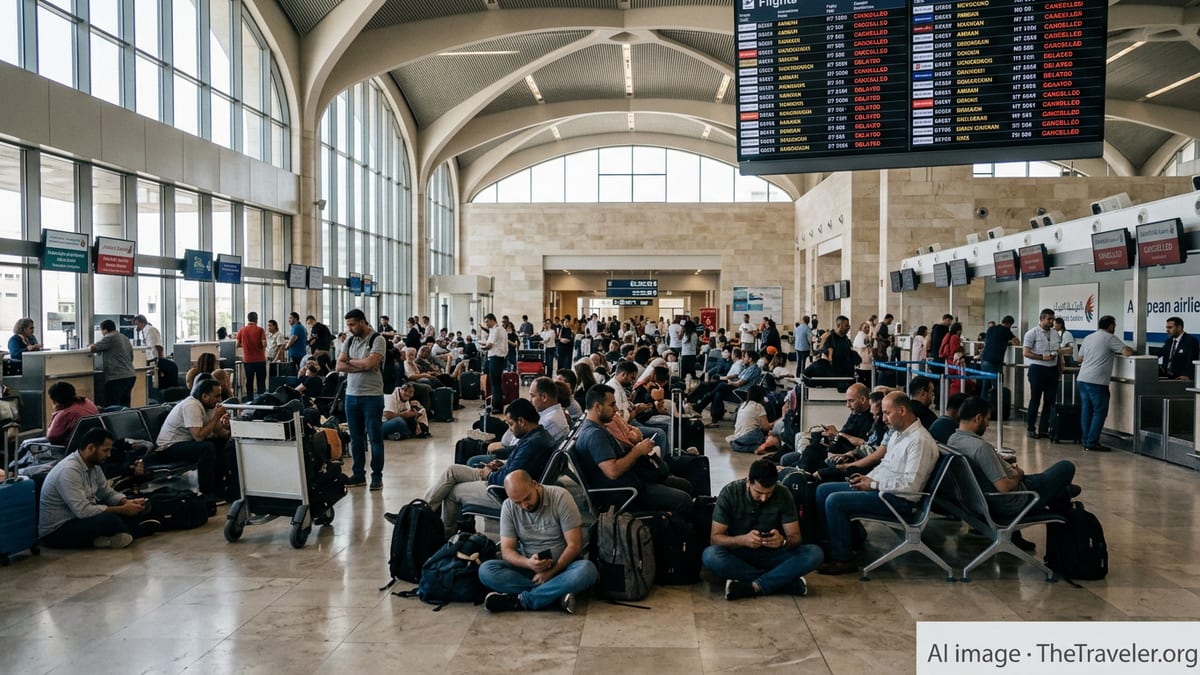
Hundreds of passengers were stranded at Amman’s Queen Alia International Airport on Saturday as at least 45 flights were cancelled and 14 delayed, snarling operations for Royal Jordanian, Qatar Airways, Oman Air, Egypt Air, Buzz and other carriers amid surging regional tensions linked to US and Israeli strikes on Iran.
Queen Alia Becomes a Flashpoint in Middle East Air Travel Turmoil
By early afternoon on March 7, departure and arrival boards at Queen Alia International Airport were dominated by red cancellation and delay notices as airlines scrambled to respond to rapidly shifting security assessments over regional airspace. Airport operations staff said the day’s schedule had been “gutted” compared with typical traffic, with a mix of regional and European services among the hardest hit.
Passengers described scenes of uncertainty inside the terminal, with long lines at airline desks and families clustered on the floor around suitcases as they waited for updates. While some flights continued to operate, widespread cancellations meant many travelers had no clear indication of when they might be able to leave Jordan or reach their original destinations.
Jordan has been considered one of the more stable air corridors in the region, but the latest escalation has underscored how quickly that status can change. Restrictions on surrounding airspace, last-minute rerouting and crew duty-time limits have all combined to create a cascading effect that is now clearly visible in Amman.
Key Carriers Cut Services as Security Concerns Mount
Flag carrier Royal Jordanian has borne the brunt of the disruption, with multiple flights to Gulf hubs and nearby capitals cancelled or heavily delayed as planners reassess routings that would normally cross areas now deemed high risk. Regional links to Doha, Dubai, Kuwait City, Riyadh and other major gateways have been especially vulnerable to short-notice changes.
Gulf heavyweight Qatar Airways has also scaled back operations through Amman, reflecting the broader squeeze on traffic to and from Doha as Qatar’s own airspace and that of neighboring states becomes more complex to navigate. Oman Air and Egypt Air, which typically use Amman as part of their regional networks, have cancelled services after Iranian drones and missiles targeted sites in Oman and raised alarms across the eastern Mediterranean.
European low cost carriers, including Buzz and other budget operators feeding leisure and VFR traffic into Jordan, have cut or consolidated rotations as insurance costs spike and regulators demand wide detours around conflict zones. These changes add hours of flying time and fuel burn, tightening crew rosters and forcing airlines to trim frequencies or suspend some routes altogether.
US-Israel Strikes on Iran Trigger Regional Airspace Shockwaves
The immediate trigger for today’s turmoil is the ongoing US and Israeli military campaign against Iran, launched on February 28 and followed by waves of retaliatory strikes by Tehran and allied groups across the Gulf, Iraq and Jordan. The conflict has prompted temporary airspace closures and severe restrictions above multiple states, fracturing the dense web of corridors that normally carry passengers between Europe, the Middle East, Africa and Asia.
Aviation analysts note that even when Jordan’s own skies remain technically open, closures and high-alert restrictions in neighboring countries force airlines to redesign flight paths on the fly. Some of these alternatives are so circuitous that they are commercially unsustainable for short- and medium-haul routes, leading carriers to opt for cancellation rather than risk extended delays, diversions or fuel stops in already congested airports.
Global tracking data over the past week has shown thousands of flights cancelled across the Middle East, with transfer hubs such as Dubai, Doha and Abu Dhabi experiencing some of the worst disruption. With those key connectors constrained, secondary airports like Amman are struggling to absorb stranded passengers while at the same time losing onward connectivity that normally allows for swift rebooking.
Stranded Travelers Face Uncertain Timelines and Limited Options
For travelers caught in today’s shutdown at Queen Alia, the human cost is measured in missed family events, broken business plans and mounting expenses. Many said they received late-night or early-morning messages informing them their flights were “under review” or delayed, only to learn at the airport that services had been cancelled outright.
Several airlines are offering rebooking at no additional cost when seats become available, but with capacity sharply reduced across the region, alternative itineraries are scarce. Some passengers have been told to expect waits of several days for the next available seat to popular destinations such as London, Istanbul, Doha or Cairo, particularly where connecting flights rely on Gulf hubs that remain heavily disrupted.
Staff at information counters in Amman have urged passengers to stay in close contact with airlines via apps and call centers rather than repeatedly queuing at airport desks, where agents have limited flexibility and are dependent on evolving operational decisions from headquarters. Hotels around the airport and in central Amman have reported a jump in last-minute bookings as travelers resign themselves to unplanned stopovers.
Jordanian Authorities Signal Caution as Conflict Drags On
Jordan’s civil aviation authorities have framed the current restrictions as a necessary response to an unpredictable security environment. Officials stress that while the country is working to keep its airspace as open as possible, safety considerations take precedence over schedule reliability, particularly while Iranian missiles and drones continue to target US and allied assets around the region.
Industry observers say Queen Alia’s experience today may foreshadow a longer period of sporadic disruptions as the Iran conflict unfolds. Even if outright airspace closures ease, intermittent launches, heightened military patrols and shifting risk assessments by insurers and regulators could keep airlines in a reactive mode for weeks, with Amman’s schedule fluctuating from day to day.
For now, travelers planning to transit through Jordan or other Middle Eastern gateways are being advised to build extra flexibility into their itineraries, allow longer connection times and monitor flight status closely. The scenes at Queen Alia on March 7 highlight how swiftly geopolitical tensions can ripple through the global travel system, turning a routine travel day into an ordeal for hundreds of passengers with little warning.