


Arriving in Kotor by sea is one of the most memorable entrances in the Adriatic, but how much you can actually see depends on where your cruise ship anchors and how long you stay. With cruise berths immediately beside the Old Town walls and additional anchorages out in the bay that rely on tender boats, the precise port arrangements on your day matter just as much as your excursion plans. This guide explains what that means in practice and how to make the most of a short port call or a longer stay in Montenegro.
Get the latest updates straight to your inbox!
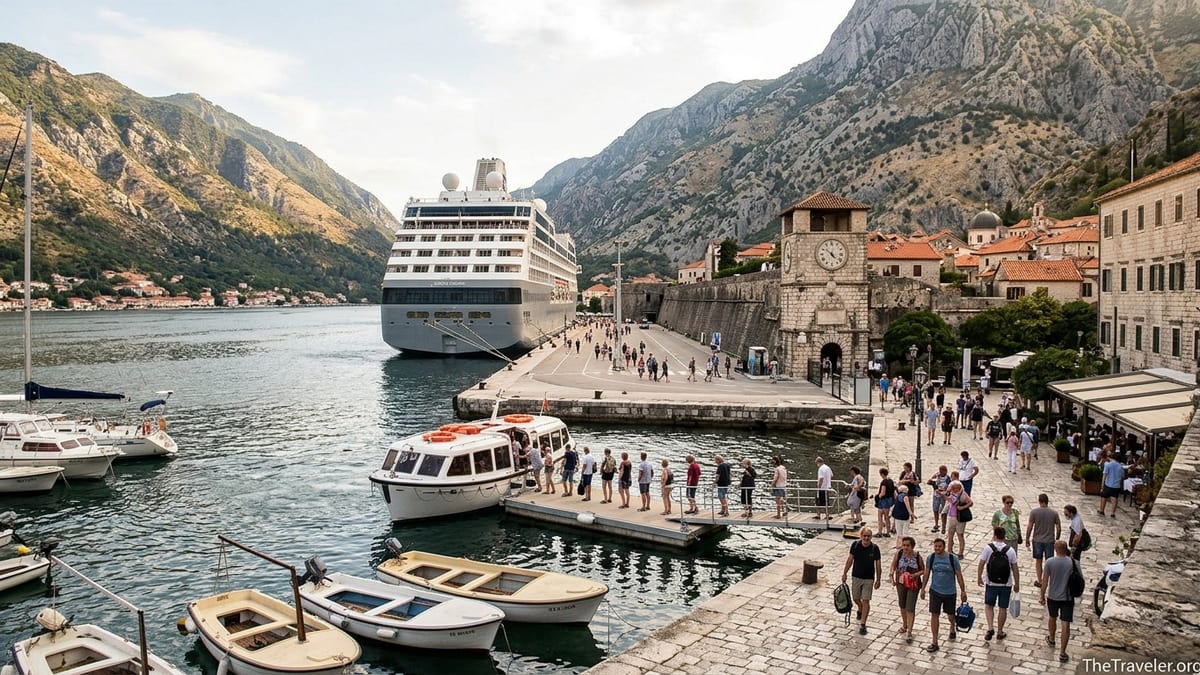
Understanding Kotor Cruise Berths, Tenders and Walking Times
The Port of Kotor has a small but busy cruise pier directly in front of the Old Town. When a ship is allocated this main berth, passengers walk off through the port gate and reach the Old Town’s Sea Gate in around 5 to 10 minutes on level but sometimes uneven paving. Several port and excursion operators describe this distance as roughly 200 to 300 metres, which matches independent cruise guides that list the port as about 0.2 miles from the town entrance. Once you leave the terminal, you cross the parking area and main road and the medieval walls are in full view ahead.
When more than one large ship is scheduled, or when a vessel’s size exceeds the pier’s capacity, the ship may anchor in the bay and run its own tenders. Port of Kotor documentation notes five berths but also confirms that ships often use lifeboat tenders to shuttle passengers to shore. In these cases, the tender pontoon is still very close to the Old Town, but passengers must factor in queuing, loading, the ride ashore and any delays in the return direction. Local shore excursion companies advise adding around 20 to 30 minutes each way on a tender day compared with a ship that is berthed alongside.
From the port entrance or tender pier, the route into town is straightforward. You follow the waterfront promenade for a few minutes, keeping the stone walls on your left. The Sea Gate, also called Vrata od Mora, is the main historic entrance, identifiable by the clock tower and Arms Square just inside. Cruise-focused guides that specialise in Kotor explain that even first-time visitors should allow 10 minutes to walk from ship to gate, longer if moving slowly or in heavy crowds. Wheelchair users and those with limited mobility can manage the distance, but cobblestones and kerbs make powered chairs or sturdy wheels preferable.
The key practical difference is that a ship at the pier gives you more controllable time: once cleared to disembark, you simply walk off and begin exploring. An anchored ship with tenders introduces extra uncertainty, particularly early in the morning when everyone is eager to go ashore, or around the last tender when hundreds of passengers are returning at once. That distinction is critical when you are planning independent trips to Perast, tackling the long climb to San Giovanni Fortress or trying to fit both Old Town sightseeing and a bay excursion into a four to six hour call.
Port Procedures, Tender Tickets and Why the Last Tender Matters
Tender arrangements in Kotor follow the pattern familiar from other Mediterranean ports, but the tight geography of the bay and the popularity of the destination make timings especially sensitive. Most cruise lines use a ticketing system when the ship is at anchor: passengers collect numbered tender tickets from a lounge or theatre and wait for their group to be called. Priority is usually given to ship-run shore excursions, elite loyalty members and suite guests, with independent travellers often called later. Recent passenger accounts from 2026 describe waits of 30 to 60 minutes for morning tenders when several large ships are sharing the bay.
The tender ride itself from ship to shore is relatively short, often in the range of 10 to 15 minutes depending on anchorage position and sea conditions. The unpredictable element is the queue on either side. Weather, delayed clearance by port authorities, and the time it takes for passengers to board and disembark all compress sightseeing windows. Cruise specialists who operate private Kotor tours have begun advising clients to treat Kotor as a high-risk port for tight independent schedules if tendering is involved, and to avoid booking fixed-time private boats or distant taxis too close to all-aboard times.
The final tender back to your ship is the most important time in your Kotor planning. Your daily cruise program will list a last tender time, often about 30 minutes before the official "all aboard" deadline printed for crew operations. In practical terms, you should plan to be physically standing in the tender queue at least 45 to 60 minutes before that last tender time, particularly when there are two or more ships in port or bad weather is forecast. Travelers posting their 2026 experiences report very long afternoon lines for tenders when sudden rain showers push everyone to return at once.
Arranging your day with these margins in mind is especially important if you go beyond the Old Town. For example, if your all-aboard is 17:30 and last tender is 17:00, independent operators generally recommend you be back at the port area by about 16:00. That allows for a queue, security checks and any unexpected disruption. Missing a tender is treated the same as missing the ship itself: the vessel will depart on schedule, and you would be responsible for catching up at the next port. In a compact place like Kotor, it is tempting to stretch your last gelato or waterfront photo session, but the risk of cutting it too close is very real on busy summer sailings.
A Four to Six Hour Independent Walking Itinerary in Kotor
If your ship is docked at the pier and you have at least four to six clear hours ashore, you can see a great deal independently without organised excursions. After disembarking, walk straight to the Sea Gate and step inside Arms Square, where the clock tower and old palace facades provide an immediate sense of Kotor’s Venetian heritage. Spend 20 to 30 minutes absorbing the atmosphere, then wander the narrow lanes that lead toward St Tryphon Cathedral. You cannot get truly lost: locals say every alley eventually circles back to a main square, and Arms Square makes a reliable mental landmark.
St Tryphon Cathedral, dating to the 12th century, sits in its own small square about three to five minutes’ walk from the Sea Gate. As of late 2026, visitors can expect an entry fee of roughly 4 to 5 euros, which includes access to the upper gallery with its fine views across the rooftops. Allow 30 to 45 minutes here to walk through the interior, see the reliquaries and climb the modest internal stairs if mobility allows. The cathedral’s twin towers also make a good orientation point when you later explore side streets.
From the cathedral, follow the maze of medieval lanes northwards, pausing in tiny squares such as Flour Square and the small plazas around Orthodox churches. Many cruise visitors remark that the pleasure of Kotor lies as much in these shady corners and cat-loving courtyards as in the formal sights. Cafes and konoba-style restaurants spill out onto cobbles, and you will find plenty of options for an espresso, local beer or quick lunch. Prices inside the Old Town trend higher than in Dobrota or other nearby suburbs, but a simple pizza slice, burek pastry and soft drink can still come in under 8 to 10 euros.
After your Old Town wander, head back to the Sea Gate and walk a short way along the waterfront promenade toward Dobrota to enjoy the classic postcard view of Kotor’s walls and bell towers backed by mountains. In four well-used hours, you can comfortably combine the Sea Gate and squares, St Tryphon Cathedral, casual street exploration and waterfront viewpoints, leaving at least 30 to 45 minutes of buffer time to stroll back to the ship and navigate any security procedures, even on a tender day. If your call is closer to six hours and the weather is not too hot, you can consider adding a partial climb toward San Giovanni Fortress.
Climbing to San Giovanni Fortress: Steps, Entrances and Safety
The long line of fortifications above Kotor rises to San Giovanni Fortress, the dramatic ruin that crowns the hillside. Recent local guides put the main path at around 1.2 kilometres in length with approximately 1,350 stone steps and about 260 metres of elevation gain from the church of Santa Maria in the Old Town up to the fortress. Municipal ticket offices at the Parilo entrance and at Škaljarska pjaca sell tickets seasonally, usually from 1 March to 30 November. Updated information from October 2026 confirms opening hours of 8:00 to 18:00 in March and April, 7:00 to 20:00 from May to September, and 8:00 to 17:00 in October and November, with ticket sales stopping before closing to allow for descent.
Admission prices have varied in recent years; sources in 2026 describe fees in the 8 to 15 euro range per adult, with residents of Montenegro entering free of charge. Because exact prices can change season by season, it is wise to carry cash and check the posted tariff at the gate. The climb itself typically takes 30 to 60 minutes to reach the top for reasonably fit visitors, not counting photo stops. The stone steps can be uneven and polished smooth in places, which increases the risk of slips, particularly when descending.
Heat is the biggest hazard. Local advice strongly recommends beginning the ascent as soon as the walls open in high summer, ideally at 7:00 or shortly after, or waiting until the late afternoon when the sun is lower. In July and August, midday temperatures on the exposed walls can feel punishing, and there is little shade once you rise above the Old Town roofs. Several travel accounts mention seeing unprepared cruise passengers attempting the climb in flip-flops with little water, only to turn back halfway. Closed footwear, at least one to two litres of water per person and basic sun protection are essential.
The fortress climb is not suitable for everyone. Travellers with heart or respiratory conditions, severe vertigo, knee or hip problems or very limited fitness should skip the full ascent. For a taste of the views with less effort, walk only as far as the small Church of Our Lady of Health, a halfway viewpoint that many visitors reach in 15 to 20 minutes from the Old Town gates. Another lighter option is to take a taxi or tour to higher viewpoints on the surrounding coast road or toward the Lovćen area, which provide sweeping bay panoramas without the staircase. Whichever option you choose, cruise passengers must also budget at least two to three hours between starting the climb and being safely back at sea level near the port, to avoid any risk of missing the last tender.
Perast and Our Lady of the Rocks: Independent Trips by Bus, Taxi or Boat
Perast and the tiny islet of Our Lady of the Rocks are the most popular side trip from Kotor and a highlight of many itineraries. Perast sits about 12 kilometres along the bay, and several sources agree that the journey takes roughly 20 to 30 minutes by road. The local Blue Line bus connects Kotor and Perast with cash fares of around 1.50 to 2 euros one way as of late 2026. Schedules can change and the buses are often crowded in summer, so you should obtain a current timetable from the Kotor bus station or tourist information and avoid the last possible departure back toward your ship.
From Perast’s waterfront, a cluster of small boat operators run constant five-minute shuttles out to Our Lady of the Rocks. Recent information from Perast travel resources and local operators indicates a typical return price of about 5 euros per person in 2025 and 2026 for the boat taxi, payable in cash after agreeing the fare and return time at the quay. Once on the islet, the church and small museum charge a further 2 to 3 euros for entry. For cruise passengers watching the clock, this combination of bus plus boat remains the most economical way to see Perast and the islet independently, but it leaves less margin for delays if your port call is only a few hours.
Taxis from Kotor to Perast form another reliable option. As of 2026, travellers report fares in the ballpark of 20 to 30 euros each way for a standard taxi, with the strong recommendation to agree the price in advance and arrange your return pickup because there is no formal taxi rank in Perast. For a small group of four, a pre-arranged transfer can work out to around 10 to 15 euros per person round trip and offers greater control over timing. There are also organised boat tours leaving directly from Kotor’s waterfront, bundling a cruise along the bay with stops at Perast and Our Lady of the Rocks. Recent brochure examples show prices from about 25 to 35 euros per person for 2 to 3 hour bay cruises, sometimes more when Blue Cave visits are included.
When deciding whether Perast fits your day, begin by calculating backwards from your last tender. If your ship requires you back at the port area by 16:00, plan to leave Perast no later than about 14:30 by taxi or 14:00 by bus, allowing for traffic or queues at the quay. That means a realistic earliest arrival in Perast around 10:00 if you depart Kotor at 09:30, which in turn means you would want to be on an early tender if your ship is at anchor. With only a six hour call on a tender day, many experienced cruise travellers now recommend focusing on Kotor itself, reserving Perast and Our Lady of the Rocks for a future land trip or for an organised ship excursion where the operator coordinates directly with tender schedules.
The Kotor Cable Car and Other Panoramic Alternatives
Since 2024, the Kotor–Lovćen cable car has been widely promoted as a signature new attraction, linking a lower station near Kotor to a higher station in the Lovćen area in about 11 minutes and offering expansive views over the bay. However, official statements from the cable car operator in late 2026 announce that the system is currently closed until spring 2027 for upgrades and maintenance. This means that for the 2026 and early 2027 cruise seasons, the cable car does not function as a practical excursion option, regardless of how long your ship stays in port.
When the cable car is operating, pricing documents and promotional material suggest that round-trip tickets would likely fall into the range commonly seen at regional lifts, but with the installation closed there is no confirmed current public price list for visitors boarding in Kotor. Shuttle transfers from the central bus station or nearby parking areas are usually mentioned as the way to reach the lower station, adding further logistics for cruise passengers whose ships anchor or dock by the Old Town. Even on a full operational day, cruise planners generally regard the cable car as an excursion better suited to those with at least eight to ten hours in port or travellers staying overnight in Kotor.
For now, cruising visitors seeking elevated views must rely on the San Giovanni fortress climb, organised minivan tours that ascend the serpentine road toward Lovćen, or taxi rides to signed viewpoints above the bay. Shared minivan tours offered on the pier often combine a panoramic road with short stops in Perast or at photo viewpoints overlooking the Kotor fjord-like inlet. Prices for these half-day tours can start around 35 to 50 euros per person, rising with private arrangements. These options bring the panoramas to those who cannot manage the fortress stairs and, when booked prudently with enough buffer time, can fit even into six to eight hour port calls.
If you are staying overnight in Kotor or Dobrota, you have greater flexibility to chase the best light for views. Early morning and golden hour drives along the waterfront road or up towards the Njeguši and Lovćen areas provide spectacular vantage points without the midday heat that challenges cruise passengers with fixed schedules. Until the cable car reopens, independent travellers should factor a taxi or rental car budget into their plans if high viewpoints are a priority.
Crowding Patterns and the Best Times to Explore the Old Town
Kotor’s Old Town is compact, and the surge of several thousand cruise passengers can transform its atmosphere within minutes. Recent visitor statistics quoted in local tourism material mention hundreds of cruise calls and well over half a million cruise passengers in a typical year, with days in summer when multiple large ships overlap. Under such conditions, Arms Square, St Tryphon Cathedral and the narrow alleys between them can feel extremely crowded from late morning through mid-afternoon.
The quietest time for cruise passengers to explore is often immediately after disembarkation, particularly if you are among the first ashore and choose to remain in town rather than heading straight for taxis or tour buses. From around 08:00 to 10:00, even on busy days, the Old Town tends to feel fresh and relatively uncrowded, with locals opening cafes and shops. Another good window is late afternoon, after 16:00, when many organised tours have ended and day-trippers begin to leave, though this depends on your ship’s sailing time.
When two or more large ships are in port, narrow streets that connect Arms Square to St Tryphon Cathedral and the north gate can become bottlenecks. In those conditions, it can be more pleasant to seek out the edges of the Old Town and sections of the walls that do not involve the full fortress climb. Some visitors also duck out beyond the gates for a while, walking along the waterfront in Dobrota or sitting at harbourfront cafes that are often slightly less congested than those directly inside the walls.
Overnight visitors enjoy a different side of Kotor. After the last tender departs and the final coachloads of day visitors leave, usually in the early evening, the Old Town becomes much quieter. Church bells echo off the walls, restaurants serve a more local crowd and the illuminated fortifications provide a striking backdrop. Early morning, before the first tender arrives, is equally atmospheric. For many travellers, these dawn and evening hours are the strongest argument for basing themselves in Kotor or nearby villages rather than experiencing it only as a midday cruise stop.
Two to Three Day Itineraries and Where to Stay Around the Bay
Travellers who choose to stay overnight in Kotor rather than visiting solely by cruise ship can explore at a more relaxed pace. A practical two day plan might dedicate the first day to Kotor’s Old Town, fortress walls and waterfront, and the second to Perast and Our Lady of the Rocks, with an option to add a third day for a more extensive bay exploration or a trip inland. On day one, check into your accommodation in or near the Old Town, wander the lanes, visit St Tryphon Cathedral and nearby churches, and time the San Giovanni climb for early morning or late afternoon, depending on temperatures and your fitness.
Day two can focus on Perast. Take an early Blue Line bus or a pre-booked taxi so that you reach the waterfront before the bulk of the excursion boats arrive. Cross to Our Lady of the Rocks on one of the small taxi boats, visit the church and museum, then return to enjoy Perast’s stone palaces and waterfront cafes. Many independent guides recommend climbing the bell tower of St Nicholas Church for an elevated view if it is open. Returning to Kotor mid-afternoon gives you time for a final stroll along the bayside promenade or a swim at one of the small beaches north of town.
A third day opens up further options. You might book a half-day boat tour exploring additional corners of the bay, such as the narrow Verige strait or the approaches to the Blue Cave area, or you could organise a road trip up the old serpentine road toward Lovćen for panoramic views and visits to mountain villages. Because you are not constrained by cruise tender times, you can choose departure hours that avoid the worst heat and coordinate with public bus schedules or car rental opening times.
Accommodation choice shapes the character of your stay. Lodging inside the Old Town puts you at the heart of the action, with characterful stone buildings, short walking distances and atmospheric nights. However, it also means potential noise from late-night bars, church bells and rolling suitcases on cobbles, as well as flights of stairs in historic houses and no on-site parking. Dobrota and nearby waterfront neighbourhoods provide a quieter experience, with guesthouses and apartments strung along the bay road. Here you are more likely to find parking, easier access for taxis and a mix of prices from modest rooms to upscale boutique hotels, all within a 20 to 30 minute waterfront walk or short taxi ride of the Old Town.
Budgets, Accessibility, Heat Precautions and When to Take a Tour
Budgeting for a Kotor visit depends heavily on whether you arrive by cruise or stay on land. A cruise passenger planning an independent four to six hour day might expect the following approximate costs in euros as of late 2026: 8 to 15 for the San Giovanni fortress entry if you choose to climb, 4 to 5 for St Tryphon Cathedral, 5 to 10 for a coffee and snack, and perhaps 15 to 20 for a simple sit-down lunch inside the Old Town. Add 5 to 10 more if you take a short taxi or local bus, and you might spend around 30 to 50 euros per person for a comfortable day without major extras. An independent half-day boat excursion could add 25 to 40 euros per person.
Overnight visitors face accommodation and local transport costs but benefit from more flexibility. Mid-range rooms in or near Kotor commonly fall somewhere in the 60 to 120 euro per night range in shoulder seasons, rising in peak summer and dropping in late autumn. A daily budget for two people might include 80 to 150 euros for lodging depending on location and season, 40 to 60 euros for meals and drinks, 15 to 30 euros for local buses or the occasional taxi, and 10 to 30 euros for entrances and small boat trips, making a rough total of 145 to 270 euros per day for a comfortable but not extravagant stay.
Accessibility in Kotor requires realistic expectations. The short stretch from the port to the Sea Gate is flat, but the Old Town’s interior is paved with stone and often uneven. There are frequent small steps, narrow alleys and very limited vehicle access. Wheelchair users may find some main squares and wider lanes manageable with assistance, but many guesthouses inside the walls sit up flights of stairs without lifts. The fortress climb is unsuitable for wheelchairs and challenging for anyone who struggles with steps or balance. For those travellers, waterfront hotels in Dobrota or modern properties on the outskirts with lift access can be a better choice than charming but impractical Old Town addresses.
Heat precautions are vital in summer. Temperatures in July and August can be high, and the stone walls reflect heat back into the streets. Plan strenuous activities like the fortress climb or long walks along the bay for the early morning or late afternoon, wear a hat, apply sunscreen generously and carry water. Cruise passengers used to air-conditioned interiors sometimes underestimate how quickly they can tire in the sun, especially when hurrying back for tenders. Taking regular breaks in shaded squares or indoor cafes is not only pleasant but prudent.
Deciding between independent exploration and organised shore excursions comes down to your risk tolerance, mobility and the length of your call. Confident travellers with a full day in port and a ship at the pier can comfortably explore the Old Town on their own, climb toward the fortress, and perhaps even add Perast by taxi or bus. Those facing a short visit, a tender operation, or mobility challenges might find better value in a carefully chosen ship tour or a reputable local operator that coordinates timings with the ship. While excursions cost more upfront, they remove the worry of missing the last tender and often bundle together highlights such as a walking tour, Perast visit and a bay cruise, which would be more complex to arrange independently under strict time pressure.
Conclusion: Matching Your Kotor Plans to Your Time in Port
Whether you first see Kotor’s walls from a cruise ship balcony at dawn or step out of a bus on the waterfront, the bay has a way of exceeding expectations. For cruise passengers, the practical details of berths, tender tickets and the last boat back to the ship can make the difference between a relaxed day of exploration and a stressful race against the clock. Understanding how long it really takes to walk from the port to the Sea Gate, to climb partway toward San Giovanni Fortress, or to reach Perast and back helps you shape a realistic itinerary that matches your schedule and energy.
Travellers who choose to stay overnight gain access to Kotor’s quieter early mornings and evenings, broader excursion possibilities and a more nuanced sense of the bay’s rhythms. They can linger in Perast after the tour boats depart, watch the fortifications light up after sunset and explore beyond the standard cruise circuit. Whichever way you visit, respecting the constraints of heat, crowds and mobility while allowing generous buffer time for tenders and transfers lets Kotor reveal itself not just as a photogenic stop, but as a place worth returning to on a future journey.