


Gdańsk in winter is not an obvious city-break choice. Between November and February the Baltic wind can be brutal, daylight is short and pavements can turn icy after snow or freezing rain. Yet the city’s brick Gothic skyline, cobbled lanes and heavyweight museums arguably feel more atmospheric in the cold season than in summer. If you can accept early nightfall, pack proper winter clothing and plan around reduced opening hours and holiday closures, a weekend here can combine moving history, cosy cafés and a realistic seaside interlude in nearby Sopot.
Get the latest updates straight to your inbox!
Is Gdańsk Worth a Winter Weekend?
From late November to February, Gdańsk often hovers around freezing, with windchill that can make it feel significantly colder along the Motława River and on the waterfront. Sunset around the December solstice can be as early as about 15:15, so you may only have six or seven useful daylight hours. On some days a damp, penetrating cold and light drizzle will feel harsher than a dry minus temperature. For visitors expecting a gentle Central European winter, the Baltic climate can be an unwelcome surprise.
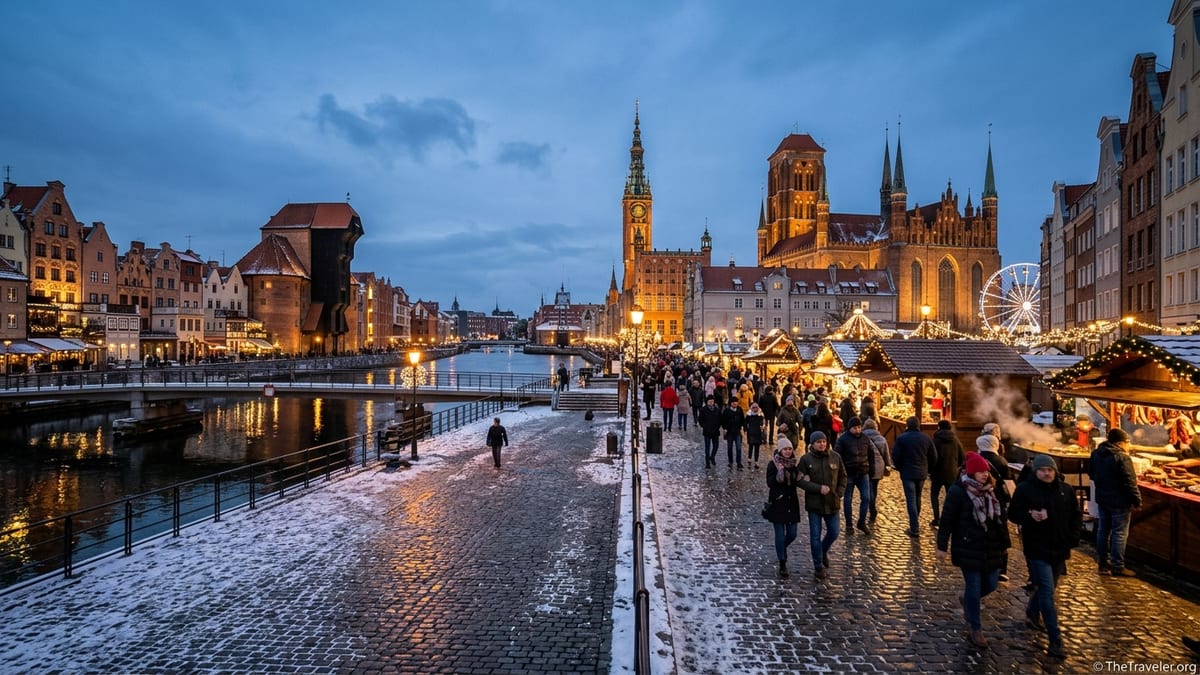
Set against that, Gdańsk is a city of brick, copper roofs and steep gables that looks made for winter. The towers of St Mary’s Basilica and the slender spire of the Main Town Hall rise above Długi Targ like a stage set when illuminated after dark. Steam from food stalls in the Christmas season, light decorations reflected in puddles on the cobbles and the sound of trumpeters playing chorales from nearby church towers give evenings a theatrical feel that is entirely different from a summer visit.
Crucially, Gdańsk has a depth of indoor attractions that makes a short winter stay worthwhile even in bad weather. The Museum of the Second World War and the European Solidarity Centre are both substantial, modern museums that comfortably fill half a day each. The Amber Museum, Main Town Hall interiors and maritime sights near the Motława allow you to stitch together an almost entirely indoor programme if conditions turn icy. Cafés around the Main Town serve hot chocolate, mulled wine and hearty pierogi at prices that are still moderate compared with many Western European cities.
There are disadvantages beyond the weather. Several museums operate reduced winter hours, ticket offices may close well before the last entry and major holidays such as 25 and 26 December, 1 January and 6 January bring full closures or very limited hours. On weekday evenings outside the Christmas season the Main Town can also feel quiet once commuters go home. If you are looking for nightlife until 02:00, you may find more options in Kraków or Warsaw. For visitors focused on history, architecture and seasonal ambience, however, winter Gdańsk can be an excellent choice.
Key Museums: Time, Tickets and Practical Limits
The Museum of the Second World War is Gdańsk’s flagship attraction and a major reason many visitors come in the first place. According to recent ticket information summarising the 2026 price list, a standard adult ticket for the permanent exhibition is about 33 zł, with family tickets and concessions available. The museum is usually closed on Mondays; current schedules for 2026 indicate Tuesday hours of roughly 10:00 to 16:00 and Wednesday to Sunday 10:00 to 20:00, with the ticket office closing around an hour earlier in the evening. Even though some publicity describes a two-hour visit, independent guides and visitor reports emphasise that three to four hours is more realistic if you want to absorb the displays without rushing from start to finish.
The European Solidarity Centre, beside the historic shipyard gates, presents the story of the Solidarity movement and the end of communist rule in Poland. Recent information checked in autumn 2026 gives winter opening times of 10:00 to 17:00 from Monday to Friday, with a closure on Tuesdays, and slightly longer hours at weekends. Tickets are in a similar band to other large Polish museums, with standard admission for the permanent exhibition costing the equivalent of a few euro. Here too, two and a half to three hours is a comfortable minimum, especially if you use the included audio guide and spend time on the viewpoint terrace overlooking the shipyards.
The Amber Museum, housed in the historic Great Mill on the Radunia Canal, focuses on Baltic amber from its geological origins to contemporary jewellery. Practical round-ups of Gdańsk museums in 2026 list a standard adult ticket at about 37 zł and a reduced ticket at around 26 zł, with family options and occasional free days published by the Museum of Gdańsk. Visiting times are shorter than at the large historical museums, but you should still allow 60 to 90 minutes if you want to appreciate both the scientific and artistic sides of the collection rather than just glancing at the most photogenic pieces.
The historic Main Town Hall stands directly on Długa and Długi Targ and today serves as a museum of Gdańsk’s history, with ornate halls and a tower view in good weather. Museum overviews note that standard tickets sit in the mid-range for city museums and that from autumn 2026 certain rooms, including the Marine Hall, are closed or restricted for conservation. A full visit, including time in the grand Red Room and any accessible tower section, still merits about an hour. When you add in smaller maritime venues, such as the medieval crane on the waterfront, it becomes clear why combining two major institutions like the Second World War Museum and the European Solidarity Centre with the Amber Museum in a single afternoon is usually unrealistic in winter, once you factor in walking time, cloakroom queues and earlier dusk.
Historic Gdańsk on Foot: From Długi Targ to the Motława
Gdańsk’s historic centre lends itself to a compact winter walking route that links the main architectural highlights while keeping you close to cafés and indoor refuges. A classic start is by the Upland Gate and Golden Gate, entering Long Street and then Długi Targ. Here, colourful facades line the former merchants’ thoroughfare, culminating in the Neptune Fountain and the silhouette of Artus Court. In the low winter sun, you can capture photographs of side streets framed by the Main Town Hall tower, then return after dark when the area is floodlit and seasonal decorations drape the facades.
From Neptune’s Fountain it is a short stroll to St Mary’s Basilica, one of the largest brick churches in the world. In winter the interior is a calm, pale space, often sparsely visited outside Sunday services. Climbing the tower is weather dependent and less appealing on icy days, but even without it you can spend half an hour tracing details of the astronomical clock and side chapels. On leaving, consider ducking into a nearby café on Świętego Ducha Street for coffee or hot chocolate, since the cold tends to accumulate in the open square outside.
Mariacka Street descends gently from the basilica towards the river. Its terraces and stone gargoyles are among Gdańsk’s most photographed motifs, especially when a light dusting of snow sits on the steps and railings. In winter, many amber shops here still open in the afternoons, but footfall is lower than in summer. That can make it easier to photograph the perspective towards St Mary’s without crowds, although icy cobbles require attention, particularly for anyone with reduced mobility.
At the bottom of Mariacka you reach the Motława waterfront and the medieval crane, one of Gdańsk’s most recognisable silhouettes. Even if you do not go inside the crane or the nearby National Maritime Museum branches, the riverside offers strong photo opportunities looking back to the green gate and along the modern Granary Island developments. After dark, reflections of the crane and adjacent townhouses in the water can be striking, but the wind on the quayside is often noticeably sharper than in the streets behind, so gloves and a windproof hood are essential if you plan to linger with a camera.
Christmas Market Season vs Ordinary Winter Weekends
In recent years Gdańsk’s Christmas Market has grown from a local event into a destination market recognised across Europe. Official information for the 2026 edition confirms that the main market runs from 20 November to 23 December on and around Targ Węglowy, the Coal Market, spilling towards the Royal Route and Bogusławskiego Street. Stalls generally open around midday and continue until about 20:00 on Sunday to Thursday, with an extra hour in the evening on Friday and Saturday. Entry to the market area is free, though specific attractions inside, such as small rides, may charge separately.
Food and drink prices at the market change annually but are now well documented by Polish media and travel writers. For 2026, reports suggest a cup of grzaniec, or mulled wine, typically costs in the region of 15 to 20 zł, a portion of oscypek-style grilled cheese with cranberry around 18 to 25 zł and a plate of pierogi from a market stall somewhere between 25 and 35 zł depending on the filling. A simple sweet snack such as chimney cake or waffles can run to 20 zł, which is noticeably more than in a neighbourhood bakery but still reasonable compared with many Western European Christmas markets.
Outside the official market season the same streets feel very different. Decorative lighting usually remains up at least into early January, and some festive installations stay in place, but the concentration of cabins, live music, Advent events and weekend crowds disappears after 23 December. On an ordinary January weekend you may find occasional craft stalls at Targ Węglowy or other squares, yet the atmosphere is far quieter. For a visitor choosing between early December and mid-January, this distinction matters: in December you trade higher hotel rates and busier evenings for the immersive market experience, whereas in January you enjoy lower prices and easier restaurant reservations but less overtly festive atmosphere.
In practical terms, the Christmas Market can also affect how you move around the city. On peak evenings, around 17:00 to 19:00, narrow passages between stalls can be very crowded, which is worth considering if pushing a buggy or if you use a mobility aid. The cobbles under temporary coverings can be uneven, and fresh snow or partially cleared slush tends to become packed by foot traffic, making some sections slippery. If you visit on a weekday afternoon in early December, crowds are thinner and it is easier to study handicraft stalls or photograph decorations without constant jostling.
Where to Stay: Main Town, Old Town and Around Gdańsk Główny
Accommodation in central Gdańsk clusters in three main areas that each work differently in winter: the Main Town around Długi Targ and the Motława, the Old Town area closer to the railway tracks and museums such as the Post Office, and the zone around Gdańsk Główny station. In the Main Town you will find boutique hotels in historic tenement houses and modern apartments on Granary Island with river views. In early December or during Christmas Market weekends, typical rates for a mid-range double room here often climb well above 400 to 500 zł per night, sometimes higher for properties directly overlooking the market streets.
The Old Town area, north of Podwale Staromiejskie and around the Great Armoury and Old Town Hall, tends to be slightly quieter and marginally cheaper, especially in January or February. You are still within a short walk of the Main Town and only a few minutes by tram or on foot from Gdańsk Główny, yet you may find three-star hotels in the 250 to 350 zł range per night outside peak December dates. This area also gives quicker access to the Museum of the Second World War on foot, which is useful on a cold morning when you want to minimise time outside.
The surroundings of Gdańsk Główny station appeal to visitors planning frequent day trips or flying in and out at unsociable hours. Several mid-range business hotels and budget chains cluster within a ten-minute walk, often at lower rates than comparable options on the Main Town streets. A January weekend can see doubles under or around 250 zł per night, especially from Friday to Sunday outside major events. The trade-off is a less romantic immediate environment and a short uphill or tram ride to reach the more picturesque historic centre.
Whichever area you choose, winter brings two clear benefits. First, even with the popularity of the Christmas Market, overall demand is lower than in July and August, especially on Sundays and in January, so it is often possible to secure free breakfast or late check-out deals. Second, insulation standards in modern Polish hotels are generally good, with effective heating and double glazing. When comparing options, it is still worth reading recent reviews to check comments on room warmth and hot water, since an underheated room can quickly undermine enjoyment of a winter stay.
Side Trip to Sopot: SKM Trains and Winter Seaside Reality
Sopot lies roughly 12 kilometres from central Gdańsk and is easily reached by SKM commuter trains that run along the Tricity corridor. Trains typically depart every 10 to 15 minutes during the day from Gdańsk Główny and Gdańsk Śródmieście stations in the direction of Gdynia. The journey time to Sopot station is around 20 minutes. The regional tariff for 2026 distinguishes between paper tickets bought from station machines or kiosks and contactless payment or electronic cards, but a one-way adult fare between Gdańsk and Sopot generally sits comfortably in the single-digit złoty range.
Visitors should be aware of ticket validation rules. Cardboard SKM tickets purchased in kiosks or ticket offices need to be stamped in yellow validators on the platform before boarding. Tickets bought from modern machines for immediate travel are usually time-stamped at purchase and do not require additional validation. Inspectors do patrol SKM services, and travelling with an unvalidated paper ticket is treated in the same way as travelling without a ticket, so it is worth taking a moment to check the instructions printed on your ticket and the signage on the platform.
From Sopot station it is an easy, mostly level walk of about ten minutes down Monte Cassino Street to the seafront. Even in winter, this pedestrianised spine remains lively at weekends, with cafés, ice-cream parlours and bars operating shorter but regular hours. The famous wooden pier, one of Europe’s longest, stays open in the cold months, though from autumn until late spring there is usually a modest entrance fee outside specific free periods. On a calm sunny day, walking the pier with clear views towards Gdynia and the low cliffs near Orłowo can be uplifting despite the temperature.
You should, however, calibrate expectations for a winter seaside visit. Strong winds on the exposed pier can make it feel substantially colder than in sheltered streets, and the Baltic Sea retains a chill that produces a raw, damp cold on grey days. Daylight is limited, so an afternoon trip from Gdańsk might only offer two or three bright hours on the beach before dusk. That said, the empty sands, muted colours of the water and the lights of Grand Hotel Sopot coming on at twilight create a distinctive mood that many visitors find worth the effort. For families, combining a brisk beach walk with hot chocolate or pizza back on Monte Cassino keeps the excursion manageable in low temperatures.
Practicalities: Airport Transfers, Transport, Clothing and Costs
Lech Wałęsa Airport lies to the west of Gdańsk and is linked to the city by both rail and road. SKM and regional trains connect the airport station with Gdańsk Wrzeszcz and Gdańsk Główny, usually in around 25 to 30 minutes. A single ticket on public transport from the airport into the city typically costs only a handful of złoty, particularly if you use integrated metropolitan tickets valid across buses, trams and trains. Airport buses also run to Wrzeszcz and central Gdańsk; they are slower than trains in traffic but can be more convenient if your accommodation lies directly on a bus route.
Within the city, trams and buses operated by the Gdańsk transport authority provide good coverage, with 24-hour ticket options that were recently priced at about 6 zł for regular adult travel across the Gdańsk and Gdynia networks. For a two-day weekend you might use a mixture of single tickets for shorter hops and day passes on one day when you combine the Museum of the Second World War, the European Solidarity Centre and evening dining away from the Main Town. Contactless payment is accepted on many services, but rules for on-board validators and proof of payment differ slightly by operator, so it is worth checking the signage inside each vehicle.
Winter clothing is particularly important in Gdańsk because of the wind. A proper insulated coat with a hood, a wind-resistant outer layer, thermal base layers, hat, scarf and waterproof gloves all contribute to comfort when walking along the river or standing on a station platform at night. Footwear with decent grip matters too, as pavements can develop thin sheets of ice where melted snow refreezes. For visitors with mobility challenges or families pushing buggies, it is sensible to build in extra time for moving between sights and to prefer main pavements where municipal services clear snow more quickly.
Restaurant prices in 2026 remain moderate by Western European standards. In central Gdańsk, a main dish such as pierogi ruskie, bigos or a meat cutlet in a mid-range restaurant often falls in the 35 to 55 zł range, while a bowl of soup like żurek might cost around 18 to 25 zł. Coffee in a café typically costs between 12 and 20 zł, with hot chocolate slightly more, and a local beer about 14 to 18 zł. A couple ordering two mains, a shared starter and drinks can expect to pay in the region of 150 to 220 zł for dinner in a central but not ultra-luxury venue, excluding any service charge.
Putting these figures together, a realistic per-person budget for a January weekend might be around 900 to 1,100 zł excluding flights if you share a mid-range double room. This would cover two nights of accommodation at approximately 250 to 300 zł per person, museum entries in the 150 to 200 zł range for several major sights, local transport and meals with one restaurant dinner and one or two more casual options. For a December weekend during the Christmas Market, the same visitor might expect to spend closer to 1,200 to 1,500 zł, reflecting higher hotel rates and additional market food and drink purchases.
Accessibility, Icy Pavements and Holiday Closures
Many of Gdańsk’s key attractions have made clear efforts to improve accessibility, but the historic fabric of the city still poses challenges. The European Solidarity Centre was designed with step-free access, lifts and accessible restrooms, and publishes dedicated accessibility information, which makes it a comparatively straightforward visit for wheelchair users. The Museum of the Second World War also has lifts and accessible routes, although the sheer size of the exhibition means that visitors with limited stamina may wish to focus on selected sections rather than trying to cover everything at once.
Older buildings such as the Main Town Hall and St Mary’s Basilica inevitably involve stairs and sometimes narrow doorways. While ground-floor areas may be accessible, tower climbs are not suitable for most visitors with mobility impairments even in dry weather, and in winter steps can be damp or slippery. The Amber Museum in the Great Mill has been modernised with lifts and offers audio guides and other adaptations, but some parts of the approach outside can remain uneven, so planning taxi drop-off points and walking routes in advance is helpful.
Across the city, pavements in the historic centre are mainly cobbled or paved with uneven stones. Municipal services do clear major routes after snowfall, yet thaw and refreeze cycles create patches of black ice, especially in shaded alleys like Mariacka and under the arches leading to the Motława. Footwear with good traction and cautious walking are therefore important for all visitors, not only those with existing mobility issues. At the Christmas Market, wooden walkways and temporary structures sometimes mask underlying cobbles, so wheels and walking frames can catch on joins between surfaces.
Holiday closures need careful attention when you plan dates. Most museums in Gdańsk close on 25 December and 1 January, and some also reduce hours or close entirely on 26 December, 6 January and certain church holidays. On 24 and 31 December many attractions shut earlier than usual, and restaurants may operate shortened menus or fixed-price festive dinners that require advance booking. Public transport runs on holiday or Sunday timetables during these periods, which can mean less frequent services in the late evening. If your winter weekend spans a public holiday, it is wise to confirm specific opening times for your priority sights a few days before travel.
Sample Itinerary: Two Days in Gdańsk plus an Extra Option
For a museum-focused first day, start after breakfast at the Museum of the Second World War, arriving for opening time to make the most of quieter galleries. Spend at least three hours on the permanent exhibition, pausing in the café if you need a break. After leaving, walk back towards Gdańsk Główny or take a tram to the European Solidarity Centre. Have a simple lunch in the café there, then devote the mid-afternoon to the Solidarity exhibition and the viewpoints over the shipyards. By the time you finish, it will likely be dusk in deep winter, leaving you free for an early dinner in the centre and an evening stroll through the illuminated Main Town.
On the second day, focus on the historic core and Sopot. Begin with a relaxed walk through the Golden Gate to Długi Targ, stopping for photos at Neptune’s Fountain and, if conditions allow, visiting the interior of the Main Town Hall. Continue to St Mary’s Basilica and down Mariacka Street to the Motława, perhaps detouring into the Amber Museum if it fits your interests. After lunch in a nearby restaurant, head to Gdańsk Główny for the SKM train to Sopot, spending the remaining daylight on Monte Cassino Street, the pier and the beach. Return to Gdańsk in the early evening for a final dinner near your hotel.
If you have a third day, you can deepen your museum experience or explore further along the coast. One option is to add more maritime history: visiting the interior of the medieval crane, the National Maritime Museum branches and, in milder weather, a boat trip towards Westerplatte when services run. Another is to take the SKM beyond Sopot to Gdynia, combining a harbour walk with a visit to one of the museum ships or the Emigration Museum. In winter the sea air in Gdynia can be bracing, but on a clear day the contrasting modern port architecture offers a different perspective on the Tricity area.
Throughout this itinerary it is important to factor in shorter daylight and the need for warming indoor breaks. A common mistake is to schedule back-to-back museum visits without time for meals or rest. In winter, lag caused by heavy clothing, snow residue on pavements and the mental load of intense historical exhibits means that a realistic schedule often includes only one major museum plus lighter activities each day, rather than three or four large institutions in a row.
Who Will Enjoy Winter Gdańsk, and When to Go
Couples often find Gdańsk appealing in winter because the city combines intimate streets, candlelit restaurants and a rich cultural programme with prices lower than many classic romantic destinations. A December visit around the Christmas Market adds twinkling lights, mulled wine and shared walks through the festive stalls, at the cost of higher hotel rates and busier evenings. A January weekend, by contrast, may feel more introspective and better suited to couples who prioritise museum-going and quiet dinners over external spectacle.
For history enthusiasts, winter is arguably one of the best times to come. Both the Museum of the Second World War and the European Solidarity Centre can be emotionally heavy and intellectually demanding. Visiting them outside high season, when visitor numbers are lower and school groups fewer, makes it easier to linger at specific exhibits and to use audio guides without battling constant background noise. The trade-off is the need to check reduced hours and plan around any holiday closures, especially if you only have a day or two.
Families need to balance the educational value of Gdańsk’s museums with the realities of winter weather and the intensity of some exhibits. Older children and teenagers who have studied twentieth-century history often engage strongly with both the war and Solidarity narratives, while younger children may appreciate shorter, targeted visits combined with more playful elements like the Christmas Market, the ferris wheel on the riverfront when operating and a beach visit in Sopot. Warm, layered clothing for children is particularly important, as they can become chilled more quickly while adults focus on photographs or museum displays.
When choosing between December and January, budget and desired atmosphere are key. December offers the full Christmas Market, Advent events and a sense of seasonal celebration, ideal for travellers willing to pay more for accommodation and to embrace crowds around key sights. January rewards those who prefer lower costs, quieter streets and a focus on indoor culture rather than festive entertainment, accepting that evenings may feel subdued and that some decorative installations and seasonal activities will already be packed away. Either way, with realistic expectations and a well-paced itinerary, a winter weekend in Gdańsk can be both memorable and surprisingly comfortable.