


More news on this day
A wave of new high-speed and night train services across France and other European countries is reshaping how people move around the continent, as governments and rail operators push low-carbon journeys as an alternative to short-haul flights.
Get the latest news straight to your inbox!
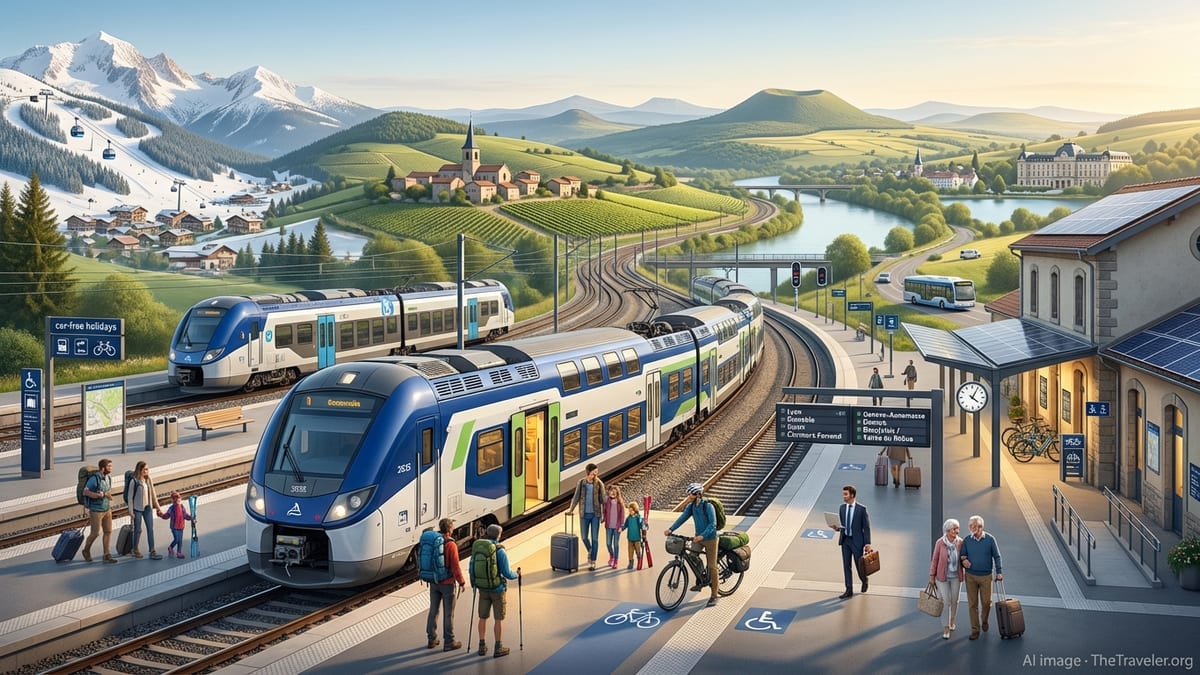
France Puts Rail at the Center of Climate Policy
France has been at the forefront of linking climate goals with transport policy, elevating rail as a key tool for cutting emissions. Publicly available information shows that the government’s decision to restrict some short domestic flights where fast rail exists has become a reference point in Europe’s wider debate on aviation and climate. The measure is limited in scope, but it has helped crystallize a political message that frequent, short-distance flights should increasingly give way to trains.
Research on French high-speed rail corridors indicates that modern trains can dramatically reduce emissions compared with flying, particularly when powered by low-carbon electricity. Studies of routes such as Paris to Bordeaux find that high-speed rail can generate several times lower greenhouse gas emissions per passenger-kilometer than air travel, especially as trains run fuller and infrastructure is used more intensively over time.
France’s state-backed rail operator has expanded both its flagship high-speed services and lower-cost brands on domestic and cross-border routes. Budget offerings have helped to fill seats that might previously have been lost to discount airlines, while traditional TGV routes continue to link major French cities with neighboring countries. The overall effect is to normalize rail as the default choice for medium-distance travel, especially for leisure and business trips inside France and to nearby hubs.
The country is also under pressure to keep investing in capacity and reliability to match growing demand sparked by climate-conscious travelers. Debates over infrastructure funding, regional connections and ticket affordability are increasingly tied to France’s climate targets, turning the rail network into a barometer of how quickly the transport sector can decarbonize.
Night Trains Return as Cross-Border Flagships
Beyond daytime high-speed services, the most visible symbol of Europe’s green travel push is the revival of night trains. After years of decline, sleeper services are reappearing on maps as operators seek to connect major cities with overnight, low-carbon journeys that compete directly with evening flights.
One of the most prominent newcomers is European Sleeper, a cooperative-backed operator linking cities such as Brussels, Amsterdam, Berlin and Prague. Company information indicates that the brand now runs several cross-border routes and is preparing further links toward the Alps and northern Italy. Future plans publicized by the firm and rail campaign groups include ambitions to reach Barcelona, positioning night trains as a bridge between northwest and southern Europe for climate-minded travelers.
These services play a strategic role because they bundle accommodation and transport into a single product. Travelers board in the evening, sleep on the train and arrive in another country the next morning, often in a city center. That timetable erodes one of aviation’s main advantages on medium distances and highlights the emissions savings that come with rail, particularly on electrified lines.
The renaissance is not without challenges. Timetabling across several national rail networks, access charges and rolling-stock shortages have all been cited in public documents as obstacles to rapid expansion. Nonetheless, the revival of sleeper services has captured public imagination and has become a focal point for campaigners advocating a broader European network of climate-aligned trains.
Spain’s High-Speed Competition Drives Rail Shift
Spain has emerged as another key laboratory for Europe’s rail transition, pairing one of the world’s largest high-speed networks with market opening to multiple operators. According to analysis published by Spain’s competition authority and summarized in official reports, the entry of low-cost and new full-service brands on high-speed routes has led to sharp fare reductions and strong growth in passenger numbers.
On the flagship Madrid to Barcelona corridor and other lines, travelers can now choose between Spain’s national operator and rivals such as Ouigo España and Iryo. Studies and regulator statistics indicate that this competition has boosted rail’s share against air on major routes, even as overall ridership climbs. Lower prices and more frequent services have helped to draw passengers out of planes and cars and into electric trains.
Spain’s infrastructure manager has signaled in investor communications that further phases of liberalization and network expansion are planned, including new regions and cities. The aim is to raise occupancy of existing high-speed lines while extending the benefits of fast, relatively low-carbon travel beyond a handful of trunk routes.
The Spanish case is increasingly cited in European policy discussions as evidence that opening markets to several operators, within a regulated framework, can support both consumer choice and decarbonization goals. The experience also underlines the importance of long-term public investment in infrastructure, given that private operators still depend on publicly built and maintained high-speed lines.
Germany, EU Initiatives and the Push for Seamless Rail
Germany is pursuing a different but complementary approach, focused on making public transport more attractive and stitching together international services. The nationwide flat-fare Deutschlandticket, introduced as a monthly pass for regional and local transport, has been extended as a pilot and continues to draw passengers toward lower-carbon modes within the country.
At the same time, German rail operators are involved in European Union-backed pilot projects to improve cross-border links. One EU-supported scheme highlighted in recent press material aims to create new direct connections such as Prague to Berlin to Copenhagen, reducing the need for transfers and making long-distance rail more competitive with air on key international corridors.
These initiatives sit alongside European Commission programs that identify and support new international services capable of shifting passengers from planes to trains. Funding channels such as the Connecting Europe Facility are being used to upgrade infrastructure and remove bottlenecks on transnational routes, reinforcing the idea of rail as the backbone of a future low-carbon mobility system.
However, the German network faces capacity constraints, aging infrastructure and operational disruptions that can undermine passenger confidence. Parliamentary debates and company reports show that policy makers are wrestling with how to simultaneously expand services, modernize tracks and keep fares broadly affordable while staying aligned with climate legislation.
From Policy Signals to Traveler Choices
Taken together, developments in France, Spain, Germany and neighboring countries point to a wider European pivot toward rail as a cornerstone of climate strategy. Short-haul flight restrictions where strong rail alternatives exist, new night train operators and competitive high-speed markets are all part of an emerging toolkit to decouple mobility from rising emissions.
European and national data sets consistently show that electrified rail produces significantly lower emissions per passenger-kilometer than aviation, especially on routes of a few hundred to about one thousand kilometers where journey times remain competitive. As renewable energy grows in the power mix, the climate advantage of trains is expected to increase further.
The success of this transition will depend on how quickly rail networks can add capacity, improve reliability and simplify booking across borders. Efforts to integrate timetables, tickets and information systems are already under way, backed by EU regulations and industry partnerships, but travelers still often encounter fragmented platforms and complex fare structures.
For now, reports from operators and regulators suggest that demand for low-carbon journeys is rising, particularly among younger and leisure travelers willing to trade airport queues for station departures. As more night trains roll out and high-speed competition spreads, Europe’s railways are emerging as both a practical transport solution and a symbol of the continent’s broader green transition.