


More news on this day
A United Express regional jet departing Indianapolis made an emergency return to the airport after a man allegedly tried to open a cabin door shortly after takeoff, leading to his arrest and a federal safety review, according to multiple published reports.
Get the latest news straight to your inbox!
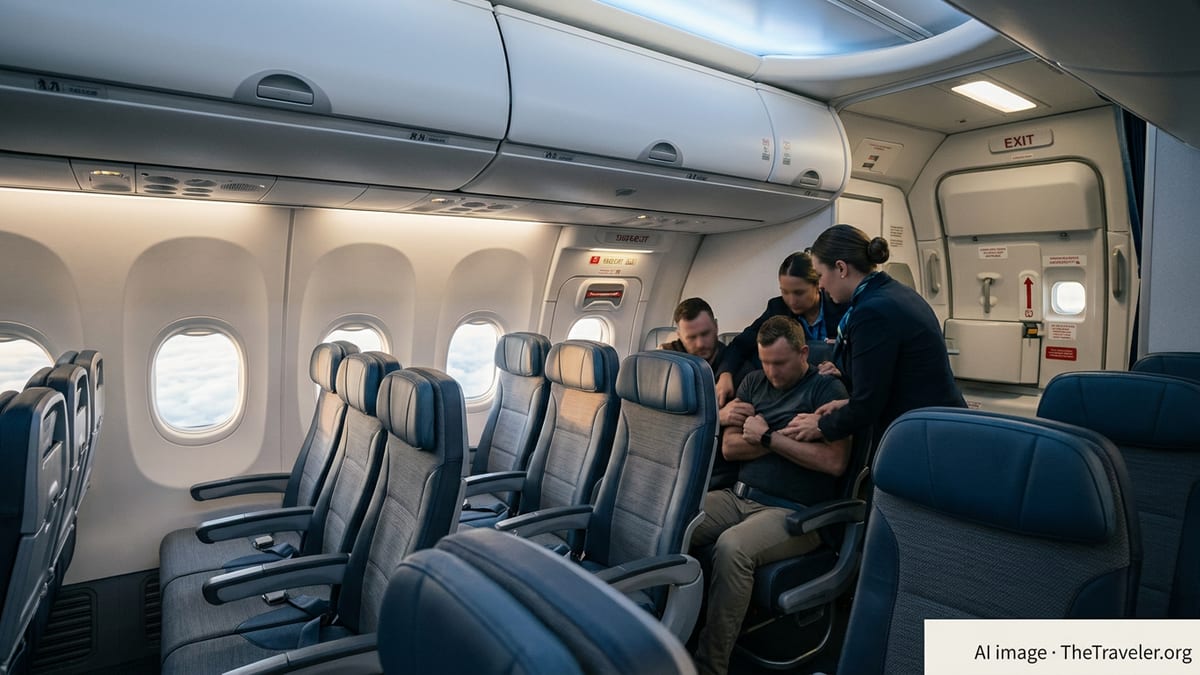
Incident unfolds minutes after Indianapolis departure
Publicly available flight tracking and news reports indicate the disruption occurred on United Airlines Flight 3989, operated by Mesa Airlines, on Tuesday, June 30. The Embraer regional jet had departed Indianapolis International Airport bound for Washington Dulles International Airport when a passenger in the cabin allegedly attempted to open one of the aircraft’s doors.
The flight had been in the air for only about 15 minutes when the crew requested to return to Indianapolis. Data from flight-tracking services shows the jet leveling off at a relatively low cruising altitude before turning back toward the airport, consistent with an early-phase in‑flight incident and precautionary return.
Accounts in national and local coverage describe a chaotic but brief episode in which cabin crew moved quickly to stop the passenger’s actions and secure the area around the door. There have been no indications in the reporting that the door was successfully opened or that the aircraft’s structural integrity was compromised during the attempt.
The flight landed safely back in Indianapolis, where law enforcement officers met the aircraft at the gate. The passenger accused of attempting to open the door was taken into custody on the tarmac, according to subsequent media summaries of the event.
Passenger detained as investigation begins
Following the emergency landing, the man at the center of the disturbance was detained and removed from the aircraft. Initial coverage indicates that he was arrested at the airport, though specific charges had not been detailed in early reports. The Federal Aviation Administration has opened an investigation into the incident, a standard step when passenger actions potentially interfere with flight safety.
Investigators are expected to review crew statements, cockpit voice recordings and any available cabin video to reconstruct exactly what occurred in the minutes after takeoff. The inquiry typically examines whether the passenger’s behavior meets thresholds for federal violations such as interference with a flight crew, which can carry significant penalties.
While information released so far focuses on the attempted door opening, investigators may also look at the traveler’s movements and behavior in the terminal and during boarding. Such reviews often involve coordination with local law enforcement, airport security and the airline’s own corporate security teams.
As of early Wednesday, publicly available reports had not indicated any serious injuries among passengers or crew. Most accounts suggest that, beyond the disruption and tension in the cabin, the episode ended relatively quickly once the aircraft was back on the ground.
Flight disruption and impact on travelers
The early return to Indianapolis disrupted travel plans for everyone on board. Passengers were required to remain seated while law enforcement boarded the aircraft, detained the man and conducted initial checks. Afterward, travelers were rebooked on later flights or alternative routings to reach Washington and other final destinations.
Regional connections such as the Indianapolis to Washington route often serve a mix of business travelers and connecting passengers, meaning missed onward flights can have a ripple effect through the broader network. Operational data and media coverage suggest this was a single‑flight disruption rather than a wider system impact, but individual travelers still faced delays and last‑minute changes.
Reports on similar events in recent years indicate that airlines commonly offer affected passengers rebooking assistance and, in some cases, travel credits or hotel accommodations when overnight stays are required. There was no immediate, detailed public information about any such arrangements following the Indianapolis incident, but standard practice is to prioritize getting customers to their destinations as quickly and safely as possible.
For some passengers, the more lasting effect is emotional rather than logistical. Attempts to open aircraft doors mid‑flight, even when unsuccessful, can be deeply unsettling. Aviation experts frequently note that although cabin doors cannot be opened at cruising altitude due to pressurization and mechanical safeguards, the perception of danger inside the cabin can still be significant.
Rising scrutiny of in‑flight disturbances
The Indianapolis case adds to a series of recent episodes in which passengers have allegedly tried to open aircraft doors or otherwise interfere with flight operations. In separate incidents reported in June, flights in the United States and abroad diverted after disruptive travelers attempted to reach exit doors or the cockpit, drawing attention to ongoing concerns about in‑flight behavior.
Regulatory data and compiled incident lists show that while such events remain rare compared with the millions of flights operated annually, they have become a recurring focus for safety agencies. Attempts to open doors, physical confrontations with crew members and efforts to access the flight deck are all treated as serious security and safety risks, regardless of whether any door is actually opened.
The Federal Aviation Administration and other regulators in recent years have emphasized stricter enforcement policies, including substantial civil penalties for passengers found to have interfered with crews. In some high‑profile cases, individuals have also faced criminal charges after allegedly trying to open exit doors or cockpit entrances, leading to court proceedings and, in some instances, prison sentences.
Aviation safety specialists often underscore that even a brief disturbance can divert crew attention from critical duties and potentially complicate responses to other in‑flight issues. That concern is part of why regulators, airlines and flight attendants’ organizations continue to push for strong deterrents and rapid intervention when cabin behavior escalates.
Airlines and regulators reinforce safety messaging
In the wake of the Indianapolis incident, attention has again turned to how airlines and regulators communicate expectations for passenger conduct. Safety briefings and in‑seat cards already describe emergency exits and door operation procedures for trained individuals in genuine emergencies, but industry messaging has increasingly stressed that any unauthorized attempt to manipulate doors or emergency equipment is both dangerous and potentially illegal.
Publicly available guidance from aviation agencies notes that doors on pressurized commercial aircraft are designed with interlocking mechanisms that prevent them from being opened in flight under normal operating conditions. Nonetheless, attempts to handle door controls can cause alarm, prompt emergency responses and, in lower‑altitude phases such as initial climb or final approach, may pose additional technical risks.
Industry observers expect that the Indianapolis case, along with other recent disruptions, will feed into ongoing policy discussions about cabin safety, mental health, and screening of potentially unruly passengers. Airlines have already expanded training for crews on de‑escalation and physical restraint techniques, and some have adopted internal no‑fly lists that bar repeat offenders from future travel with the carrier.
For travelers, the message remains that cooperation with crew instructions and awareness of the seriousness of in‑flight rules are central to maintaining safety. As investigators review what happened on Flight 3989 out of Indianapolis, the incident serves as another reminder that even a short regional hop can quickly turn into an emergency when conduct on board crosses critical lines.