


On my first MSC cruise, I picked up the slim plastic cruise card from my cabin desk and immediately started comparing it to the SeaPass, Sail & Sign and other cards I have carried on ships from Miami to Marseille. On the surface, every card looks the same: your name, a barcode or chip, maybe a loyalty status color. In practice, they feel very different once you start tapping for drinks, booking shore excursions and checking your final bill. This is my honest experience putting MSC’s cruise card head to head with other major cruise lines, focusing on what actually matters when you are standing at the bar or trying to get off the ship in Cozumel.
Get the latest updates straight to your inbox!
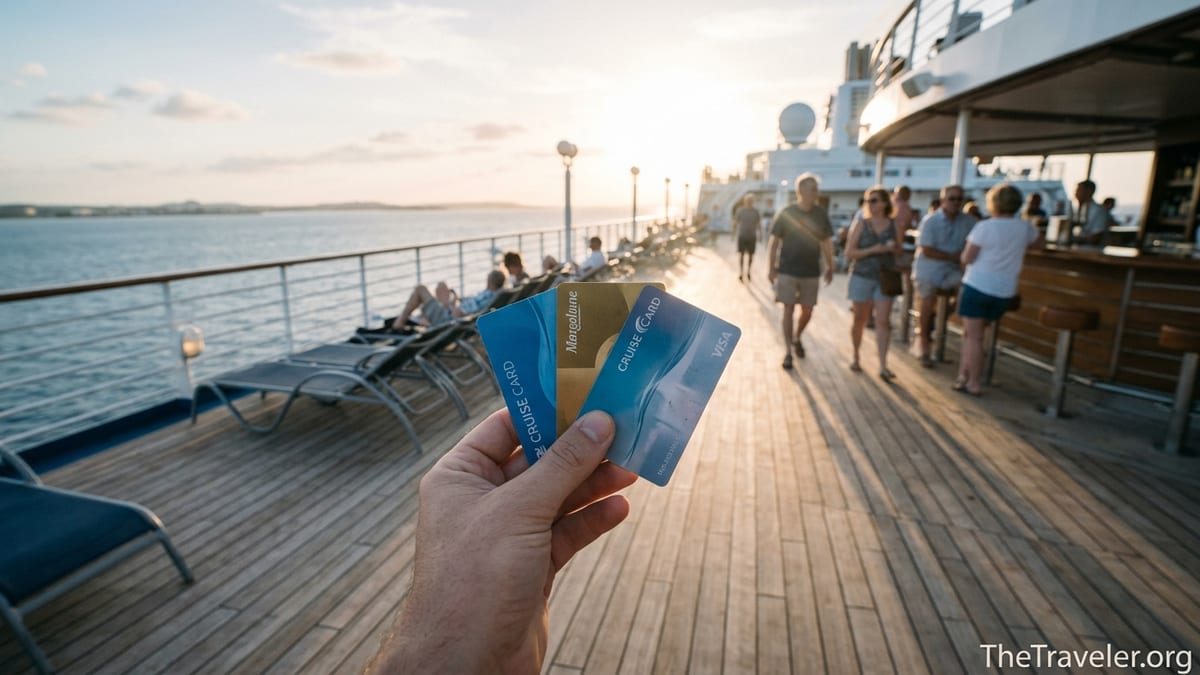
How the MSC Cruise Card Actually Works On Board
MSC calls its card the Cruise Card, and it is your room key, onboard ID and payment method all in one. You find it in your stateroom when you embark, then activate it at a self service kiosk or at Guest Services by linking a credit card, debit card or by leaving a cash deposit. In my case, I used a travel rewards Visa and registered it at a kiosk near the reception area. The system pre authorized around 250 US dollars for a 7 night sailing for two people, which felt similar to what I have seen on Royal Caribbean and Carnival.
Once activated, you use the MSC Cruise Card for almost every transaction: a cappuccino at the coffee bar, a gelato at the pool deck stand, bingo cards in the lounge, shore excursions from the excursion desk and spa treatments. On my Mediterranean cruise, all prices on board were in euros, even though my card charged in US dollars, so I saw small variations on my bank statement due to exchange rates. On a later Caribbean sailing, the ship used US dollars, which made it easier to mentally track what I was spending.
Checking the running bill on MSC is reasonably straightforward. I could pull up my account on the stateroom television or ask for a printout at Guest Services. On newer ships, the MSC for Me app also showed recent transactions, though there was sometimes a delay of a few hours. Compared with the instant, app based breakdown I am used to with Royal Caribbean, MSC still feels a little less polished here, especially when you are trying to track bar spending on sea days.
At the end of the cruise, MSC automatically settles your account if you used a credit or debit card. On one voyage where I left a 300 euro cash deposit instead, I had to queue at Guest Services on the last morning to receive the unspent balance in cash. That is standard practice at sea, but it is a detail worth knowing if you dislike last day lines.
MSC Voyagers Club Card Colors vs Other Loyalty Cards
One thing that stands out with MSC is that your loyalty status is printed directly on the Cruise Card as a color band and label, tied to the MSC Voyagers Club program. MSC refreshed this program recently with tiers from Welcome and Classic up to Silver, Gold, Diamond and a new Blue Diamond level. In practical terms, your card color affects the small perks you are offered, such as priority embarkation lines, a complimentary specialty dining treat on some sailings and tier based discounts on onboard purchases.
On my third MSC cruise, I sailed as a Gold member. My gold striped Cruise Card came with tangible perks like a free thermal area pass in the spa on sea days and a small basket of chocolate covered strawberries in the cabin on embarkation afternoon. The discount on onboard purchases, including merchandise and photos, was particularly noticeable. For example, a branded hoodie listed around 60 euros ended up closer to the low 50s once my Gold discount was applied at the register.
By comparison, Royal Caribbean’s SeaPass card also reflects your Crown & Anchor Society tier through colors and labels, but the most meaningful perks at higher tiers tend to be lounge access, free drinks at specific times and discounted laundry, rather than direct discounts on almost every onboard purchase. Carnival’s Sail & Sign card has historically reflected VIFP status with colored cards, and as Carnival transitions toward its new Carnival Rewards program, the card design and milestone perks are changing again, with some previous automatic onboard credits being phased out. In practice, that means your Carnival card color still signals loyalty, but the financial value attached to it is evolving and can be less straightforward than MSC’s simple percentage discounts.
Norwegian Cruise Line’s keycard also shows your Latitudes Rewards status with a color band and sometimes special icons for suites or Haven guests. On a Norwegian sailing out of Miami, my mid tier Latitudes card did not translate into discounts at every register the way MSC’s Gold card did. Instead, I saw benefits like priority tender tickets and a bottle of sparkling wine in the cabin. Nice perks, but they did not shrink my final bill as visibly as the MSC Voyagers Club discounts.
Deposits, Holds and Budgeting: MSC vs SeaPass vs Sail & Sign
The least glamorous part of any cruise card is the behind the scenes money hold. On MSC, the hold amount depends on your cruise length and region, but on my 7 night Caribbean cruise the system initially held just over 250 dollars on my credit card. On a 4 night Mediterranean sailing, the hold was noticeably lower, closer to 150 euros. These holds function much like hotel pre authorizations and are released after the final bill is settled, though in my experience the release can take several days to show up on a bank account.
Royal Caribbean’s SeaPass account works in almost the same way. When I checked in for a 7 night Western Caribbean cruise, Royal placed an initial authorization of about 100 dollars per person on my credit card, then periodically added more as my onboard spending increased. It was easy to see the running total and daily gratuities in the Royal app, which showed each line item almost in real time. For budget conscious travelers, that level of transparency is extremely helpful. I have not found MSC’s systems quite as immediate, which sometimes left me relying on mental math and paper receipts.
Carnival’s Sail & Sign account is comparatively flexible for people who prefer cash or gift cards. On a recent sailing out of Galveston, I watched several families load 200 to 500 dollars at onboard kiosks using Carnival branded gift cards, then monitor their balance through the Carnival Hub app. The Sail & Sign card tapped for every drink, arcade session and shop purchase, but guests with a strict budget appreciated being able to pre load a fixed amount instead of authorizing a large credit card hold. You can do something similar on MSC with a cash deposit, though the process relies more heavily on Guest Services counters and less on self service kiosks.
Norwegian usually pre authorizes a sum based on cruise length and number of guests on the reservation. On a 10 night Baltic itinerary, my card saw a hold of more than 400 dollars soon after boarding. That was higher than what MSC charged for a similar length Mediterranean sailing, though differences in onboard pricing and gratuity policies can make direct comparisons tricky. The main point is that all these systems are trying to protect the cruise line from unpaid bills, but the guest experience can feel quite different depending on how visible and flexible the budgeting tools are.
Day to Day Use: Drinks, Dining and Shore Excursions
Where the MSC Cruise Card shines is its simplicity. You tap or swipe once and are done. On my last MSC voyage in the Caribbean, I had a drinks package that covered most cocktails up to a certain price. When I ordered a 10 dollar frozen daiquiri at the pool bar, the bartender simply tapped my card, confirmed the package, and no additional line item appeared on my account. When I splurged on a 14 dollar aged rum, the difference of roughly 4 dollars appeared as a small supplement on my bill. Over a week, those top up charges added about 60 dollars to my account, which was easy enough to spot on the printed statement even though it did not always show up instantly in the app.
MSC’s card also handles specialty restaurants cleanly. I booked a steakhouse dinner for two priced around 45 euros per person. When the waiter tapped my card, the full amount posted to my onboard account under restaurant charges, and my Voyagers Club Gold discount brought it down by just under 10 percent. I appreciated that the receipt clearly showed the discounted amount, something that is not always obvious on other lines where discounts are applied in the background.
On Royal Caribbean, the SeaPass card integrates tightly with the Royal app. When I reserved a sushi dinner at Izumi for around 35 dollars per person, the charge appeared almost immediately in the app, tagged with the venue name and date. Gratuities, beverage package supplements and even arcade swipes for my nephew showed up as separate lines. That level of granularity is outstanding for families trying to keep teenagers within a budget. By contrast, MSC’s statement tends to group some small purchases, which is fine for couples but less ideal if you are trying to track what each child spent in the arcade.
For shore excursions, all the major lines work similarly. On MSC in the Greek Islands, I booked a 79 euro per person excursion to Oia and Fira in Santorini using my cabin television and Cruise Card. The total appeared on my account later that day. On Carnival, I booked a 69 dollar per person beach day at a private destination using the app and Sail & Sign card, with the charge appearing almost instantly. Norwegian’s system for a 129 dollar fjord tour in Norway felt much like Royal’s, with fast updates and clear line items. In everyday use, MSC’s card does not fall behind its competitors, but its digital tools feel a half step less refined than the slickest apps in the industry.
Practical Pros and Cons of MSC’s Card System
After multiple sailings, a few practical themes stand out with MSC’s Cruise Card. On the positive side, activation kiosks make embarkation smoother than it used to be. Instead of queuing at Guest Services, you can tap your card, insert a bank card, enter a PIN and walk away in a minute or two. I have seen similar kiosks for Carnival gift cards and Sail & Sign accounts, but MSC’s implementation felt particularly intuitive on newer ships like MSC Seascape.
The direct link between the Voyagers Club card tier and onboard discounts is another real strength. For frequent MSC travelers, that means your card is not just a pretty color but a consistent way to save on everyday items. On a weeklong sailing, it is easy for a family of four to buy a couple of logo T shirts, a photo package, and a round of gelato every afternoon. With a 5 to 15 percent discount applied automatically, the savings accumulate in noticeable ways, sometimes offsetting part of the daily service charges.
On the downside, MSC’s technology ecosystem still feels a little behind the most app forward brands. During an Atlantic crossing, I had several afternoons where purchases did not appear on my account for 12 to 24 hours, leaving me to trust the system without real time confirmation. When everything reconciled correctly at the end, it was fine, but travelers used to smartphone level instant transparency might find this unnerving. Royal Caribbean and Norwegian, in particular, have put a lot of effort into making their card systems feel like extensions of a modern mobile wallet.
Another practical downside is that MSC’s cash based process on disembarkation day can be slow on busy itineraries. When many passengers have left cash deposits, Guest Services queues are long. On a South America voyage, I watched travelers line up with paper statements in hand to reclaim unspent balances. This is not unique to MSC, but because the line attracts many first time cruisers who are wary of linking a credit card, the proportion of cash accounts can be high, which amplifies the problem.
Real World Scenarios: Families, Solo Travelers and Big Spenders
For families, MSC’s cruise card setup works best when parents take a proactive approach to setting spending limits. On a spring break cruise from Miami, a family I met at dinner gave their teenagers limited spending privileges by having Guest Services cap the daily allowance on the kids’ cards. The teens could tap for arcade games and non alcoholic drinks, but once they hit the threshold, further charges were declined unless a parent approved more credit at the desk. Carnival offers similar controls for minors’ Sail & Sign cards, and Royal allows you to disable or limit charging on kids’ SeaPass cards entirely. If you are cruising with children on MSC, it is worth visiting Guest Services on day one to configure these permissions.
Solo travelers usually appreciate how lightweight the card system is. On my solo MSC sailing around the Canary Islands, I carried nothing but my Cruise Card and a folded photocopy of my passport when stepping off in port. The card was scanned leaving and reboarding the ship, and all my onboard spending stayed neatly consolidated. Compared with a similar solo voyage on Norwegian, the main difference was again the quality of the supporting app. Norwegian’s app made it easier to confirm charges while sipping a drink at the observation lounge, whereas with MSC I had to rely more on occasional TV checks and paper receipts.
Big spenders, especially those booking suites or MSC’s Yacht Club, get a somewhat different relationship with the card system. Yacht Club keycards are often branded differently and link not only to spending but also to exclusive areas like the Yacht Club restaurant and lounge. Inside this enclave, I signed for almost everything with the same card but rarely had to think about prices because many premium offerings were already included. Royal Caribbean’s suite guests and Norwegian’s Haven guests have similar experiences, but they often receive additional metal or differently styled cards that act as subtle status signals. MSC’s approach is a little more understated, which some luxury travelers prefer.
For casino players, these cards double as tracking tools for points and offers. On MSC, my Cruise Card linked to the casino players club, and my slot play generated points that converted into small onboard credits and offers toward future cruises. Carnival and Royal run more elaborate casino programs that sometimes tie into land based partners and promotional free cruise offers. If gambling is a central part of your vacation, you may find more lucrative rewards on those lines, even though the card you carry looks similar on the surface.
The Takeaway
After comparing MSC’s Cruise Card with Royal Caribbean’s SeaPass, Carnival’s Sail & Sign and Norwegian’s keycards across multiple voyages, my conclusion is that MSC does the basics reliably and adds a few meaningful perks, but falls slightly short on polish and digital transparency. Where MSC stands out is the direct, tier based discounts tied to the Voyagers Club card colors and the ease of using one simple card across a European centered fleet with mixed currencies. If you sail MSC regularly and reach Silver, Gold or Diamond, your cruise card can legitimately reduce what you pay for drinks, dining and shopping on every sailing.
However, if you care deeply about tracking every line item in real time or want the most seamless app experience, Royal Caribbean and Norwegian still feel one step ahead. Carnival’s evolving loyalty and Sail & Sign setup sits somewhere in the middle, with excellent options for people who like to pre load gift cards and operate on a fixed budget. None of these systems are perfect and all require you to keep an eye on your spending, especially once cocktails start flowing on sea days.
For most travelers, the real question is not which plastic card looks better, but which cruise line’s broader ecosystem of pricing, loyalty benefits and onboard tech suits your habits. If you like European itineraries, do not mind checking your account the old fashioned way and appreciate straightforward percentage discounts, the MSC Cruise Card is a solid choice. If you are a gadget oriented traveler who wants every charge at your fingertips on an app, you may prefer how competitors handle their cards, even if their loyalty benefits are less directly visible at the register.
FAQ
Q1. What is the MSC Cruise Card used for on board?
The MSC Cruise Card is your room key, onboard identification and cashless payment method for almost all purchases on the ship, from drinks to excursions.
Q2. How do I activate my MSC Cruise Card at the start of the cruise?
After boarding, you activate the card at a self service kiosk or at Guest Services by linking a credit or debit card or leaving a cash deposit.
Q3. Does the MSC Cruise Card show my Voyagers Club status?
Yes. Your Voyagers Club tier, such as Classic, Silver, Gold, Diamond or Blue Diamond, appears as text and color on the card and can unlock onboard perks.
Q4. How is MSC’s Cruise Card different from Royal Caribbean’s SeaPass?
Functionally they are similar, but Royal’s SeaPass is more tightly integrated with a real time app, while MSC leans more on printed statements and TV account checks.
Q5. Can I use cash instead of a credit card with MSC’s Cruise Card?
Yes. You can leave a cash deposit at Guest Services, and your onboard spending is deducted from that balance, with any remaining amount refunded at the end.
Q6. Do MSC Voyagers Club discounts apply automatically when I use the card?
In most cases, eligible discounts on merchandise, photos and some services are applied automatically when you pay with your Cruise Card, reflecting your tier.
Q7. How do Carnival’s Sail & Sign cards compare with MSC’s Cruise Cards?
Carnival’s Sail & Sign cards work similarly but are especially friendly to guests who like pre paid budgets using cash or gift cards and a detailed mobile app breakdown.
Q8. Can I limit my children’s spending with MSC Cruise Cards?
Yes. You can visit Guest Services to restrict or disable charging privileges on minors’ cards and set daily spending limits if needed.
Q9. What happens if I lose my MSC Cruise Card during the cruise?
You should immediately report it to Guest Services so they can deactivate the card and issue a replacement, protecting your onboard account from unauthorized use.
Q10. Will the final bill on my MSC Cruise Card include gratuities and taxes?
Yes. Daily service charges, drink gratuities and applicable taxes are added to your onboard account and appear on the final statement you receive before disembarkation.