

More news on this day
Marlink is set to provide the digital backbone for TUI Cruises’ new flagship Mein Schiff Flow, deploying a hybrid satellite and IT platform designed to keep guests, crew and ship operations continuously connected as the LNG-powered vessel enters service in 2026.
Get the latest news straight to your inbox!
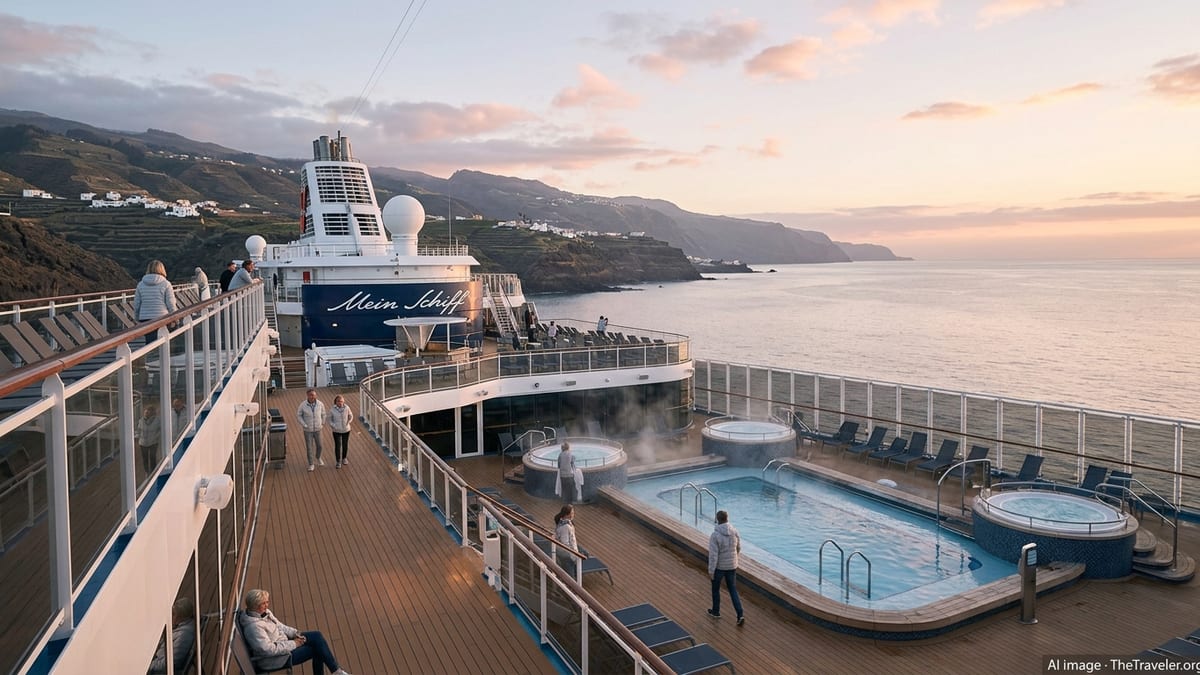
Hybrid network at the core of the new flagship
According to recent industry coverage, TUI Cruises has selected Marlink to deliver a fully managed connectivity and digital services platform aboard Mein Schiff Flow, the second vessel in the line’s new InTUItion class. The ship is scheduled to be named in Trieste and will debut with an integrated communications environment intended to mirror onshore digital expectations at sea.
The solution combines multiple satellite technologies, including low Earth orbit services from Starlink, traditional geostationary VSAT links and MSS backup capacity. These are orchestrated through Marlink’s network management systems and XChange NextGen edge platform, which the company promotes as the foundation for its wider “Possibility Portfolio” of maritime digital services.
Reports indicate that the hybrid architecture is engineered to maximise uptime and performance across varied cruising regions, from Mediterranean routes to more remote itineraries where connectivity can be challenging. By dynamically shifting traffic between satellite paths based on coverage, latency and application priority, the system aims to provide smooth user experiences for both passengers and crew.
The approach reflects a wider move in the cruise sector toward multi-orbit connectivity, as operators seek to deliver bandwidth-intensive services such as streaming, remote work capability and real-time operational data transfer without interruptions caused by geography or weather conditions.
Supporting guest experience and crew welfare
Mein Schiff Flow has been conceived as a premium, suite-focused ship with capacity for around 4,000 guests and roughly 1,500 crew. Against that backdrop, Marlink’s managed service is expected to underpin a range of guest-facing applications, from high-speed Wi-Fi in cabins and public spaces to digital dining, spa and entertainment reservations.
Cruise trade reports suggest that onboard digital platforms are becoming a key differentiator in the competitive European market, where travelers increasingly expect seamless connectivity for social media, messaging and video calls throughout their voyage. TUI Cruises is positioning the newbuild to meet those expectations, using the hybrid satellite network to bring a shore-like online experience to sea days and port calls alike.
For crew members, resilient communications can translate into more reliable internet access during off-duty hours, as well as streamlined internal systems for training, scheduling and shipboard administration. Marlink’s wider maritime portfolio includes secure remote IT support and cyber protection tools, which are designed to keep mission-critical applications running while protecting sensitive data.
By handing day-to-day management of the connectivity estate to a specialist provider, TUI Cruises is also expected to gain more predictable service levels and a single point of coordination for future upgrades, including the potential integration of additional low Earth orbit networks.
Enabling data-driven and low-emission operations
Mein Schiff Flow is being delivered by Fincantieri as an LNG-capable, next-generation cruise ship built around dual-fuel engines, advanced emissions controls and shore power connectivity. Publicly available information from the yard and operator points to a design that can operate on both liquefied natural gas and marine gas oil, while also being prepared for future low-carbon fuels such as bio-LNG and e-LNG.
Within that sustainability framework, Marlink’s role extends beyond passenger internet access. The company markets its maritime solutions as enablers of digitalised ship operations, bringing together connectivity, cloud access and edge computing to support fuel optimisation, predictive maintenance and real-time monitoring of hotel loads and environmental systems.
Onboard sensors and control systems can use the hybrid network to feed data to shoreside teams and analytics platforms, helping to fine-tune routing, speed profiles and energy consumption. This capability aligns with TUI Cruises’ publicly stated ambition to move toward climate-neutral operations over the coming decades, using each new vessel to advance both environmental performance and digital sophistication.
The combination of LNG propulsion, shore power, waste heat recovery and data-driven optimisation is intended to reduce emissions both at sea and in port, where cruise ships can spend a large proportion of their operating time connected to the pier. Reliable connectivity is seen as a prerequisite for orchestrating these complex systems in real time.
Partnership builds on earlier InTUItion-class deployments
The selection of Marlink for Mein Schiff Flow continues a relationship that has been developing since 2018, when the provider first began supporting TUI Cruises’ wider fleet. That collaboration deepened with the introduction of Sealink NextGen connectivity on the earlier InTUItion-class ship Mein Schiff Relax, delivered in 2025.
Industry reports describe Mein Schiff Relax and Mein Schiff Flow as standard-bearers for the brand’s evolution, pairing larger open decks and contemporary interior design with stronger environmental credentials and more advanced IT infrastructure. Marlink’s managed network is a central component of that infrastructure, forming the link between shipboard systems and data centers on land.
Over time, both companies are expected to benefit from the ability to replicate and refine a common digital architecture across multiple hulls. For TUI Cruises, that can simplify training, maintenance and cybersecurity strategies. For Marlink, it extends the opportunity to apply lessons learned from one vessel to another, improving performance and resilience across the fleet.
The collaboration also reflects a broader pattern in the cruise and shipping industries, where operators increasingly rely on long-term technology partners to handle complex networking, security and cloud integration tasks while they focus on itinerary planning, guest product and brand development.
Signal of rising expectations in the cruise market
The decision to livestream Mein Schiff Flow’s naming ceremony via Starlink connectivity highlights how fully integrated digital infrastructure is becoming part of the cruise narrative itself. Public communications about the vessel increasingly reference not only design features and itineraries, but also its digital capabilities and environmental technologies.
Analysts note that passengers now evaluate cruise products with the expectation that they will be able to stay online throughout their journey, whether to share their experiences in real time, keep up with work obligations or manage travel logistics. Ships entering service in 2026 and beyond are being developed with these expectations in mind, combining high-capacity satellite links with robust onboard Wi-Fi and device-friendly services.
For ports and destinations, the presence of a fully connected, LNG-capable ship like Mein Schiff Flow could bring additional opportunities, from enhanced coordination of turnaround operations to new forms of digital shore excursion content. As cruise lines and their technology partners refine these capabilities, connectivity is becoming as much a part of the competitive landscape as dining concepts or cabin design.
With Marlink’s hybrid network and digital operations platform at its core, Mein Schiff Flow is emerging as an example of how the next generation of large cruise ships seeks to blend guest comfort, environmental performance and always-on data flows into a single, integrated proposition.