


More news on this day
San Francisco International Airport faced significant disruption today as 213 delayed flights and three cancellations rippled across some of the busiest United, Alaska, Delta and American Airlines routes linking the Bay Area to Los Angeles, New York, Chicago, London, Tokyo and other major hubs.
Get the latest news straight to your inbox!
Major Carriers Hit Across Domestic and International Networks
Publicly available flight tracking data and industry coverage indicate that San Francisco International Airport recorded more than two hundred delays alongside a small number of cancellations, affecting a broad mix of domestic and long haul services. The disruption cut across marquee routes to Los Angeles, New York and Chicago, as well as transatlantic and transpacific links to cities such as London and Tokyo.
United Airlines, the dominant carrier at San Francisco, appeared among the most heavily affected operators, with delays stacking up on high frequency shuttle-style routes to Los Angeles and other West Coast destinations, as well as on widebody services to key international hubs. Alaska Airlines, Delta Air Lines and American Airlines also reported substantial schedule impacts, particularly on flights connecting the Bay Area with New York area airports and Chicago O’Hare.
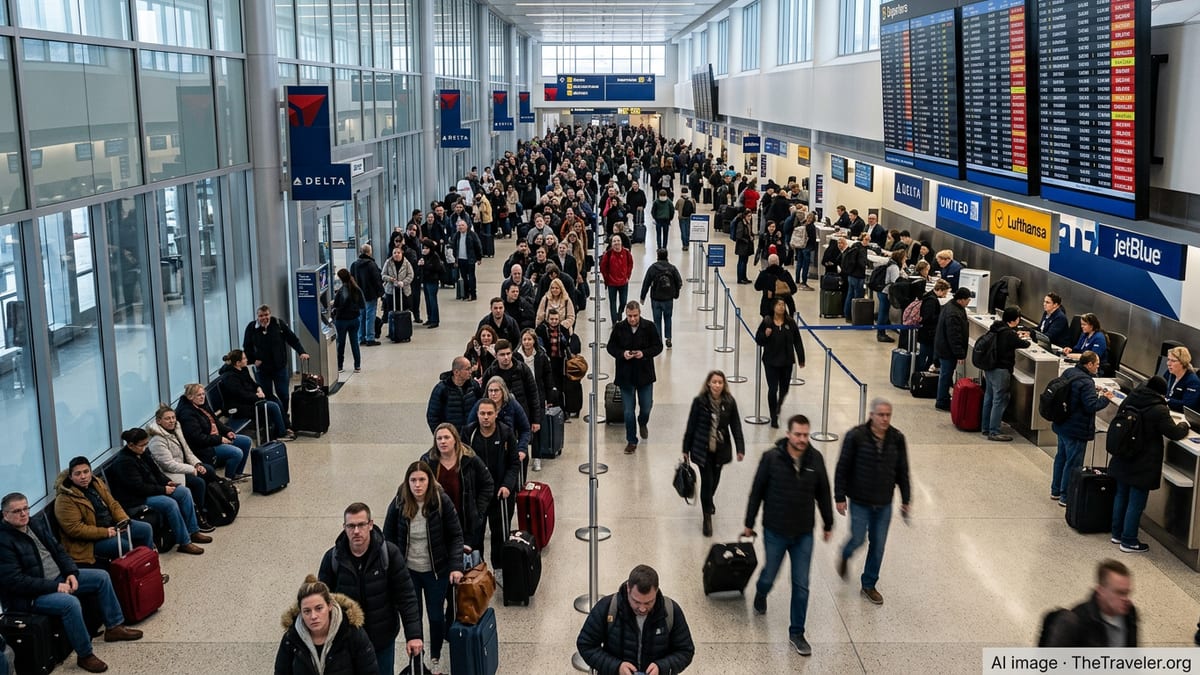
Travel industry reports describe passengers facing extended waits at departure gates and crowded terminal concourses as departure boards updated to show rolling pushbacks. The pattern of disruption follows a recent series of operationally challenging days at San Francisco, where delays have periodically climbed into the triple digits.
Operational Pressures Behind San Francisco’s Delay Burden
San Francisco International Airport occupies a complex operating environment that can amplify small disturbances into widespread knock-on delays. The airport relies heavily on closely spaced parallel runways and is highly sensitive to low cloud, rain and coastal winds, conditions that can require increased spacing between aircraft and slower arrival and departure rates.
Recent aviation and local coverage has highlighted how changes to landing procedures and ongoing infrastructure work can further constrain capacity at peak times. When arrival rates are cut back, even modest schedule peaks can generate queues of inbound aircraft and force airlines to hold departures at gates while they wait for usable takeoff slots, a dynamic that often shows up as mounting delays through the middle of the day.
Because San Francisco serves as a major hub in the networks of large U.S. carriers, delays there can quickly cascade across the country and beyond. When long haul aircraft depart late for destinations such as London or Tokyo, the same aircraft often arrive late at their next origin, narrowing maintenance windows and leaving little room to absorb additional disruption later in the schedule.
Impact on Key Routes to Los Angeles, New York, Chicago and London
The latest disruption has been particularly visible on some of the busiest domestic corridors in the United States. Flights between San Francisco and Los Angeles, one of the country’s most heavily traveled routes, saw a series of late departures as aircraft and crews rotated through the constrained SFO operation. Similar patterns were reported on transcontinental services to New York, where even short ground delays can translate into late-night arrivals on the East Coast.
Chicago O’Hare, itself a major hub, also felt the effects of San Francisco’s congestion as westbound and eastbound connections were squeezed by late inbound aircraft. Passengers traveling between the two hubs on United, American and other carriers faced the prospect of missed onward connections, particularly for evening departures linking to last-bank domestic flights in the Midwest and on the East Coast.
On the international side, heavily booked departures to London and major Asian gateways were among those experiencing schedule knock-ons. When long haul flights from San Francisco depart behind schedule, airlines often prioritize completing the journey rather than canceling outright, which can help limit the number of cancellations but increases the pool of delayed services that must be recovered later.
Passenger Experience and Limited Cancellations
Despite the scale of the delays, the number of outright cancellations remained comparatively low, with only three flights reportedly scrubbed from the schedule. That ratio suggests airlines were focused on operating as much of the planned program as possible, even with significant departure time slippage. For travelers on canceled services, however, rebooking challenges could still be substantial given already high load factors on remaining flights.
Passengers caught in the disruption at San Francisco described conditions consistent with recent large-scale delay events at major U.S. hubs: longer lines at customer service desks, congested gate areas, and frequent gate and time changes displayed on terminal information screens. Travel advisories from aviation and consumer outlets consistently recommend that passengers rely on airline mobile apps and text or email alerts to keep abreast of rapid schedule changes in such situations.
For many travelers, the most acute impact came from disrupted connections rather than the initial delay out of San Francisco. A late afternoon slip of one or two hours on a transcontinental or long haul departure can lead to missed overnight or early morning links at intermediate hubs, forcing passengers into overnight stays or extended layovers far from their original itinerary.
What Today’s Disruptions Signal for Summer Travel
The latest spike in delays at San Francisco arrives as airlines and airports prepare for one of the busiest travel periods of the year. Industry analysts have warned that high demand, tightly packed schedules and ongoing staffing and air traffic control constraints could leave little margin for error across major U.S. hubs during peak travel days.
Recent reporting on national air travel performance shows that San Francisco has periodically featured among airports with elevated delay counts, alongside other large hubs such as Chicago O’Hare, Los Angeles International and New York’s primary airports. Those patterns suggest that even localized weather or operational issues at one hub can quickly ripple across networks operated by United, Alaska, Delta, American and their partners.
For travelers planning trips through San Francisco in the coming weeks, publicly available guidance from airlines and aviation agencies emphasizes flexibility and preparation. Recommendations typically include allowing additional connection time, traveling with carry-on baggage where possible to simplify rebooking, and monitoring flight status closely in the 24 hours before departure. As today’s 213 delays and three cancellations illustrate, even a relatively modest number of cancellations can translate into large numbers of displaced passengers once network-wide effects are taken into account.