

More news on this day
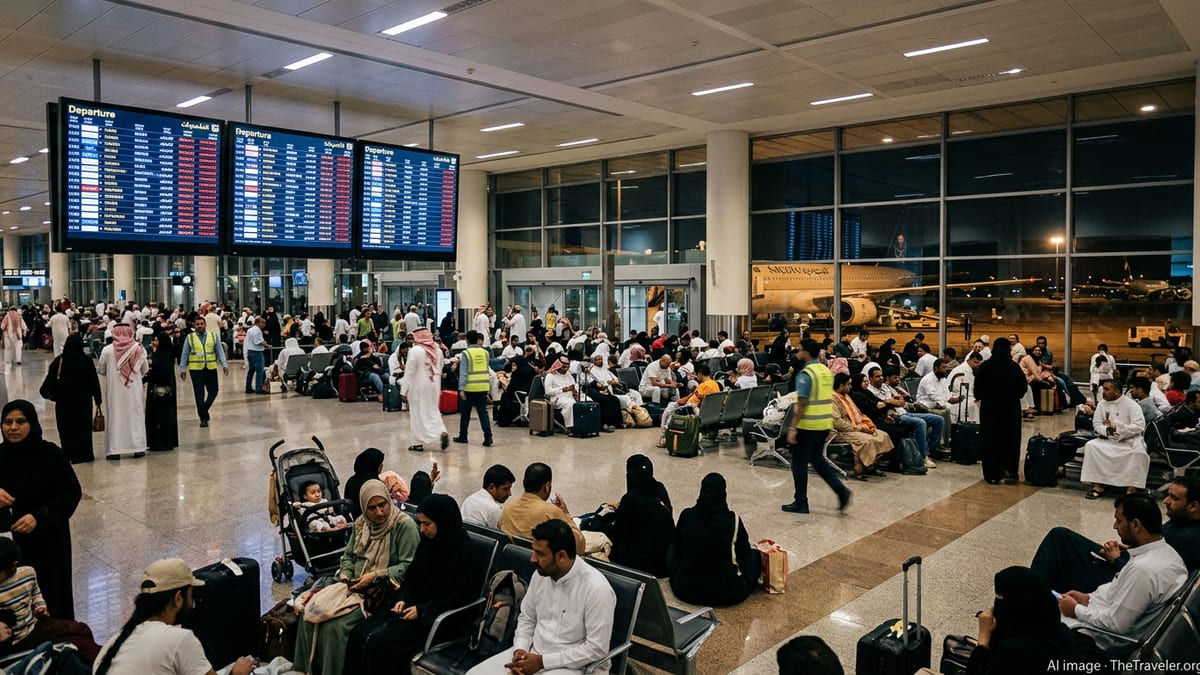
Hundreds of passengers were left stranded at King Abdulaziz International Airport in Jeddah on Wednesday as a fresh wave of flight delays and cancellations rippled across the Gulf, disrupting services by Saudia, Qatar Airways, Flynas and other major carriers linking Jeddah, Dubai and Doha.
Severe Disruptions at Jeddah Hub
Operational data from King Abdulaziz International Airport indicate at least 166 flights delayed and 66 canceled within a 24-hour period, turning one of Saudi Arabia’s busiest gateways into a scene of mounting frustration. Long queues formed at airline service desks and check-in counters as travelers tried to secure scarce alternative connections, while departure boards filled with red status updates.
Passengers reported spending the night on terminal floors and in crowded seating areas, with many unable to access nearby hotels due to limited availability and uncertainty over revised departure times. Families with children and elderly travelers were among the hardest hit, as the disruption coincided with heavy regional travel demand and already constrained seat capacity on remaining routes.
Airport staff intensified crowd management efforts, directing travelers between terminals and security checkpoints as airlines updated schedules in real time. Despite the scale of the disruption, authorities said safety and controlled airspace access remained the overriding priorities as carriers attempted to thread limited corridors through an increasingly congested region.
Airspace Closures Ripple Across the Gulf
The chaos in Jeddah is part of a much wider wave of flight disruption triggered by airspace restrictions and route suspensions across the Middle East in recent days. Gulf hubs including Dubai International and Doha’s Hamad International have faced rolling cancellations and sharply reduced operations, forcing airlines to ground aircraft, reroute services and hold departing flights on the ground.
Industry observers describe the current situation as one of the most severe regional aviation disruptions since the pandemic, with thousands of flights canceled or heavily delayed since late February. Airlines are being forced into complex detours around closed or restricted flight information regions, stretching crew rosters, inflating fuel burn and eroding the built-in flexibility that normally absorbs routine operational shocks.
As a result, knock-on delays reach far beyond the Gulf itself, affecting connections to Europe, Asia and Africa. With Doha and Dubai operating at a fraction of their usual capacity and Qatar’s airspace effectively closed, neighboring airports such as Jeddah have become pressure valves, absorbing diverted traffic while themselves grappling with congestion and limited runway slots.
Saudia, Qatar Airways, Flynas and Others Under Strain
National carrier Saudia has been among the most visibly affected operators at Jeddah, with multiple short- and medium-haul flights scrubbed or rescheduled at short notice. The airline has extended cancellations on select regional routes, including services to Gulf capitals, while advising passengers to verify their flight status before travelling to the airport.
Qatar Airways, normally a key connector between Jeddah, Doha and long-haul destinations, has seen its network heavily curtailed by the closure of Qatari airspace and the suspension of normal operations at Hamad International. Many travelers booked via Doha have found themselves stranded mid-journey in Saudi Arabia or the United Arab Emirates as their onward segments disappear from departure boards.
Low-cost Saudi carrier Flynas and other regional airlines, including flydubai and Emirates on routes linking Jeddah with Dubai, have also been forced into widespread schedule changes. Capacity constraints mean that spare seats on operating flights are limited, making same-day rebooking difficult and pushing some disrupted passengers onto services days later than originally planned.
Stranded Passengers Face Difficult Choices
For travelers caught in the disruption, options remain limited and often expensive. With so many flights canceled or rerouted, rebooking onto alternate itineraries frequently involves circuitous journeys via secondary hubs, overnight layovers, or last-minute one-way tickets on carriers that still have seats available.
Some passengers at Jeddah reported receiving meal vouchers and hotel accommodation from airlines in line with carrier policies, while others said they were offered only rebooking assistance or the option of a refund. Travel experts note that because many cancellations stem from airspace closures and security considerations, traditional compensation rules applied in some jurisdictions may not fully cover affected journeys.
Travel insurers and consumer advocates are urging passengers to keep all documentation, including boarding passes, booking confirmations and receipts for additional expenses such as accommodation and ground transport. They also stress the importance of maintaining direct contact with airlines through official channels, as call centers and digital platforms are being continuously updated with new options, including fee waivers and flexible change policies.
What Travelers Should Do Now
With the situation in Gulf airspace evolving by the hour, airlines and aviation authorities are urging passengers to avoid heading to the airport unless their flight has been explicitly confirmed as operating. Travelers with upcoming itineraries through Jeddah, Dubai or Doha are being advised to monitor airline apps, text alerts and email notifications, and to consider adjusting their plans where possible.
Passengers whose trips are not time-critical are encouraged to look at postponing travel or rerouting through less congested hubs that still have stable operations. Where rebooking is necessary, experts recommend consolidating all changes through the original issuing airline or travel agent to reduce the risk of fragmented tickets that can complicate further assistance if conditions worsen.
While there are tentative signs that some carriers are beginning to restore limited services, officials caution that backlogs at key hubs will take days to clear even in the best-case scenario. For now, travelers across the region, and particularly those stranded in Jeddah, face an unpredictable wait as airlines and regulators work to reopen critical corridors and stabilize the Gulf’s air traffic network.