


Melbourne Airport has become one of Australia’s most Uber friendly airports, but for visitors the mix of forecourt pickup zones, a multi level ground transport hub and Uber’s PIN style rides can still be confusing. This guide walks through exactly where to go at each terminal, how PIN pickups work, what to watch for with surge pricing and scams, and when it might make sense to choose a taxi instead.
Get the latest updates straight to your inbox!
How Uber Works at Melbourne Airport Today
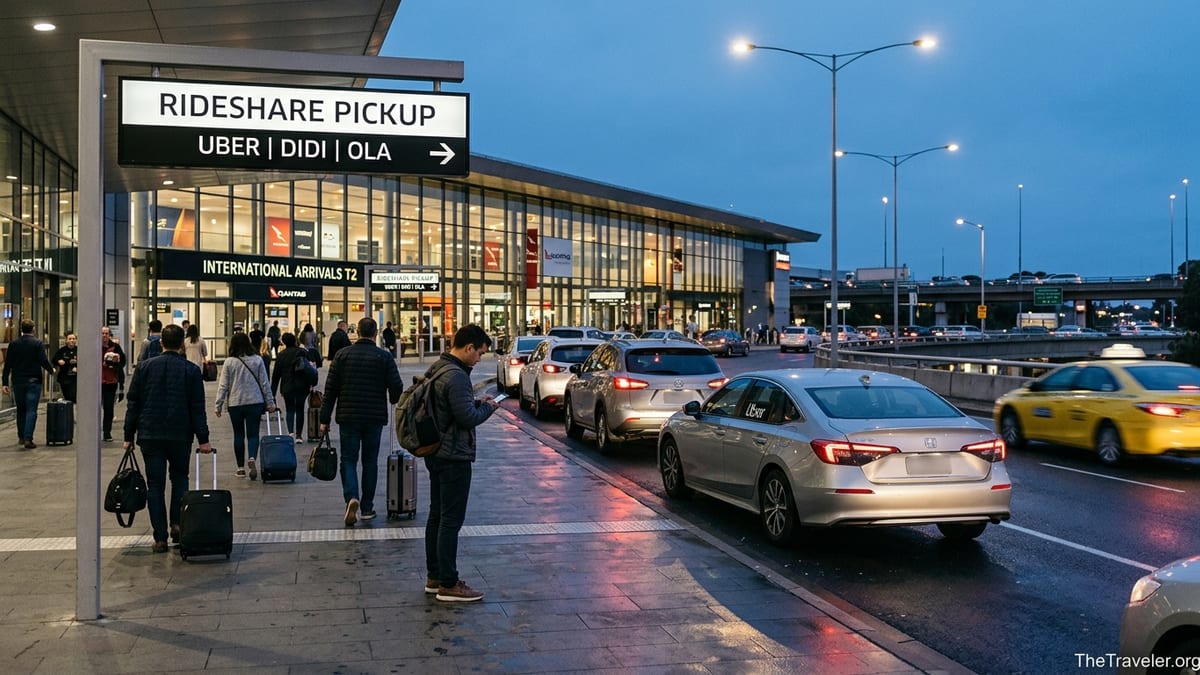
Uber is fully integrated into Melbourne Airport’s ground transport system, with dedicated pickup areas for each terminal and clear signage for “Rideshare” and “Uber” zones. If you open the Uber app after landing and set your pickup to “Melbourne Airport,” the app will prompt you to select your terminal and then guide you on foot to the correct rank. For most international and full service domestic flights that means the forecourt in front of Terminals 1, 2 and 3, while low cost airlines at Terminal 4 mostly use the Ground Transport Hub attached to the T4 car park.
Importantly, airport pickups are treated differently from normal city trips. You will often be sent to a shared Uber rank rather than matched with a specific car coming to the curb just for you. In busy periods the app will issue you a 4 digit PIN instead of a driver name and rego, and you can get into any UberX waiting in the queue. This system is designed to reduce queues and wasted time as drivers loop the terminal roads, but it does mean you need to understand exactly where to walk and what to say when you reach the car.
A typical evening arrival from Sydney at Terminal 1 might see you walk straight out of baggage claim, follow the “Uber / Rideshare” signs down to Lane 1 of the ground level forecourt, and then join a short line of passengers at the Uber rank. Ten minutes later you are in an UberX heading to the CBD, usually paying somewhere around the same as a taxi, but with dynamic pricing that can swing higher or lower depending on demand.
T1, T2 and T3: Forecourt Pickup and the New T123 Transport Hub
Terminals 1, 2 and 3 share a common forecourt, and Melbourne Airport has recently reshaped this entire area into what it now calls the T123 Transport Hub. For passengers, the key change is that taxis and rideshare vehicles, including Uber, pick up on the ground level forecourt rather than from scattered curbside spots. If you are arriving on Qantas domestic at T1, Virgin Australia at T3 or almost any international airline at T2, you will end up in the same general pickup area on the roadway in front of the building.
When you order an Uber, select the correct terminal in the app and then look for signs to “Rideshare, Lane 1.” You may need to cross one or two traffic lanes used for private cars and hotel shuttles to reach the dedicated rideshare lane closest to the terminal wall. In practice, this might look like walking out of international arrivals at T2, turning right, and following the blue rideshare pictograms until you see a staffed Uber rank with numbered bays and a short fence separating pedestrians from moving traffic.
The T123 Transport Hub layout is designed with luggage in mind. The walking distance from baggage claim to the Uber area is usually less than five minutes, with no stairs. If you are pushing a full airport trolley after a long haul flight from Los Angeles, you can keep your bags with you right up to the curb. Travelers with mobility needs will find accessible kerb ramps and marked disability pick up spaces alongside the main rideshare lane, and can still summon an Uber as usual from those spots if a standard Uber rank feels too hectic.
Terminal 4: Ground Transport Hub & Multi Level Pickup
Terminal 4 handles Jetstar, Rex and some regional and low cost flights, and its ground transport setup is different from the older terminals. Instead of stepping straight out to a road, you exit into a plaza connected to the multi level T4 Ground Transport Hub and car park. Rideshare pickups here are split between the ground floor and a dedicated transport hub level, so it is crucial to follow the route shown in your app.
If your Uber app tells you to go to the “T4 Ground Transport Hub,” you will usually be sent either to the ground floor of the T4 car park or to Level 2 inside the hub where many rideshare bays are located. Signs read “Rideshare / Uber Pickup” and point you to a series of numbered parking bays where Uber drivers queue. For example, after arriving on a Jetstar flight from Brisbane, you might walk over the short bridge from the terminal to the car park, follow the rideshare arrows up a ramp or lift to Level 2, and find a covered pickup area with clear bay numbers and shelter from rain and wind.
The main advantage of the T4 Ground Transport Hub is protection from Melbourne’s famously changeable weather. On a winter evening with sideways rain, being able to wait under cover rather than on an open forecourt can make a real difference, especially if you have children or multiple large suitcases. It also allows Uber and other rideshare services to stack more cars safely, which often translates into shorter waits during peak holiday periods when every Jetstar flight seems to be arriving at once.
Understanding Uber PIN Trips and Common Confusion
Melbourne Airport is one of the few places in Australia where Uber’s PIN system is widely used. During busy periods, particularly at the international T2 rank, your UberX request will not show a specific driver. Instead, once you confirm the ride, the app gives you a 4 digit PIN and instructs you to walk to the Uber zone. When you reach the front of the line, you simply get into the next available UberX, tell the driver your name and give them the PIN. They enter the code into their driver app, which links your trip to their car.
For first time users this can be disorienting, because it breaks the usual habit of checking the license plate and looking for a particular vehicle. Many travelers report walking along the rank asking drivers “Are you here for Alex?” only to be told that they can get into any car as long as it says Uber on the windshield and is waiting in the correct PIN queue. Once you understand that the PIN is what creates the match, the process becomes straightforward and often faster than waiting for a specific car to navigate crowded airport roads.
However, the system has created a breeding ground for confusion and attempted scams. There have been repeated reports on local forums and Reddit of drivers sitting at the airport with fake or secondary apps, asking passengers for their PINs and then claiming the code is not working. The passenger is inside the car, the driver starts moving, and only later does the rider realize the trip never actually started in the Uber app. In a worst case scenario, the driver may pressure the passenger to cancel and rebook, or even ask for direct cash payment.
To protect yourself, treat the PIN like a one time password. Only share it when you are seated in the car, have confirmed it is an Uber waiting in the official Uber zone, and can see the driver enter the digits into the legitimate Uber Driver app before the car departs the rank. If the driver says the PIN is not working, politely insist that they stop somewhere safe and either resolve the issue within the app or end the trip so you can order another Uber. Do not give the PIN to anyone approaching you inside the terminal building or standing on the footpath away from the marked Uber bays.
Beat Surge Pricing: When Your Flight Lands in Peak Demand
Like in most cities, Uber prices at Melbourne Airport vary with demand. Late Friday nights, Sunday evenings and Monday morning peak periods are classic surge windows, when dozens of flights land close together and hundreds of passengers request rides into the city at once. In those windows you might open the app at T2 and see an estimated UberX fare to the CBD jump from a typical off peak figure to something significantly higher, sometimes approaching or exceeding the cost of a regulated taxi.
As an example, on a quiet midweek afternoon a rider traveling from T2 to a hotel near Southern Cross Station might see an UberX estimate around the same ballpark as a typical regulated taxi fare from the airport to the CBD, which many fare trackers currently put in the mid 70 dollar range including the airport surcharge. Late on a busy Sunday night after multiple international arrivals, that same trip might spike noticeably higher in the app while a taxi meter would still start from its standard flagfall plus the airport rank fee. The Uber app always shows a fare estimate before you confirm, so you can compare in real time against what a taxi queue would likely cost.
If you are flexible, one strategy is simply to wait ten or fifteen minutes in the terminal. Surge multipliers are driven by short term imbalances in supply and demand. Once a few more Uber drivers clear the airport holding area and arrive at the ranks, prices can settle back toward normal. Another tactic used by some locals is to compare services. If UberX shows a high surge, it may be worth checking competing rideshare apps or walking to the SkyBus counter to price out a bus to the CBD plus a short taxi hop to your final destination.
There is also a temptation for some travelers to move their pickup point off airport property in search of cheaper prices, for example by setting the pin to a petrol station on Airport Drive and asking the driver to collect them there. While stories circulate online of riders saving money this way, it introduces new risks: you may be walking along unlit roads with luggage, crossing busy traffic without proper footpaths, and creating confusion for drivers who are not expecting pickups outside the official terminals. For most visitors, it is safer and more comfortable to leave from the signed rideshare zones and simply weigh Uber surge prices against taxis and buses in the moment.
Luggage, Groups and Accessibility: Choosing the Right Uber Option
Not every Uber category works equally well for airport trips. At Melbourne Airport, standard UberX is the most common choice, and most drivers operate mid sized sedans or compact SUVs. A solo traveler or couple with two medium suitcases and carry on bags will fit comfortably in almost any UberX. On the other hand, a family of four arriving from Singapore with four large checked bags, two strollers and backpacks might quickly find a small sedan too cramped.
In that situation, it is worth considering ordering a larger vehicle class if available, such as UberXL, which typically sends a people mover or large SUV. You will pay more than for UberX, but you avoid the safety and comfort issues of stacking suitcases on passengers’ laps or blocking rear visibility. At T4’s Ground Transport Hub in particular, the extra turning space and numbered bays make it easier for larger vehicles to pull in and for groups to load up quickly without holding up the queue.
For travelers with mobility needs, Melbourne Airport’s design offers level or ramped access from baggage claim to all official rideshare zones. If you use a collapsible wheelchair, an UberX or UberXL may work as long as the chair can fold and the driver is comfortable helping you lift it into the boot. Riders who need extra time should avoid feeling rushed by the queue behind them; Uber’s charging only starts once the trip is live in the app, so you can take a moment to secure seatbelts and check that all baggage is loaded before giving the PIN.
One small but practical tip: if you are collecting checked sporting equipment, such as a surfboard bag or golf clubs, mention it in the “add a note for your driver” section of the app. While the PIN system at T2 limits how much advance matching you can do, notes can still help drivers quickly decide if they have enough space before accepting the trip at non PIN times, and at other terminals where you are meeting a specific vehicle.
When a Taxi or Bus Might Be the Better Choice
Despite the convenience of Uber’s app, there are moments when a traditional taxi or the SkyBus might make more sense. Melbourne Airport maintains large taxi ranks outside all terminals, and fares into the CBD are regulated by the state government. While you will pay an additional airport pickup surcharge that is folded into the meter total, the per kilometre and per minute rates do not surge. For a straightforward trip to a central city hotel during a high demand period, a taxi fare sitting around the mid 70 dollar mark can be competitive with or cheaper than a heavily surged UberX.
Taxis can also be simpler for expense reporting. Corporate travelers who need an official tax invoice or who are traveling on a company policy that specifies taxis may find it easier to walk to the taxi rank, especially if they have not enabled roaming data on their phone or are unsure whether their international SIM will work immediately on landing. In those cases, standing in a clearly signed taxi queue at T2 and hopping into the next available cab can feel reassuringly old fashioned.
For budget travelers heading directly to the CBD, the SkyBus is another strong option. Services run between the airport and Southern Cross Station throughout the day, with luggage racks on board and no need to pre book. Once you reach the city, a short tram ride or inner city Uber completes the journey. A solo backpacker arriving on a midday flight might reasonably choose SkyBus for the first leg to save money and then use Uber only for the last few kilometres to a laneway hostel in Fitzroy or Collingwood.
There are also situations where a pre booked private transfer or hotel shuttle beats any on demand option. Families arriving very late at night with young children, travelers with very large equipment, or visitors with complex accessibility needs may prefer the certainty of a named driver waiting with a sign. In those cases, the main role of Uber and taxis is as a backup option if a pre booked transfer is delayed or fails to appear.
Staying Safe and Avoiding Airport Scams
While the vast majority of Uber trips at Melbourne Airport are uneventful, the complexity of the forecourt and PIN system has encouraged a small number of opportunists. The most common theme in local reports is unofficial drivers approaching passengers inside the terminal or just outside the doors, asking “Do you need Uber?” and then attempting to steer them to a car that is not properly booked through the app. Sometimes these drivers claim that the Uber system is down, or that they can offer a cheaper flat fare in cash.
The golden rule is simple: never accept a ride from anyone who approaches you directly. Only order through the official app, walk to the signed Uber or rideshare zones, and make sure your ride is either properly matched in the app or, for PIN pickups, that the driver is waiting in the official Uber queue. If someone inside the terminal asks for your PIN before you reach the curb, decline and keep walking toward the rank.
Another pattern described by riders involves drivers who start moving before the trip is properly connected in the app. A driver might take your PIN, claim there is a problem, and then suggest you cancel and rebook or complete the journey off platform. That leaves you with reduced recourse if the fare is disputed or if something goes wrong. To avoid this, wait until you see your phone display that the trip is “On Trip” with the correct vehicle details before the car pulls away from the rank. If that status does not appear, ask the driver to stop in a safe place within the airport precinct and clarify what is happening.
Finally, trust your instincts about vehicle condition and driver behavior. If a car waiting in the rank does not display any Uber or rideshare identification, or the driver pressures you to change your destination or pay outside the app, it is perfectly acceptable to step out of the vehicle before the trip begins and return to the rank staff or airport ground transport office for assistance. Melbourne Airport security and customer service are used to dealing with these issues and can often intervene quickly.
The Takeaway
Used correctly, Uber is an efficient and comfortable way to travel between Melbourne Airport and the city or suburbs. The key is understanding how the airport’s dedicated rideshare infrastructure works: T1, T2 and T3 use the ground level forecourt within the T123 Transport Hub, while Terminal 4 relies on its own Ground Transport Hub and car park. Within that framework, Uber’s PIN system allows for fast, high volume pickups, provided you treat the PIN like a security code and share it only once you are seated in a legitimate Uber at the official rank.
Surge pricing is the main variable. At quiet times, UberX can be similar in cost to a taxi into the CBD, while at peak times it may be noticeably higher. Comparing the live fare estimate with the likely taxi meter, considering alternatives like SkyBus, and being willing to wait ten minutes for prices to settle are all smart moves. For groups with lots of luggage, upgrading to a larger vehicle class or even booking a private transfer can make the first leg of your trip far less stressful.
Ultimately, your choice between Uber, taxi and bus at Melbourne Airport should balance cost, convenience and comfort. With a little advance knowledge of where to walk, how to handle PIN pickups and what red flags to watch for, you can step off the plane, collect your bags and be on the Tullamarine Freeway toward the city with minimal fuss.
FAQ
Q1. Where exactly is the Uber pickup area for international arrivals at Melbourne Airport?
For most international flights arriving into Terminal 2, Uber pickups are on the ground level forecourt within the T123 Transport Hub. Follow the “Rideshare / Uber” signs from baggage claim to Lane 1, where you will see a dedicated Uber rank with staff and numbered bays.
Q2. How do Uber PIN trips work at Melbourne Airport?
During busy times, especially at Terminal 2, UberX uses a PIN system. After you request a ride, the app gives you a 4 digit code. Walk to the Uber rank, get into the next available UberX in the official queue, and give the driver your PIN. They enter it in their driver app, which links your trip to their car.
Q3. How long does it take to walk from baggage claim to the Uber pickup zones?
At Terminals 1, 2 and 3 the walk from baggage claim to the rideshare lane on the forecourt is usually three to five minutes on level or gently ramped paths. At Terminal 4, you should allow about five to eight minutes, as you need to cross into the Ground Transport Hub and possibly go up one or two levels depending on your pickup bay.
Q4. Is Uber cheaper than a taxi from Melbourne Airport to the CBD?
It depends on demand. In off peak periods, UberX fares to central Melbourne are often in a similar range to a regulated taxi fare, which typically sits in the mid 70 dollar range including the airport surcharge. During heavy surge periods Uber can be noticeably more expensive, while taxi fares remain regulated.
Q5. What should I do if a driver says my Uber PIN is not working?
If a driver claims your PIN is not working, ask them to stop in a safe spot within the airport precinct and check your app. Make sure your trip has not already started with another car. If there is any doubt, cancel the ride in the app, leave the vehicle and rejoin the official Uber queue. Do not give your PIN to anyone outside the marked Uber zone or before you are in the car.
Q6. Can I use Uber if I have a lot of luggage or bulky items?
Yes, but choose the right vehicle type. A standard UberX suits one or two people with moderate luggage. For larger groups or bulky items like golf clubs or strollers, consider requesting an UberXL or similar larger vehicle so you have sufficient boot space and legroom.
Q7. Are there accessible options for passengers with mobility issues?
Melbourne Airport provides step free routes from arrivals to all official rideshare zones, along with kerb ramps and designated disability pickup areas. Many UberX and UberXL vehicles can accommodate folded wheelchairs or walkers. If you need extra assistance, allow more time at the curb and consider adding a note for the driver in the app.
Q8. Is it safe to walk off airport property to avoid Uber surge pricing?
While some people try to set their pickup point just outside the airport to reduce surge prices, it is generally not recommended. Walking along airport access roads with luggage can be uncomfortable and potentially unsafe, and drivers may have trouble finding you. For most travelers it is better to depart from the signed rideshare zones and compare Uber prices with taxis or the SkyBus instead.
Q9. Can I be scammed by unofficial drivers at Melbourne Airport?
Scams are uncommon but do occur. Typical tactics include people inside or just outside the terminal offering “Uber” rides not booked through the app, or drivers asking for your PIN and then claiming it does not work. Avoid problems by only ordering through the official app, using the marked Uber ranks and never sharing your PIN until you are in the car and can see the driver using the real Uber app.
Q10. What are my alternatives if Uber prices are very high when I land?
If Uber is surging heavily, you can join the taxi queue, which uses regulated fares plus an airport surcharge, or take the SkyBus to Southern Cross Station and connect by tram or a short rideshare trip. If your schedule is flexible, waiting ten or fifteen minutes inside the terminal can also allow Uber prices to drop as more drivers reach the airport.