


Landing at Melbourne Airport for the first time can be confusing, especially when you are tired, jet lagged and just want a straightforward ride into the city. Between official taxi ranks, multiple Uber pickup zones, late-night surcharges and the ever-present SkyBus, choosing the right option can easily save you both money and stress. This guide walks you through exactly how taxis and rideshare work at Melbourne Airport in 2026, what you should expect to pay to the CBD, and how to navigate the different terminal zones with real-world examples.
Get the latest updates straight to your inbox!
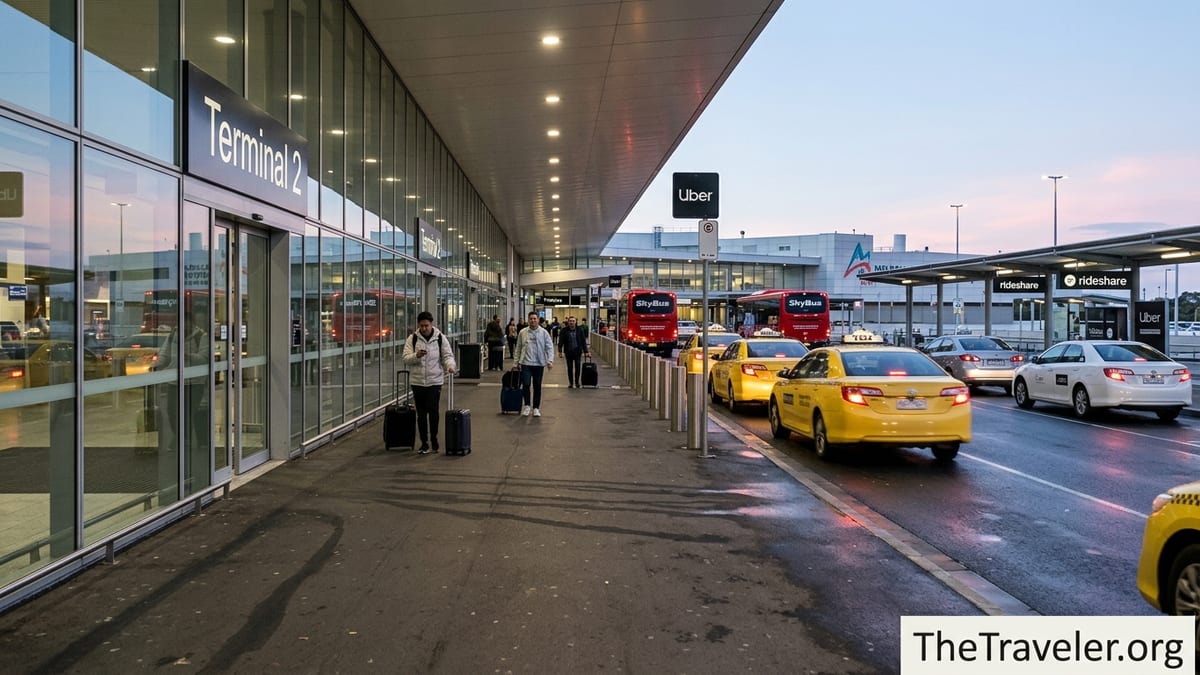
Understanding Melbourne Airport and Its Terminals
Melbourne Airport, often called Tullamarine, sits about 22 kilometres northwest of the Central Business District. The terminal layout matters because taxi ranks and rideshare pickup zones are tied to specific buildings. Terminal 1 handles Qantas and QantasLink domestic flights, Terminal 2 is the international terminal, Terminal 3 serves Virgin Australia and some regional carriers, while Terminal 4 caters mainly to budget airlines such as Jetstar and Rex. Most first-time visitors arrive through Terminal 2, but domestic connections between T3 and T4 are common, and signage can feel inconsistent if you are in a hurry.
All terminals sit along the same main loop road, but not every ground transport option is at every front door. Official taxi ranks are positioned across from Terminals 1, 2 and 4, and the main rideshare zones are clustered around T2 and the T4 car park. In practical terms, if you land at T2 or T3 you will almost always walk past both taxi and Uber signage within a few minutes, while T4 passengers are usually funnelled into a more concentrated ground transport hub in and around the multi-level car park. Understanding where you will emerge helps you decide whether to follow signs to “Taxi,” “Rideshare,” or “SkyBus” as soon as you clear customs or baggage claim.
Because the airport is quite compact, walking between terminals is realistic for most travellers. For example, a passenger landing on an international flight at T2 but meeting friends at the domestic rideshare zone can walk to the T1–T3 side in about five minutes, and to T4 in around ten. This can be useful if a particular taxi rank is busy or if you prefer the Uber setup at one zone over another, especially during peak hours when queues form quickly outside T2.
The airport road system is dense with signage, roadworks and pick-up restrictions that change periodically. As a visitor, avoid trying to arrange informal kerbside pickups from private cars at the front of the terminal, as these areas are heavily patrolled and drivers face fines for stopping illegally. Instead, use the clearly signed official zones for taxi, rideshare, hotel shuttles and coaches, which sit a short walk from each arrivals hall.
Official Taxi Ranks: T1, T2 and T4
Authorised taxis at Melbourne Airport wait at designated ranks across from Terminals 1, 2 and 4. You reach them by exiting the arrivals hall, crossing the first roadway and following yellow “Taxi” signs to the covered rank area. At T1 and T2 the taxi ranks sit beside the main forecourt, while at T4 the rank links into the ground transport hub around the car park. These ranks are staffed during busy periods, and queues are managed so that the next available cab pulls forward, much like at other major airports in Australia.
Every legal taxi will display a roof sign, meter, and an accredited taxi number on the doors. If in doubt, look for the official accreditation on the windscreen and side panels and never accept a ride from someone approaching you inside the terminal offering a “cheap taxi” or “private car.” For example, if you land late at night at T2 and a person in plain clothes offers you a ride while you wait at baggage claim, decline politely and head straight for the marked rank outside. Scams involving unlicensed vehicles have been reported at busy times, and official taxis are the safest on-the-spot option if you have not pre-booked a car.
Pre‑booked taxis usually meet passengers at a separate pre‑booked zone or at an arranged spot within the car park rather than at the main on-demand ranks. If you have booked a silver service or wheelchair-accessible taxi, your confirmation email or SMS will specify the location, such as “T2 pre‑booked taxi zone” or “T123 car park pickup.” Give yourself a few extra minutes to find these locations, particularly if travelling with children or bulky luggage, as they may require crossing a second roadway or taking a lift up or down a level.
At peak times such as weekday mornings between 7 am and 9 am, or Sunday evenings when many domestic flights arrive, queues at the taxi rank can stretch to 15–20 minutes. The lines tend to move steadily because taxis are constantly feeding in from a large holding area, but if you are in a rush and travelling light, you might consider walking to an Uber zone where cars could be available more quickly, or taking SkyBus which has a fixed timetable and priority access on the freeway.
What You Will Pay: Typical Taxi Fares to the CBD
The taxi ride from Melbourne Airport to the central city is one of the longest airport runs in Australia, and the fare reflects that. As of mid‑2026, online fare estimators and recent traveller reports suggest a typical daytime metered fare from the airport to a CBD hotel near Southern Cross Station lands around 70 to 80 Australian dollars, including the airport taxi fee and CityLink tolls, assuming normal traffic and no extended detours. For instance, a weekday mid‑afternoon ride to a Collins Street hotel might clock in near 75 dollars for a 30‑minute trip in light traffic.
Fares can rise noticeably during peak congestion or late at night. If you land at 5 pm on a weekday and your taxi spends ten minutes crawling through freeway traffic, the meter keeps running. In heavy conditions or if there is an accident on the Tullamarine Freeway, that same ride to the CBD can creep towards 90 dollars. Late-night surcharges and higher tariffs on some public holidays can also bump up the price by a few dollars. Always expect to pay an additional airport fee on top of the metered fare; this is automatically added when your taxi passes the airport’s boom gates.
Many drivers will ask whether you prefer a tolled or non‑tolled route. Using the CityLink toll road is usually a few minutes faster and slightly more expensive, but the difference in total fare for an airport–CBD run is often modest compared with the overall trip cost. For example, skipping tolls might save 6 to 10 dollars but add 10 to 15 minutes of travel time depending on inner-suburban traffic. If you arrive after a 14‑hour international flight and are exhausted, it is usually worth paying for the toll route to reach your hotel sooner.
Most taxis accept credit and debit cards, as well as contactless payments such as Apple Pay and Google Pay, though a small card surcharge is common. Before the driver pulls away from the rank, quickly confirm that card is accepted if you do not have cash, and note that tipping is not expected in Australia. Locals might round up a fare from 74 to 78 dollars for good service, but there is no obligation to add a fixed percentage as you might in North America.
T1, T2 and T4 Taxi & Rideshare Zones Explained
Melbourne Airport’s ground transport language can be confusing because signs refer to both terminal numbers and combined hubs. For taxis, the key point is that on-demand ranks are located outside T1, T2 and T4. For rideshare, the main public pickup areas are at the T123 side near T2 and in the T4 car park precinct. If you arrive at T1, T2 or T3 and call an Uber, the app will typically direct you towards a rideshare zone close to T2, while T4 passengers head towards the marked rideshare pickup level in the T4 car park.
At the T1–T3 side, Uber has a pickup area just outside the international terminal zone. Depending on the time of day and your ride type, you may be instructed to walk to a clearly signed Uber pickup lane where cars queue in a taxi-rank style system. For many standard UberX trips this operates with a PIN system: you request a ride, receive a short numeric code and then join a physical queue. When you reach the front, you give your PIN to the next available Uber driver, which links your trip to that car inside the app. This system speeds up boarding and prevents drivers from selectively cancelling short rides such as nearby inner‑north suburbs.
Terminal 4 works somewhat differently. The main rideshare pickup zone is integrated into the ground floor or lower level of the T4 multi‑storey car park, where Uber, DiDi and other services funnel through controlled access points. Here, individual bookings are matched to specific cars and drivers navigate a holding pattern before entering the pickup lane. For travellers, it often means a slightly longer walk from arrivals but more shelter from the weather and clearer separation between cars and general traffic. However, local passengers occasionally report longer waits during very busy periods as drivers move through the car park system.
If you are connecting between terminals, factor in walking time to reach your preferred zone. For example, a traveller landing on a Rex flight at T4 but staying in a Docklands hotel might choose to walk ten minutes over to the T2 Uber PIN queue because they prefer that system, while someone arriving on Qantas at T1 might simply cross the road to the nearest taxi rank rather than drag luggage to the T4 rideshare area. There is no right answer, but knowing that multiple zones exist allows you to adapt if one area is overcrowded or closed temporarily.
Luggage, Families and Late-Night Arrivals
With luggage, the difference between taxi and rideshare becomes practical rather than theoretical. Standard Melbourne taxis are sedans, station wagons or maxis; most can handle two large suitcases and a couple of smaller bags without issue. If you are travelling with three or four large checked bags or bulky sports equipment, look for a station wagon or maxi taxi at the front of the rank or ask the rank marshal to direct you to one. It is common for a family of four with two large suitcases and two cabin bags to pile into a single wagon for the airport–CBD run without needing to book in advance.
Rideshare vehicles through UberX or similar services are also usually medium sedans or SUVs, but there is more variation. When booking, consider selecting a larger ride category such as UberXL if available, particularly if you have a stroller, ski bag or musical instrument. For example, two adults with a toddler, stroller, travel cot and three suitcases might find an UberXL or a pre‑booked maxi taxi far more comfortable than squeezing into a compact sedan. Unlike the taxi rank where you can visually choose a vehicle, rideshare matches you to a car sight unseen, so err on the side of more space.
Late-night arrivals are common in Melbourne, especially long‑haul flights from Asia and the Middle East that land between 10 pm and 2 am. At these hours, taxi ranks may be shorter but the mix of available vehicles can be unpredictable. The Uber zones operate 24 hours a day, but wait times can fluctuate depending on how many drivers are in the airport holding area. A traveller arriving on a midnight international flight might find taxis lined up with no waiting time, while Uber shows an estimated 15‑minute pickup, or vice versa. It is worth checking both options as soon as you clear immigration to see which will be faster that night.
Safety is a key concern for solo travellers arriving after dark. Stick to well‑lit, signed pickup zones monitored by airport staff and security cameras. Avoid following anyone who approaches you inside the terminal offering an unsolicited “Uber,” and only get into vehicles that match the official taxi branding or, for rideshare, the car make, model and registration shown in your app. If anything feels wrong at the Uber queues, such as someone asking you to cancel the trip and pay cash or take a ride in an unmarked car, simply step back to the terminal and request assistance from airport staff or call a regular taxi from the rank instead.
Taxi vs Uber vs SkyBus: What Really Makes Sense?
For most visitors choosing between a taxi, Uber and the SkyBus airport bus comes down to a trade‑off between price, convenience and predictability. A metered taxi or UberX for one or two people from Melbourne Airport to a central hotel will usually cost between 60 and 90 dollars depending on traffic, surcharges and tolls. SkyBus, by contrast, offers a flat per‑person fare to Southern Cross Station that is usually much cheaper on a solo ticket but can become comparable or even more expensive for groups of three or four once individual fares are added up.
As a simple example, consider a couple arriving at 8 pm on a Tuesday and staying at a hotel opposite Southern Cross Station. Two SkyBus tickets might total roughly half the price of a typical taxi, and the bus runs every 10 minutes or so until midnight. In that scenario, they might choose SkyBus, walk across the road to their hotel and save a substantial amount. However, a family of four with two young kids and heavy luggage staying in East Melbourne might find that a single UberXL door‑to‑door from the airport works out only slightly more expensive than four bus tickets plus a connecting tram or taxi from Southern Cross, while being far less hassle.
Uber pricing is dynamic and can surge during busy events, storms or airline disruptions. On a Friday evening when several delayed flights arrive at once, a typical UberX to the CBD might spike well above a taxi fare, especially if there is a rideshare access fee added at the airport. At other times, particularly off‑peak daytime hours, UberX might undercut a taxi by 10 to 15 dollars on the same route. Before committing, open the Uber app landside and compare the quoted fare with a quick check of a taxi fare estimator to see which option is currently better value.
SkyBus has one major advantage: reliability. Services operate around the clock, with high frequency during the day and reduced but regular departures overnight. The bus uses dedicated coach bays and runs a straightforward route along the Tullamarine Freeway, avoiding the guesswork of variable Uber wait times or taxi queues. Once you know your hotel’s proximity to Southern Cross Station or other SkyBus stops such as Southbank or Docklands, it becomes easy to plug the bus into your arrival plan and budget. However, if you are arriving during heavy rain at midnight with two children and multiple suitcases, the appeal of walking straight from baggage claim into a warm taxi or Uber should not be underestimated.
Savvy Tips to Avoid Scams and Hassles
Although Melbourne is generally safe, some travellers do encounter unwanted hassles around the airport ranks and rideshare zones. The golden rule is to use only official channels. For taxis, that means joining the marked queue at the designated rank or meeting a clearly identified pre‑booked cab at the agreed spot. Refuse offers from people walking the terminal with “cheap ride” pitches and avoid getting into vehicles without taxi branding or a confirmed booking in your rideshare app.
With Uber and other rideshare services, remain inside the app ecosystem from request to drop‑off. When you request a pickup from the T2 Uber zone, for example, expect to receive precise instructions and either a vehicle match or a PIN code. Do not share your destination or show your app screen to anyone who is not the matched driver. Be wary of drivers who ask you to cancel the app trip and pay cash, claim that your hotel is “closed” and suggest an alternative, or try to redirect you away from the signed pickup lane to a darker side street or level of the car park.
If something feels suspicious, it is perfectly acceptable to step out of the car before departure, cancel the trip and choose another vehicle or switch back to the taxi rank. For extra peace of mind, share your trip status with a friend or family member through the app so they can see your route into the city in real time. This is particularly reassuring for solo travellers arriving late at night from long‑haul flights.
Finally, pay attention to signage and audio announcements, especially during ongoing changes to pickup and drop‑off arrangements. Melbourne Airport has been progressively shifting private car pickups away from the immediate kerbside into multi‑level car parks and transport hubs. That means today’s recommended meeting point or Uber lane may not be identical to last year’s blog post or video you watched. When in doubt, follow the current airport signs to “Taxis,” “Rideshare” or “SkyBus” first, then double‑check the exact zone details inside your app or booking confirmation rather than relying on old screenshots.
The Takeaway
For most travellers, getting from Melbourne Airport to the CBD comes down to three realistic choices: a metered taxi from the official ranks, an Uber or similar rideshare from the designated zones, or the SkyBus airport coach. Taxis excel for simplicity and availability, especially after a long flight when you want a straightforward, regulated option and do not mind paying 70 to 80 dollars into the city. Uber can be slightly cheaper or more expensive depending on demand, but offers app‑based convenience and a clear price estimate before you ride.
SkyBus provides a reliable, often cheaper alternative for solo travellers and couples staying near Southern Cross Station or along its connecting routes, though it adds a transfer step with luggage. Families, groups and late‑night arrivals tend to value the door‑to‑door comfort of taxis and rideshare over marginal savings. Whichever option you choose, sticking to official taxi ranks and signed rideshare pickup zones, watching for up‑to‑date signage at T1, T2 and T4, and confirming fares and vehicle details in advance will go a long way towards making your arrival in Melbourne smooth and stress‑free.
FAQ
Q1. How much does a taxi from Melbourne Airport to the CBD usually cost?
A typical daytime taxi from Melbourne Airport to a central CBD hotel generally costs around 70 to 80 Australian dollars, including airport fees and tolls, depending on traffic and the exact destination.
Q2. Is Uber cheaper than a taxi from Melbourne Airport?
Sometimes. During off‑peak periods UberX can be slightly cheaper than a taxi, but during busy times or surge pricing it can be equal to or more expensive than a metered cab for the same trip.
Q3. Where do I find the official taxi ranks at Melbourne Airport?
Official on‑demand taxi ranks are located across from Terminals 1, 2 and 4. Follow the yellow “Taxi” signs from arrivals, cross the first roadway and join the marked queue.
Q4. How do Uber pickups work at Terminals 1, 2 and 3?
For many UberX trips, you walk to the signed Uber pickup zone near Terminal 2 and either meet a matched vehicle or use a PIN queue system where you give a code to the next available driver.
Q5. What is different about the T4 rideshare zone?
Terminal 4 rideshare pickups are concentrated in and around the T4 car park, where drivers pass through a controlled holding area before entering the pickup lane, offering more shelter but sometimes longer waits.
Q6. Is SkyBus a good option from Melbourne Airport?
Yes. SkyBus runs frequently between the airport and Southern Cross Station, offering a fixed per‑person fare that is often cheaper for solo travellers and couples staying near the CBD transport hub.
Q7. Are taxis and Ubers available late at night?
Both taxi ranks and Uber zones operate 24 hours a day, but actual wait times can vary. After midnight you may find taxis immediately available while Uber has a short wait, or the reverse.
Q8. Can I pay for a taxi by card?
Almost all Melbourne taxis accept credit and debit cards and contactless payments, often with a small card surcharge. Cash is still accepted but not required, and tipping is optional.
Q9. How can I avoid taxi and Uber scams at the airport?
Use only official taxi ranks and signed rideshare zones, check vehicle and driver details in your app, refuse unsolicited offers inside the terminal, and never agree to cancel the app and pay cash instead.
Q10. Is it easy to walk between terminals to reach a different pickup zone?
Yes. The terminals are connected by pedestrian paths; walking from T2 to T1 or T3 takes only a few minutes, and reaching T4 usually takes around ten minutes for an able‑bodied traveller.