


Melbourne is one of the few major cities in the world where the main international airport sits just 23 kilometers from the central business district yet is not connected by rail. For visitors, the lack of a simple “hop on the train at the terminal” option can be confusing. For locals, it has been a running joke and political football for decades. This guide explains why there is still no direct airport train to Melbourne Airport, what you should use right now instead, and how future rail plans may eventually transform the way travelers move between the terminals and the city.
Get the latest updates straight to your inbox!
Why There Is Still No Train to Melbourne Airport
On paper, a rail line between Melbourne Airport and the city looks obvious. The airport handles tens of millions of passengers each year and sits on the edge of an expanding metropolitan area. In practice, turning that idea into tracks has proved slow and politically complicated. Proposals for an airport train have surfaced regularly since the airport site at Tullamarine was chosen in the late 1950s, but successive governments prioritized other big-ticket projects and road upgrades on the Tullamarine Freeway instead.
Cost is a core reason. Recent business case work by state and federal agencies has put the total capital bill for a heavy rail link at many billions of dollars, with early estimates often quoted in the high single to low double digit billions once contingency and related upgrades are included. For governments already committed to other megaprojects such as the Metro Tunnel and the Suburban Rail Loop, diverting that amount of money to the airport line has required careful staging and hard choices about timing.
The airport itself has also played a role. Melbourne Airport is operated by a private company that earns significant revenue from car parking and road access. Public documents and commentary reference disagreements between the Victorian Government and the airport over whether any future station should be elevated above the forecourt or built underground closer to existing terminals. An elevated station is generally cheaper and easier to integrate with the planned Sunshine route, while the airport has argued an underground design better supports its future terminal expansion. That design dispute contributed to pauses and delays in progressing detailed construction.
Then there is the question of urgency. Studies prepared for Infrastructure Australia and Victoria’s transport agencies describe current bus-based access as adequate for now, with a dedicated freeway, premium SkyBus services and a growing mix of suburban buses. Those reports suggest rail is most critical once the freeway reaches capacity in the 2030s. In other words, to planners the airport train is important but not as immediately pressing as projects that relieve daily suburban crowding or unlock new housing corridors.
What Has Been Promised: The Melbourne Airport Rail Link
Despite the lack of tracks today, the airport rail link is not just an idea on election posters. The Australian and Victorian governments have jointly committed multi‑billion‑dollar funding and completed a formal business case for a line running from the airport to Sunshine, then into the city via the new Metro Tunnel. That alignment, often called the Sunshine route, would connect airport passengers not only to central Melbourne but also to key suburban hubs and regional lines to Ballarat, Bendigo and Geelong.
Under the reference design released in recent years, trains would run as a branch of existing electrified lines. A traveler landing at Terminal 2, for example, would walk to a new station near the terminals, then travel by train to Sunshine, and from there continue directly through the Metro Tunnel to major city stations such as Arden, Parkville and Town Hall. This through-running concept aims to reduce transfers and create a one-seat ride to key destinations like the university and hospital precincts around Parkville.
The business case documents highlight projected journey times that are competitive with driving in peak periods. Indicative figures often cited are around 25 minutes from the airport to Sunshine and 30 to 35 minutes through to central city stations, depending on stopping patterns. Those travel times rely on upgraded track, new dedicated sections between Sunshine and the airport, and modern signalling. However, they remain sensitive to final design decisions, funding availability and integration with the wider network.
Recent announcements from the Victorian Government have emphasized that early works have begun in and around Sunshine, including utility relocations and design refinements for a future transport super-hub there. For travelers, that means visible construction activity is starting to appear on the ground. At the same time, ministers have acknowledged that the full line will not be operating this decade. Many references now talk about the early to mid‑2030s for a realistic opening, and even that depends on continued funding and a settled agreement with the airport over station design.
Why It Keeps Being Delayed or Re‑scoped
If you talk to Melbourne residents, you will hear a familiar story: the airport train always seems to be just over the horizon. Several overlapping factors explain why the start date has shifted so often. The first is the broader infrastructure pipeline. Victoria has been building a series of very large projects at once, from level crossing removals and new freeways to the West Gate Tunnel and Metro Tunnel. Construction markets, engineering teams and budgets are stretched. Governments have periodically slowed or resequenced the airport rail link to avoid peak cost pressures.
The second factor is evolving transport strategy. Earlier concepts imagined a dedicated airport express running straight to Southern Cross Station, similar to the Heathrow Express in London or the Arlanda Express in Stockholm. More recent plans folded the airport link into suburban and regional services via Sunshine and the Metro Tunnel. That integrated model promises more benefit for everyday commuters but requires extra capacity and track work that must be timed carefully alongside housing and regional growth plans. Each strategic reset has meant more design work and more time.
Politics has also intervened. Changes of federal government, shifting budget priorities and negotiations between Canberra and Spring Street have all influenced when large transfers of funding could be confirmed. At one point, public debate focused on whether the line should be delivered as a standalone project or as part of the Suburban Rail Loop, which itself carries a very large price tag and long construction horizon. Each of those debates added complexity and, from a traveler’s point of view, more delay.
Finally, there are the practical details that rarely make headlines. Land acquisition around the airport, relocation of fuel pipelines and high‑voltage power lines near the proposed alignment, and detailed environmental assessments all take years. Even once contracts are signed for the main works, significant enabling works must be finished before tunnelling or track laying can advance. The result is that while an airport train is formally on the books, its delivery date has remained a moving target.
How Most Travelers Reach the City Today
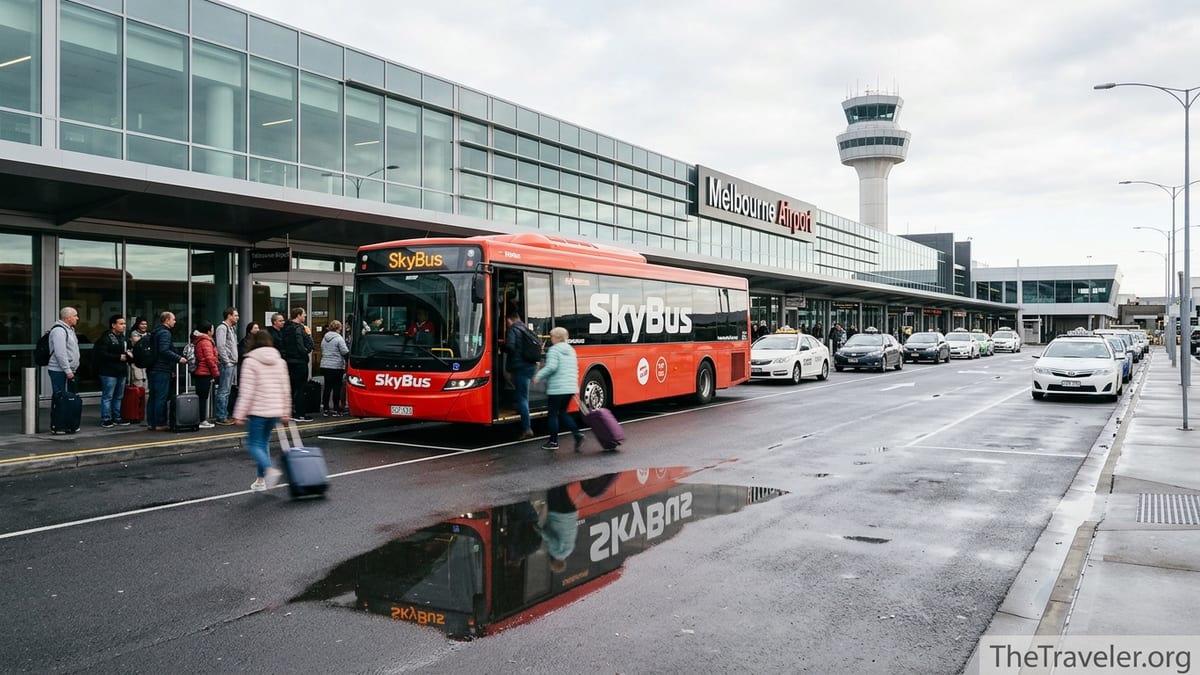
Until the train arrives, almost everyone uses road-based options to travel between Melbourne Airport and the city. The flagship public transport service is SkyBus, which runs between the airport and Southern Cross Station on the edge of the central business district. The main Melbourne City Express usually operates at high frequency through much of the day, with services typically every 10 to 15 minutes during daytime and evening periods. The coach-style buses pick up outside Terminals 1, 3 and 4, and drop off at a dedicated terminal at Southern Cross.
For a concrete example, a couple arriving on a mid‑afternoon international flight can walk directly from customs to the SkyBus stop, tap a card or buy tickets at the kiosk, and be at Southern Cross in around 30 to 45 minutes depending on traffic. From there they can connect to the free City Circle and other tram routes to reach hotels along Collins Street, Russell Street or near the sports precinct. For many visitors staying in the city, that two‑stage bus and tram combination is the default airport transfer.
Rideshare and taxis remain popular, particularly for those with luggage or traveling in groups. A family of four staying in Carlton or Fitzroy may find that booking an Uber or using a taxi rank outside the terminal costs only modestly more than four SkyBus tickets and delivers a direct door‑to‑door trip. In normal traffic, the drive to the inner north is often around 25 to 35 minutes. During the weekday afternoon peak, it can stretch beyond 45 minutes when the Tullamarine Freeway is congested, at which point the relative reliability of SkyBus using bus lanes can become more attractive.
Private shuttles and hotel transfers fill specific niches. Some regional travelers arriving at the airport for early morning flights pre‑book door‑to‑door shared shuttles that collect them from the outer suburbs before dawn. A few large hotels, particularly near the convention center or Southbank, also work with transfer companies that meet guests at designated pick‑up zones. These services are generally slower than taxis but can be cost‑effective for solo travelers on longer stays.
Using Suburban Buses and Trains as a Low‑Cost Alternative
Budget‑conscious travelers and locals often use the regular public bus network to connect Melbourne Airport with nearby train stations. Several routes operate from the airport to surrounding suburbs. The best known is typically route 901, which runs as part of an orbital SmartBus line between Melbourne Airport and the south‑eastern suburbs via Broadmeadows and other key interchanges. Riders can tap on with a standard myki card, paying the normal metropolitan fare rather than a premium airport surcharge.
One practical example is a solo backpacker landing late morning who wants to reach a hostel on Flinders Street without paying for SkyBus. They can take a myki‑enabled bus such as the 901 or 478 or 479 from the airport to a nearby train station, for instance Broadmeadows on the Craigieburn line or Essendon on the Craigieburn route via a connecting bus. From there, a suburban train runs into the city loop, stopping at Flinders Street or Melbourne Central. The total journey time might be 60 to 75 minutes, roughly double SkyBus in light traffic but at a significantly lower cost.
These bus and train combinations work particularly well for travelers heading to suburban destinations rather than the city. A university student returning from an overseas trip and living in Greensborough, for example, can ride a SmartBus to a northern interchange and then change to a suburban train that runs close to home. For them, the lack of an airport train to the CBD matters less than having a one‑ticket journey across the existing bus and rail network.
The trade‑offs are comfort and simplicity. Regular buses are not designed specifically for luggage and can be crowded during commuter peaks. Signage at airport bus bays is improving but is still less intuitive than a single airport rail station would be. Travelers choosing this route should be comfortable reading local timetables, checking real‑time apps and managing at least one transfer.
Comparing Costs, Time and Convenience
Because Melbourne has no single default rail option, the best airport transfer depends on your priorities. Time‑poor business travelers usually value speed and predictability. For someone landing at 7 am on a Monday with a meeting in the CBD at 9 am, the choice is often between SkyBus plus a short tram or taxi from Southern Cross, or a direct rideshare. SkyBus has the advantage of a dedicated service and relatively stable journey times even in heavy traffic, while a rideshare offers door‑to‑door convenience at a higher but still manageable cost.
For families and small groups, cost per person changes the equation. Four adults or parents with older children might find that the total SkyBus fare approaches or exceeds the price of a single UberXL or taxi to an inner‑city hotel. In that scenario, many choose the private vehicle to avoid wrangling children and suitcases across platforms at Southern Cross. On the other hand, solo travelers can keep costs low by combining SkyBus with free CBD trams, especially if their hotel is within the central free tram zone.
At the budget end, the suburban bus and train option remains the cheapest. The trade‑off is time and the need to handle transfers, which can be stressful after a long international flight. It suits backpackers, long‑term visitors and residents who are familiar with Melbourne’s myki system and comfortable sitting on an all‑stops train. From a policy perspective, this low‑cost option is one reason authorities have felt less pressure to rush an expensive airport train, because technically a public transport option already exists for every budget.
Accessibility is another dimension. SkyBus coaches have luggage racks and low‑floor access, making them easier for many travelers with mobility challenges than standard route buses. Taxis can usually accommodate foldable wheelchairs and mobility aids, while some specialist transfer companies offer vehicles with ramps or lifts that can be pre‑booked. A future airport rail station will need to match or exceed that level of accessibility, with step‑free access from terminal to platform and level boarding onto trains.
How Future Rail Plans Could Change Airport Transfers
When Melbourne Airport Rail eventually opens, it will reshape how both visitors and locals think about airport access. One of the biggest shifts will be psychological. Having a dedicated train stops people asking “how do I get into town” and replaces it with a simple expectation that you can follow signs to a station, tap a card and be on your way. Cities like Sydney and Brisbane have demonstrated how quickly travelers adapt when airport rail becomes a standard part of the arrival experience.
In practical terms, the Sunshine route and connection into the Metro Tunnel will paint a very different map. A medical researcher flying in for a conference at the Parkville biomedical precinct, for example, could ride the airport train directly to a new Parkville station without changing at Southern Cross or crossing busy streets. A regional traveler from Bendigo or Ballarat could change at Sunshine onto an airport service, trimming time and uncertainty compared with the current mix of regional trains and separate airport buses.
Airport hotels and park‑and‑ride businesses will also adjust. Some visitors who currently choose accommodation in the CBD purely for ease of SkyBus transfers might in future stay near intermediate stations such as Sunshine or Arden, confident they can still catch an early‑morning flight. Car parks that rely on long‑stay airport customers may see less demand if inner‑suburban residents can roll luggage onto trains instead of driving and parking for a week.
At the same time, experience from other cities suggests that premium buses and private cars will not disappear. Even with a rail line, travelers with large families, bulky sports equipment or pets often prefer door‑to‑door road travel. Airlines and tour operators may continue to run dedicated coaches for certain passenger groups. The likely outcome is a richer mix of options, with the train taking a large share of solo and business travel while buses and cars serve more specialized needs.
The Takeaway
Melbourne’s lack of an airport train is the product of decades of political hesitation, cost pressures and design disputes rather than a simple oversight. The city has chosen, for now, to lean on a mix of premium buses, suburban services and road capacity instead of committing earlier to a dedicated rail line. That choice has kept options flexible but left many visitors bemused when they step out of the terminal and see only buses and car parks.
In the short term, travelers should think in practical terms. Decide whether speed, cost or convenience matters most, then choose between SkyBus, taxis and rideshare, hotel shuttles or regular buses and trains. A first‑time visitor staying near Southern Cross Station might find SkyBus ideal. A family heading to a townhouse in Brunswick could be better served by an Uber or taxi. A student on a tight budget might willingly trade time for savings by using the myki‑based bus and train combination.
Looking ahead, the Melbourne Airport Rail Link remains on the agenda, with funding commitments and early works around Sunshine signalling that the project is more than a campaign slogan. Once built, it will close an embarrassing gap in the city’s transport network and give Melbourne the straightforward airport access that many travelers now expect. Until that day, understanding today’s options and planning your route before you land is the best way to ensure a smooth arrival or departure from this fast‑growing Australian gateway.
FAQ
Q1. Why does Melbourne still not have a direct airport train?
Melbourne lacks an airport train because governments have historically prioritized other major projects, the cost is very high, and disagreements over station design and route details have slowed decisions.
Q2. When is the Melbourne Airport Rail Link expected to open?
There is no confirmed opening date. Public discussion often refers to the early to mid‑2030s, but this depends on final funding and construction progress.
Q3. What is the fastest way to get from Melbourne Airport to the CBD right now?
In most cases the fastest public option is the SkyBus service to Southern Cross Station, especially during peak traffic, while taxis and rideshare can be quicker in lighter traffic.
Q4. Is there any cheap public transport option from the airport?
Yes. Regular myki‑based bus routes, such as SmartBus services linking the airport to suburban train stations, offer the lowest cost but take longer and involve transfers.
Q5. How long does SkyBus take between the airport and Southern Cross?
Travel time typically ranges from about 30 to 45 minutes depending on traffic, with more reliable times outside weekday peaks and during off‑peak periods.
Q6. Can I use the free tram zone once I reach the city?
Yes. If you arrive at Southern Cross by SkyBus, many central trams are free within the designated city zone, which helps keep overall transfer costs down.
Q7. Will the future airport train replace SkyBus and taxis?
No. The train is expected to take a large share of passengers but premium buses, taxis and rideshare will likely continue for door‑to‑door and special‑needs trips.
Q8. Why is the route going via Sunshine instead of a direct tunnel to the CBD?
The Sunshine route uses existing corridors, connects regional lines and is cheaper than a brand‑new tunnel straight to the city, even though it is not the most direct path.
Q9. Is Melbourne unique in lacking an airport rail line?
Several major cities introduced airport rail only recently or still rely on buses, but among large Australian cities Melbourne’s lack of a train has become particularly notable.
Q10. What should first‑time visitors do to avoid confusion on arrival?
First‑time visitors should decide their transfer option in advance, follow airport signs to the SkyBus or taxi ranks, and, if using regular buses or trains, check timetables before landing.