


For many visitors, the first real taste of Miami is not Ocean Drive or Little Havana, but the elevated Orange Line train gliding out of Miami International Airport. Used correctly, the Metrorail can get you from your gate to downtown, Brickell or Dadeland quickly and cheaply. Used badly, it can mean missed connections, unnecessary Uber rides and a lot of confusion with ticket machines. This guide walks you through the Orange Line step by step, from the Miami Intermodal Center and EASY Card basics to real-world route examples and the common mistakes first-timers make.
Get the latest updates straight to your inbox!
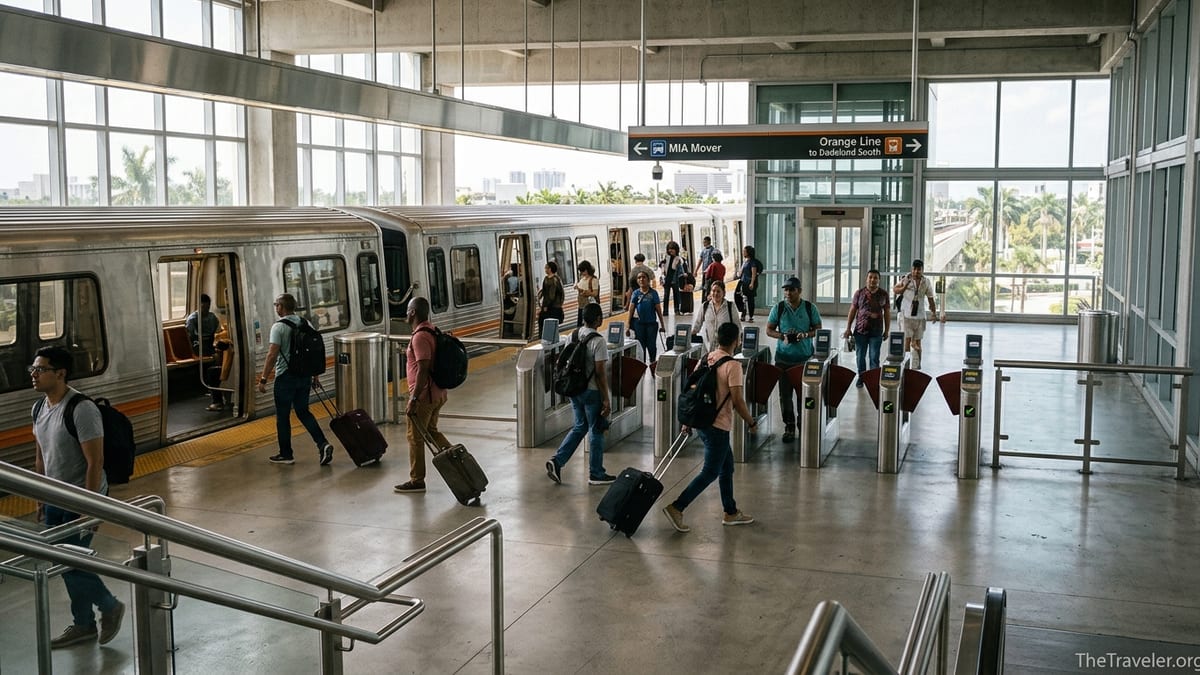
Understanding the Orange Line From Miami International Airport
Miami’s Orange Line is the backbone of rail travel from Miami International Airport into the city. It runs between the Airport station at the Miami Intermodal Center and Dadeland South along the busy south corridor shared with the Green Line. For travelers, that means a direct train connection between the airport and key stops including Civic Center, Historic Overtown, Government Center in downtown, Brickell, University, South Miami, Dadeland North and Dadeland South. In practice, the Orange Line is the train you will almost always take when leaving the airport.
Service patterns can be a little confusing because the Orange and Green Lines overlap. On weekdays, Orange Line trains usually run all the way between Miami International Airport and Dadeland South, doubling frequency on the central trunk between Dadeland South and Earlington Heights. On weekends, the Orange Line often operates only as a shuttle between the Airport and Earlington Heights, with Green Line trains continuing south to Dadeland. The result is that your exact routing can change by day and time, even though the map looks simple.
For a concrete example, imagine landing at Miami International at 4 p.m. on a Tuesday and heading to Brickell. You follow signs to the MIA Mover, reach the Airport station and board the Orange Line marked toward Dadeland South. You stay on the same train and in around 20 minutes you step off at Brickell station, directly above the financial district. On a Sunday morning, that same journey may require a quick transfer at Earlington Heights from an Orange Line shuttle to a southbound Green Line before continuing to Brickell. The trains are clearly signed, but knowing this pattern in advance avoids last‑minute panic on the platform.
Travel time from the Airport station to Government Center downtown is typically around 15 to 20 minutes once on board, and a few minutes longer to Brickell and Dadeland. Even including the short people-mover ride from the terminal, many travelers find the Orange Line significantly faster than sitting in traffic on State Road 836 during rush hour, especially on weekday afternoons.
From Terminal to Train: Miami Intermodal Center & MIA Mover
The Orange Line does not depart directly from the airport terminal. Instead, trains leave from Miami Airport Station at the Miami Intermodal Center, a large transportation hub just east of the airport. To get there, every passenger must take the free MIA Mover people mover. The MIA Mover is clearly signposted throughout the terminal. From baggage claim, you follow the purple MIA Mover signs to the third level, walk along a climate‑controlled corridor and board an automated train that shuttles continuously between the terminals and the Intermodal Center.
The ride on the MIA Mover takes about 4 to 7 minutes. As the doors open at the Intermodal Center, you step into a multi-level facility that combines the rental car center, Miami Airport Metrorail station, Tri-Rail commuter rail platforms and bays for local and intercity buses. Escalators and elevators lead you up to the Metrorail concourse where you will find ticket vending machines, fare gates and signs for the Orange Line platform. If you are picking up a rental car, this is also where you will find desks for major brands like Hertz, Avis, Enterprise, National and others, all connected to the same building.
Many first-time visitors underestimate the size of the Intermodal Center and expect a small station attached directly to the terminal. In reality, it functions more like a separate transport hub. Give yourself an extra 10 to 15 minutes from baggage claim to the actual Metrorail platform, especially if you are traveling with checked luggage or children. This extra buffer is important if you are catching a specific connection, such as a Tri-Rail train toward Fort Lauderdale or West Palm Beach, or a Brightline departure from downtown Miami.
Another point of confusion is that the Orange Line’s “Airport” station is not named after a neighborhood but after this Intermodal Center. When you see “Miami International Airport” or “Airport” on Metrorail maps, it always refers to this hub at the end of the MIA Mover, not a platform within the terminal itself. Once you understand that, reading the maps and wayfinding signs becomes much easier.
Paying Your Fare: EASY Card, EASY Ticket and Contactless
Miami-Dade Transit uses a smartcard system called EASY Card and a disposable smart ticket called EASY Ticket. These, along with contactless bank cards and mobile wallets, are the main ways to pay for the Orange Line. The base adult Metrorail fare is generally in the low single digits per ride per person, and fares can change, so check the latest prices on official Miami‑Dade Transit materials before you travel. The important point is that you cannot feed cash directly into the fare gates. You must load value or a pass onto an EASY Card or EASY Ticket, or tap a contactless bank card or mobile wallet at the reader.
At the Airport station concourse, rows of blue and silver ticket machines sell EASY Tickets and reload EASY Cards. Machines accept major credit and debit cards, and most also accept cash, though exact change makes the process smoother. For a short visit of a few days, many travelers buy a single EASY Ticket and load a few rides or a pass onto it. For longer stays, a reusable plastic EASY Card makes more sense, especially if you expect to use both Metrorail and Metrobus. The card can be purchased and topped up at any station and reused on future trips to Miami.
Transfers between Metrorail and Metrobus are usually cheapest when you pay with an EASY Card, EASY Ticket or contactless rather than cash. For example, a traveler landing at Miami International and staying in Coconut Grove might ride the Orange Line or Green Line to Douglas Road or Coconut Grove station, then transfer to a local bus for the final mile. Using an EASY Card, the total cost of train plus bus is typically lower than paying separately with cash, and some transfers within a set time window may be free or discounted. Specific transfer rules change periodically, so verify the current policy shortly before your trip.
In practice, many visitors now skip the ticket machines entirely and tap in with a contactless Visa, Mastercard or American Express or a mobile wallet such as Apple Pay or Google Pay. This can be the most convenient option if you are used to similar systems in places like London or New York. You simply tap your card or phone on the reader at the fare gate, wait for the green light, and walk through. Just make sure everyone in your group uses a separate card or device. If two people try to tap the same card at the same gate in quick succession, the system will usually register only one valid fare.
Key Stops: Government Center, Brickell and Dadeland
Government Center is the main downtown hub and often the first stop visitors use after leaving the airport. The station sits in the heart of downtown, close to county offices, the main courthouse and a growing cluster of hotels and apartment towers. From Government Center, you can transfer for free to the elevated Metromover system that circles downtown and Brickell. Many travelers staying at hotels near Bayside Marketplace or the arena area ride the Orange Line to Government Center, then switch to the Metromover’s Inner Loop or Omni Loop for a short hop to stations like College Bayside.
Brickell, one stop south of Government Center, is Miami’s financial district and a major destination in its own right. The Brickell Metrorail station drops you above a dense mix of office towers, residential high‑rises, bars and restaurants. Brickell City Centre, a large shopping and dining complex, is a short walk from the station via shaded pedestrian bridges and sidewalks. Metromover’s Brickell Loop also connects here, providing free circulation around the neighborhood. This makes the Orange Line a natural choice for business travelers who need to go straight from the airport to a meeting in one of the glass towers lining Brickell Avenue.
Further south, Dadeland North and Dadeland South serve one of Miami’s biggest suburban retail and residential areas. Dadeland Mall, anchored by brands like Macy’s and Nordstrom‑type department stores, sits next to Dadeland South and is a common destination for shopping or meeting friends. Many locals who live in the southern suburbs drive to Dadeland South’s park‑and‑ride garages and ride the Orange or Green Line north into downtown or Brickell, avoiding heavy traffic on US‑1. For visitors staying in budget hotels along US‑1 south of the city, these two stations can be useful access points to the rail network.
Realistically, most tourists at Miami International are heading to one of three places: downtown, Brickell or South Beach. While the Orange Line does not go to Miami Beach itself, it does get you most of the way there. A typical budget‑minded traveler might take the Orange Line from the airport to Government Center, then connect to a local bus toward South Beach along the MacArthur or Julia Tuttle Causeway. Even factoring in the bus transfer, the combined cost is usually far less than a taxi or ride‑hail, and travel time can be competitive outside of peak congestion.
Service Hours, Frequency and Timing Tips
The Orange Line generally operates from early morning to around midnight, with slightly later trips on Friday and Saturday nights. Timetables can vary by season and are occasionally adjusted for maintenance projects or major events, so it is wise to confirm the latest schedule on Miami‑Dade Transit’s official channels before you travel. As a rule of thumb, service starts around 5 a.m. and the last trains leave terminal stations just before or around midnight, with some late‑night extensions on weekends.
On the busy central segment between Dadeland South and Earlington Heights, combined Orange and Green Line service can reach train intervals of roughly 5 minutes during peak weekday rush hours. At off‑peak times, headways typically stretch to around 10 to 15 minutes. On weekends, when the Orange Line often operates as a shuttle between the Airport and Earlington Heights, trains on that shuttle segment usually run about every 15 minutes. That means even if you just miss a train at the airport, your wait is unlikely to exceed a quarter of an hour under normal conditions.
For airport travelers, the key is to factor in not only the headway but also walking and transfer time. A visitor landing at 8 p.m. might clear immigration and baggage in 30 to 60 minutes, then spend another 10 to 15 minutes walking to and riding the MIA Mover. If a train arrives just as they reach the platform, they may be downtown by around 9 p.m. If they miss one by seconds, they might be closer to 9:15 p.m. This is still far cheaper than a taxi, but if you are catching a late‑evening Brightline train from downtown Miami or a cruise departure the next morning, allowing a time cushion is essential.
It is also worth remembering that like any urban rail system, Metrorail can experience delays due to track work, equipment problems or weather. Locals often check the real‑time train tracker on the official website or app to see when the next train is due. As a visitor, you can do the same on your phone while waiting at the Airport station. If you see a gap longer than 15 minutes or a notice of suspended service due to maintenance, it may be worth considering alternatives such as a rideshare, taxi or one of the airport express bus routes if they better match your destination.
Common Traveler Mistakes and How to Avoid Them
One of the most frequent mistakes at Miami International is assuming that trains leave directly from inside the terminal. Visitors follow “Ground Transportation” signs looking for a platform and miss the separate MIA Mover route to the Intermodal Center. This can lead to wandering around the arrivals level with heavy suitcases, especially in the older sections of the terminal. To avoid this, as soon as you have your bags, look specifically for the purple “MIA Mover” signage and head up to level 3. If you are unsure, ask any airport employee for directions to the MIA Mover, not to “the train.”
Another common error involves buying the wrong type of fare or not realizing the gates do not accept cash. Some travelers arrive with only low‑denomination bills and try to feed them directly into the turnstiles, only to discover they must first use a machine to load value onto an EASY Ticket or Card. In busy periods, a small line can form at the ticket machines while inexperienced users work through the onscreen menus. If you know you will be using Metrorail, it is sensible to have a major credit or debit card ready, or to download the official transit app in advance if you plan to use mobile tickets and passes where available.
Weekend service patterns are also a source of confusion. A first‑time visitor might read that the Orange Line runs to Dadeland South and assume that is true at all times. On a Saturday, they board an Orange Line train at the airport, only to find it terminates at Earlington Heights and they must transfer to a Green Line train to continue south. The change is simple once you understand it, but if you are not expecting a transfer, you can feel disoriented, especially if you are traveling at night or with family. Checking the day‑specific service notes for the Orange Line before your trip will prevent surprises.
Finally, some travelers misjudge how the Orange Line connects to other modes. For example, someone catching Brightline to Fort Lauderdale might assume there is a direct train from the airport to the private rail station. In reality, the cheapest combined option is usually to take the Orange Line from the Airport to Government Center or Historic Overtown / Lyric Theater, then walk or take a short rideshare to the Brightline terminal nearby. In contrast, someone staying in Wynwood might mistakenly ride all the way to Dadeland, thinking it is closer to Miami Beach, when in fact transferring to a bus or rideshare from downtown would have been smarter. Planning your route with an online map in advance can save both time and money.
Real-World Itineraries: From MIA to Popular Neighborhoods
Consider a solo traveler arriving on a mid‑afternoon flight from New York and staying at a boutique hotel near Brickell City Centre. After collecting a carry‑on bag only, they follow signs to the MIA Mover, ride to the Miami Intermodal Center and buy an EASY Ticket at the first machine using a credit card. They tap the ticket at the gate, descend to the platform and board the next Orange Line train marked “Dadeland South.” About 20 minutes later, they exit at Brickell station, walk 5 to 10 minutes along covered sidewalks and arrive at their hotel. Total transit cost is around a couple of dollars, compared with a taxi that might run ten times that amount in moderate traffic.
Now picture a family of four from Europe staying in South Beach. They are carrying two large suitcases and two backpacks. Knowing the Orange Line does not go directly to the beach, they plan a mixed journey. After the MIA Mover ride and an EASY Card purchase loaded with enough value for the whole stay, they ride the Orange Line to Government Center. From there, they walk up one level, find the bus bays and board a bus toward South Beach that crosses the causeway. The total travel time door to door might be around an hour, but the savings over two taxis or a pre‑booked shuttle are substantial, especially during the busy winter season when road traffic is heavy.
A different example involves a student heading to the University of Miami in Coral Gables. With a rolling suitcase and a backpack, they board the Orange Line at the Airport and ride south, watching the station indicators for “University.” Once off the train, they either walk or take a short campus shuttle or rideshare to their dorm. During the semester, students familiar with the route often time their arrival so they catch the Orange Line just before a class, turning what would be a long bus ride into a predictable 10 to 15 minute train journey between South Miami or Dadeland and campus.
There are also cases where the Orange Line is useful in combination with intercity services. A traveler arriving on Brightline from Orlando at MiamiCentral station can walk to the adjacent Metrorail station, tap an EASY Card or contactless card, and ride the Orange Line northbound directly to Miami International Airport. With the train running frequently during the day, the transfer from high‑speed rail to the airport can be handled in under an hour, including the MIA Mover leg. This is often more reliable in peak traffic than taking a car across downtown and along the highway.
The Takeaway
The Orange Line from Miami International Airport is one of the most efficient ways to reach downtown, Brickell and the southern corridor toward Dadeland. It is inexpensive, relatively quick and well integrated with other parts of Miami’s transit network, including the free Metromover and a wide array of bus routes. The key to getting the most out of it is understanding how the Miami Intermodal Center works, how to use EASY Card, EASY Ticket or contactless payment, and how service patterns can shift on weekends or during maintenance.
By allowing extra time for the MIA Mover transfer, familiarizing yourself with major stops like Government Center, Brickell and Dadeland, and checking the latest schedule before you travel, you can avoid the frustration that leads many first‑time visitors to give up and call a rideshare. With a bit of planning, the Orange Line becomes not just an airport shuttle but a practical everyday tool for exploring Miami’s neighborhoods, from downtown’s towers to the tree‑lined streets of Coral Gables.
FAQ
Q1. How much does it cost to ride the Orange Line from Miami Airport to downtown?
The base adult fare for a one‑way Metrorail trip is typically in the low single digits per person, but exact prices can change, so check the latest fare information from Miami‑Dade Transit before you travel.
Q2. How long does the Orange Line take from the Airport to Government Center?
Once you are on board at Miami Airport Station, the ride to Government Center in downtown usually takes about 15 to 20 minutes, not including the 10 to 15 minutes needed for the MIA Mover and station access.
Q3. Do I need an EASY Card to use the Orange Line, or can I just tap my bank card?
You can use an EASY Card or disposable EASY Ticket, but many visitors simply tap a contactless bank card or mobile wallet at the fare gate. Each rider must use a separate card or device.
Q4. Does the Orange Line run directly to South Beach?
No. The Orange Line takes you from Miami International Airport to downtown, Brickell and points south toward Dadeland. To reach South Beach, you transfer to a bus or rideshare from downtown or another convenient stop.
Q5. Is the Orange Line safe to use with luggage and children?
Most travelers find the Orange Line reasonably safe during the day and early evening. As in any big city, stay aware of your surroundings, keep valuables close, and avoid displaying expensive items unnecessarily.
Q6. How often do Orange Line trains run from the airport?
During daytime hours, trains usually arrive about every 10 to 15 minutes, with more frequent combined service on the shared corridor toward Dadeland. Late at night and early morning, intervals can be longer, so check real‑time information when possible.
Q7. What is the difference between the Orange Line and the Green Line?
The Orange Line connects Miami International Airport to downtown, Brickell and Dadeland, while the Green Line mainly serves northern neighborhoods and suburbs. Both share tracks between Earlington Heights and Dadeland, which is why you may use either train on that segment.
Q8. Do I have to pay separately for the MIA Mover between the terminals and the Intermodal Center?
No. The MIA Mover is free. You only start paying once you pass through the Metrorail fare gates at Miami Airport Station.
Q9. Can I transfer from the Orange Line to a bus without paying a second full fare?
When you pay with an EASY Card, EASY Ticket or contactless card, many transfers between Metrorail and Metrobus are discounted or included within a set time window. Specific rules and prices can change, so confirm details before traveling.
Q10. What should I do if the ticket machines at the Airport station are not working?
If a machine is out of service, look for another one nearby or use a contactless bank card or mobile wallet at the gates. If all machines appear to be down, ask a station staff member or security officer for guidance before boarding.