

More news on this day
Thousands of travellers have been left stranded across the Middle East as a cascade of airspace restrictions and security concerns triggers at least 558 flight cancellations and scores of delays involving Gulf Air, Saudia, Emirates, FlyDubai, IndiGo, EgyptAir and other major carriers, disrupting key routes through Bahrain, Saudi Arabia, the United Arab Emirates, Egypt, Qatar and beyond.
Get the latest news straight to your inbox!
Escalating Conflict Pushes Gulf Aviation Networks to Breaking Point
Published coverage indicates that the latest wave of cancellations is closely linked to heightened regional conflict involving Iran, Israel, the United States and several Gulf states, which has led to partial or full airspace closures across parts of the Middle East and North Africa. Aviation data cited in regional newspapers and industry briefings shows thousands of flights have been scrubbed or rerouted in recent days, with a significant share concentrated in and around key Gulf hubs.
Airspace restrictions in countries including the United Arab Emirates, Qatar, Kuwait and Bahrain have forced airlines to ground or divert services on some of their busiest long-haul corridors between Europe, Asia and Africa. Reports from flight-tracking platforms and aviation analytics firms describe an abrupt collapse in traffic over traditional Gulf routes, followed by a patchy and uneven attempt at recovery as authorities gradually relax some closures and allow limited operations to resume.
Travel industry analyses suggest that the cumulative disruption now extends well beyond the Gulf itself, affecting schedules across South Asia, Europe and even North America as airlines attempt to redesign routings to avoid conflict zones. The 558 cancellations directly tied to the current wave of restrictions are part of a broader pattern of several thousand scrapped flights since the start of March, according to publicly available operational summaries.
Major Carriers Slash Schedules as Hubs Grind to a Halt
Among Gulf-based airlines, Emirates and FlyDubai are reported to have cancelled or suspended large parts of their schedules into and out of Dubai International and Al Maktoum International after airspace closures around the UAE sharply curtailed movements. At several points during the disruption, media reports and airline updates indicated that close to all scheduled passenger flights from Dubai were cancelled, leaving only a limited number of repatriation, cargo and special services operating.
In Bahrain, the situation has been even more acute for Gulf Air. A detailed March update on the airline’s status states that its operations remain temporarily suspended as Bahrain’s airspace closure continues, effectively grounding the carrier and forcing the cancellation of its regional and long-haul network. This has severed a key transit link for passengers traveling between the Indian subcontinent, the Levant, and Europe via Manama.
National and regional operators from outside the Gulf have also been hit. Saudia has faced severe schedule disruption on key routes linking Jeddah and Riyadh with Dubai, Doha and other Gulf cities, while EgyptAir has publicly confirmed suspensions on multiple Middle Eastern routes despite Egyptian airspace itself remaining open. Low-cost and regional players such as FlyDubai and Air Arabia are reported to have trimmed services drastically, especially to destinations affected by airspace closures.
Indian and International Travellers Face Cascading Disruptions
The crisis has been particularly disruptive for travellers from India and other South Asian countries who rely on Gulf hubs as transit points to Europe, North America and Africa. Indian carriers including IndiGo have temporarily suspended or sharply reduced flights to the UAE, Qatar, Saudi Arabia and Israel, according to Indian and regional media coverage, in response to both airspace restrictions and insurance and safety considerations.
Publicly available accounts from passengers and airport observers describe large crowds of stranded travellers at major Indian gateways such as Mumbai, Delhi, Hyderabad and Bengaluru, where queues formed at airline desks as travellers attempted to rebook or secure refunds. With key Gulf connections cut or operating only sporadically, some long-haul services have been rerouted via southern corridors across Oman, Saudi Arabia and Egypt, increasing flight times and reducing available seats.
International airlines from Europe, North America and Asia have also reshaped their schedules to avoid the affected region. Travel advisories and timetable changes from global carriers show suspensions of direct services to certain Gulf airports and widespread rerouting of Europe–Asia flights, shifting what is normally some of the world’s busiest overflight territory to more southerly or northerly tracks.
Airports Struggle With Backlogs and Stranded Passengers
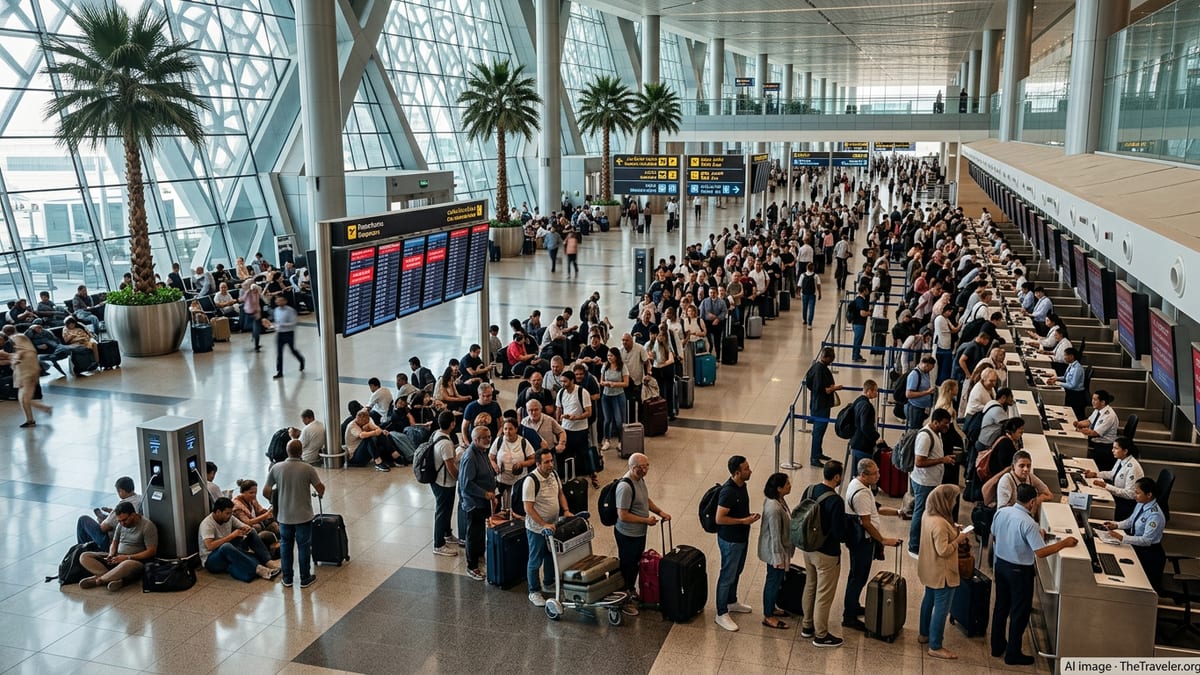
Airports across the Gulf have struggled to cope with the sudden stop in operations followed by a slow and uneven restart. Reports from Dubai, Abu Dhabi and Doha describe departure boards dominated by cancellations and indefinite delays at the height of the crisis, as terminal halls filled with passengers awaiting news of onward travel or emergency accommodation.
As limited services have resumed at some hubs, a sizeable backlog of stranded travellers has complicated efforts to return to normal operations. Travel forums, social media posts and local press reports chronicle accounts of passengers sleeping in terminal areas, queuing for many hours to reach customer service counters and competing for scarce seats on the first available flights once airlines restart certain routes.
Operational updates from several airlines indicate that priority is being given to rebooking passengers whose original flights were cancelled, while new ticket sales on some routes remain restricted or paused. However, the sheer volume of affected travellers across multiple countries means that the process of clearing backlogs could extend over several days or longer, particularly on high-demand routes between the Gulf, India and major European capitals.
Uncertain Timeline for Full Recovery Across the Region
Industry observers note that while some airspace restrictions have begun to ease and selected services are returning, the overall outlook for full restoration of normal schedules across the Middle East remains uncertain. Security conditions continue to evolve, and aviation authorities are reassessing risk on a rolling basis, leading airlines to adjust or extend cancellations at short notice.
Analysts tracking airline capacity caution that even when airspace fully reopens, carriers may require additional time to reposition aircraft and crews, rebuild schedules and process the backlog of disrupted passengers. In the interim, travellers are being urged by travel agencies and consumer advisories to monitor airline notifications closely, remain flexible on routing and dates, and consider alternative departure points such as airports in Saudi Arabia or Oman that retain more stable operations.
With the Gulf acting as a critical crossroads for global travel, the current disruption underlines the vulnerability of international aviation networks to regional conflict and airspace closures. The struggle by Gulf Air, Saudia, Emirates, FlyDubai, IndiGo, EgyptAir and other carriers to manage hundreds of cancellations and delays in a matter of days highlights how quickly a local security crisis can ripple through global mobility, leaving thousands of travellers suddenly and unexpectedly grounded.