


More news on this day
After one of the most extensive airspace shutdowns in modern aviation history, Gulf and Levant states are cautiously reopening critical corridors, setting the stage for a gradual rebuilding of Middle East travel networks spanning Egypt, Saudi Arabia, Jordan, Kuwait, Oman, Iraq, Bahrain, Qatar, the UAE and beyond.
Get the latest news straight to your inbox!
From Sudden Closures to Managed Reopenings
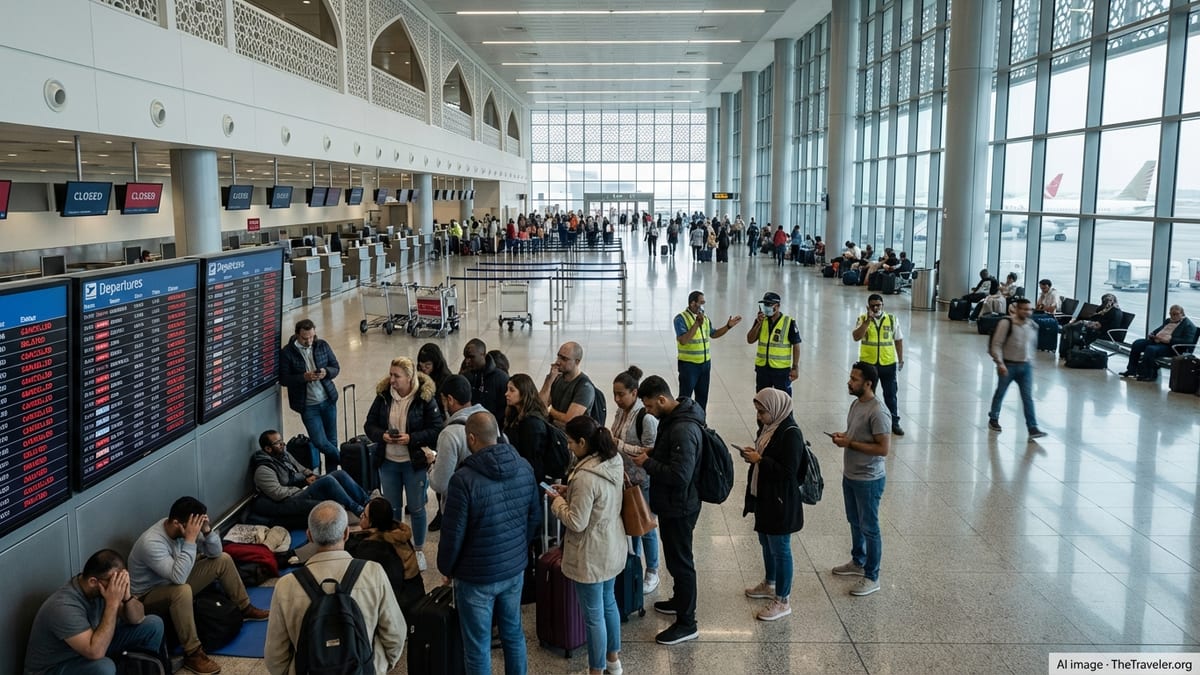
The latest regional crisis, culminating in the 2026 Iran war, triggered sweeping airspace closures across Bahrain, Iraq, Israel, Kuwait, Qatar, Syria and the United Arab Emirates, as well as heavily constrained use of neighboring skies. Publicly available analyses describe thousands of daily flight cancellations and widespread route suspensions that rippled across global networks and stranded large numbers of travelers.
Flights operated by major Gulf carriers such as Emirates, Saudia, Etihad, flydubai and Gulf Air were among those most heavily affected. Network planners were forced to suspend or reroute services across key flows between Europe, Asia and Africa as access to traditional Gulf corridors disappeared almost overnight.
As the intensity of direct hostilities eased, national aviation authorities began to lift blanket bans and move toward regulated reopenings. Iraq, for example, reopened its airspace to international traffic in 2025 after earlier closures linked to missile exchanges, restoring its role as a strategic bridge between East and West. That move foreshadowed a broader regional shift from total shutdowns toward controlled operations under tighter risk management.
By mid and late 2025, advisories from freight and logistics providers indicated that core Gulf airspace, including Qatar, the UAE, Bahrain, Kuwait and Oman, had resumed operations, although overflight across neighboring conflict zones remained restricted. Egypt and Jordan kept their airspace open, emerging as vital southern anchors for detour routes when large sections of Gulf and Levant skies were unavailable.
EASA Advisories Highlight Ongoing Risk Environment
Even as regional governments reopened FIRs and airports, international regulators have continued to flag elevated risk levels. In April 2026, the European Union Aviation Safety Agency extended its conflict zone advisory telling European air operators to avoid most Middle East and Gulf airspace, including Bahrain, Iran, Iraq, Israel, Jordan, Kuwait, Lebanon, Oman, Qatar, the UAE and parts of Saudi Arabia, except under tightly managed conditions.
The updated bulletin effectively codified a reality already faced by network planners. Airlines may technically be able to transit certain corridors, but they must weigh exposure to missile, drone and anti aircraft activity, the potential for short notice closures, war risk insurance costs and crew safety considerations before restoring previous schedules.
Specialist operational briefings describe a patchwork region where some FIRs are fully closed, others operate with altitude or routing constraints, and several, including parts of Saudi Arabia and Oman, serve as controlled conduits for north south and east west traffic. Operators are urged to plan on the assumption that the region remains restricted but manageable, with the main challenges driven by capacity bottlenecks, rerouting and regulatory unpredictability.
For travelers, this means that while bookings between major hubs are again possible, itineraries may route further south via Egypt and Saudi Arabia or farther north through the Caucasus and Central Asia, often with increased flight times and higher fares compared with pre conflict patterns.
Gulf Carriers Rebuild Networks Under New Constraints
As airspace gradually reopens, leading Middle East airlines are working to rebuild their networks while retaining flexibility to respond to sudden changes. Publicly available schedules show that Emirates and Etihad are operating reduced, but steadily expanding, long haul programs, prioritizing trunk routes and high demand markets while maintaining waivers and flexible rebooking options for affected passengers.
Flydubai and other regional carriers have resumed selective services to previously suspended destinations where airspace access and airport operations are judged sufficiently stable. Earlier in the crisis, these same airlines had halted flights to Iran, Iraq, Israel and Syria, and in some cases temporarily restricted operations to neighboring states such as Jordan and Lebanon to daylight hours only. The pattern now is one of calibrated returns, often with lower frequencies and contingency routings.
Saudia and Gulf Air, along with Kuwait Airways, Oman Air and other national carriers, are following similar strategies. Reports from regional media and aviation consultancies indicate that these airlines are restoring flights in phases, focusing first on intra Gulf links and high volume routes to Europe and South Asia that can be supported by available corridors through Saudi, Egyptian and Omani airspace.
Because regulatory advisories from bodies such as EASA continue to discourage certain overflights, Gulf carriers are also repositioning aircraft and optimizing bank structures at their hubs to match the new geography of permissible routes. That includes greater reliance on southern detours around the Red Sea and Arabian Sea when direct crossings of the central Gulf or northern Middle East are not viable.
Egypt, Saudi Arabia, Jordan and Oman Anchor Alternative Corridors
Throughout the period of heightened tension, Egypt, Saudi Arabia, Jordan and Oman have played outsized roles in keeping at least some east west air connectivity intact. Operational bulletins aimed at commercial pilots and dispatchers describe two enduring patterns for long haul traffic avoiding the most volatile airspace blocks: a northern arc via the Caucasus and Afghanistan, and a southern arc running from the eastern Mediterranean across Egypt, Saudi Arabia and Oman toward the Indian Ocean.
Egyptian and Saudi skies, in particular, have served as high capacity conduits for aircraft that would normally cross Iraq, Iran or the central Gulf. At the same time, Jordan and Oman have functioned as crucial junctions, allowing airlines to stitch together modified routings between Europe, the Gulf and South Asia while steering clear of active conflict zones and GPS interference hotspots.
As Gulf airspace reopens in stages, these states are transitioning from emergency alternatives to integral components of a rebalanced regional network. Their ability to provide reliable overflight and airport infrastructure, even while neighboring airspace remains constrained, has strengthened their standing in aviation planning and could influence future hub development and alliance strategies.
For hub carriers in Dubai, Abu Dhabi, Doha, Jeddah, Riyadh and Manama, access to predictable corridors through Egypt, Saudi Arabia, Jordan and Oman will remain central to any durable recovery in transfer traffic between Europe, Asia and Africa.
Iraq, Qatar, UAE and Bahrain Signal a Managed Return
Among the states that faced full or near full closures, Iraq provides an early example of cautious reopening. After a 2025 shutdown linked to cross border missile activity, Baghdad announced the resumption of international overflights on the basis of enhanced security and air traffic control capability, explicitly positioning the country as a strategic corridor between East and West. The reopening reduced flight times and fuel burn for some operators that had been forced into lengthy detours.
Qatar, the UAE and Bahrain have followed similar arcs, moving from abrupt suspensions during the peak of the 2025 and 2026 escalations to corridor based operations subject to stringent risk assessments. Industry circulars and crisis advisory notes from early 2026 describe periods when these states maintained heavily restricted but technically open airspace, allowing limited traffic under defined conditions while keeping options to tighten or relax controls at short notice.
Most recently, humanitarian and logistics coordination documents from April 2026 have pointed to signs of incremental reopening in Bahrain, alongside resumed but still closely managed operations in the UAE and Qatar. At the same time, they note that certain FIRs, including Iran and Kuwait, remain closed, underscoring that the regional recovery is uneven and highly contingent on security developments.
For passengers flying on Emirates, Saudia, Etihad, flydubai, Gulf Air and neighboring carriers, the result is a Middle East travel landscape that is more complex and dynamic than before the conflicts. Airspace is no longer assumed to be permanently available, and schedules can reflect rapid regulatory shifts. Yet the direction of travel is clear: states across the region are working, often in coordination with international safety guidance, to reopen skies and restore connectivity while attempting to insulate civil aviation from recurring geopolitical shocks.