

More news on this day
Thousands of travellers have been stranded across the Middle East after a fresh wave of airspace restrictions and security concerns triggered hundreds of flight cancellations and rolling delays across Bahrain, Saudi Arabia, the United Arab Emirates, Egypt, Qatar and neighbouring states, disrupting major routes for Gulf Air, Saudia, Emirates, FlyDubai, IndiGo, EgyptAir and other carriers.
Get the latest news straight to your inbox!
Regional Airspace Closures Disrupt Core Gulf Corridors
Publicly available aviation and travel-advisory updates indicate that large sections of Middle East airspace, including parts of Bahrain, Qatar and the United Arab Emirates, remain subject to full or partial closures, forcing airlines to cancel or reroute services on short notice. The measures follow a period of heightened regional tensions that has sharply reduced safe routing options over key Gulf transit corridors.
Analysis of airline schedules and airport operations reports points to at least 558 cancellations and a much larger number of delays across regional and long haul routes over recent days, as carriers attempt to navigate evolving restrictions. Major hubs such as Dubai, Abu Dhabi and Doha, which normally anchor global connections between Europe, Asia, Africa and Australasia, have seen sharply reduced movements and complex diversion patterns.
Industry briefings describe the disruption as a rolling operational crisis rather than a short single day event. Flight status boards across the region show repeated waves of cancellations, with some routes briefly resuming before being suspended again as new airspace advisories are issued or extended.
Network-wide, the result has been a patchwork of suspended, truncated and heavily delayed services that has rippled far beyond the Middle East, affecting itineraries across Europe, North America, South Asia and Oceania that typically rely on Gulf hubs for onward connections.
Gulf Air, Emirates, Saudia and Others Forced to Ground or Reroute
According to airline notices and corporate travel advisories, Gulf Air, Saudia, Emirates, FlyDubai, IndiGo and EgyptAir are among the operators most exposed to the current wave of cancellations. Gulf Air has been particularly affected where Bahrain’s airspace and its main hub remain constrained, severely limiting the carrier’s ability to operate its usual regional network.
Emirates and FlyDubai, both highly dependent on Dubai as a central transfer point, have published reduced schedules and route adjustments, with some flights suspended outright and others operating with extended block times as they detour around restricted zones. These changes have added congestion to alternative routings and stretched aircraft and crew resources, increasing the likelihood of rolling delays even on flights that remain scheduled.
Saudi Arabia’s flag carrier Saudia has also faced significant operational headwinds, with restrictions affecting services to and from key Gulf and Levant destinations. EgyptAir has cut or adjusted selected routes into the region while maintaining core operations over Egyptian airspace, in some cases absorbing passengers who are being rebooked away from suspended Gulf connections.
Low cost and regional operators are similarly affected. IndiGo and other South Asian carriers have scaled back flights into Gulf destinations, particularly services to the UAE, Saudi Arabia and Qatar, citing uncertainty over routing and schedule reliability. For many travellers from India and other South Asian countries, these disruptions have severed a primary air bridge to jobs and families in the Gulf.
Passengers Face Long Queues, Unexpected Stopovers and Limited Options
Travellers transiting the affected hubs have reported extensive queues at rebooking desks, overnight stays in terminal seating and difficulty securing updated information on departure times. With many flights cancelled outright and others heavily oversold following consolidations, same day alternatives have often been unavailable, even for those prepared to route via secondary or more distant hubs.
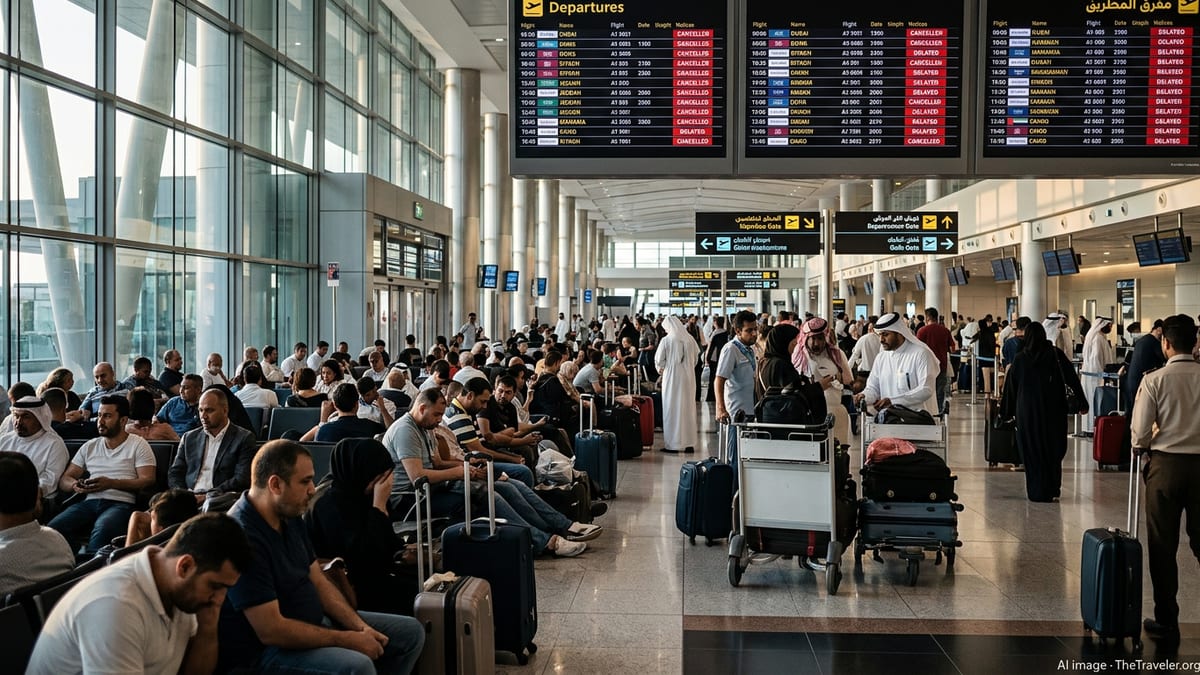
Publicly shared airport and social media images from Dubai, Doha, Riyadh and Bahrain show crowded departure halls and improvised waiting areas as passengers await news of replacement flights. In some cases, travellers have been advised to remain away from the airport unless specifically instructed by their airline, reflecting limited capacity to process additional rebookings on site.
Regional travel advisories note that some carriers are arranging indirect routings via less affected airports in Oman, Egypt and parts of southern Europe to move stranded passengers, but seats on these options remain scarce and often involve extended layovers. For travellers on complex multi leg tickets, missed connections have created additional challenges around ticket revalidation, baggage handling and immigration formalities.
Consumer advocates tracking the situation emphasise that rebooking and refund policies vary by airline and jurisdiction, and that passengers may need to document cancellations carefully to claim entitlements once immediate travel needs are resolved. Many airlines are prioritising travellers already in transit or stranded away from home over those with future bookings.
Major Hubs in Bahrain, Saudi Arabia, the UAE, Egypt and Qatar Under Strain
Operational data and airport bulletins show that major hubs across Bahrain, Saudi Arabia, the UAE, Egypt and Qatar remain under acute strain as the disruptions continue. Bahrain International Airport has experienced an extended reduction in activity in line with restrictions on the surrounding airspace, greatly limiting Bahrain’s role as a transfer point across the Gulf.
Dubai International and Abu Dhabi International, normally among the world’s busiest international gateways, are managing significantly reduced and irregular schedules, with some terminals operating at lower capacity while airlines concentrate resources on a subset of core routes. This has created uneven passenger flows, with some periods of intense crowding followed by lulls as batches of delayed flights depart.
In Qatar, Doha’s Hamad International Airport has confronted similar pressures as airlines adjust to changing guidance on overflights and inbound services. At the same time, Cairo and other Egyptian airports have become important diversion points, handling additional traffic where Egyptian airspace remains comparatively less restricted and can serve as a staging ground for rerouted long haul services.
The cumulative effect of these operational shifts has been to redraw, at least temporarily, the map of long haul connections across the broader Middle East and North Africa region. Airlines are dynamically rebalancing capacity between hubs, testing new routings and, in some cases, deploying larger aircraft on the limited number of corridors that remain reliably open.
What Travellers Can Expect in the Coming Days
Flight operations specialists and travel management firms monitoring the situation suggest that volatility is likely to persist in the near term, with further cancellations and schedule adjustments expected as security assessments and airspace notices are updated. Even if restrictions begin to ease, the backlog of stranded passengers and displaced aircraft is likely to take days, and potentially longer, to clear.
Public guidance from airlines and airports across the region consistently advises travellers to check flight status repeatedly in the 24 hours before departure and to avoid travelling to the airport until a specific flight is confirmed as operating. Same day rebooking at the terminal is expected to remain challenging while capacity is constrained and many flights depart fully booked.
Travel analysts note that ripple effects are likely to continue across global networks that depend on Gulf connections, including services linking Europe and North America to South and Southeast Asia, as well as routes between Africa and Asia. Some carriers are exploring more southerly or northerly routings that bypass the most affected airspace, but these paths typically add time and cost, limiting their widespread adoption.
For now, the picture across the Middle East remains highly dynamic. With at least 558 flights already cancelled across the region and many more delayed, travellers are being urged by public advisories and airline updates to prepare for extended journey times, flexible itineraries and a continued risk of last minute changes as the situation evolves.