


More news on this day
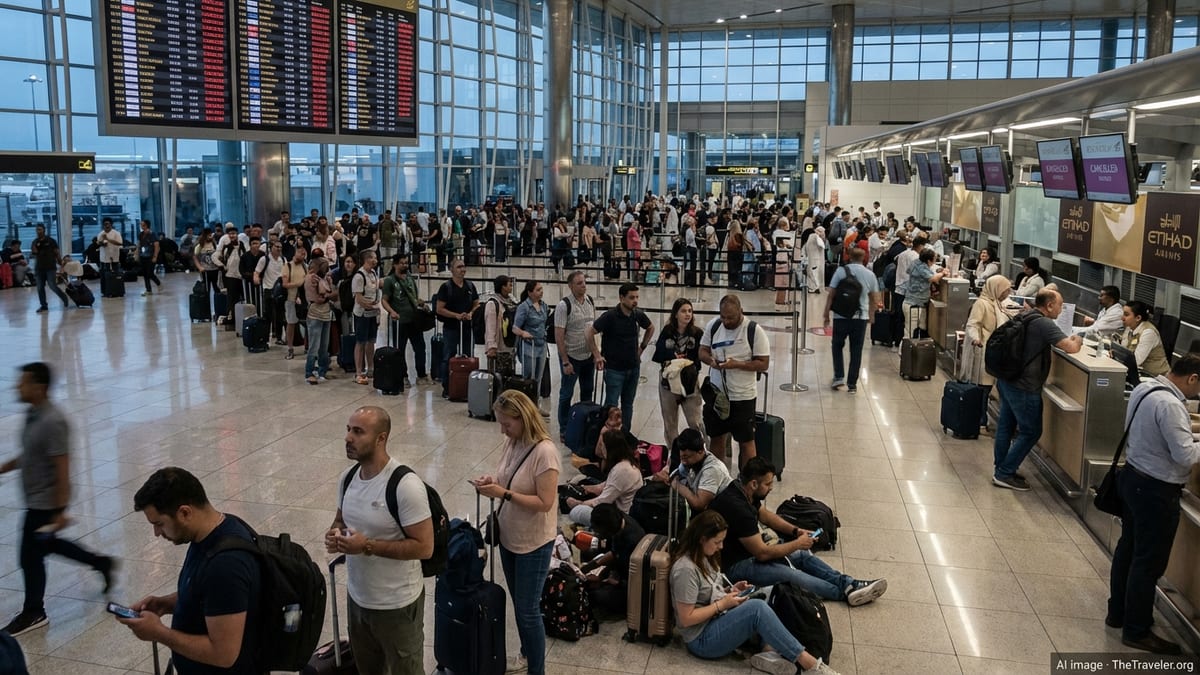
Air travel across the Middle East has been hit by a fresh wave of disruption, with regional airports collectively recording 1,261 delayed flights and 59 cancellations in a single day, highlighting the ongoing fragility of global routes that rely on Gulf and Levant hubs.
Get the latest news straight to your inbox!
Fresh Data Underscore Persistent Strain on Middle East Hubs
Tracking dashboards used by consumer-facing claims platforms and aviation data firms indicate that the latest tally of 1,261 delays and 59 cancellations emerged within a 24-hour window at airports across the Middle East, cutting across domestic, regional and long-haul services. Publicly available figures show that disruption is concentrated at major connection points such as Dubai, Abu Dhabi, Doha, Riyadh and Jeddah, but secondary hubs in the Levant and North Africa are also feeling the impact as aircraft and crews fall out of position.
Recent coverage of operations in the Gulf notes that single-airport disruption can reach similar orders of magnitude. One report on Dubai International, for example, cited 611 delays and 66 cancellations in a single day, illustrating how an already stretched network can tip quickly into widespread imbalance when schedules are pressured. The new regional snapshot of 1,261 delays and 59 cancellations reflects that volatility at a multi-airport scale, turning what might appear a localized problem into a cross-border challenge.
Analytical summaries from airspace risk specialists add further context, pointing to a pattern of intermittent closures and route restrictions above Iran, Iraq and neighboring states since late February 2026. These changes have periodically forced carriers to abandon preferred corridors and lengthen routings, adding flying time, fuel burn and operational complexity. The result is a system in which even small timetable changes at key hubs can propagate rapidly into measurable disruption across the region.
Industry-focused bulletins also highlight that, since the start of the year, total traffic to, from and within the Middle East has dropped sharply compared with pre-crisis baselines. One advisory firm estimated that overall flight volumes fell by close to 60 percent at certain points in March as airspace closures peaked, and while some services have since been restored, delay and cancellation rates remain elevated whenever restrictions tighten or weather and staffing constraints coincide.
Airspace Restrictions and Conflict Ripple Through Flight Schedules
Publicly available information from flight-rights organizations links recent spikes in disruption to ongoing airspace restrictions associated with the conflict involving Iran and neighboring states. One widely cited 24-hour snapshot for late July reported 222 cancellations and 960 delays across the Middle East due to war-related route restrictions, underlining how quickly operational stress can accumulate when key flight information regions are curtailed.
Risk analyses from aviation intelligence providers describe the late-February closures as among the most extensive in the region’s history, with multiple flight information regions over Iran, Iraq, Kuwait, Syria, Israel, Jordan, Qatar, Bahrain and the United Arab Emirates either closed or heavily constrained. These measures forced airlines to redraw routings on the busy Europe–Asia corridor, often lengthening sectors by hundreds of nautical miles and concentrating traffic through narrower, more congested airspace bands.
Factbox-style roundups from international news wires and specialist outlets show that many global carriers responded by suspending services to major Middle Eastern hubs or rerouting around the region altogether. Some European and Asian airlines postponed the restart of flights to cities such as Dubai, Doha, Riyadh and Tel Aviv, while others continued operating on reduced schedules that remain vulnerable to renewed restrictions. The net effect is a smaller, more brittle network in which day-to-day irregularities translate faster into system-wide delays.
Regional media also report ongoing caution among Gulf-based airlines as the conflict passes the six-month mark. While flagship carriers in the United Arab Emirates and Qatar have reintroduced many services, schedules continue to be adjusted around evolving security assessments. This environment helps explain how a single-day count of 1,261 delays and 59 cancellations can emerge even when airports are technically open and functioning, as airlines juggle route approvals, crew duty limits and rolling operational changes.
Hub Airports Absorb Disruption for Global Connecting Traffic
The pattern of 1,261 delays and 59 cancellations is particularly significant because of the outsized role Middle Eastern hubs play in global connectivity. Dubai, Doha and Abu Dhabi sit on some of the world’s busiest long-haul corridors, linking Europe and North America with South and Southeast Asia, Australia and East Africa. Reports from aviation analytics sites emphasize that when arrivals into these hubs are delayed, the disruption often cascades to onward legs, affecting passengers whose journeys neither originate nor end in the region.
Recent reporting on Gulf operations illustrates this dynamic. One analysis of hub performance in Saudi Arabia, for instance, highlighted more than 1,300 delays and several dozen cancellations in a short window across key airports, pointing to the strain on connections to Europe, Asia and within the Gulf. Another article focusing on Dubai underlined how a single day of 611 delays and 66 cancellations translated into missed long-haul departures for connecting travelers, hotel rebookings and additional costs for airlines.
Outside the Gulf, regional gateways such as Cairo and Tel Aviv have also recorded elevated disruption levels when Middle Eastern airspace becomes constrained. Coverage of flight operations into Cairo notes that delay rates on popular corridors, including Riyadh–Cairo, have at times climbed into double digits over recent months, with average delays surpassing an hour on difficult days. Separate regional reports from early July described cancellations and delays at Tel Aviv and Sharjah that disrupted well over a hundred onward connections in a single operational episode.
This wider network effect means that the 1,261 delays and 59 cancellations recorded in the latest snapshot likely affected itineraries far beyond the Middle East itself. Passengers traveling between Europe and Asia, or between Africa and North America, can encounter missed connections or unplanned overnight stays even if their original flights do not pass through the most affected airspace, as airlines rearrange aircraft and crews to protect the remainder of their schedules.
Operational and Financial Impact on Airlines and Airports
Aviation consultancies and financial analysts note that disruption on the scale of 1,261 delays and 59 cancellations in a single day carries tangible cost implications for airlines and airports. Longer routings imposed by airspace restrictions increase fuel consumption at a time when carriers are already facing higher input costs. Missed connections trigger expenses for rebooking, accommodation, meals and ground transport, while aircraft and crew displaced from their planned rotations can take several days to bring back into balance.
Specialist reports on the first quarter of 2026 indicate that some Gulf-based airlines have responded by placing part of their fleets into temporary storage and trimming capacity on certain routes, in order to create more slack in their systems. One analysis cited a major regional carrier parking more than 40 percent of its aircraft during the heaviest wave of disruption in March. While such measures can help stabilize operations, they also reduce revenue potential and limit seat availability on popular corridors, contributing to higher fares and fewer options for travelers.
Airport operators are also required to adapt. When airspace restrictions shift quickly, terminals must accommodate sudden surges or lulls in passenger flows as flights are retimed or consolidated. Ground-handling providers face peaks in demand for baggage handling, aircraft turnaround and passenger services when clusters of delayed flights arrive simultaneously. Regional business press reports that some Gulf and Levant airports have adjusted staffing patterns and invested in additional stand capacity and bussing arrangements to handle these irregular operations more smoothly.
Despite these challenges, sector-specific intelligence suggests that most airlines still view the current disruption as a medium-term shock rather than a permanent reset of Middle Eastern hub strategies. Advisory firms point out that once security conditions stabilize and airspace restrictions ease, the geographic advantages of Gulf and Levant hubs are likely to reassert themselves. For now, however, elevated counts of delays and cancellations remain an operational reality that both carriers and airports must plan around.
What Travelers Can Expect in the Current Environment
For passengers, the headline numbers of 1,261 delays and 59 cancellations translate into a practical need for flexibility and preparation. Guidance from flight-compensation platforms and consumer travel advisories emphasizes that schedules in the Middle East can change at relatively short notice, even on routes that appear to be operating normally. Travelers are encouraged to monitor their itineraries closely in the 24 hours before departure and to pay attention to airline notifications that might indicate retimings, equipment changes or reroutings.
Public-facing disruption trackers highlight that, on some corridors linking the Middle East with Europe and North Africa, a notable share of flights have operated late over the past year, with delay rates occasionally nearing one in five departures. On days when regional airspace restrictions tighten or major hubs experience adverse weather, average delays can increase significantly. This context helps explain why a single day can produce more than a thousand delayed flights across the broader region.
Consumer rights organizations also point out that passenger entitlements vary widely depending on the route, airline and underlying cause of disruption. In jurisdictions covered by European Union regulations, for instance, travelers may under certain circumstances be eligible for compensation or assistance when flights are delayed or cancelled, although war-related airspace closures are frequently classified as extraordinary circumstances that limit compensation. Even when financial redress is unlikely, airlines may still be required to provide care in the form of meals, refreshments and accommodation during extended waits.
Given the persistence of elevated disruption levels, travel advisers increasingly recommend allowing longer minimum connection times when itineraries pass through Gulf or Levant hubs, especially for long-haul journeys that are difficult to rebook at short notice. Booking slightly longer layovers, selecting earlier departures where possible, and ensuring that contact details are up to date in airline profiles can all help passengers navigate an environment in which large numbers of delays and dozens of cancellations can materialize across the Middle East on any given day.
FlySafe Data Q1 2026 airspace disruption analysis
AirHelp overview of Middle East airspace-related disruptions
AviNews report on Dubai delays and cancellations
Reuters factbox on airlines resuming some Middle East flights