


More news on this day
Air travel across the Middle East has entered a new phase of disruption as Kuwait International, Sharjah International, Cairo International, Hamad International and Dubai International airports register dozens of cancellations and delays, straining airline schedules and leaving passengers facing renewed uncertainty at the start of the peak summer travel period.
Get the latest news straight to your inbox!
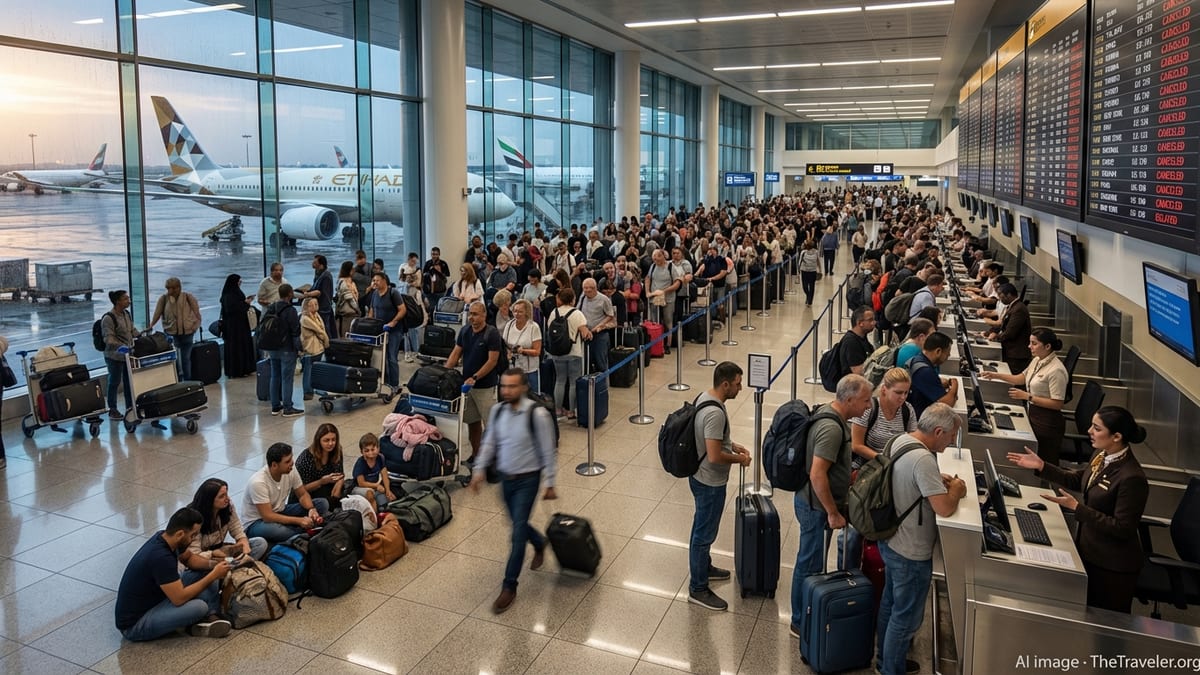
Regional Hubs Under Pressure Again
Airports in Kuwait, the United Arab Emirates, Qatar and Egypt are once more experiencing operational instability, with publicly available data and local reporting indicating around 60 flights canceled and nearly 100 delayed over a 24 hour window. The turbulence is centered on five of the region’s most important gateways: Kuwait International, Sharjah International, Cairo International, Hamad International in Doha, and Dubai International.
These hubs were already recovering from months of airspace restrictions and security concerns linked to the wider regional conflict earlier in 2026. Dubai International and Dubai World Central endured a full shutdown in late February when airspace closures halted all movements, with only a limited restart permitted in early March. Subsequent regulatory steps in the United Arab Emirates further constrained foreign carrier operations, leaving airlines with reduced flexibility even as passenger demand started to return.
In Kuwait, operations only began to normalize in stages after February’s attacks on Kuwait International forced the suspension of most civilian traffic. A gradual reopening that started in late April and extended into June allowed more airlines to restore services, but schedules remain fragile. Recent flight boards show recurring cancellations and rolling delays as carriers adjust to capacity limits and evolving security postures.
Hamad International and Sharjah International, which had been used as alternative gateways when Dubai and Kuwait faced closures, are now seeing their own bouts of disruption. Regulators in Qatar have worked in recent months to restore access for foreign airlines, yet temporary suspensions and rerouting of services in and out of Doha continue to filter through to the departure boards.
Knock-on Effects Across Kuwait, UAE, Qatar and Egypt
The latest cluster of cancellations and delays is affecting both point to point and connecting traffic. Kuwait City’s role as a regional transfer node is limited compared with Doha and Dubai, but its partial shutdown earlier in the year forced tens of thousands of travelers to reroute through neighboring hubs. The present operational strain, even after a structured reopening, means airlines are still consolidating flights and revising timings on short notice.
In the United Arab Emirates, Dubai International remains the primary global transit hub, handling tens of millions of transfer passengers annually. Reports from the first half of 2026 describe how airspace closures and subsequent capacity restrictions forced airlines based there to thin out schedules and prioritize key trunk routes. Although official traffic figures show a gradual improvement through the second quarter, the rhythm of cancellations and delays has not entirely subsided, complicating itineraries that rely on tight connections.
Cairo International, a major gateway for North Africa and a critical base for Egypt’s flag carrier, has been less directly affected by airspace shutdowns but remains intertwined with the broader regional picture. Publicly available information shows that Egypt’s aviation authorities kept national airspace open during earlier phases of the crisis, yet airlines serving Cairo have trimmed or reshuffled flights in response to changing demand, security assessments and rerouting needs elsewhere in the Middle East.
Doha’s Hamad International, the second busiest airport in the Gulf, has also been subject to evolving restrictions. Published regulatory updates over recent months describe periods in which foreign carrier access was curtailed or adjusted while Qatar’s authorities recalibrated airspace management. Even as most corridors were reopened, airlines have continued to operate with contingency plans, which surface as last minute changes on the departure and arrival screens.
Passengers Confront Another Wave of Uncertainty
For travelers, the numerical tally of 60 cancellations and 96 delays translates into long queues, missed connections and improvised stopovers. Flight status tools that pull data from airline feeds are showing a spate of Middle East bound and Middle East originating services marked as canceled or heavily delayed, often only a few hours before scheduled departure. Routes linking Kuwait City, Dubai and Doha, as well as services between Gulf hubs and Cairo, feature prominently in these irregularities.
Airlines are responding with schedule consolidations, extended minimum connection times and, in some cases, temporary route suspensions. Regional carriers have already publicized pauses to certain Kuwait and Beirut operations lasting into mid July, citing regional conditions and regulatory requirements. Other operators have extended earlier suspensions to Dubai or continued to cap frequencies into Gulf airports while airspace and security assessments evolve.
Travelers with tickets routed through any of the affected hubs are being encouraged through airline advisories and publicly available notices to monitor flight status frequently and to build in extra time for airport formalities. Enhanced security checks at some airports, coupled with potential last minute gate or terminal changes, are adding friction to journeys that were already complex due to previous months of rerouting.
Consumer experiences shared on travel forums and social platforms point to a patchwork of outcomes: some passengers are receiving automatic rebooking messages and revised itineraries, while others report sudden cancellations with limited immediate alternatives. Higher fares on still operating routes, especially from Kuwait, are another recurring theme as reduced capacity meets sustained demand from expatriate and migrant worker communities.
Airlines and Regulators Balance Recovery With Risk
The uneven nature of the current disruptions underlines how fragile the regional aviation recovery remains. Airlines have spent the second quarter of 2026 rebuilding networks, with several Gulf and North African carriers announcing plans to restore dozens of destinations by mid year. At the same time, operators continue to navigate a patchwork of airspace restrictions, overflight risk assessments and airport capacity limits that can change rapidly.
Regulators across the Gulf and wider Middle East have issued a series of advisories since March outlining temporary closures, partial reopenings and operational caveats for major hubs. These notices show that while airspace has broadly reopened compared with the complete shutdown at the end of February, some airports are still constrained by infrastructure repairs, heightened security measures or lingering concerns about nearby military activity.
For airport operators, maintaining a baseline of connectivity while ensuring safety and compliance has meant accepting short term volatility in schedules. Statements and data published by major hubs such as Dubai International emphasize efforts to work with airlines to add movements back cautiously as airspace capacity improves. Similar language appears in updates tied to Hamad International and Kuwait International, reflecting a shared approach that prioritizes controlled growth over a rapid, full scale rebound.
Industry analysts note that the Middle East’s position as a central corridor between Asia, Europe and Africa magnifies the impact of even modest schedule disruptions. A handful of cancellations or delays at a major transit hub can cascade through global networks, forcing last minute aircraft and crew reallocations as far away as Europe, South Asia or North America. As the region heads deeper into the busy summer period, airlines and airports across Kuwait, the United Arab Emirates, Qatar and Egypt are likely to remain on high alert for further shocks that could upend carefully rebuilt timetables.