


On the southern edge of Rome, where the modern Via Ostiense follows the ancient road toward the sea, stands one of Christianity’s most important yet often overlooked sanctuaries: the Basilica of Saint Paul Outside the Walls, or Basilica San Paolo fuori le Mura. Built over the place where Christians have honored the tomb of the Apostle Paul since the first centuries, this vast church is more than a monument. It is a living testimony to martyrdom, pilgrimage, and the continuing spiritual influence of one of the most influential figures in Christian history.
Get the latest updates straight to your inbox!
From Roman Execution Site to Constantinian Basilica
According to early Christian tradition, the Apostle Paul was executed by beheading along the Ostian Way under Emperor Nero around the year 65 to 67. A small memorial known as a cella memoriae, essentially a simple shrine in a burial ground, was raised over his grave a short walk outside the city walls. When travelers arrive today by Metro line B to the Basilica San Paolo station and step out into the busy Ostiense district, it is striking to imagine that this same ground once lay beyond the protective circuit of Rome, in open countryside dotted with tombs.
With the end of persecutions in the early fourth century, Emperor Constantine ordered excavations at the cella memoriae to prepare a proper church above Paul’s burial place. The first basilica was consecrated around 324 by Pope Sylvester, relatively modest compared to what stands there now, but already a destination for pilgrims who wanted to pray as close as possible to the apostle’s tomb. For a modern visitor, the idea feels familiar: just as people today will travel specifically to see the exact spot where a historical figure lived or died, Christians of late antiquity were willing to walk several kilometers outside the city to kneel at Paul’s grave.
Within a century, the flow of pilgrims had grown so much that a larger basilica was required. Under emperors Valentinian II, Theodosius, and Honorius, the church was rebuilt on a grander scale in the late fourth and early fifth centuries, with a five‑aisled plan and imposing colonnades. That outline, preserved in the 19th‑century reconstruction, is still what a traveler experiences when stepping into the nave: a long, processional space that leads the eye and the heart directly toward the high altar and the tomb beyond it.
For modern travelers, this early history shapes simple practical choices. Many tours of Christian Rome will combine visits to the catacombs on the Appian Way with a stop at San Paolo, consciously echoing the paths of ancient pilgrims who moved between martyrs’ tombs across the countryside outside the city walls.
Fire, Rebirth, and the Basilica You See Today
On the night between 15 and 16 July 1823, disaster struck. A workman repairing the roof reportedly left a brazier burning, and the wooden structures of the ancient basilica caught fire. Flames tore through a church that had been a continuous witness to Christian history since late antiquity. By morning, much of the building lay in ruins, with only the apse, the triumphal arch, and a few structural elements surviving. Contemporary travel accounts compare the loss to seeing an entire era of Christian art and architecture vanish in a single night.
The shock was not only artistic but spiritual. For centuries, popes, pilgrims, and monastic communities had prayed in that space. The decision was taken not to abandon the site but to rebuild San Paolo on almost exactly the same footprint and plan, preserving the sense of continuity over Paul’s grave. Reconstruction began under Pope Leo XII in 1825 and continued through the middle of the 19th century. As you walk the nave today, the rhythm of 80 granite columns and the basilica’s long, rectangular proportions intentionally recall the earlier church, even though most of what you see is from the 1800s.
The rebuilding involved international support that still surprises visitors. Travelers from France, Russia, and other parts of Europe funded columns, mosaics, and decorative marbles. Guides often point out that the alabaster columns in the triumphal arch came from Egypt, while some of the colored marbles were gifts of viceroys and monarchs who wanted their nations associated with the renewal of such a revered site. For today’s traveler, this becomes an object lesson in how religious heritage can mobilize international cooperation long before the age of global NGOs.
A few medieval treasures survived the fire. Most striking is the 13th‑century Gothic baldachin by Arnolfo di Cambio, which still stands over the papal altar and the tomb of Saint Paul. Nearby, a venerated wooden statue of Saint Paul from the late 13th century and an older crucifix, attributed to Pietro Cavallini, found refuge in side chapels and are now carefully highlighted by guides. Seeing these pieces, blackened slightly by time but spared from the blaze, travelers often sense the fragility of sacred buildings and the tenacity with which communities choose to rebuild them.
The Tomb of Saint Paul and What Excavations Revealed
The heart of Basilica San Paolo is not its facade or cloister, but the tomb beneath the main altar. For centuries, the exact location was known only in a general way: pilgrims prayed at the altar that tradition said was built over Paul’s grave, but the sarcophagus itself was not visible. That changed in the early 2000s, when a Vatican‑sponsored archaeological project opened a window into the ancient tomb area, responding in part to pilgrims who had asked to see more during the Jubilee Year 2000.
Excavations between 2002 and 2006 uncovered a large marble sarcophagus directly under the papal altar, aligned with an older inscription bearing the words in Latin that translate as “To Paul, apostle and martyr.” In 2006 the Vatican publicly presented these findings, and in 2009 Pope Benedict XVI announced that scientific analysis of tiny bone fragments taken from the sarcophagus indicated they belonged to a man who had lived in the first or second century and had been wrapped in costly purple‑dyed linen with gold thread. For Catholics, this was seen as a strong confirmation of the long‑held tradition that the remains are truly those of Saint Paul.
For a modern visitor, this archaeological story shapes the experience at the altar. When you stand at the rail in front of the confessio, you can look down through a rectangular opening in the marble and see the side of the sarcophagus, lit gently from within the chamber. Pilgrims regularly kneel here, some leaving handwritten prayers in multiple languages. Tour groups often fall silent at this point, even if they have been chatty elsewhere in the basilica, because they are suddenly confronted with a physical link to the man who wrote many of the letters now gathered in the New Testament.
This encounter has a concrete impact on how people plan their visit. Rather than just quickly photographing the nave and mosaics, many choose to time their arrival to avoid the busiest coach tours so they can spend a few minutes in quiet at the tomb. Early afternoon on weekdays, especially outside Easter and major feasts, tends to be calmer, and independent travelers often remark that this is the moment when San Paolo moves from being “another big church in Rome” to a place of personal spiritual significance.
Art, Architecture, and Symbols Every Traveler Should Notice
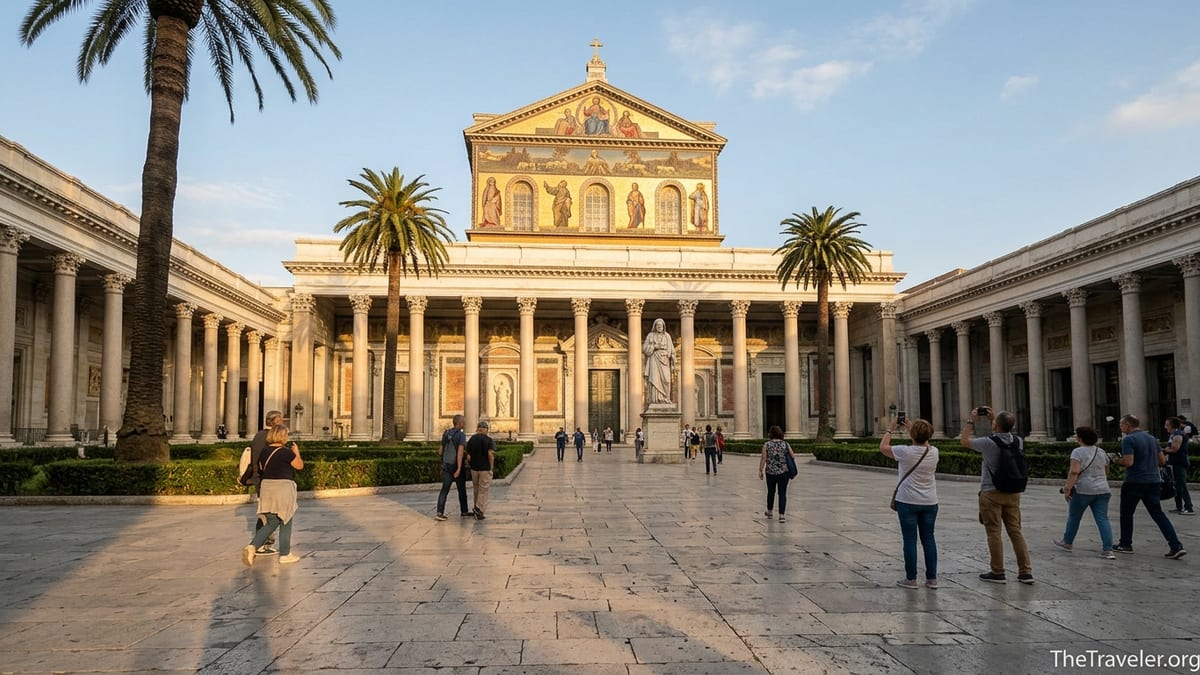
Stepping into the nave from the modern piazza, one of the first things visitors notice is the golden mosaic on the facade, catching the Rome sun in late afternoon. The current facade mosaic, completed in the 19th century, depicts Christ flanked by Peter and Paul, with scenes from the lives of the apostles below. Tour guides often point out how Paul is shown with a long dark beard and a sword, symbols that help visitors recognize him consistently in Christian art throughout Rome.
Inside, the basilica’s vast interior can overwhelm first‑time visitors. It helps to focus on a few key elements. Above the arcades, encircling the nave, is a continuous series of papal medallions, each showing a pope from Saint Peter to the present. Travelers with a bit of background in church history sometimes pause to spot familiar names like Gregory the Great or John Paul II, while others simply grasp the visual message: an unbroken chain of leadership linked back to the apostles. The blank or subtly lit spaces after the most recent portraits remind visitors that the story is still unfolding.
The apse mosaic, originally from the 13th century but restored after the fire, is another highlight. It presents Christ in majesty with the apostles Peter and Paul, along with saints such as Luke and Andrew. Even non‑religious visitors resonate with the intensity of the gold ground and the stylized yet expressive faces, which echo Byzantine and medieval artistic traditions. Guides often compare this to the mosaics in the churches of Ravenna or the apse of Santa Maria in Trastevere, helping travelers see Basilica San Paolo as part of a wider Mediterranean artistic conversation.
Off to one side, usually accessed through the cloister, lies one of the basilica’s most peaceful spaces: the Benedictine monastery’s medieval cloister, with its double columns and delicate inlaid mosaics. Here, far from traffic noise, you can actually hear the fountains and the footsteps of other visitors. Many travelers say that paying the small additional fee to enter the cloister is one of the best decisions of their day, since it gives them time and space to reflect on what they have seen in the main basilica.
Why Basilica San Paolo Matters Spiritually Today
The religious importance of Basilica San Paolo is anchored in its role as the guardian of Paul’s tomb, but it extends much further. The church is one of the four major papal basilicas of Rome, alongside Saint Peter’s, Saint John Lateran, and Saint Mary Major, and it is among the traditional Seven Pilgrim Churches of the city. For practicing Catholics, this gives a visit to San Paolo a special weight: praying here is more than sightseeing, it is participating in a centuries‑old pattern of pilgrimage.
Paul’s life and writings give the basilica a distinctive spiritual focus. While Saint Peter is often associated with leadership and authority, Paul is remembered as the missionary to the nations and the author of letters that wrestle with grace, faith, and Christian identity. Homilies and guided reflections offered at the basilica frequently draw on Paul’s words about being “crucified with Christ” or about the Church as a single body with many members. For a traveler attending Mass here, the preaching tends to place special emphasis on personal conversion and carrying the Gospel into everyday life, themes that resonate even with visitors who describe themselves as only loosely connected to the Church.
The basilica is also a symbol of ecumenical openness. Over the last decades, popes have chosen Basilica San Paolo as the place to close the annual Week of Prayer for Christian Unity, often joined by leaders from Orthodox, Anglican, and Protestant communities. For instance, during recent commemorations, representatives of other churches processed together, each reading texts from Paul’s letters. This gives the space a distinctive atmosphere: even on an ordinary weekday, visitors will see side chapels with icons and prayer texts inviting intercession for unity among Christians worldwide.
For individual pilgrims, this spiritual significance shows up in small, practical ways. Retreat groups from Europe or North America might spend a morning here including time for the sacrament of reconciliation, taking advantage of the basilica’s confessionals where priests hear confessions in multiple languages. Others participate in vespers with the Benedictine community, scheduling their visit toward late afternoon so they can end the day singing psalms in Latin alongside monks who have prayed in this place for more than a millennium.
The Holy Door, Jubilee Years, and Indulgences Explained
One feature of Basilica San Paolo that often confuses first‑time visitors is the large bronze door on the right side of the facade, distinct from the main entrance. This is the Porta Sancta, or Holy Door, which is opened only during Jubilee Years proclaimed by the pope, usually every 25 years or on special occasions. Outside of those periods, the door is sealed from the inside with a brick wall. Travelers arriving in 2025, for example, will encounter special signage and lines outside the basilica when the Holy Door is opened for the Jubilee Year, mirroring similar scenes at Saint Peter’s and the other major basilicas.
Passing through the Holy Door is connected to the Catholic practice of indulgences, which are understood not as a “ticket” to heaven but as a way of expressing and receiving God’s mercy after sin. During a Jubilee, pilgrims who walk through the Holy Door at San Paolo, attend Mass or spend time in adoration, receive the sacrament of reconciliation, and pray for the intentions of the pope can obtain a plenary indulgence under the usual conditions. Practically speaking, this means that many visitors plan their day so they can visit the basilica, go to confession in one of the multilingual confessionals, then join a scheduled Mass, often in the late morning.
For travelers who are not Catholic, watching this ritual can be a way to understand how physical actions and sacred spaces work together in Catholic spirituality. Guides often explain that the Holy Door symbolizes Christ himself as the gate of salvation, and that crossing its threshold is meant to reflect an inner decision to leave behind sin and start again. During Jubilee periods, you may see families, youth groups, and elderly pilgrims alike pausing with evident emotion before they step through.
Outside Jubilee years, the Holy Door remains a visible reminder of these themes. Even when it is sealed, visitors often stop to photograph its panels depicting Saint Paul and scenes from salvation history. The bricks behind it, invisible from the outside but frequently mentioned in tours, underline a core idea of Catholic devotion: certain graces are connected to specific times and actions, and part of pilgrimage is simply being present when those doors are open.
Planning Your Visit: Practical Tips for Engaging With the Story
Because Basilica San Paolo lies a few kilometers outside Rome’s historical center, many visitors reach it on the Metro. From Termini station the journey on line B to Basilica San Paolo typically takes around 15 minutes, followed by a short, well‑signed walk. Unlike the dense crowds at Saint Peter’s, queues here are often shorter, especially in the late morning or early afternoon. Entry to the main basilica is free, while access to the cloister and small museum comes with a modest fee that many seasoned travelers consider worthwhile.
To truly appreciate the story behind the basilica, it helps to allow at least 90 minutes. A good route starts with a slow walk up the nave, taking time to notice the papal medallions and the interplay of light on the marble floor, then moves to the confessio and tomb area for quiet prayer or reflection. After that, crossing into the cloister gives a sense of the monastic life that has surrounded San Paolo for more than a thousand years. Those interested in history should look for displays in the museum area that show fragments of earlier mosaics and documentation about the 1823 fire and reconstruction.
Travelers who wish to attend Mass will find several options each day, usually in Italian and sometimes in other languages depending on visiting groups. Schedules can vary slightly with seasons and special events, so checking locally when you arrive in Rome is prudent. Dress expectations are similar to those at other major churches in the city: shoulders and knees covered, no beachwear, and hats removed inside. While the atmosphere is more relaxed than at Saint Peter’s, security checks are still present, especially during major liturgical celebrations or Jubilee periods.
Small details can make the visit more meaningful. Bringing a pocket New Testament or an app and reading a passage from one of Paul’s letters while seated in the nave can help travelers connect the physical basilica to the text. Some group leaders choose a specific passage such as the end of the Letter to the Romans, where Paul greets the Christian community in Rome, and read it aloud near the tomb. Others light a candle in one of the side chapels as a concrete way of linking their personal intentions to the centuries of prayer that have filled this space.
FAQ
Q1. What is the Basilica San Paolo and why is it called “Outside the Walls”?
The Basilica of Saint Paul Outside the Walls is one of Rome’s four major papal basilicas, built over the tomb of the Apostle Paul along the ancient Ostian Way. It is called “Outside the Walls” because it stands beyond the line of Rome’s old Aurelian city walls, in what was once open countryside.
Q2. Is Saint Paul really buried beneath the basilica’s main altar?
Catholic tradition has consistently held that Saint Paul is buried here, and excavations in the early 2000s revealed a large sarcophagus beneath the papal altar bearing an ancient inscription referring to Paul as apostle and martyr. While archaeology cannot offer absolute proof in the modern scientific sense, the physical evidence strongly supports the long‑standing tradition.
Q3. How is Basilica San Paolo different from Saint Peter’s Basilica?
Saint Peter’s Basilica is located within Vatican City and is closely associated with the tomb of the Apostle Peter and the papal liturgy. Basilica San Paolo lies farther south along the Via Ostiense and centers on the tomb of Saint Paul. It is generally quieter and less crowded, offering more space for silent prayer, and its interior emphasizes a long, colonnaded nave and monastic setting rather than monumental Baroque decoration.
Q4. What survived the 1823 fire, and what was rebuilt?
The devastating fire of 1823 destroyed most of the ancient basilica, but parts of the apse, the triumphal arch, the Gothic baldachin over the altar, and some important artworks survived. The current church, rebuilt in the 19th century on nearly the same plan and footprint, incorporates these surviving elements and adds new columns, mosaics, and structural supports designed to recall the appearance of the earlier basilica.
Q5. What is the Holy Door at Basilica San Paolo?
The Holy Door, or Porta Sancta, is a special bronze door on the facade that remains sealed most of the time and is opened only during Jubilee Years proclaimed by the pope. Passing through it, together with specific prayers and the sacrament of reconciliation, is associated in Catholic teaching with the granting of a plenary indulgence, a sign of God’s mercy and forgiveness.
Q6. Can non‑Catholics visit and feel welcome at Basilica San Paolo?
Yes. The basilica is open to all visitors regardless of religious background. Non‑Catholics are welcome to walk through the nave, visit the cloister, attend services as observers, and spend time in quiet reflection. Guides and signage typically focus on the historical and artistic aspects as well as the spiritual meaning, and respectful behavior is all that is expected.
Q7. How much time should I plan for a visit?
Most travelers find that 60 to 90 minutes is the minimum to appreciate the basilica, visit the tomb area, and see the cloister. Those who wish to attend Mass, go to confession, or spend longer in prayer or photography may comfortably allow two hours or more, especially during busy seasons or Jubilee periods when lines can lengthen.
Q8. Is there an entrance fee, and what about the cloister?
Entry to the main basilica is free, making it accessible to individual travelers and families on a budget. There is usually a small fee for access to the medieval cloister and museum area, which many visitors consider worthwhile for the quieter atmosphere and the chance to see historic fragments and inscriptions up close.
Q9. What role does the Benedictine monastery play today?
The ancient Benedictine abbey attached to the basilica remains active. Monks maintain a rhythm of prayer that includes daily liturgy and often vespers open to the public. They also help care for the site, welcome pilgrims, and sometimes offer guided reflections or retreats, ensuring that San Paolo functions not just as a historic monument but as a living center of prayer.
Q10. Why is Basilica San Paolo important for Christian unity?
Because it guards the tomb of the Apostle Paul, who dedicated his life to preaching Christ across cultural boundaries, Basilica San Paolo has become a favored place for ecumenical gatherings. Popes regularly preside here at the conclusion of the Week of Prayer for Christian Unity, joined by leaders of other Christian communities, making the basilica a visible sign of the desire for reconciliation among divided Christians.