


More news on this day
Air travel across parts of the Middle East and surrounding corridors is again facing disruption, with industry data indicating at least 67 flights cancelled and 114 delayed in recent days, affecting services on Saudia, Flydubai, Airblue and other carriers operating through Doha, Seeb, Cairo, London, Oslo and additional hubs.
Get the latest news straight to your inbox!
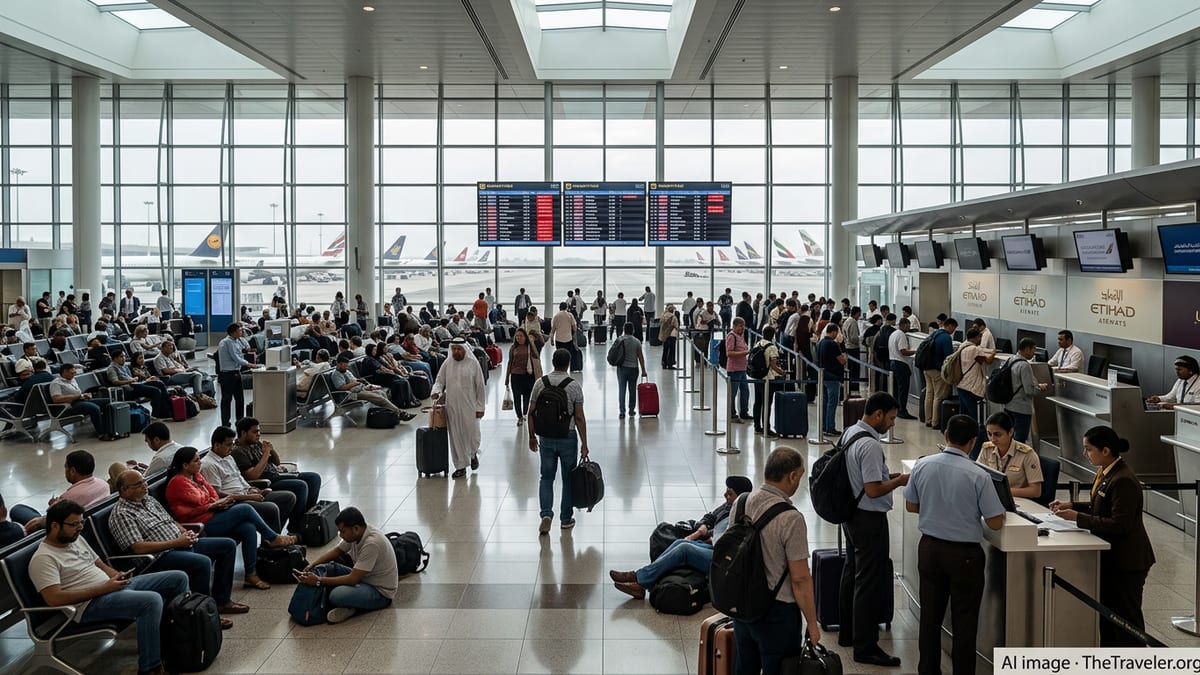
Conflict Fallout Keeps Pressure on Regional Airspace
Published aviation and security assessments indicate that the latest wave of disruption is rooted in continuing instability linked to the Iran conflict, which has periodically shut or restricted key flight information regions over the Gulf. Airspace constraints over Iran, Iraq and nearby states have forced commercial airlines to reroute, lengthen or suspend services, with knock-on impacts stretching well beyond the immediate region.
Recent digests tracking the crisis describe an uneven reopening of skies, with some Gulf states restoring near-normal schedules while others retain partial closures or night-time restrictions. This patchwork of measures continues to complicate flight-planning for carriers serving Qatar, Saudi Arabia, Kuwait and the United Arab Emirates, as well as for airlines using these hubs to connect Europe, Africa and Asia.
Analysts note that the Middle East sits on one of the world’s most heavily used aviation corridors, meaning even limited closures can quickly translate into widespread delays and cancellations. Flights that would ordinarily cross affected airspace have been diverted via longer routes over Turkey, the Caucasus or the Arabian Sea, adding time and cost and reducing schedule resilience when disruptions occur.
Hubs in Qatar, Saudi Arabia, Kuwait and UAE Feel the Strain
Operational updates compiled since late May show Doha’s Hamad International Airport running below normal capacity, with airlines gradually rebuilding their networks but still facing occasional suspensions and rolling timetable changes. Although some carriers have resumed daily links between Doha and major Gulf cities, residual uncertainty in regional airspace continues to create vulnerabilities in the schedule.
In Saudi Arabia, publicly available airline notices point to a more mixed picture. Flights to and from major Saudi gateways remain broadly active, but several operators have adjusted routings and timings, particularly for services that would ordinarily cross restricted northern sectors. Industry summaries describe certain Gulf routes as temporarily suspended or operating at reduced frequencies, leaving passengers more exposed to last-minute changes.
For Kuwait and the UAE, including Dubai and Abu Dhabi, the trajectory has been one of gradual recovery following earlier full or partial shutdowns. Executive briefings for corporate travel buyers in June suggest that Dubai International Airport is operating at just over half of its typical capacity, with Flydubai and other carriers rebuilding schedules yet still short of pre-crisis levels. Airlines continue to warn that individual flights may be cancelled or heavily delayed at short notice when airspace restrictions tighten or traffic is rerouted.
Flight Cancellations and Delays Spread Beyond the Gulf
While much of the immediate disruption is centered on Gulf hubs, its effects are being felt across a wide geographic footprint that includes Seeb in Oman, Cairo, London, Oslo and other long-haul endpoints. Network-data tallies showing 67 cancellations and 114 delays over a short monitoring period highlight how quickly issues in one region can cascade into missed connections and reshuffled rosters across continents.
Routes linking the Gulf with Europe and North Africa appear particularly sensitive. Factboxes on airline operations compiled by international news agencies in late June describe trimmed frequencies to Doha, Dubai and Riyadh by several European and Asian carriers, with some long-haul routes reduced to a single daily service. These adjustments reduce buffer capacity in the system, meaning that when a single sector is cancelled, alternate options for stranded passengers may be limited.
Airports such as London and Oslo, which serve as gateways for connecting traffic to and from the Middle East, have seen intermittent disruption as inbound aircraft arrive late or repositioned, and as crews and aircraft are cycled away from risk-prone routes. Travel advisers caution that even if a specific airport appears to be operating normally, itineraries involving Gulf connections can still be vulnerable to delay.
Airlines Adjust Schedules as Recovery Remains Uneven
In response to the ongoing constraints, carriers including Saudia, Flydubai, Airblue and others have published a series of timetable changes and advisories aimed at stabilising operations. Some airlines have shifted capacity onto widebody aircraft flying longer alternate routes, while others have temporarily suspended certain city pairs to concentrate on core corridors that can be served more reliably.
Industry digests tracking airline performance across the region indicate that recovery is progressing but incomplete. Major Gulf network airlines are approaching their pre-disruption destination counts, yet low-cost and regional operators remain further behind, especially on secondary routes that depend on overflights of sensitive airspace. This divergence has created a patchy map of connectivity, with some destinations well served and others seeing sharply reduced options.
Travel-management bulletins issued to corporate clients in early June stress that schedule volatility is likely to persist into the summer, even as more flights are restored. Airlines continue to flag the possibility of same-day cancellations, rolling delays and equipment changes, particularly on routes that thread through or around constrained sectors over the Gulf and Levant.
Passengers Face Longer Journeys and Ongoing Uncertainty
For passengers, the immediate impact of the latest disruption has been missed connections, extended layovers and, in some cases, overnight stays as airlines work through rescheduling backlogs. Reports from affected travellers describe multi-leg reroutes via alternative hubs in Turkey, North Africa or southern Europe when direct services through Doha, Dubai or other Gulf points are cancelled.
Consumer-facing guidance from aviation regulators and travel agencies recommends that passengers build in additional buffer time for connections involving the Middle East, monitor their bookings closely through airline apps, and remain alert to schedule changes in the 24 to 48 hours before departure. Where possible, travellers are being encouraged to register contact details with airlines so that rebooking options can be communicated quickly if flights are disrupted.
Industry observers note that, despite the ongoing challenges, the overall direction of travel is toward gradual normalisation as airspace restrictions are fine-tuned and carriers refine their schedules. However, with conflict-related risks still present and traffic volumes not yet fully restored, the latest cluster of 67 cancellations and 114 delays serves as a reminder that plans involving Qatar, Saudi Arabia, Kuwait, the UAE and their global connections may remain fragile for some time.