


More news on this day
Hundreds of passengers across the Middle East faced another turbulent travel day as airports in the United Arab Emirates, Saudi Arabia, Egypt and Israel collectively recorded more than 750 delayed flights and over two dozen cancellations, disrupting operations for Saudia, flyadeal, FlyDubai, Air Arabia, Ethiopian Airlines and other regional and international carriers at hubs including Jeddah, Dammam, Riyadh, Dubai and Sharjah.
Get the latest news straight to your inbox!
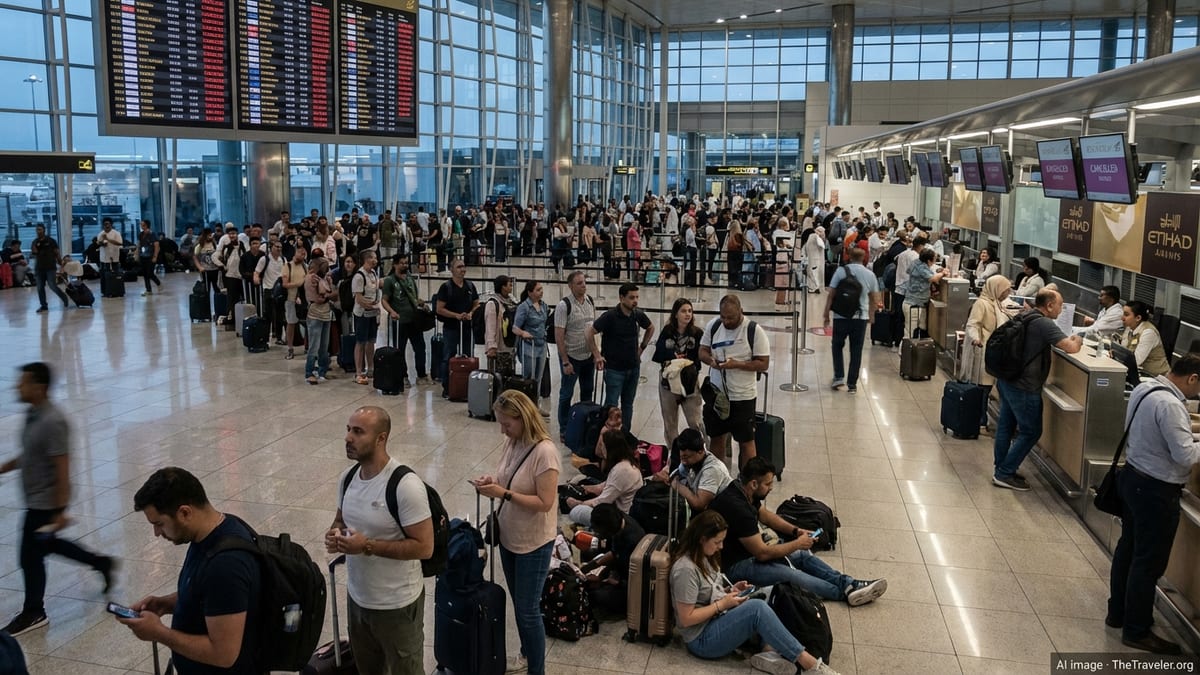
Wave of Disruptions Sweeps Key Middle Eastern Hubs
Operational data compiled from regional flight tracking platforms and industry reports indicates that a recent cluster of disruptions produced around 754 delayed services and at least 26 grounded flights across Middle Eastern airspace, concentrated on routes touching the UAE, Saudi Arabia, Egypt and Israel. The figures highlight how quickly conditions can deteriorate when multiple hubs experience strain at the same time.
Dubai International and Sharjah International in the UAE, alongside Saudi Arabia’s major gateways in Jeddah, Riyadh and Dammam, were among the most heavily affected. Published coverage describes these airports handling high traffic volumes while also managing altered routings and late-arriving aircraft, leaving schedules vulnerable to rolling knock-on delays throughout the day.
While Egypt’s Cairo International and Israel’s Ben Gurion Airport saw fewer outright cancellations, they were drawn into the disruption through their role as important connection points on routes linking the Gulf with Europe, Africa and North America. Flight tracking snapshots show departure and arrival boards dotted with late operations, as aircraft arriving from congested Gulf hubs missed their planned slots.
The net result for travelers was a patchwork of long waits, missed connections and last-minute rebookings, with some passengers held on the ground as airlines reassessed whether certain rotations could still be completed within crew and curfew limits.
Saudia, FlyDubai, Air Arabia and Others Forced to Reroute
The disruption rippled across a broad mix of full-service and low-cost carriers. Publicly available movement data shows Saudia contending with schedule changes at its Riyadh and Jeddah hubs, while low-cost subsidiary flyadeal adjusted domestic and regional rotations that depend on tightly timed turnarounds and high aircraft utilization.
In the UAE, FlyDubai and Air Arabia faced pressure at Dubai and Sharjah, where even modest ground delays can quickly escalate across short-haul networks. Reports indicate that late inbound aircraft from Saudi Arabia and beyond forced crews to juggle aircraft assignments and push back departure times on shorter Gulf and Levant sectors.
Ethiopian Airlines and other African and European carriers also experienced secondary impacts. Many of their flights rely on Middle Eastern hubs for onward connections or overflight, meaning that congestion in Gulf airspace and at key airports narrowed scheduling buffers and contributed to arrival delays at destinations as far away as Europe and East Africa.
Not all carriers opted for outright cancellations, but several trimmed frequencies or temporarily suspended select rotations to stabilize operations. These tactical cuts helped reduce further knock-on disruption but left some city pairs without nonstop service on short notice.
Conflict, Airspace Restrictions and Peak Demand Intersect
The latest wave of delays and cancellations is unfolding against a backdrop of continuing regional security tensions and airspace restrictions related to the 2026 conflict involving Iran and several Middle Eastern states. Travel advisories and industry bulletins describe a network that has yet to fully normalize after earlier closures and route suspensions affecting corridors over and around the Gulf.
Temporary or partial airspace closures have forced airlines to adopt longer routings on some services, increasing flight times and narrowing ground windows for turnarounds in Dubai, Riyadh, Jeddah and Tel Aviv. Even when airports remain open, these extended routings leave little room for error once weather, runway works or minor technical checks are factored into already compressed schedules.
At the same time, strong seasonal demand continues to push capacity at airports in the UAE and Saudi Arabia, where passenger numbers have rebounded sharply. Industry analyses suggest that when peak loads coincide with constrained airspace, a small number of initial delays can quickly cascade into widespread network disruption, especially across low-cost carriers operating multiple daily rotations with limited slack.
Egypt and Israel, while less directly affected by the heaviest airspace limitations, sit on the fringes of these stressed corridors. Their airports have absorbed diverted or rescheduled flights at various points in recent months, reinforcing their role as alternative gateways but also exposing them to congestion and irregular operations.
Passenger Experience: Longer Waits and Uncertain Connections
For travelers moving through Jeddah, Dammam, Riyadh, Dubai and Sharjah, the operational picture has translated into longer queues at check in, security and transfer desks, as well as crowded departure areas. Social media posts and local coverage from recent disruption days describe passengers waiting several hours for rebooking options as airlines restructured their schedules in real time.
Those on multi-leg itineraries involving connections between Saudia, flyadeal, FlyDubai, Air Arabia and partner airlines faced a heightened risk of misaligned schedules. When an inbound from Riyadh or Jeddah arrived late into Dubai or Sharjah, connecting flights to secondary cities in South Asia, Africa or Europe often could not be held, forcing passengers to overnight or accept alternative routings.
Families and business travelers alike have reported uncertainty about departure times, with some flights repeatedly pushed back in small increments as updated slot information became available. In several cases, once accumulated delay exceeded crew duty limits or airport night curfew windows, flights were ultimately cancelled, contributing to the tally of at least 26 grounded services tied to the most recent disruption phase.
While many airlines provided hotel accommodation or meal vouchers where required by local regulations, availability varied by hub and carrier, and some passengers were left seeking their own arrangements in already busy airport districts.
Outlook: Gradual Stabilization but Continued Volatility
Industry observers expect operations at Gulf and Levant airports to gradually stabilize as airlines refine revised routings and adjust schedules to better reflect current airspace conditions. Some carriers have already reduced frequencies or swapped to larger aircraft on core routes, in an effort to consolidate demand and build more resilience into peak banks.
However, operational bulletins and travel advisories continue to emphasize that conditions remain fluid. Any renewed shift in regional security dynamics, further airspace notices or localized weather events could once again trigger clusters of delays and cancellations across the same network of hubs in the UAE, Saudi Arabia, Egypt and Israel.
For now, publicly available information suggests that passengers planning to travel with Saudia, flyadeal, FlyDubai, Air Arabia, Ethiopian Airlines and other carriers through Jeddah, Dammam, Riyadh, Dubai, Sharjah and Cairo should expect a higher-than-normal risk of schedule changes. Travelers are being encouraged by airlines and aviation agencies to monitor flight status closely on the day of departure and to allow additional time for connections at major Middle Eastern hubs.
While the scale of disruption fluctuates from day to day, the recent episode of 754 delayed flights and 26 cancellations underscores how intertwined the region’s aviation system has become. A problem at one hub can rapidly ripple across multiple countries and carriers, reshaping travel plans for thousands of passengers in a matter of hours.