

More news on this day
Escalating conflict involving Iran, Israel and U.S. forces has plunged Middle East travel into crisis, with governments urging citizens to leave as airspace closures, shuttered airports and mass flight cancellations sever vital links between Europe, Asia and the Gulf.
Governments Urge Citizens to Depart Immediately
In an unusually stark series of advisories issued since the weekend, the United States and a growing list of European governments are urging their citizens to leave parts of the Middle East while commercial routes remain sporadically available. The U.S. State Department has called on Americans to depart more than a dozen countries, including Israel, Egypt, Saudi Arabia, Qatar and the United Arab Emirates, citing serious security risks linked to the widening conflict with Iran.
Officials in Washington say they are scrambling to support citizens stranded by the sudden collapse of normal air links. Charter and military-supported flights are being explored from hubs such as Saudi Arabia, Jordan and the UAE, though capacity is limited and subject to rapid change. An interagency task force has been activated to coordinate information, but authorities openly acknowledge they cannot guarantee evacuation for all who wish to leave.
European governments are taking similar steps. France has announced plans to facilitate the return of “vulnerable” nationals from the region while warning that closed airspace makes it difficult to organize departures. Germany, Spain, Italy and the United Kingdom are arranging special flights from Saudi Arabia, Oman and the Gulf, prioritizing tourists, dual citizens and those with pressing medical or family needs.
Diplomats stress that anyone who can still exit safely using remaining commercial or charter options should do so as soon as possible. Foreign ministries are urging travelers to register with consular alert systems so they can be contacted quickly if evacuation flights or overland convoys become available.
Airspace Closures Create Patchwork of No-Fly Zones
The warnings come amid a rapidly tightening web of airspace restrictions that has transformed Middle East skies into a patchwork of no-fly zones and narrow corridors. Authorities in Iran, Iraq, Israel, Qatar, Kuwait and Bahrain, along with parts of Syria and Jordan, have imposed full or partial closures to civilian aircraft following the latest strikes and missile exchanges.
Key Gulf aviation hubs are bearing the brunt of the disruption. Dubai International, typically the world’s busiest airport for international traffic, has seen operations largely suspended for days, with similar shutdowns or severe capacity cuts in Abu Dhabi and Doha. Industry data show thousands of flights canceled in a matter of days across the region, with cancellation rates in some Gulf states exceeding 80 percent as airlines react to shifting security assessments.
The ripple effects extend far beyond the immediate conflict zone. With large swathes of regional airspace effectively off limits, many long-haul services between Europe and Asia are being rerouted over Africa or the Caucasus, adding three to five hours to flight times and increasing fuel costs. Airlines that typically rely on Gulf hubs for connections have been forced to cancel or significantly curtail schedules, stranding passengers in transit.
Regulators in the United States and Europe have issued their own do-not-fly warnings for affected airspace, further constraining commercial options. Aviation analysts say even if limited corridors remain technically open, insurers and airlines are often unwilling to assume the heightened risks, resulting in a de facto shutdown of many routes.
Airlines Suspend Routes as Stranded Travelers Seek Escape
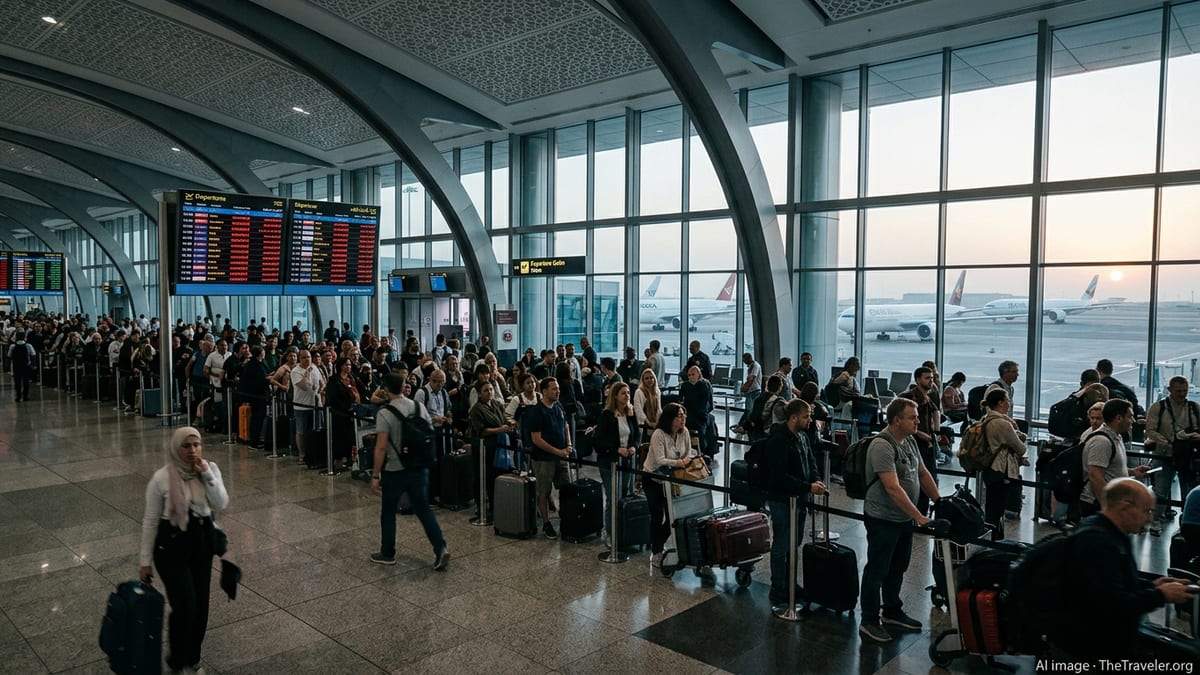
Major Middle Eastern and international carriers are responding with sweeping schedule changes that have left terminals across the region crowded with confused and anxious travelers. Emirates has suspended most operations from Dubai, while Etihad has pulled back flights from Abu Dhabi as damage assessments and security briefings continue. Qatar Airways has halted services to and from Doha pending the reopening of Qatari airspace.
Other regional airlines, including Saudia, Oman Air and Gulf Air, have extended cancellations on routes linking Gulf cities with Amman, Tel Aviv, European capitals and South Asian gateways. Data from flight-tracking services indicate that several thousand flights have been canceled or diverted at major Gulf airports in just a few days, affecting hundreds of thousands of passengers.
For travelers already in the region, the situation on the ground is fluid and often confusing. Some airports have allowed limited departures on specially cleared flights, while others remain closed to regular traffic but host occasional government-organized evacuations. In the United Arab Emirates, authorities say a small number of international services are once again departing, but warn of heavy congestion at land borders with Oman and Saudi Arabia as people seek alternative escape routes.
Airlines are generally offering flexible rebooking policies and, in some cases, refunds, but access to customer service is strained. Travelers report hours-long waits on phone lines and crowded ticket counters as they compete for scarce seats on the few flights still operating. Officials advise against going to the airport without confirmed bookings, warning that security conditions can force last-minute changes.
Evacuation Flights and Overland Routes Offer Limited Lifelines
As commercial options dwindle, governments are piecing together evacuation plans using charter aircraft, military transports and overland convoys. European officials say several special flights have already brought home citizens from Saudi Arabia, Oman and other relatively stable gateways, with more departures planned in the coming days if airspace permissions can be secured.
Some embassies in Israel are helping citizens travel by road to neighboring countries such as Egypt, where airports remain operational and international flights, though disrupted, are still departing. Shuttle buses and chartered coaches have been organized in coordination with local authorities and tour operators, though officials stress that such routes carry inherent security risks and may be suspended without notice.
In the Gulf, where airspace closures are most severe, the focus is shifting to land and sea exits. Land crossings from the UAE into Oman and Saudi Arabia remain open, albeit with heavy traffic and intermittent security checks. Cruise operators and ferry companies in the region are coordinating with governments to reposition vessels and, in some cases, to carry stranded tourists toward safer ports where flights are available.
Not all governments are mounting large-scale evacuation missions. Some foreign ministries emphasize that their capacity is finite and that citizens should not assume they will be airlifted out. Officials repeatedly underscore a central message: if you have a safe path out of the region now, take it, because conditions and access may worsen without warning.
What International Travelers Should Do Now
Travel experts and consular officials are urging anyone currently in, or scheduled to transit through, the Middle East to review their plans immediately. The core advice is to avoid entering the region unless absolutely essential, to seek routes out via relatively stable countries such as Saudi Arabia, Oman or Egypt, and to remain flexible as schedules change.
Authorities recommend registering with consular alert systems, keeping passports and essential documents ready, and maintaining a fully charged phone with backup power sources. Travelers are encouraged to monitor airline apps and official advisories closely rather than relying on social media, where rumors about reopened airports and special flights can spread quickly but prove inaccurate.
For those still trying to depart, experts caution against rushing to the nearest airport without confirmation that a flight is operating and that check-in is open. In several countries, curfews, sporadic strikes and security checkpoints complicate ground movements to and from terminals. Overland travel to alternative gateways should be planned carefully, with consideration for fuel, supplies and overnight accommodation in case of delays.
Looking ahead, aviation and security analysts say the duration of the current disruption will depend largely on whether regional hostilities intensify or begin to de-escalate in the coming days. Even if airspace gradually reopens, it may take weeks for airline networks and airport operations to normalize. Until then, travelers can expect sparse flight options, higher prices and a heightened emphasis on flexibility and contingency planning.