

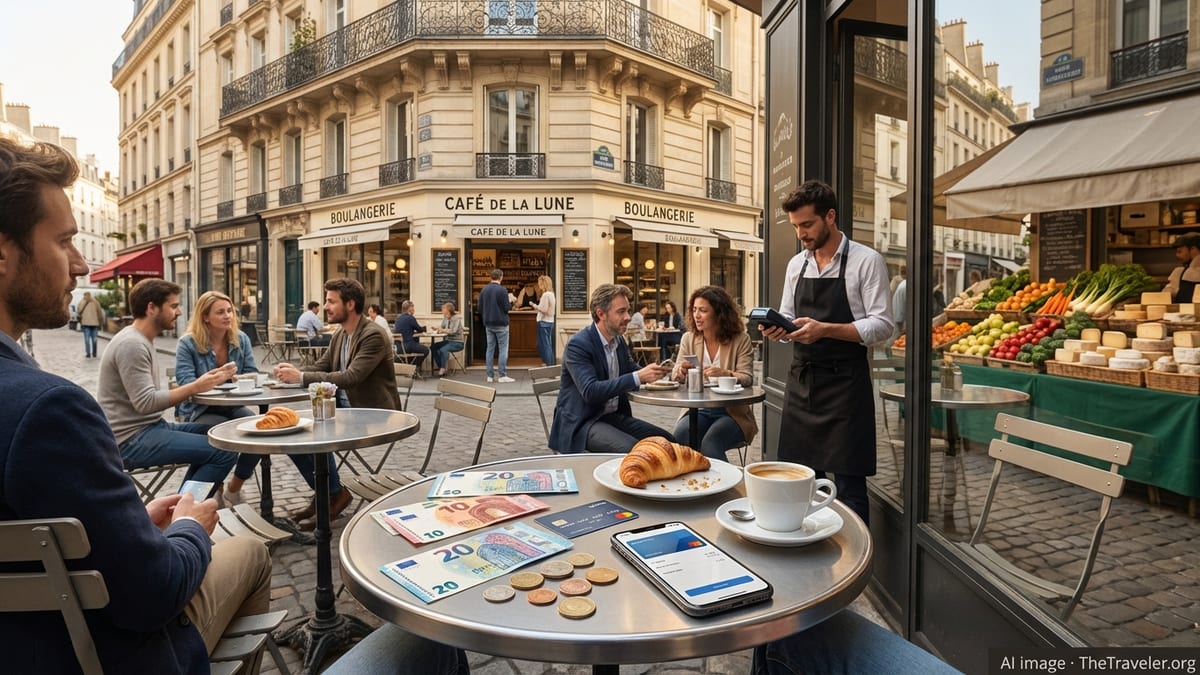
Planning a trip to France means thinking beyond museums and markets to how you will actually pay for everything once you arrive. The country is highly card friendly and increasingly cash light, but there are still moments when only a few euros in your pocket will do. Understanding how money works in France today will help you avoid fees, awkward confusion at the checkout, and unnecessary stress so you can focus on enjoying your journey.
The Basics: Currency and Everyday Prices
France uses the euro as its official currency, shared with many other countries in the euro area. Banknotes range from 5 to 500 euros, but most everyday transactions involve smaller notes of 5, 10, 20 and 50 euros. Coins are issued in 1 and 2 euro denominations, along with cents. As a visitor, you will mainly handle coins for small purchases such as coffee, pastries, and public toilets, and notes for meals, taxis, and attractions.
In daily life, France is a relatively card driven economy, yet cash remains important in smaller towns, markets, and for tips. Official statistics show that card payments now account for a clear majority of non cash transactions in the euro area, and contactless “tap” payments are widespread in shops, restaurants, transport systems and museums. At the same time, surveys still find that cash is used in a substantial share of face to face transactions, especially for low value purchases.
Prices in France are almost always displayed with tax included, so the price you see is the price you pay. This applies in supermarkets, boutiques, cafes and restaurants. Tips and service charges are handled differently, but you will not find surprise sales tax added at the register the way you might in some other countries. For budget planning, keep in mind that big cities like Paris or Nice will feel noticeably more expensive than rural areas or smaller towns.
Because France is in the eurozone, travelers coming from other euro using countries do not need to exchange money at all. Visitors arriving with other currencies will get better value by using ATMs or competitive card products rather than airport exchange bureaus or hotel desks, which tend to add higher margins. Having a general understanding of the euro and typical price levels before arrival makes it much easier to sense whether a quote or offer is reasonable.
Using Cards in France: What Works Best
France is one of the most card friendly destinations in Europe. Visa and Mastercard are widely accepted, including most debit cards that run on these networks. In cities and many mid sized towns, you can usually pay by card in supermarkets, chain stores, major attractions, hotels, restaurants, and even small bakeries or kiosks. American Express is accepted at some hotels, higher end restaurants, and larger retailers, but it is not as universal as Visa or Mastercard, so it should not be your only card.
Chip and PIN technology is the norm in France. Terminals expect you to insert your card and enter a four digit PIN, or tap for contactless payment. Signature only cards that are still common in some non European countries can sometimes cause friction, especially at unattended terminals such as ticket machines at train or metro stations. Many of these machines are designed for chip and PIN or contactless verification and may refuse a card that cannot complete that process.
Contactless payments have grown rapidly across Europe, and France is no exception. Recent changes mean that you can now tap for payments above the old 50 euro limit, although for larger amounts you will typically be prompted to enter your PIN after tapping the card. The effect for travelers is straightforward: you can expect to tap for almost all everyday purchases, from a coffee to a full restaurant meal, provided your card is enabled for contactless payments and the terminal supports it, which it usually does.
To avoid surprises, check your own bank’s fees for overseas card use before you travel. Many banks charge foreign transaction fees on non euro purchases or withdrawals, and dynamic currency conversion at the point of sale can add further cost if you accidentally allow a payment to be processed in your home currency instead of euros. Where possible, choose cards that charge low or no foreign transaction fees, and always opt to pay in euros when asked on the payment terminal.
ATMs, Cash Withdrawals, and Exchange Options
Automated teller machines, often labeled as “distributeurs” or “DAB,” are easy to find in French cities, airports, transport hubs, and most towns. They usually accept foreign cards on the Visa and Mastercard networks, including debit and credit cards. The exchange rate on ATM withdrawals is usually competitive compared to traditional moneychangers, because it is based on interbank rates with a small margin from your bank or card issuer.
When using an ATM in France, pay close attention to any offers to convert your withdrawal into your home currency on the spot. This service, called dynamic currency conversion, often comes with a poor exchange rate. For better value, select the option to be charged in euros and let your home bank apply its own rate. You may also be charged a local ATM fee by the machine operator or a foreign ATM fee by your bank, so it is usually better to take out moderate amounts rather than many very small withdrawals.
Dedicated currency exchange booths in airports, train stations, or tourist streets are convenient but tend to offer weaker rates and higher fees than ATMs, especially for small sums. If you need to arrive with some euros in your wallet for peace of mind, consider ordering a modest amount from your bank before departure and then relying mostly on ATMs once in France. You will rarely need large piles of cash, because cards are so widely accepted.
If you plan to visit remote rural areas, small mountain villages, or travel on Sundays and public holidays when bank branches are closed, it is sensible to withdraw some extra euros in advance. While ATMs are common, they are not present in every tiny village, and occasional machine outages can happen. Having a small cushion of cash reduces the risk of being stuck without a working payment method just when you need to pay for fuel, a small inn, or local food.
Cash Culture and Legal Limits You Should Know
Although France has embraced digital payments, cash still plays an important role, especially for lower value purchases and in independent or rural businesses. Many cafes, bakeries, and corner shops continue to welcome coins and notes, and cash is often the simplest way to pay at street markets, flea markets, and some small restaurants. It is also the preferred method for small tips, as most card terminals do not offer a tip prompt.
There are, however, legal rules and limits on the use of cash in France. For residents, cash payments to professional businesses are generally capped at 1,000 euros per transaction, but tourists who are not tax resident in France benefit from a higher legal ceiling of up to around 15,000 euros for consumer purchases. Above certain thresholds, sellers may ask for proof of identity, and for higher private sale amounts, a written document such as a contract or handwritten receipt is recommended to show the origin and purpose of the funds.
France also enforces rules around cross border cash movements. Under European and French regulations, anyone entering or leaving France with 10,000 euros or more in cash or similar instruments, or the equivalent in another currency, must declare it to customs. This is not a ban on carrying larger sums, but a reporting requirement aimed at combating money laundering and other illicit activity. Most tourists never approach this limit, but it is important to know if you are traveling with significant funds for a long stay or large purchase.
At the everyday level, shopkeepers cannot simply refuse euro notes and coins in normal circumstances, because cash is legal tender and protected in consumer law. They may, however, decline to accept more than a certain number of coins, refuse damaged notes, or set reasonable rules such as not accepting very large denomination notes for tiny purchases. Cash is therefore safe and legitimate to use, but France’s payment culture is clearly moving toward cards and digital methods, especially in urban areas and among younger customers.
When You Will Still Need Cash in France
Despite the spread of cards and contactless payments, there are still many situations where having cash in your wallet is either useful or necessary. Traditional open air markets often operate largely in cash, especially for small purchases of produce, cheese, or baked goods. Some stallholders may accept cards using portable terminals, but cash keeps the line moving quickly and may be preferred for small amounts.
In some rural regions and older neighborhoods, small bars, family run restaurants, and independent shops may set minimum card amounts, for example 10 or 15 euros. In practice, this might mean that two coffees are better paid in cash, while a full sit down meal or a larger grocery shop easily meets the minimum for card payment. Having a mix of coins and smaller notes allows you to avoid awkward conversations or the need to buy extra items just to reach the minimum.
Public toilets, coin operated machines, and certain local services can also require cash, particularly coins. While many transit systems in major cities now allow card or mobile payments at gates or ticket machines, some older machines still prefer coins or exact change. Similarly, small parking meters or rural bus services may rely on coin payments, so it is practical to carry a small stash of one and two euro coins in an accessible pocket or purse.
Finally, cash is especially handy for small gestures of appreciation, such as tipping housekeeping staff, leaving a coin for a street performer, or thanking a helpful concierge. Because bills in France typically include service, tips are less central than in some other countries, but when you do choose to tip, a few euros in cash is often the simplest and most direct way to do it.
Tipping, Service Charges, and Everyday Etiquette
Understanding French tipping customs can prevent both over tipping and moments of doubt at the table. In restaurants and cafes, service is usually included in the prices by law, indicated by the words “service compris” on the menu or bill. This means that staff wages and a basic service charge are already built into what you pay, and there is no expectation of an additional percentage on top as a requirement.
That said, leaving a small extra amount is a common way to show appreciation for good service. Locals often round the bill up to the nearest euro or leave a few coins, such as one or two euros, for a coffee or simple meal. In sit down restaurants with table service where you are particularly pleased, adding around 5 to 10 percent in cash is considered generous but not obligatory. For very high end dining or exceptional experiences, some guests may choose to leave more, but it remains a choice rather than a social rule.
For taxis and ride hail services, rounding up to the next euro or leaving an extra euro or two is customary if the driver has been helpful or the ride was smooth. Hotel porters typically receive a couple of euros per bag, and housekeeping staff might be left a few euros per night in an envelope or with a note. Tour guides may receive a modest cash tip at the end of a tour if you enjoyed the experience, particularly on small group or private tours.
In most of these situations, cash is the preferred tipping method. Many French payment terminals do not include a built in option to add a tip when paying by card, and even when staff can add an amount, it may not be as clearly directed to the person who served you. Carrying small denomination notes and coins makes it easy to respond naturally when you want to tip, without needing to think about how to add a percentage on a card payment.
Digital Wallets, Mobile Payments, and Contactless Culture
As in many parts of Europe, digital wallets and mobile payments are gaining ground in France. Apple Pay, Google Pay, and similar services are widely supported wherever contactless card payments are accepted, which is now the majority of supermarkets, chain stores, and many independent businesses. These services essentially act as a digital version of the card you have stored, so acceptance depends on both your card issuer and the local terminal.
French consumers have rapidly adopted contactless payments, with official data for the euro area showing double digit annual growth in tap to pay transactions and a rising share of total card usage. For visitors, this translates into a very familiar experience: you can usually pay for a metro ride, a coffee, or a museum ticket with a simple tap of your phone or card. Limits that once restricted contactless to small purchases have been relaxed, and for sums above a certain amount you may be asked to confirm with a PIN or device authentication rather than being forced to insert the card.
Mobile payments can be especially convenient for solo travelers or those who prefer to carry fewer physical cards. However, it is wise not to rely on them entirely. A dead battery, a damaged phone, or a local terminal that does not recognize your wallet service can leave you in a difficult spot if you have no physical backup. Keeping at least one tangible card separate from your phone, and a small amount of cash, gives you a safety net.
Some peer to peer payment apps are popular among locals for splitting bills or reimbursing friends, but they are typically tied to French bank accounts and are not accessible to short term visitors. For splitting restaurant bills, it is still common to ask for separate checks, pay one bill with multiple cards, or settle up with cash between friends. French servers are generally used to groups who need to divide a bill, though it is considerate to warn them in advance if you plan to pay with several cards.
Safety, Scams, and Smart Money Habits
France is generally safe for travelers, but the usual precautions around cash and cards still apply. In busy tourist areas, pickpocketing can occur, especially in crowded metros, popular squares, and major attractions. Avoid carrying large amounts of cash in one place, and consider using a money belt or an inside pocket for larger notes and spare cards, keeping only what you need for the day in an accessible wallet.
At ATMs, choose machines that are attached to bank branches or located in well lit, busy areas, particularly at night. Shield your PIN when entering it, and watch for anyone standing uncomfortably close behind you. Inspect the card slot and keypad for anything that looks loose or unusual, which could indicate tampering. If anything seems off about a machine, move on to another.
Card fraud at payment terminals is relatively rare but can happen, so try to keep your card in sight when paying in restaurants or shops. In many French establishments, staff will bring a portable terminal to your table so you can insert or tap your card yourself. If a server insists on taking your card away out of view, and there is no clear reason, you are entitled to request a table side terminal instead.
Finally, keep digital records of important information such as your bank’s emergency phone numbers, card cancellation contacts, and any travel insurance details. If your card or wallet is lost or stolen, being able to act quickly makes a significant difference. Many banking apps now allow you to freeze or block a card instantly from your phone, which can stop fraudulent use while you arrange a replacement or switch to a backup card.
The Takeaway
For most travelers, managing money in France is straightforward once you understand the balance between cards, cash, and modern payment habits. The country is highly card friendly, particularly for chip and PIN and contactless payments, and you can rely on cards for the majority of your spending in cities and tourist destinations. At the same time, keeping a modest amount of cash on hand will make life easier in markets, rural areas, and for small tips.
By choosing payment methods with reasonable fees, using ATMs wisely, respecting local cash rules, and practicing basic security, you can navigate French money matters with confidence. That leaves you free to concentrate on far more enjoyable questions, such as which pastry to order next or which vineyard to visit, secure in the knowledge that when the bill arrives you will be ready.
FAQ
Q1. What currency does France use, and should I bring euros in advance?
France uses the euro. It can be convenient to arrive with a small amount of cash, but you will usually get better value by withdrawing euros from ATMs once in the country rather than exchanging large sums before you travel.
Q2. Are credit and debit cards widely accepted in France?
Yes. Visa and Mastercard are widely accepted across France in shops, restaurants, hotels, and transport. American Express is accepted in some larger or more upscale places but not everywhere, so it is best to carry at least one Visa or Mastercard as your primary card.
Q3. Do I need a chip and PIN card to pay in France?
Most French terminals expect chip and PIN or contactless verification. Many foreign cards now support this, but if your card is signature only, you may have issues at unattended ticket machines or toll booths. Having at least one chip and PIN enabled card makes payments much smoother.
Q4. How much cash should I carry day to day?
For everyday sightseeing, many travelers are comfortable carrying between 40 and 100 euros in small notes and coins. That is usually enough for small purchases, markets, tips, and any places that do not accept cards, while the bulk of your spending can stay on cards.
Q5. Is it better to pay in euros or in my home currency when using my card?
Always choose to pay in euros when a terminal offers a choice. Allowing the merchant or ATM to convert into your home currency often leads to a worse exchange rate and higher overall cost.
Q6. Are there legal limits on cash payments in France?
Yes. For residents, cash payments to businesses are generally limited to 1,000 euros, while tourists who are not tax resident benefit from higher ceilings for consumer purchases. In practice, most visitors rarely encounter these limits, but very large cash payments may require identification or written documentation.
Q7. What are the tipping customs in French restaurants and for services?
Service is usually included in restaurant prices, so tipping is not obligatory. Locals often round up or leave a few extra euros for good service. For taxis, hotel staff, and guides, small cash tips are appreciated but not required.
Q8. Can I rely on mobile payments like Apple Pay and Google Pay?
In many urban locations you can, because mobile wallets are accepted wherever contactless cards work. However, do not rely on them exclusively. Carry at least one physical card and some cash in case of technical issues, dead batteries, or terminals that do not recognize your wallet.
Q9. Are ATMs safe to use in France, and are there many of them?
ATMs are common in cities and most towns and are generally safe to use if you choose machines attached to banks or in well lit areas. Basic precautions such as shielding your PIN and avoiding suspicious looking machines are usually sufficient.
Q10. What should I do if my card is lost or stolen while in France?
Contact your bank or card issuer immediately using their emergency number to block the card and prevent unauthorized use. Many banking apps allow you to freeze a card instantly. Having a backup card stored separately and some spare cash makes it easier to continue your trip while you arrange a replacement.