

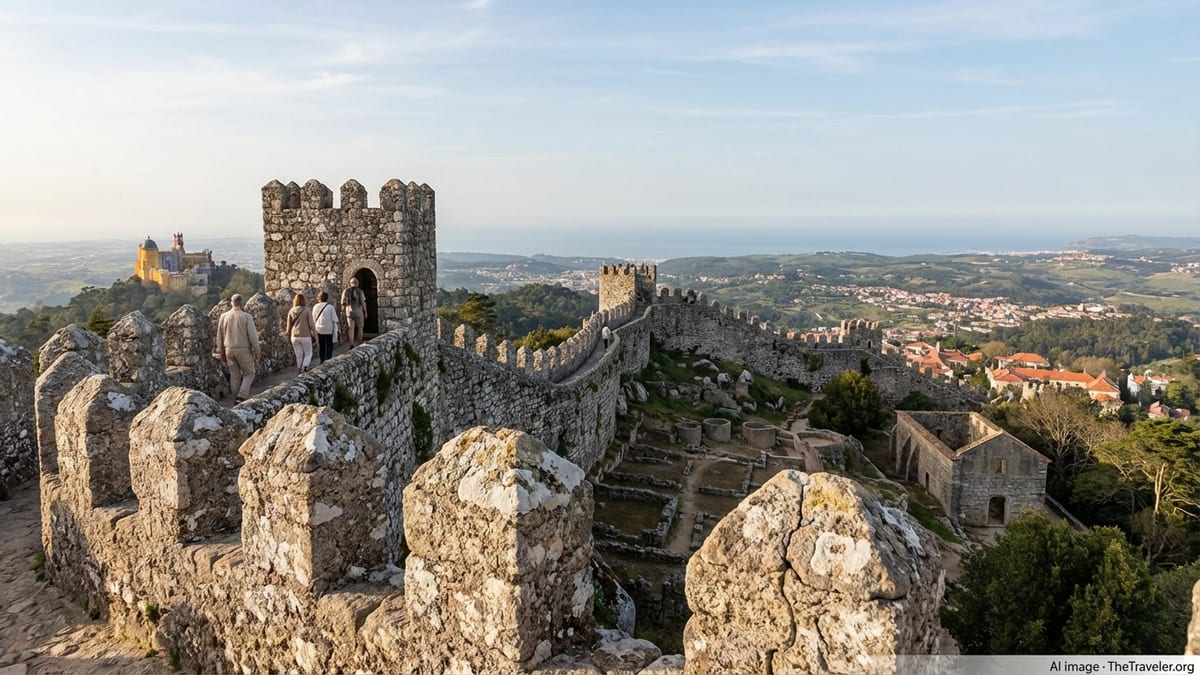
High on a granite ridge above Sintra’s fairy-tale palaces, the Moorish Castle looks today like a romantic ruin. Its broken walls and jagged battlements seem to belong to the nineteenth century imagination that restored them.
Yet behind this picturesque skyline lies a much older story, rooted in the Islamic conquest of Iberia and the frontier culture that flourished here when Sintra was a stronghold of the westernmost Muslim world.
To understand the Moorish Castle is to uncover the Islamic roots of Sintra itself, and to trace how a medieval hilltop fortress evolved into one of Portugal’s most atmospheric historic sites.
An Islamic Fortress on the Edge of the Atlantic
The Moorish Castle, or Castelo dos Mouros, began life as a military outpost during the period of Muslim rule in the Iberian Peninsula. Most historians attribute its origins to the 8th or 9th centuries, when North African and Arab forces consolidated control over what would become central Portugal. Built along a rugged granite crest overlooking the Atlantic Ocean, the castle formed part of a chain of fortifications guarding routes to Lisbon and the fertile agricultural hinterland.
The choice of site was strategic. From the ramparts, sentries could monitor movements on the coastal plain and the roads that linked Sintra to Lisbon and inland territories. The hill itself provided natural defenses, with steep slopes on several sides and a commanding view that made surprise attacks difficult. For the Muslim rulers of the region, this was not simply a watchtower but a vital piece of a broader defensive system that included other strongholds such as Santarém and the fortifications of the Tagus valley.
In these early centuries, Sintra lay within the Muslim province often referred to as Belata, encompassing parts of today’s Ribatejo and Estremadura. The castle acted as a fortified center for a largely rural territory, protecting farming communities, overseeing trade routes and offering a refuge in times of conflict. Its stone walls, rising directly from the granite outcrops, symbolized both the power and the precariousness of Muslim authority on a frontier that was always under pressure from northern Christian kingdoms.
Although later periods transformed the site, the essential character of the Moorish Castle as a frontier Islamic stronghold remains legible in its layout. The irregular plan, adapted to the contours of the ridge, and the layered rings of walls evoke a fortress designed for defense first and aesthetics second. Long before Sintra became synonymous with romantic palaces and landscaped parks, this ridge was shaped by the priorities of medieval Islamic military architecture.
The Islamic Settlement Behind the Walls
Beyond its role as a fortress, the Moorish Castle also sheltered an Islamic community whose traces are only now being fully understood. Archaeological excavations in recent decades have revealed the remains of houses, silos, ovens and water systems inside the walls, particularly on the more sheltered southern and southeastern slopes of the enclosure. These finds indicate that the castle was not just a garrison post but a lived-in settlement.
The inhabitants were likely a mix of soldiers, officers, their families and support staff who serviced the needs of the military elite. Fragments of foundations show small structures clustered along terraces, often arranged around narrow lanes and inner courtyards. This pattern echoes broader features of Islamic urbanism, in which domestic life was organized around enclosed patio spaces that provided privacy, shade and shared access to water and ovens.
Storage silos carved into the rock and remains of simple drainage channels speak to a community attuned to the logistical demands of life on an exposed hilltop. Cereal silos and underground storage areas ensured food supplies during sieges or periods of isolation, while the rudimentary sewage systems helped manage waste in a constrained environment. In a region where water could be scarce in summer, careful management of resources was essential.
Daily life in this Islamic settlement would have followed the rhythms of the seasons and the obligations of frontier service. The call to prayer, now long vanished from the hilltop, would have structured the day. While no mosque survives above ground, it is likely that a small oratory or prayer space existed within the community, integrated into modest architecture rather than expressed in monumental form. What survives today is a palimpsest of foundations and post-holes, yet together they sketch a portrait of a missing world that once animated these stones.
Water, Walls and Watchtowers: Islamic Military Design
The physical form of the Moorish Castle reflects both the practical needs and the aesthetic vocabulary of Islamic military engineering in western Iberia. The most striking feature is the double ring of curtain walls that once encircled the hilltop. The outer wall, now in part collapsed, created an initial defensive line, while the inner walls enclosed the core stronghold and settlement. Within this system, towers of rectangular and circular plan punctuate the ramparts, offering raised vantage points for archers and lookouts.
The walls, built largely from local granite, follow the irregular outline of the ridge. Rather than imposing a strict geometric form, the builders adapted the fortification to the terrain, taking advantage of natural rock outcrops as anchors and obstacles. This close fit between architecture and landscape is a signature of many Islamic frontier castles, where speed of construction, available materials and defensive logic trumped ceremonial symmetry.
Water management was another critical aspect. Near the center of the enclosure, an underground cistern was dug directly into the rock, with interior dimensions of roughly 18 by 6 meters. Fed by rainwater through openings in its vaulted ceiling, the cistern ensured a secure freshwater supply during times of siege or drought. The presence of such an infrastructure underlines the intention to hold this position for extended periods if necessary, a hallmark of serious military investment.
Access points reveal additional traces of Islamic design. The so-called Gate of Betrayal, discreetly hidden within the curtain wall at the northern end, provided a concealed exit for messengers or a last resort escape route. Elsewhere, a horseshoe-arched gateway, often described as an “Arab door,” preserves a characteristic Islamic architectural motif in its curvature and profile. Together, these elements situate the Moorish Castle firmly within the world of Muslim fortification while also anticipating the layers of adaptation and reinterpretation that would come later.
From Muslim Frontier to Christian Outpost
The Islamic hold on Sintra was never absolute. Political fragmentation in Muslim Iberia, combined with the military pressure of expanding Christian kingdoms, made the region a contested zone. In the early 11th century, as the caliphal structures crumbled and taifa kingdoms jostled for power, Sintra briefly entered the orbit of the Christian king Alfonso VI of León and Castile through diplomatic cession. That arrangement proved ephemeral, and incoming Almoravid forces soon restored Muslim control.
The decisive turning point came in 1147. During the wider Christian campaign that culminated in the conquest of Lisbon, forces loyal to Afonso Henriques, the first king of Portugal, advanced on the Sintra hills. The Moorish Castle, recognizing its vulnerable position and perhaps calculating that resistance would be futile, is believed to have surrendered without enduring a prolonged siege. With this capitulation, Sintra’s Islamic chapter effectively closed, even if material traces of it endured.
In the years that followed, the castle was integrated into the emerging Portuguese kingdom’s defensive network. A royal charter issued in 1154 encouraged Christian settlers to inhabit the stronghold, granting privileges to those who took on the responsibility of guarding the site. The once-Muslim fortress thus became a Christian frontier outpost, its walls still strategically important but now serving a different crown and faith.
This transition reshaped the hilltop’s religious and social landscape. Within the walls, a small Christian church dedicated to São Pedro de Canaferrim was built in the 12th century, rising near what had been the heart of the Islamic settlement. Over the following centuries, the castle’s role slowly evolved from active stronghold to symbolic sentinel as the frontiers of the Portuguese kingdom moved further south. Yet the original Islamic fabric survived, woven into the background of a now-Christianized landscape.
Burials, Ruins and Romantic Visions
Archaeology has revealed that the Christian conquest did not simply overlay a new religious identity on the castle. It also brought a drastic reorganization of space. The area once occupied by the Islamic neighborhood, especially on the more sheltered slopes inside the walls, was transformed into a Christian cemetery serving the new parish church. Graves, often containing multiple individuals, were cut into the layers of earlier domestic occupation, literally burying the memory of the Muslim community beneath Christian dead.
This cemetery remained active from roughly the 12th to the 14th century, after which the castle’s strategic value declined. As royal and administrative power concentrated in Lisbon and other lowland centers, maintaining a garrison on the windy ridge of Sintra became less pressing. By the late Middle Ages, the fortress had slipped into partial disuse. Records suggest that some structures collapsed or were quarried for stone, and that marginalized groups, including members of the Jewish community, occupied parts of the decaying complex in the late 15th century.
Further destruction came from natural forces. In 1636, lightning struck and damaged key elements of the castle, and the devastating Lisbon earthquake of 1755 shook the Sintra mountains, toppling sections of the walls and gravely damaging the already neglected chapel. By the turn of the 19th century, the Moorish Castle existed as a romantic ruin in the most literal sense: crumbling battlements wrapped in vegetation, suggestive of a lost past but poorly understood in historical terms.
The romantic movement in Europe, however, transformed ruin into an aesthetic object. When Ferdinand II, the “artist king” of Portugal, acquired the Sintra hills in the 19th century, he saw in the Moorish Castle an ideal canvas for his vision. Rather than reconstructing it as a functioning fortress, he stabilized and selectively rebuilt sections of the walls and towers to heighten their picturesque impact. Pathways were cut, viewpoints curated, and the ruin was integrated into the broader romantic landscape that included the nearby Pena Palace. In the process, the castle’s Islamic roots were partially obscured beneath a layer of 19th century imagination.
Reading the Islamic Past in Today’s Castle
For visitors today, the Moorish Castle presents itself as a sequence of terraces, stairways and crenellated walls winding along the ridge. It is easy to be distracted by the sweeping views over Sintra, the Pena Palace and the Atlantic coast. Yet a more attentive gaze reveals traces of the Islamic heritage that first shaped this hilltop. The irregular plan of the walls, the alignment of certain towers and the location of the cistern all point to a medieval Muslim logic of defense and survival.
Modern research and interpretation have begun to foreground this dimension. Excavations undertaken since the late 20th century have systematically uncovered the Islamic settlement layers, including foundations of homes, grain silos and ovens. Artefacts such as ceramics, metal objects and the remains of daily life are now displayed in the former church of São Pedro de Canaferrim, transformed into an interpretation center that tells the story of the site from prehistory through the Islamic period to the Christian and romantic eras.
At several points along the visitor route, interpretive panels identify the “Islamic settlement” zone and explain how the Christian medieval necropolis cut across earlier living spaces. These explanations invite travelers to look beyond the scenic ruin and imagine the textures of everyday life when the sounds of Arabic, Berber dialects and Romance languages mingled on the wind-swept terraces of Sintra’s heights.
Recognizing the Islamic roots of the castle also reframes Sintra’s broader narrative. Rather than an exclusively Christian medieval town later embellished by romantic monarchs and 19th century exiles, Sintra emerges as a place deeply entangled with the story of al-Andalus. The Moorish Castle is not an exotic backdrop to the Pena Palace but a foundational chapter in Sintra’s evolution as a cultural landscape, one that UNESCO has recognized for its layered interplay between nature, architecture and memory.
Visiting With History in Mind
Climbing the steep approach to the Moorish Castle, visitors trace a path that has been used for over a millennium. The outer walls, though partially ruined, still suggest the first line of defense that an approaching force would have confronted. Passing through the main gate into the inner ring of fortifications, one steps into a space that has shifted roles many times: from Islamic settlement to Christian stronghold, from burial ground to romantic viewpoint.
Walking the battlements reveals the strategic logic behind the original Islamic construction. From one tower, the Atlantic glints in the distance, hinting at maritime routes and the wider horizon of the Muslim Mediterranean world. From another, the view falls across the plains toward Lisbon, recalling the castle’s role in monitoring inland roads and serving as an early warning post for threats approaching the Tagus estuary. These lines of sight, once instruments of war, now offer some of the most iconic panoramas in Portugal.
Within the enclosure, the cistern, silos and foundations invite a different kind of reflection. They evoke the domestic and logistical side of frontier life, the routines that sustained soldiers and families through long winters and uncertain times. By pausing at these quieter corners as well as at the spectacular viewpoints, travelers can piece together a more complete picture of the castle’s Islamic past.
Contemporary management of the site, under the umbrella of Sintra’s heritage authorities, balances preservation with accessibility. Stabilization works aim to protect the medieval and romantic layers alike, while archaeological research continues to refine the chronology of construction and adaptation. For the historically curious traveler, this means that each visit touches not just a static monument but an active research landscape where new findings periodically adjust the story that is told about Sintra’s Islamic centuries.
The Takeaway
The Moorish Castle of Sintra is more than a dramatic set of ruins crowning a popular day-trip destination from Lisbon. It is a rare surviving witness to the Islamic presence in western Iberia, a fortress and settlement that once stood at the intersection of faiths, cultures and competing political visions. Built in the early centuries of Muslim rule, it guarded agricultural lands and coastal routes, sheltered a small community and anchored a frontier province that looked both toward North Africa and deep into the Iberian interior.
Subsequent centuries layered new meanings onto the site: Christian conquest and sacralization of space through church and cemetery, gradual military decline, catastrophic natural disasters and finally romantic reinvention as a scenic ruin. Yet beneath these later additions, the core lines of the Islamic fortress remain, carved into granite and encoded in the layout of walls, towers and water systems.
For travelers willing to look beyond the postcard views, the Moorish Castle offers a compelling entry point into the intertwined histories of al-Andalus and Portugal. It reminds us that Sintra’s enchantment is not only a product of 19th century fantasy but also of much older interactions between landscape, power and belief. To walk its walls is to move through a living archive of Iberia’s Islamic past, written in stone along the edge of the Atlantic.
FAQ
Q1. When was the Moorish Castle in Sintra originally built?
The Moorish Castle is generally dated to the 8th or 9th centuries, during the early centuries of Muslim rule in the Iberian Peninsula, when Islamic forces consolidated control over central Portugal and established a defensive network around Lisbon.
Q2. Why is it called the “Moorish” Castle?
The name reflects its origins under Muslim, or “Moorish,” rule. The fortress was constructed and first occupied by Islamic settlers and soldiers, who integrated it into a broader system of defenses in what was then a frontier region of al-Andalus.
Q3. What evidence shows that there was an Islamic community living inside the castle walls?
Archaeological excavations have uncovered foundations of houses, storage silos, ovens, drainage channels and other structures on the more sheltered slopes within the enclosure. These remains indicate a small but permanent settlement of soldiers, officers and families living behind the castle’s walls.
Q4. How did the Moorish Castle pass from Muslim to Christian control?
In 1147, during the campaign that also led to the conquest of Lisbon, forces commanded by Afonso Henriques advanced on Sintra. The castle surrendered to the Christian army, and shortly afterwards a royal charter encouraged Christian settlers to occupy and guard the site, marking its transition into a Portuguese frontier post.
Q5. Is there anything recognizably Islamic visible in the castle today?
Yes. While much was altered over time, visitors can still see structural features that reflect its Islamic origins, including the irregular layout of the walls adapted to the ridge, the strategic siting of towers, the large underground cistern and a horseshoe-arched gateway often identified as an “Arab door.”
Q6. What happened to the Islamic neighborhood after the Christian conquest?
After the conquest, the area where the Islamic community had lived was repurposed as a Christian cemetery serving the new church of São Pedro de Canaferrim. Graves were cut into earlier domestic layers, effectively overlaying the Islamic living spaces with Christian burials from roughly the 12th to the 14th centuries.
Q7. How did the 19th century change the appearance of the castle?
In the 19th century, King Ferdinand II embraced the ruin as part of his romantic vision for Sintra. Rather than fully reconstructing it, he stabilized and selectively rebuilt parts of the walls and towers, cut picturesque paths and integrated the site into a designed landscape that emphasized dramatic views and a sense of evocative decay.
Q8. What role does the former church of São Pedro de Canaferrim play today?
The 12th century church, originally built just after the Christian conquest as Sintra’s first parish church, now serves as an interpretation center for the Moorish Castle. Inside, visitors can see objects and artefacts from archaeological excavations and trace the site’s history from its Islamic origins through the Christian and romantic periods.
Q9. How can visitors best appreciate the Islamic roots of the castle during a visit?
To focus on the Islamic heritage, visitors should pay attention to the location and shape of the walls and towers, the underground cistern, the area marked as the “Islamic settlement,” and the concealed Gate of Betrayal. Reading on-site interpretive panels and visiting the interpretation center helps connect these physical traces with the story of the medieval Muslim community that once lived here.
Q10. Why are the Islamic roots of Sintra important for understanding the town today?
Recognizing Sintra’s Islamic chapter places the town within the wider history of al-Andalus and Iberian frontiers. It shows that the celebrated romantic palaces and gardens of the 19th century grew atop much older layers of occupation and exchange, and that the Moorish Castle is not merely a scenic backdrop but a key to understanding Sintra’s deep, multicultural past.