


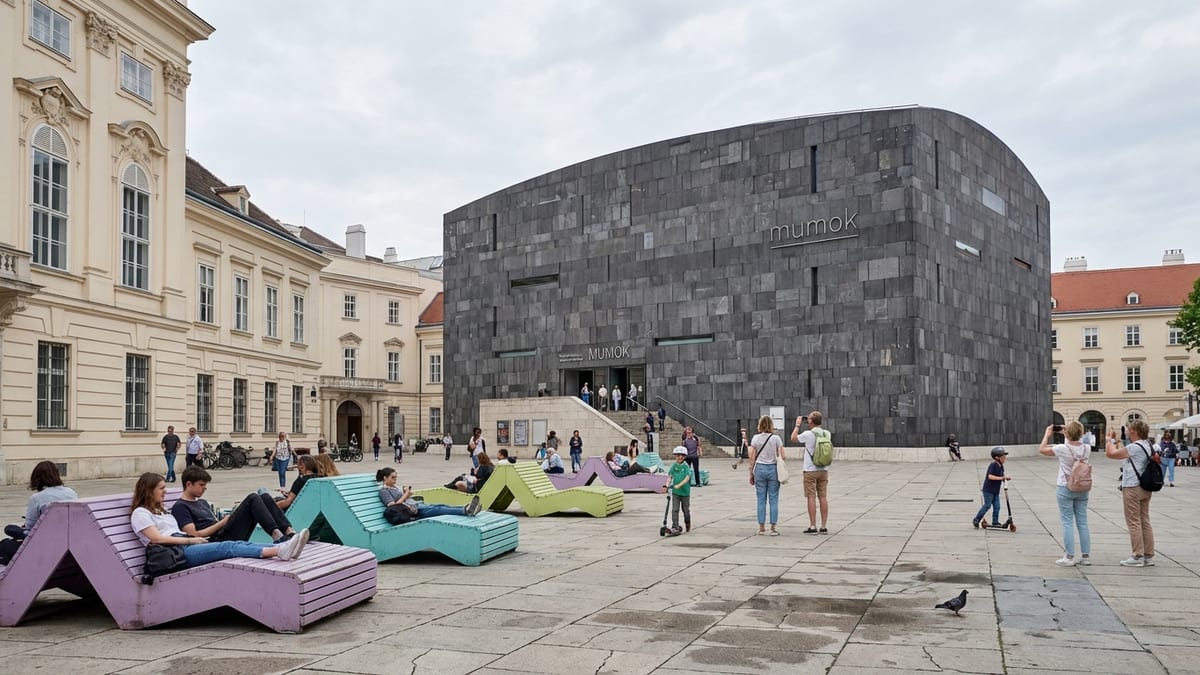
I had seen the stark basalt block of MUMOK in so many Vienna photos that by the time I finally walked into the MuseumsQuartier courtyard, it already felt familiar. The question in my head was the same one you are probably asking: is this actually worth carving out half a day and paying modern-art prices for, in a city overflowing with Klimt, Baroque churches, and imperial palaces?
After spending several hours inside, a bit longer than I expected, I left with mixed but ultimately positive feelings. MUMOK is not a crowd-pleaser in the same way the Kunsthistorisches Museum or the Belvedere are. It is a serious, sometimes challenging, sometimes frustrating space. Under the right conditions, and for the right person, it can be absolutely worth it. If you walk in cold with generic “Vienna museum” expectations though, you may come out puzzled and underwhelmed.
First Impressions: Architecture, Atmosphere, And Getting In
Approaching MUMOK was actually one of my favorite parts of the experience. The museum sits right in the MuseumsQuartier, at Museumsplatz 1, a few minutes on foot from the U2 Museumsquartier station or the Volkstheater station on U2 and U3. The huge dark-gray basalt cube rises over the courtyard, which tends to be full of people lounging in the colorful outdoor benches, kids on scooters, and the usual mix of students, tourists and locals. The exterior makes a statement long before you see any art: this is not a pretty palace full of gold and frescoes. It is blunt and a bit austere, and that sets the tone.
Once inside, the atmosphere shifted from lively to quite clinical. The lobby is bright and functional, with the ticket desk, cloakroom, shop, and café clustered together. I went on a weekday afternoon, which helped: there was no line at the ticket counter at all. Regular adult tickets were 17 euros when I visited, with reduced tickets in the mid-teens and free entry for visitors under 19. There are discounts with the Vienna City Card and free entry once a month on the first Sunday, but that free day also means bigger crowds and more noise. I intentionally avoided that and would do so again, unless budget was my top priority.
Check-in was smooth but felt a bit impersonal. I was handed a small map and a quick explanation of where to start. Large bags had to go into lockers or the staffed cloakroom, which is normal, but it does add a few minutes of logistical fiddling. Everything is step-free, with elevators serving all floors, and I noticed clear signage about accessibility and wheelchairs available at the entrance. Practicality is a strong point here. What struck me, though, was how quiet and slightly intimidating the interior felt. High white walls, a lot of concrete, not much natural light. It is more “serious institution” than “welcoming playground,” which will either excite you or switch you off, depending on your taste.
The Collection: Depth, Highlights, And Letdowns
MUMOK’s collection focuses on modern and contemporary art: classical modernism, Pop Art, Fluxus, conceptual art, Vienna Actionism, and quite a bit of photography, video, and film. On paper, there are some heavyweight names here: Picasso, Klee, Mondrian, Warhol, Lichtenstein, and a substantial holding of Viennese Actionism. I went in expecting a string of instant hits, the way some major modern art museums bombard you with icons. That is not how MUMOK works.
The permanent collection is arranged across multiple floors, and how satisfying it feels depends heavily on the current curatorial concept. When I went, much of the display leaned into thematic groupings and historical narratives rather than a greatest-hits approach. I appreciated the intellectual ambition, but I have to admit that parts of it felt dry. There were moments where I stood in front of walls of conceptual pieces, reading long labels, and not feeling much of anything. If you are the kind of visitor who likes big emotional punches and visually stunning masterpieces, you may find yourself a little hungry here.
That said, there are genuine highlights. Seeing important works by Warhol and Lichtenstein in person is always a thrill, and MUMOK uses Pop Art smartly to balance some of the more austere conceptual rooms. A few pieces of classical modernism gave me exactly what I wanted: a sense of standing in front of something with both historical weight and aesthetic presence. The collection of Vienna Actionism is intense and not exactly pleasant, but it is significant. The museum does not shy away from difficult material, and I respect that. I just wish more of the storytelling around those works connected them emotionally to a broader audience rather than assuming a lot of prior knowledge.
Overall, the permanent collection impressed me more with its breadth and seriousness than with its ability to move a general visitor. I came away thinking that if you already care about 20th century art movements, you will appreciate the depth. If you are more of a casual museum-goer just hoping to “see some modern art,” you might leave feeling that the famous names were thinner on the ground than you expected for the price.
Temporary Exhibitions: Hit Or Miss, But Often The Deciding Factor
In practice, the real value of MUMOK hinges on the temporary exhibitions. The museum invests heavily in them, and they occupy a lot of space on the upper floors. Before I went, I checked the current shows on Vienna’s official listings and on MUMOK-related pages and realized quickly that my level of interest in those themes would make or break the visit. This is not a museum where you can ignore what is on and just “see the usual.”
The main temporary exhibition during my visit tackled the idea of how museums and collections evolve over time. Conceptually, it was right up my alley. In reality, I found it uneven. Some rooms were brilliantly done, with smart juxtapositions of historical and contemporary works, thoughtful wall texts in German and English, and a clear sense of narrative. In those spaces, I actually slowed down, sat on the benches, and let the ideas land. Other sections felt like walking through an academic conference turned into an exhibition: dense texts, muted visuals, and an atmosphere that made me feel like I was cramming for an exam.
This hit-or-miss feeling seems to be a recurring pattern at MUMOK. When a show clicks with you, the museum suddenly feels like one of the most engaging places in Vienna. When it does not, the architecture starts to feel cold, the white cubes oppressive, and the whole experience drifts toward worthy but forgettable. My advice, based on this, is simple: always look up the current and upcoming exhibitions and ask yourself honestly whether those themes excite you. If they do, MUMOK is worth prioritizing. If they do not, you might be better off putting your euros into another museum that has a more evergreen appeal.
Layout, Facilities, And Practical Annoyances
From a structural standpoint, MUMOK is fairly logical. After the ticket desk and cloakroom you move into a sequence of galleries that flow around the central atrium, with staircases and elevators linking different levels. However, I did find the vertical layout slightly disorienting at times. It is easy to lose track of which floor you are on or whether you have looped back on yourself, especially when some exhibitions cut across multiple levels. The map helps, but I had a couple of moments where I wondered whether I had missed a room entirely.
Signage is a bit of a mixed bag. Basic wayfinding is fine, but I found that some exhibition labels were placed at awkward heights, and occasionally there were bottlenecks around video installations where people clustered to read and watch. There is a museum cinema, which I liked in principle, but the screening schedule did not line up with my visit time, and I did not feel inclined to wait around for a later slot. If you are particularly interested in the film program, you will want to check times in advance and build that into your plan. Otherwise, you may leave feeling that a major feature of the museum was technically there but functionally out of reach.
On the plus side, the practical facilities are mostly excellent. There are plenty of restrooms, all clean during my visit, elevators that worked and arrived quickly, and free Wi-Fi throughout the building. The shop is well stocked with art books, postcards, and design objects. It felt more curated than souvenir-oriented, which I appreciated, though prices are what you would expect. The café, just off the lobby, is convenient if you want a coffee or light snack, and you can sit inside or spill back out toward the courtyard. It is a pleasant place to decompress between floors, but again, not cheap.
My main annoyance, apart from the slightly confusing floor progression, was the cumulative sense of “little extras” that ate up time: queue for the locker, adjust to the strict bag rules, navigate around closed-off sections for an installation change, and so on. None of these were dramatic, but together they chipped away at the flow of the visit. If I were short on time in Vienna, I would resent those frictions more than I did on a fairly relaxed afternoon.
Tickets, Value For Money, And Crowds
When I think about whether MUMOK is “worth it,” cost is hard to ignore. At around 17 euros for a regular adult ticket, this is not a minor expense, especially if you are visiting several museums in a few days. There are ways to soften the blow: under-19s get in free, the Vienna City Card knocks off about 20 percent, and various combined tickets with nearby institutions like the Leopold Museum bring down the per-museum cost a bit. For example, the combined Leopold plus MUMOK ticket worked out cheaper than buying two full-price tickets separately. If you are serious about modern art, that combination can be a strong deal, because Leopold covers late 19th and early 20th century art with a very different spirit.
There is also the monthly free Sunday, which is very attractive in theory. In reality, I would only pick that day if my budget was genuinely tight. Free admission inevitably means thicker crowds, longer waits at the cloakroom, and more jostling for space in front of key works. MUMOK is not designed to absorb large masses of people as gracefully as the big imperial museums; too many bodies in those white cubes quickly make the place feel cramped rather than lively.
On a standard weekday afternoon, the museum felt comfortably busy. I had several galleries to myself for short stretches, and even the more popular spaces never got truly congested. That quiet came at the cost of paying full price, but for me it was worth it. It let me sit in front of videos without constant interruptions and read labels at my own pace. If you decide to go, I would strongly recommend a midweek visit and arriving before or after the main 11:00 to 15:00 window, when many organized groups and day-trippers pass through.
Is it good value? I would say it is fair rather than generous. I spent around three hours inside without rushing, and I did feel that I got a substantial amount of art and thought-provoking material for the money, even allowing for the exhibitions that did not fully land. If you only breeze through in an hour though, or if the temporary exhibitions at the time of your visit leave you cold, the ticket price will feel steep. MUMOK rewards time and attention; it is not a quick-hit highlights museum.
Who Will Love MUMOK, And Who Might Be Disappointed
Walking out of MUMOK, I did a quick mental comparison with Leopold, Kunsthistorisches, Belvedere, and Albertina. In that company, MUMOK is easily the least immediately gratifying for a broad audience. That is not a criticism so much as a recognition of its niche. It digs deep into modern and contemporary art history and expects you to meet it halfway. If your idea of a perfect museum visit is drifting from Klimt to Rubens to Roman antiquities in one afternoon, MUMOK will probably feel too narrow and cerebral.
On the other hand, if you already have an interest in 20th century movements, conceptual art, or the politics of museums and collections, this is one of the few places in Vienna that will truly feed you. I noticed that many of my fellow visitors looked like art students or professionals, notebooks in hand, spending ten minutes in front of works most tourists would pass by in thirty seconds. That tells you something about the museum’s natural audience. I found myself oscillating between those two modes. In some rooms I was completely absorbed; in others I felt like the museum and I were speaking different languages.
Families are a more complicated question. MUMOK offers educational programs and workshops, and children under 19 go in free, which is generous. But the permanent collection leans heavily on content that is either conceptually dense, visually minimal, or in the case of Vienna Actionism, potentially disturbing. With younger kids, I would think carefully about how much of the material you really want to walk them through, and I would definitely prepare them for the idea that “we are going to see some strange things, and that is okay.” For teens who are already artistically inclined or used to discussing edgy topics, MUMOK could actually be an excellent, horizon-expanding stop. For a casual family day out, I would probably steer them toward other museums first.
If accessibility is a concern, MUMOK is a solid choice. The step-free layout, elevators, and accessible restrooms were all clearly integrated, and staff seemed comfortable assisting people who needed help. The climate control was also consistent throughout, which might sound minor, but after a few older buildings in Vienna where temperature fluctuated wildly between rooms, the stability was welcome.
How I Would Do It Differently Next Time
Looking back, I realized that I made one tactical mistake: I treated MUMOK as a standalone, anchor museum for the day. In hindsight, pairing it with another nearby institution would have created a more rounded experience and helped balance its intellectual heaviness with a different emotional tone.
If I were planning the day again, I would probably start at the Leopold Museum in the morning, dive into Schiele, Klimt, and the early moderns there, take a break in the MuseumsQuartier courtyard for lunch, and then move into MUMOK for the afternoon. That way, the more conceptual and critical angles of MUMOK would feel like a second chapter rather than an entire book. Another option would be to slot in MUMOK on a day when I was already in the area for the Hofburg or a walk along the Ringstraße, and limit my time inside to two focused hours instead of three sprawling ones.
I would also pay even closer attention to the temporary exhibition calendar. Before my visit I did a cursory check to confirm that “something interesting” was on. Next time, I would read the exhibition descriptions more closely and time my visit around a show that truly grabs me, even if that meant adjusting my Vienna itinerary by a day or two. MUMOK is at its best when you are deeply curious about what is on those upper floors; otherwise, the permanent collection alone might not fully justify the investment.
One more thing I would change is logistical timing. I arrived mid-afternoon and found my energy flagging by the time I reached the last levels. Given the density of some of the displays, starting earlier in the day, when I was fresher, would probably have improved my patience with the more demanding rooms. If modern art is not your usual territory, you will want those energy reserves even more.
The Takeaway
So, is MUMOK worth visiting? For me, the answer is a qualified yes. I did not walk out buzzing the way I did after seeing Klimt at the Belvedere or the Old Masters at the Kunsthistorisches Museum. But I also did not feel like I had wasted my time. Instead, I left with a slower-burning appreciation, a handful of specific works that stuck in my mind, and a clearer sense of how Vienna’s story of art extends past its golden age into the messy, experimental 20th century.
I would recommend MUMOK strongly to anyone who already enjoys modern and contemporary art, who is willing to read a bit, think a bit, and accept that not every room will deliver immediate pleasure. It is particularly worthwhile if a temporary exhibition aligns with your interests and if you can visit on a relatively quiet weekday, with at least two to three hours at your disposal. It is also a good fit if you are building a broader picture of Vienna’s art scene and want to see more than just the usual Klimt and Habsburg highlights.
For first-time visitors with only a couple of days in the city, or for those who are indifferent or hostile to modern art, MUMOK is much more skippable. In that situation, your time and money will probably go further elsewhere. For families, the free admission for under-19s and educational programs are appealing, but the content requires thoughtful handling and may not be the easiest or most entertaining option.
In other words, MUMOK is not a universal must-see, but it is an important and often rewarding stop for the right traveler under the right conditions. If you come prepared, with realistic expectations and an exhibition you genuinely want to explore, you are likely to find it a serious and stimulating counterpoint to Vienna’s more glamorous museums. If you show up just because it is that dark cube everyone photographs, you may walk out wondering what all the fuss was about.
FAQ
Q1: How much time should I plan for a visit to MUMOK?
Most visitors who engage with both the permanent collection and at least one temporary exhibition will need about two to three hours. If you only want a quick overview, you can see the main highlights in 60 to 90 minutes, but the museum’s strengths reveal themselves more slowly if you are willing to linger.
Q2: When is the best time of day and week to visit?
Weekdays, especially Tuesday to Thursday, are generally quieter than weekends. Aim for late morning or late afternoon to avoid the midday peak. I would avoid the free first Sunday of the month unless the savings are crucial, because the museum can feel crowded and less contemplative then.
Q3: Is MUMOK suitable for children and families?
It depends on the children and on your expectations. Under-19s get free entry, and there are educational programs, but much of the art is conceptual, minimalist, or thematically challenging. For older kids and teens who are curious about modern art, it can be a great experience. For younger children looking for something visually entertaining and easy to grasp, other Vienna museums may be a better fit.
Q4: How do I get to MUMOK using public transport?
The easiest options are the U2 line to Museumsquartier station, which brings you almost directly to the MuseumsQuartier complex, or the U2 and U3 to Volkstheater, followed by a short walk. Several tram lines along the Ring, such as 1, 2 and D, stop at nearby stations from which you can walk into the complex in a few minutes.
Q5: Are there any money-saving options for tickets?
Yes. Visitors under 19 enter free, Vienna City Card holders receive a discount on regular tickets, and there are combined tickets that bundle MUMOK with neighboring museums like the Leopold, which lowers the cost per museum. The first Sunday of each month currently offers free entry, although the trade-off is heavier crowds and less peace and quiet inside.
Q6: Is the museum accessible for visitors with mobility issues?
MUMOK is well equipped for accessibility. There are elevators connecting all levels, step-free routes through the galleries, and accessible restrooms. Wheelchairs are available at the entrance, and staff were accustomed to assisting visitors who needed extra help. If accessibility is a priority for you, this is one of the more straightforward museums in Vienna to navigate.
Q7: How does MUMOK compare to other major museums in Vienna?
MUMOK is more specialized and cerebral than many of Vienna’s headline museums. While the Kunsthistorisches, Belvedere, or Leopold deliver more immediate visual gratification and a denser concentration of famous works, MUMOK focuses on 20th and 21st century art and often takes a more conceptual approach. It is less of a general crowd-pleaser, but more compelling if you are specifically interested in modern and contemporary movements.
Q8: Do I need to book tickets in advance?
For typical weekdays, it is usually possible to buy tickets on the spot without any problem. During popular temporary exhibitions, weekends, or the free first Sunday, advance booking can help you avoid waiting and ensure you get in at your preferred time. If you have a tight schedule or are visiting at peak times, booking ahead is a sensible precaution.
Q9: Is there a café or place to rest inside MUMOK?
Yes, there is a café near the entrance that serves drinks and light food, with indoor seating and easy access back out into the MuseumsQuartier courtyard. Inside the galleries, you will find benches in many rooms where you can sit, particularly near video installations. The overall atmosphere is calm, so it is a comfortable place to take short breaks as you move through the floors.
Q10: If I only have two days in Vienna, should I include MUMOK?
If you are a modern-art enthusiast or a repeat visitor to Vienna who has already seen the main historical collections, then yes, it can be a valuable addition. If this is your first trip and your time is limited, I would prioritize the more iconic museums and attractions first. MUMOK makes the most sense once you have covered the basics and still want to dive deeper into Vienna’s modern and contemporary cultural side.