


Landing at Munich Airport and suddenly seeing references to Terminal 1, Terminal 2, a satellite building and cryptic codes like G, H, K or L can be confusing, especially if you are trying to make a connection. This guide explains in plain language how Munich’s two main terminals work, which airlines use which building, what the check in and gate areas look like in practice, and how to move between Terminal 1 and Terminal 2 without stress.
Get the latest updates straight to your inbox!
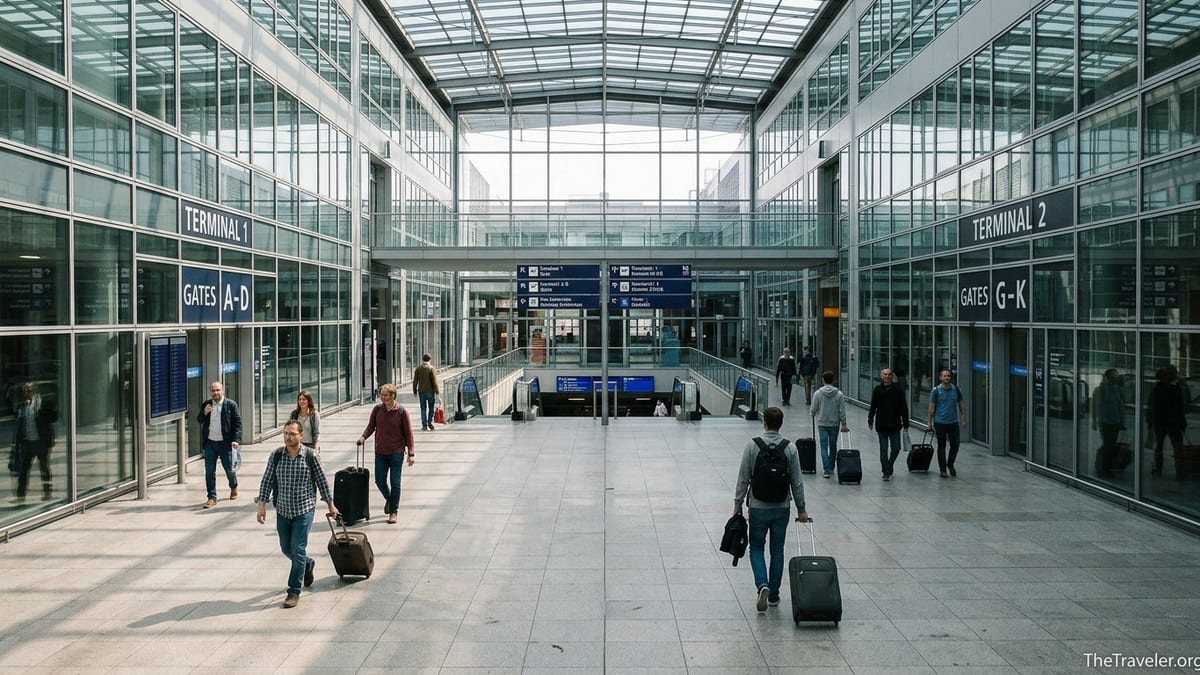
Munich Airport in a Nutshell: How the Terminals Are Laid Out
Munich Airport has a simple overall layout on paper: Terminal 1 on one side, Terminal 2 on the other, with the open air Munich Airport Center (MAC) plaza in between. In reality, each terminal is split into several modules or concourses, and Terminal 2 also has a separate satellite building reached by an underground shuttle. Understanding this basic geography helps you decode your boarding pass and the signs in the terminal.
Terminal 1 is the older, more segmented building. It is divided into modules A, B, C, D and E plus the Z check in area which sits directly at the MAC. Arrivals and departures for most non Lufthansa and non Star Alliance airlines use one of these modules. For example, many leisure carriers to the Mediterranean or charter flights to Egypt and Turkey will show gate areas in Terminal 1 such as B or C on departure boards.
Terminal 2 is newer and more unified. It has a central check in hall and two main gate levels, G and H, plus an additional satellite terminal across the apron with J, K and L gates, connected by an underground shuttle train. When you see a boarding pass marked “MUC T2, Gate G23” you are departing from the main Terminal 2 building in the Schengen zone. If you see “K16” or “L24” you are in the satellite.
Between the two stands the Munich Airport Center, a covered plaza that feels like a small town square with supermarkets, cafés and seating. Many travelers use this area to regroup between flights, pick up snacks or even visit the Christmas market that sets up here in December, before heading on to Terminal 1 or 2.
Who Flies From Where: Airlines in Terminal 1 vs Terminal 2
The simplest rule of thumb is this: Lufthansa Group and most Star Alliance airlines use Terminal 2, while almost all other airlines use Terminal 1. The airport and Lufthansa jointly operate the Terminal 2 system, and official information confirms that T2 and its satellite are reserved exclusively for Lufthansa Group and Star Alliance partners, plus a handful of close cooperation partners that periodically move into T2 as agreements change.
In practice, this means that if you are flying with Lufthansa, Swiss, Austrian, Brussels Airlines, Eurowings, Air Dolomiti or the Italian carrier ITA Airways, you will typically depart and arrive at Terminal 2. Star Alliance partners such as United Airlines, Air Canada, ANA, Singapore Airlines and Turkish Airlines also use Terminal 2, which allows for easier connections within the alliance. For example, a passenger flying Denver to Munich on United and then Munich to Rome on Lufthansa will usually remain within Terminal 2 for the entire transfer.
Terminal 1 handles everyone else. This includes many oneworld and SkyTeam airlines and a wide range of non aligned carriers. Long haul flights with American Airlines and Delta Air Lines, for example, use the new non Schengen pier connected to Terminal 1, while Gulf carriers such as Emirates, Etihad and Qatar Airways are also grouped into the expanded Terminal 1 non Schengen area. Leisure and low cost airlines to holiday destinations, such as SunExpress or some seasonal operations by European carriers, also work out of Terminal 1’s modules.
Because airline allocations can change, especially after new cooperation deals, it is always worth checking your booking confirmation or the airport’s airline list shortly before you fly. As a real world example, ITA Airways moved its Munich operations into Terminal 2 once it joined the Lufthansa Group, simplifying connections from its Rome flights onto Lufthansa and Air Dolomiti.
Decoding Your Boarding Pass: Check In Areas and Zone Codes
Your boarding pass and booking confirmation usually tell you which terminal and zone to use in Munich, but the codes can look cryptic. If you see T1A, T1B, T1C, T1D or T1E, your check in is at Terminal 1 in the corresponding module. T1Z on the ticket points you to the Z check in counters in the Munich Airport Center, which serve as an extension of Terminal 1. When only “T1” is shown, screens on site will direct you to the correct module once your flight opens for check in.
For Terminal 2, the code is simply T2. Official airport guidance states that T2 on your ticket means using the central departure hall of Terminal 2. In practice, if you arrive at Munich by train, S Bahn or bus, signs for Terminal 2 lead you directly into this light filled hall with long rows of Lufthansa and partner airline check in counters, as well as self service bag drop machines for many destinations.
Digital and evening before check in options exist in both terminals, but they are most widely used by Lufthansa and its partners in Terminal 2. For instance, a traveler on Lufthansa from Munich to Frankfurt at 08:00 can often check in baggage the evening before at dedicated counters, freeing up time the next morning. Many airlines also support mobile boarding passes, in which case you only need to locate the bag drop counter listed for your flight on the departures screens.
One practical tip: look at the gate letter as soon as it appears. If you see a G or K gate, you are in the Schengen area of Terminal 2 (main building for G, satellite for K). An H or L gate indicates a non Schengen departure in Terminal 2. In Terminal 1, the module letter doubles as your general direction inside the building: an A gate means following signs to Module A, a D gate to Module D, and so on.
Gates, Schengen vs Non Schengen, and the T2 Satellite
Munich is a Schengen hub, so the airport clearly separates Schengen flights, such as those within most of the European Union and associated countries, from non Schengen long haul services. Terminal 2 handles this using different gate levels and the satellite building. Gates G and K typically serve Schengen flights, while H and L are mostly non Schengen, though occasional operational exceptions occur. Passport control points sit between these zones, so you may pass through immigration when moving from, say, a G gate to an L gate.
The Terminal 2 satellite is a large, modern concourse that opened about a decade ago and is connected to the main T2 building by an underground shuttle train. Gates J, K and L are located here, with K and L on different levels. Transfer times between the main building and the satellite are relatively short: many travelers report being able to move from an H gate in the main terminal to an L gate in the satellite in around 10 to 15 minutes, including the short ride on the shuttle train, as long as there are no extra security checks.
In Terminal 1, the modules function a bit differently but follow the same Schengen versus non Schengen logic. Selected modules and the new pier focus on non Schengen traffic to destinations like New York, Doha or Dubai, while other modules see a mix of European Schengen flights and medium haul services. For instance, a passenger flying Munich to Athens on a leisure airline might depart from a Schengen equipped module in Terminal 1, pass through a dedicated passport control, then board from a C or D gate.
The difference in ambience between the two terminals is noticeable. Terminal 2 and its satellite tend to feel more like a single, cohesive Lufthansa hub with uniform signage, frequent Star Alliance branding and several airline operated lounges. Terminal 1 can feel more fragmented and utilitarian, with some areas upgraded in line with the new pier and others still reflecting older design, but it offers a wide mix of carriers and is the only option if your airline is not part of Lufthansa’s network.
Transferring Between Terminal 1 and Terminal 2
If your itinerary involves changing from an airline in Terminal 1 to one in Terminal 2 or the other way around, you will need to transfer between buildings. This is common, for example, on a journey booked as two separate tickets, such as arriving from London on a low cost carrier in Terminal 1 and then continuing to Asia on Lufthansa from Terminal 2. Official information and passenger reports agree that you should factor in generous time for this, typically at least 90 minutes and preferably 2 hours, especially if you must clear immigration, collect bags and recheck.
Munich Airport provides a free shuttle bus between Terminal 1 and Terminal 2 that runs on airside and landside routes depending on your status and ticket. Signage in the arrivals areas points toward the shuttle stops, and announcements on long haul flights often mention the bus for connecting passengers. In real experiences shared by travelers, a typical transfer from Terminal 1 to Terminal 2, including walking, waiting for the shuttle and riding it, can easily take 20 to 30 minutes before you even re enter security or passport control.
In addition to the shuttle bus, it is possible to walk between the terminals via the Munich Airport Center. This can be more pleasant in good weather, as you pass cafes and shops in the covered plaza. However, it is still a substantial walk, especially with luggage. Once you arrive at the other terminal, you may need to pass through security again and possibly immigration, depending on whether you are switching between Schengen and non Schengen flights or rechecking baggage.
Because of these variables, itineraries that change alliances between terminals on a single ticket, such as an American Airlines arrival in Terminal 1 followed by a Lufthansa departure in Terminal 2, are usually given longer official minimum connection times. When booked on separate tickets, travelers often choose at least three to four hours in case of delays. That extra time can make the difference between a calm stroll through the MAC and a stressful dash across the airport.
What It Feels Like: Check In, Security and Amenities in Each Terminal
From a passenger’s perspective, the check in experience differs slightly between the two terminals. Terminal 2’s central hall is designed as a Lufthansa hub, with long, clearly numbered check in islands and self service kiosks. For example, on a busy Monday morning you might find all Lufthansa economy check in for flights within Europe grouped in one area, premium economy and business class in another, and dedicated counters for First Class or status customers. Many travelers appreciate the efficient flow and the abundance of automated bag drops which shorten queues during off peak periods.
Terminal 1, by contrast, spreads check in across its modules and the Z area. Each airline or group of airlines has its own bank of counters. On a summer Saturday, you might see long lines of holidaymakers checking in for charter flights to Antalya or Hurghada in one module, while a handful of business passengers quietly check in for an evening transatlantic service in another. Some areas have modernized layouts with self service options, especially around the new non Schengen pier, but others still rely primarily on traditional counters.
Security control can also feel different. Terminal 2 often benefits from the airport’s investment in faster screening technology and standardized lanes, which can cut wait times during normal operations. That said, any major hub can see peaks where queues lengthen. In the modular Terminal 1 layout, security checkpoints are more dispersed, and experiences can vary considerably between modules. Travelers connecting from Terminal 2 to Terminal 1 sometimes comment that security in certain parts of T1 feels slower or less streamlined than in T2, so it is wise to head for the checkpoints as soon as they open for your flight.
On the amenities side, Terminal 2 and its satellite offer a dense cluster of Lufthansa and Star Alliance lounges, from Senator and Business Lounges to a First Class Lounge with direct transfer services for some premium passengers. There are also many mid range and higher end dining options, including Bavarian style restaurants where you can order a pretzel and a local wheat beer, as well as international chains. Terminal 1 has a different mix, including pay in lounges such as Airport Lounge World, popular with Priority Pass members, and a variety of cafes and fast food options that support its broader mix of airlines.
Timing Your Connection: How Much Time Do You Really Need?
Munich has a reputation for being an efficient connecting airport, particularly within Terminal 2 for Lufthansa and Star Alliance itineraries on a single ticket. Many passengers report successful domestic or Schengen connections of 45 to 60 minutes entirely within T2, especially when arriving and departing from the same zone, such as G to G or G to K, without extra security checks. The airport designs its minimum connection times with this in mind, and airlines will usually protect you if inbound delays cause a missed connection.
Connections that involve the satellite, such as H to L or G to K, add only a few minutes of transit time because of the frequent underground shuttle train. If you arrive on a long haul flight from North America at an H gate and continue to a Schengen destination from a K gate, passport control and the shuttle ride are normally the main steps. Many travelers describe walking at a normal pace, riding the shuttle and reaching their onward gate in under 30 minutes.
The picture changes significantly when you must cross between Terminal 1 and Terminal 2. Here you should avoid booking tight transfers unless you are confident in your rights on a single alliance ticket. An example shared by many travelers involves arriving with Lufthansa in Terminal 2 and connecting to a long haul flight with a non Star Alliance airline in Terminal 1. Even if the systems show a legal connection time of 90 minutes, any delay, long queues at immigration or slow baggage delivery can quickly eat into that margin.
If you have booked separate tickets, such as a low cost arrival in Terminal 1 followed by a Star Alliance departure in Terminal 2, a safer approach is to leave at least three hours between flights. This gives you time to clear formalities, use the shuttle or walk, recheck bags and still have some buffer for security queues. Travelers using Munich as a gateway for ski trips to the Alps, for example, often intentionally plan a long layover to accommodate luggage like skis or snowboards and potential winter weather delays.
The Takeaway
Choosing between Terminal 1 and Terminal 2 at Munich Airport is less about preference and more about which airline you fly, but knowing how the two terminals work can make your journey smoother. Terminal 2 and its satellite operate as a dedicated hub for Lufthansa, the wider Lufthansa Group and most Star Alliance partners, with a modern, integrated layout that favors straightforward connections and a dense network of lounges and services. Terminal 1 serves as the home for almost all other airlines, from major US carriers to Gulf airlines and leisure operators, spread across several modules and a new non Schengen pier.
For simple point to point trips, your main tasks are to read the terminal and module codes on your ticket, follow the signs to the correct check in area and allow enough time for security and, where applicable, passport control. For connections, especially between Terminal 1 and Terminal 2 or between Schengen and non Schengen flights, it pays to build in extra time and to understand how to use the shuttle bus or the underground train to the T2 satellite.
In practical terms, if your itinerary is all on Lufthansa or Star Alliance, you can usually relax knowing you will stay within Terminal 2’s ecosystem. If you are mixing alliances or combining separate tickets, think strategically: longer layovers, minimal checked luggage where possible and a willingness to walk briskly can turn Munich’s two terminal system from a source of anxiety into a manageable part of your trip. With the right expectations and a clear sense of the layout, Munich Airport becomes a hub you can navigate with confidence instead of confusion.
FAQ
Q1. How do I know if I need Terminal 1 or Terminal 2 at Munich?
Your airline determines the terminal. Lufthansa, Lufthansa Group and most Star Alliance airlines use Terminal 2, while most other airlines, including many US and Gulf carriers, use Terminal 1. Check your booking confirmation or boarding pass for “T1” or “T2.”
Q2. What is the easiest way to transfer between Terminal 1 and Terminal 2?
The airport operates a free shuttle bus between Terminal 1 and Terminal 2, and you can also walk via the Munich Airport Center plaza. Plan at least 20 to 30 minutes just for the physical transfer, plus extra time for immigration, baggage and security if needed.
Q3. How much time do I need for a connection within Terminal 2?
For connections entirely within Terminal 2 on a single ticket, 45 to 60 minutes is often sufficient when operations are normal. If you must change between Schengen and non Schengen gates or use the satellite, aim for at least 60 to 75 minutes to be safe.
Q4. Can I walk from Terminal 2 to the T2 satellite gates K and L?
No, the satellite is reached by an underground shuttle train that runs frequently between the main Terminal 2 building and the satellite. The ride itself takes only a few minutes, but allow time for walking to and from the shuttle platforms.
Q5. Are security procedures different in Terminal 1 and Terminal 2?
Both terminals follow the same security rules, but the layout and equipment differ. Terminal 2 generally has more standardized and modern checkpoints, while Terminal 1’s experience can vary by module. In either case, arrive early and be prepared for peak time queues.
Q6. Where are the Lufthansa and Star Alliance lounges at Munich Airport?
Lufthansa and Star Alliance lounges are concentrated in Terminal 2 and the T2 satellite, near both Schengen and non Schengen gates. They include Business, Senator and some First Class facilities. Terminal 1 instead offers independent pay in lounges such as Airport Lounge World.
Q7. What happens if my inbound flight is delayed and I miss a connection between terminals?
If both flights are on a single ticket and the connection meets the airline’s minimum time, the airline must rebook you on the next available option. If you bought separate tickets, you are usually treated as two separate trips and may need to buy a new onward ticket if you miss the second flight.
Q8. Is it possible to stay airside when connecting between Terminal 1 and Terminal 2?
In some specific through ticket scenarios, airside buses and controlled corridors may allow you to stay airside, but many passengers will need to enter the public area, especially when changing airlines or alliances. Always follow the transfer signs and staff instructions for your specific flight combination.
Q9. Which terminal is better for food and shopping during a layover?
Terminal 2 and its satellite generally offer a broader range of dining and shopping, from Bavarian restaurants to international chains and duty free stores. Terminal 1 still has plenty of options, and the Munich Airport Center between the terminals adds supermarkets, cafes and seasonal markets.
Q10. Can I use the train or bus to reach either terminal directly from Munich city?
Yes. The S Bahn suburban trains stop at the airport and provide access to both terminals via clearly marked exits, and dedicated airport buses stop at Terminal 1, the Munich Airport Center and Terminal 2. Follow the signs from the station or bus stop to your designated terminal and check in area.