


Landing at Munich Airport can feel surprisingly calm for a major European hub, but your first hour still matters. Knowing exactly what happens after touchdown – from passport control and baggage claim to finding cash, mobile data and the right train or taxi – will save you time, stress and in some cases a fair amount of money. This guide walks you through the arrivals process at Munich Airport in 2026, using concrete examples so you know what to expect at each stage.
Get the latest updates straight to your inbox!
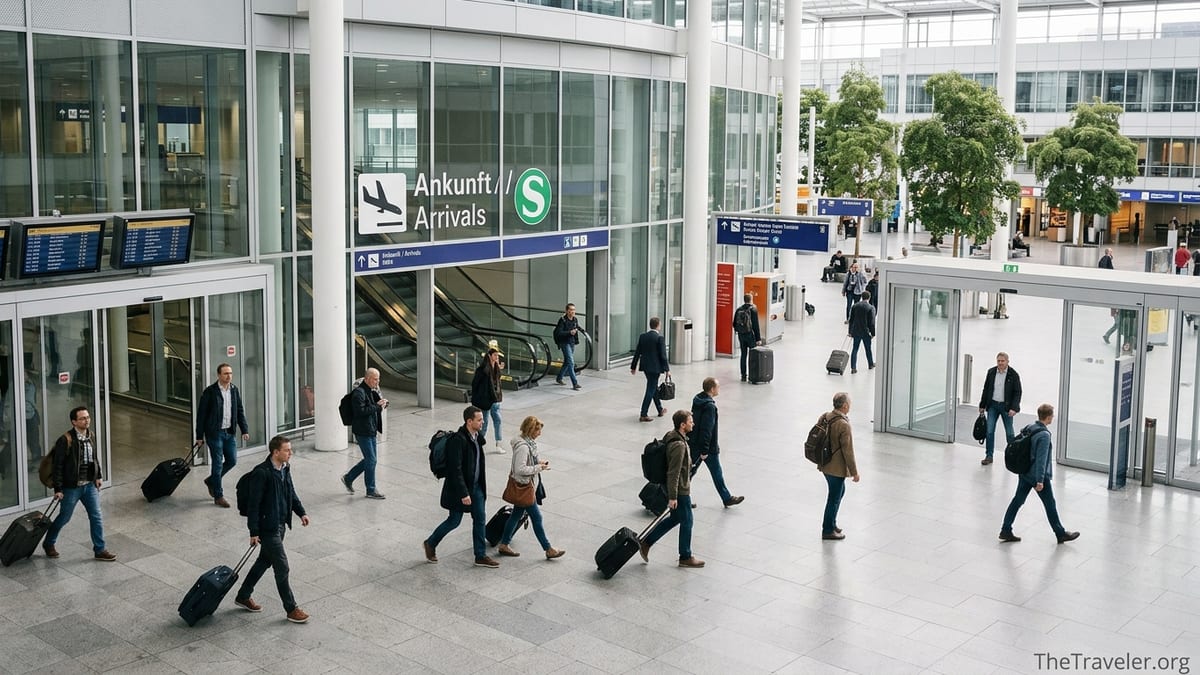
Understanding Munich Airport’s Layout After You Land
Munich Airport (MUC) has two main passenger terminals: Terminal 1 and Terminal 2, plus a central area known as the Munich Airport Center (MAC). Most non Lufthansa and non Star Alliance airlines arrive in Terminal 1, split into several modules (A, B, C, D, E). Lufthansa, SWISS, Austrian and many Star Alliance partners usually arrive in Terminal 2, including its satellite gates which are connected to the main building by an underground people mover. Wherever you land, all arriving passengers eventually funnel toward passport control and baggage claim on the arrivals level.
Arrivals in Terminal 1 typically exit the aircraft directly into the terminal building or via bus from a remote stand, then follow yellow “Ankunft / Arrivals” and blue “Transfer” signs. In Terminal 2, long haul flights may arrive at the satellite gates (G or L). From a satellite gate you take the short underground shuttle to the main Terminal 2 building, then follow the “Exit / Baggage Claim” signs. You do not need to make any decisions yet about trains or buses; all of that comes after customs in the public arrivals hall.
The Munich Airport Center connects Terminal 1 and Terminal 2 and sits directly above the S Bahn suburban train station. Many key services you will need after arrival – larger ATMs, some SIM card options, supermarkets and cafes – are in or around the MAC. Walking time from either terminal’s central arrivals area to the MAC is typically 5 to 10 minutes under cover, so you do not need to go outside or take a shuttle to reach public transport.
Because arrivals for different airlines are clustered, it is useful to know your terminal in advance. For example, a United Airlines flight from Newark will normally arrive into Terminal 2, while a Ryanair flight from a European city will use Terminal 1. This affects where your friends meet you and which signage you follow to the train station, but the overall arrivals process is similar in both terminals.
Passport Control and the New EES Process
If you are arriving from outside the Schengen Area – for example from the United States, the United Kingdom or Turkey – you will first go through passport control. Travelers from Schengen countries such as France, Italy or Austria usually arrive as domestic passengers and skip immigration, going straight to baggage claim. Follow signs for “Passport Control” or the blue EU flag symbols to reach the correct lane.
Munich Airport is part of the new EU Entry / Exit System (EES) rollout for many non EU travelers. On your first entry after EES has been activated for your nationality, you may be asked to use automated kiosks that capture your fingerprints and facial image before you go to a border officer. Passengers report that at busy evening peaks this process can add 15 to 30 minutes to the normal queue, while at quieter times early in the morning they are through immigration in about 10 to 20 minutes. Plan conservatively if you have a tight onward train: assuming 45 to 60 minutes from landing to exiting passport control is prudent for long haul non EU arrivals.
EU and many other eligible biometric passport holders can usually use automated eGates in both terminals. You place your passport on the reader, look at the camera, and once the gate opens you proceed without an officer stamping your passport. If you are traveling as a family and have children under 12, they may need to use the staffed booths, which can be slower. Check for queue signage that separates EU / EEA / Swiss passports from “All Passports” so you do not wait unnecessarily in the wrong line.
If you have a tight rail connection pre booked, it is safer to choose a flexible ticket rather than a specific departure immediately after landing. For example, instead of booking a non changeable long distance ICE train from Munich Central Station only 90 minutes after your scheduled arrival, consider an unreserved regional ticket or allow a two hour buffer. Passport control is the step with the most unpredictable delays, particularly on peak summer weekends when many long haul flights arrive back to back.
Baggage Claim and Customs: What Happens and How Long It Takes
Once through passport control you descend to the baggage claim level. Overhead monitors show your flight number and carousel. At Munich Airport, waiting times for checked bags vary: some passengers collect luggage within 15 minutes of reaching the carousel, while others report 30 minutes or more during busy periods. If you are seated at the back of the aircraft or arrive via bus from a remote stand, you may reach baggage claim a little later and find your suitcase already circulating.
The baggage halls in both terminals offer trolleys, toilets and the first basic services for arriving passengers. If your bag does not appear, look for your airline’s lost baggage desk directly in the hall. For example, Lufthansa and its partners in Terminal 2 have a dedicated service counter, while other airlines in Terminal 1 use shared ground handling offices. Have your baggage tag and boarding pass ready. Many airlines at Munich can arrange delivery of delayed bags to hotels within the city at no extra charge, though it might take 24 to 48 hours.
After retrieving your bags you walk toward customs. As in most EU airports there are separate channels: “Nothing to declare” and “Goods to declare.” Travelers arriving from other EU countries usually have minimal customs checks unless they are carrying exceptional quantities of alcohol, tobacco or high duty items. Passengers from non EU countries should be aware of limits on cigarettes, spirits, perfume and certain foods. In practice most visitors with standard holiday shopping pass straight through the green channel in under a minute, but customs officers can select individuals for random checks.
Customs is your last controlled step before you enter the public arrivals hall. Once you exit, you cannot easily go back to the baggage area, so double check that you have your full luggage set, baby strollers and any items removed from overhead bins. If you realize something is missing after you are already in the arrivals hall, you may need to contact your airline or an information desk rather than simply walking back.
Money, ATMs and SIM Cards: Getting Connected and Equipped
After customs you step into the public arrivals area of your terminal. This is where you first see meeters and greeters, car rental desks and a selection of shops. If you need cash, use an ATM belonging to a major bank rather than a generic currency exchange kiosk. In practice this means looking for machines branded by large German banks integrated into the Sparkasse or Volksbank networks, or international banks that have branches at the airport. Avoid standalone currency machines that prominently advertise “0 percent commission” but offer poor exchange rates.
A typical cash withdrawal with a foreign debit card might incur a small fee from your home bank and an optional conversion fee from the German ATM. Always choose to be charged in euros rather than letting the ATM convert the amount into your home currency at a dynamic rate. For most everyday expenses in Munich you can rely on cards and mobile payments, but it is still useful to withdraw 50 to 100 euros to cover smaller bakeries, public restrooms away from the airport or rural buses if you are traveling into Bavaria.
For mobile connectivity you have several options. Inside the arrivals areas and the Munich Airport Center you will usually find convenience stores and telecom stands selling prepaid SIM cards from providers such as Telekom, Vodafone, O2 or discount brands that ride on these networks. Typical short stay prepaid packages sold in Germany in 2026 include around 10 to 20 GB of data plus domestic calls and texts for roughly 15 to 30 euros, valid for four weeks. Regulations require identification when you buy a SIM, so bring your passport. Staff typically scan your ID and complete the registration; you may be asked to confirm via video or automated system.
If you have an eSIM capable phone, buying and activating a travel eSIM before you land can be even simpler. Several international providers sell German or Europe wide data packages that you can install via app while still at home, then switch on as you taxi to the gate in Munich. Prices are often competitive, especially for pure data plans without local voice minutes, and you avoid needing to queue or navigate German language registration screens while jet lagged. As a real world example, many visitors load a 10 GB Europe wide eSIM for around 20 euros and keep their home number active on the same device for calls from family.
Reaching the Train Station: S Bahn, Regional Trains and Tickets
Munich Airport’s train station, called München Flughafen Terminal, is directly beneath the Munich Airport Center between Terminals 1 and 2. To reach it, follow signs with the white “S” in a green circle that indicate the S Bahn. From both terminals it is a short indoor walk, usually 5 to 10 minutes, plus escalators or elevators down to the platform level. You do not need a shuttle bus to reach the station unless you have significant mobility constraints.
Two S Bahn lines, S1 and S8, connect Munich Airport with the city. They run at least every 20 minutes each and are staggered so that a train into town usually departs every 10 minutes. Both lines reach major city center stations like Munich East (München Ost) and Munich Central (München Hbf), but they take slightly different routes and travel times. The S8, which goes via the eastern districts and Marienplatz, is usually a bit faster to the historic center, with a travel time of around 38 to 45 minutes to the main station. The S1 runs via the northwest suburbs and can take closer to 45 minutes, depending on where you exit.
For ticketing, Munich Airport lies in the outer zones of the Munich public transport network, so you need a ticket that covers all zones from the airport into the city. Many visitors choose an all day ticket that includes the airport zone and the city center, which is especially good value if you plan to use trams or buses later the same day. As a rule of thumb, a one way adult ticket from the airport to Munich Central Station is often in the low teens in euros, while a group day ticket for up to five people costs more but becomes much cheaper per person.
You can buy tickets from the blue and white machines on the station concourse, from some red Deutsche Bahn machines, or via public transport apps that support mobile tickets. Machines can be switched to English and accept most international credit and debit cards. If you buy a paper ticket, check whether it needs to be validated in the small blue stamping machines on the platform before boarding. Many city tickets are time stamped at purchase, but some products still require you to validate just once at the start of your journey.
Buses, Long Distance Coaches and Onward Rail Travel
In addition to the S Bahn, several regional buses and long distance coaches serve Munich Airport. Local public buses connect the airport with nearby towns such as Freising, Erding or Moosburg. These buses usually depart from stops in front of Terminal 1 or Terminal 2 on the arrivals level and are clearly marked with route numbers. For example, if you are staying in Freising to catch an early long distance train the next morning, you can take a regional bus or a short S Bahn hop instead of going all the way into Munich and back out again.
A dedicated airport bus connects Munich Airport with key points in the city, such as Munich Central Station or the Schwabing district near Nordfriedhof. This coach style service offers luggage storage and Wi Fi and can be more comfortable if you have bulky suitcases. Prices are typically higher than the S Bahn but still noticeably cheaper than a taxi, and the travel time into the city center is similar to or slightly faster than the train depending on traffic. Tickets are sold at airport counters, ticket machines near the bus stops and often directly from the driver.
For travelers continuing by long distance train, you will usually change from S Bahn to long distance services at Munich Central Station or Munich East. Some regional express trains now start or end at the airport station itself, heading toward destinations in Lower Bavaria and beyond, but most intercity and high speed ICE trains still originate in the city. When planning connections, allow at least 20 to 30 minutes buffer between your S Bahn arrival and your long distance departure to account for any minor delays or platform changes.
If you are connecting to Austrian resorts or Alpine towns, such as Kitzbühel or Zell am See, many itineraries require you to reach Munich East station, then change to an international regional or long distance service. In this case it can be quicker to stay on the S8 until Munich East rather than heading first to the central station. Always check your rail ticket’s departure station carefully; missing that detail is one of the most common causes of last minute stress for newly arrived passengers.
Taxis, Ride Hailing and Private Transfers
Taxis at Munich Airport line up outside each terminal on the arrivals level. Official city taxis are beige sedans or larger vehicles with roof signs and meters. The city of Munich sets regulated fares, and in 2026 there is also a fixed price for standard taxi trips between the airport and the central city zone. As a ballpark example, a typical official taxi ride from Munich Airport to the vicinity of Munich Central Station or Marienplatz costs on the order of 90 to 100 euros in normal traffic, with the fixed tariff protecting you from significant surcharges due to congestion.
Ride hailing services such as Uber, Bolt or Free Now operate in Munich, but new local regulations have narrowed the price gap between them and traditional taxis. Depending on the time of day and demand, you may find a ride hailing fare to the city center around 75 to 90 euros, which is still substantial compared with public transport. Pick up points for these services are usually near the official taxi ranks, and the app will guide you to the exact zone. Given the similar pricing, many visitors focus instead on comfort and ease of payment when choosing between a traditional taxi and an app based ride.
For families or groups with heavy luggage, a pre booked private transfer can make sense. Local companies and some hotel chains offer fixed price airport pickups where a driver waits in the arrivals hall with a sign, helps with bags and drives you directly to your lodging. Prices vary but often start around 110 to 130 euros for a private van or larger vehicle, which can be cost effective if four or more people share the trip, especially late at night when S Bahn frequencies are lower.
When evaluating cost and convenience, compare realistic examples. A couple arriving at 8 p.m. with two checked bags might spend roughly 25 to 30 euros total for two S Bahn tickets into the city and arrive in about 45 minutes, versus paying around 95 euros for a door to door taxi in about 35 to 40 minutes in moderate traffic. If you are staying beside a central S Bahn station like Marienplatz or Isartor, the train option is usually simple. If your hotel is in a side street far from any station and you arrive late with children, the extra cost of a taxi may be worth it.
Practical Tips for Your First Hour in Munich
Your first 60 to 90 minutes after landing set the tone for your trip. Small decisions at each stage can reduce stress. Try to use airport Wi Fi, which is usually free and does not require complex registration, as soon as you step off the aircraft or reach the terminal. This lets you message your hotel, check the live S Bahn departure board or download a transport app before you reach the busy arrivals area.
If you are worried about missing a specific train or bus, focus on controlling what you can. Sit closer to the front of the aircraft when possible so you disembark earlier, keep your documents ready for passport control, and use restrooms after customs rather than just before immigration when lines are longest. At baggage claim, stand where you can see both your carousel and the nearest information screen; if your flight number disappears from the monitor, it usually means all bags have been delivered.
In the arrivals hall, ignore anyone approaching you directly to offer transport or unofficial exchange services. Stick to clearly signed taxi ranks, official ticket counters and ATMs that belong to recognized banks. Munich is generally a safe airport with low levels of aggressive touting compared with some other European hubs, but being polite and firm about using only official channels will keep you on the safe side.
Finally, consider your energy levels. After an overnight flight from North America you might feel tempted to squeeze in a side trip on the way into town, such as stopping at the nearby town of Freising or heading straight onto a long distance train to another region. While these plans are absolutely possible in practice, leave yourself a generous buffer and be ready to adjust if passport control or baggage takes longer than expected. Building in an extra hour at Munich Central Station for a coffee and a walk in the fresh air can be a more pleasant start to your trip than sprinting across platforms with jet lag.
FAQ
Q1. How long does it usually take to get from landing to the Munich Airport train station?
For most passengers it takes about 45 to 75 minutes from touchdown to reaching the S Bahn platform, including taxiing, disembarking, passport control and baggage claim. At very quiet times with hand luggage only you might reach the station in around 30 minutes; at peak times with EES registration it can take closer to 90 minutes.
Q2. Which S Bahn line should I take from Munich Airport, S1 or S8?
Both reach the city center, but many visitors prefer the S8 because it is usually a little faster to Munich East, Marienplatz and the central station. The S1 is better if you are staying in the northwestern suburbs. If in doubt, take whichever line departs first and change later if needed.
Q3. How much does the train from Munich Airport to the city center cost?
Exact fares depend on the ticket type, but as a guideline a standard adult one way ticket from the airport to Munich Central Station typically costs in the low teens in euros. Day tickets that cover the airport and the whole urban area are more expensive but can be cheaper overall if you plan multiple rides the same day.
Q4. Is taking a taxi from Munich Airport worth the price?
It depends on your priorities. A regulated taxi to central Munich usually costs around 90 to 100 euros and takes roughly 35 to 45 minutes. For solo travelers or couples near an S Bahn station the train is far cheaper, while families with lots of luggage or those arriving late at night may find the convenience of a taxi or pre booked transfer worth the extra cost.
Q5. Can I buy a local SIM card at Munich Airport on arrival?
Yes. Convenience stores and telecom counters in the arrivals areas and the Munich Airport Center sell prepaid SIM cards from major German operators and discount brands. Expect to show your passport for ID checks and to pay roughly 15 to 30 euros for a data rich package valid for about a month.
Q6. Is it better to use an eSIM instead of buying a physical SIM in Munich?
If your phone supports eSIM, many travelers find it easier to purchase and activate a Europe wide eSIM before they fly. You land already connected, avoid queues and still pay similar or sometimes lower prices compared with airport kiosks. Physical SIMs work well too, but the registration process can take a little longer when you are tired.
Q7. Where are the ATMs located in Munich Airport arrivals?
ATMs are available in each terminal’s public arrivals hall and in the Munich Airport Center near the train station. Look for machines branded by established banks and decline any offer to charge your withdrawal in your home currency, choosing to pay in euros instead for better rates.
Q8. How late do public transport options run from the airport into Munich?
The S Bahn lines S1 and S8 run from early morning until late at night, with services roughly every 20 minutes on each line and combined frequencies of about every 10 minutes during much of the day. Late evening and early morning intervals can be longer, so if you land around midnight or very early, check the first and last train times in advance and consider a taxi as backup.
Q9. What should I do if my luggage is lost or delayed at Munich Airport?
Stay in the baggage hall and go directly to your airline’s lost baggage desk or the ground handler’s counter before passing through customs. Show your baggage tag and boarding pass, file a report, and provide the address of your hotel or accommodation. Most airlines can deliver your bag to a Munich address once it arrives, so you do not necessarily need to return to the airport.
Q10. Is Munich Airport easy to navigate for first time visitors?
Yes. Signage is clear, terminals are compact compared with many other major European hubs, and the walk between terminals and the train station is short and indoors. As long as you follow the “Ankunft / Arrivals” and green S Bahn signs step by step, you should find passport control, baggage claim, customs and onward transport without difficulty.