


For many long-haul travelers, Germany’s two big hubs, Munich Airport (MUC) and Frankfurt Airport (FRA), are the gateway to Europe. Both are major bases for Lufthansa and Star Alliance, both offer a deep route network across Europe, North America and Asia, and both regularly appear as connection points when you search for flights from the United States to Europe, the Middle East or India. Yet the experience on the ground can feel very different. This comparison looks at real-world factors that matter when you are booking: flight connections and Lufthansa routes, transfer and immigration experience, city access, delays and reliability, and day-to-day convenience in each hub.
Get the latest updates straight to your inbox!
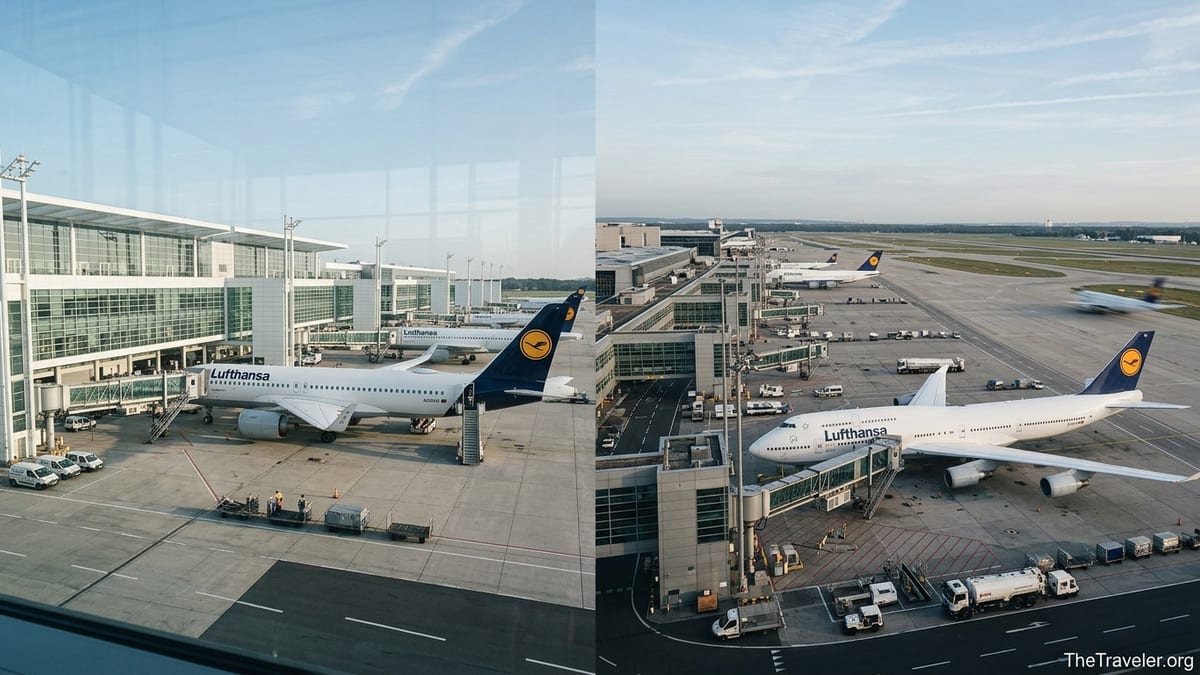
How Munich and Frankfurt Compare as Lufthansa Hubs
Frankfurt Airport is the larger of the two hubs by total traffic and remains Lufthansa’s primary intercontinental base. It typically offers the widest selection of long-haul destinations on the carrier, including multiple daily flights to major U.S. gateways such as New York, Chicago and Los Angeles, as well as dense schedules to India and the Middle East. For example, a traveler flying from Denver to Bangalore is more likely to see an attractive same-day connection via Frankfurt than via Munich when searching on Lufthansa’s website or a major online travel agency. Frankfurt’s long-distance train station directly under Terminal 1 also feeds in passengers from across Germany using Lufthansa Express Rail, which sells combined train plus flight itineraries that are protected in case of delay.
Munich, however, has grown into Lufthansa’s second hub and often feels more manageable. While it serves fewer total long-haul destinations, it has become an important hub for North America and Asia with routes such as Boston, New York, Los Angeles, Tokyo and Seoul operated seasonally or year-round depending on demand. Recent Munich Airport reports show that transfer passengers make up roughly two-fifths of its traffic, underlining its role as a true connecting hub rather than just an origin-and-destination airport. This is evident on typical itineraries like San Francisco to Rome or Toronto to Prague, where booking engines often surface a smooth 90-minute to 2-hour connection in Munich as an alternative to a change in Frankfurt.
For travelers, this means a trade-off: Frankfurt maximizes sheer choice and frequency, especially if you are headed to secondary cities in Africa, Asia or the Middle East. Munich, by contrast, balances a still-strong route network with an airport layout and processes that many frequent flyers consider less stressful. If your priority is the single fastest connection to a niche destination, Frankfurt often wins. If your priority is a smoother transit experience with fewer bottlenecks, Munich is frequently the better bet even when that means a slightly longer journey on paper.
Transfer Experience and Minimum Connection Times
When you are connecting from a long-haul flight to a European short-haul service, transfer experience can matter more than almost anything else. In Frankfurt, terminals and gate areas are spread out, often involving long walks, multiple escalators and busy security checkpoints. Non‑Schengen to Schengen transfers frequently require passengers to pass both passport control and security again. It is common for a traveler arriving from Chicago at one of the Z gates to need 25 to 45 minutes simply to reach an A or B gate for a European flight, especially at morning peaks when lines for immigration and security can lengthen.
Munich’s layout is more compact, with its two main terminals organized in a way that generally keeps walking distances shorter. Passengers arriving on Lufthansa or other Star Alliance carriers often find themselves transferring within the same terminal complex, frequently with clear signage and fewer chokepoints. Real-world reports from frequent flyers who connect several times a year often describe Munich as a “breeze” for transfers, with 60 to 90 minutes typically feeling comfortable for non‑Schengen to Schengen connections under normal conditions. A traveler connecting from Newark to Vienna via Munich, for example, might land at a non‑Schengen gate, pass through a relatively efficient passport control, and then walk directly to a nearby Schengen gate without additional security screening, depending on the gate pair.
In practice, Lufthansa and other airlines tend to offer slightly shorter minimum connection times in Munich than in Frankfurt for many international itineraries. You might see legal connections of around 45 minutes on some intra‑Schengen itineraries in Munich, while similar connections in Frankfurt may be padded to an hour or more. While both hubs can handle tight turns when operations run smoothly, travelers who prefer a stress-free layover often deliberately choose Munich when booking, even if that means a 30-minute longer total journey to their final destination. On the other hand, if you value redundancy in case of disruption, the sheer number of daily departures out of Frankfurt may increase your chances of being rebooked the same day should you misconnect.
Delays, Disruptions and Reliability
Delays and irregular operations are a moving target at any major hub, and performance changes by season. However, anecdotal feedback from frequent flyers and recent operational reviews point to some consistent patterns. Frankfurt, as the busier and more slot-constrained hub, often shows more strain during peak periods. Long security queues in Terminal 1, crowded immigration lines for non‑EU travelers and tight runway capacity all combine to create a higher likelihood of pushback delays, especially during morning and evening banks when many long-haul flights arrive and depart.
Munich has faced its own challenges, particularly during bad weather and in periods of staffing shortages, but it generally benefits from a less congested airfield and a more modern terminal design. Recent efforts by Munich Airport and Lufthansa to optimize operations and reliability have focused on adjusting schedules, reallocating aircraft stands and improving baggage handling times. For a typical passenger arriving from Los Angeles and connecting to a flight to Athens in summer, this can translate into slightly higher odds that both flights depart and arrive near their scheduled times compared with a similar pairing via Frankfurt, especially when thunderstorms or fog cause air traffic control restrictions around the Rhine‑Main region.
Real-world traveler choices reflect this perceived reliability gap. Many frequent flyers who shuttle several times a year between North America and Europe with Lufthansa or its partners say they proactively filter search results to favor itineraries via Munich whenever possible, even when ticket prices are identical. Some will accept a longer layover in Munich over a tighter one in Frankfurt because they have experienced repeated delays and stressful sprints across Frankfurt’s terminals when inbound flights arrived late. Still, travelers connecting to more remote destinations, particularly in parts of Africa and the Middle East where Lufthansa schedules cluster around Frankfurt, often accept Frankfurt’s higher disruption risk as the price of better onward connectivity.
Getting into the City: Rail, Time and Cost
Access to the city center is another key factor if you are starting or ending your trip in Germany rather than just transiting. Munich Airport sits roughly 28 to 30 kilometers northeast of the city, and the main public transport link is the S‑Bahn commuter rail. Lines S1 and S8 run from the airport into central Munich, alternating every few minutes. Typical journey times from the airport to Munich Hauptbahnhof range from about 40 to 50 minutes, depending on line and time of day. Tickets from the airport to the central zone are priced around the mid‑teens in euros for a standard day ticket, with special Airport‑City day tickets costing a bit more but giving unlimited travel in the city for the rest of the day. For example, a solo traveler arriving in the morning might pay a bit over 15 euros for a day ticket covering the airport journey plus all U‑Bahn, bus and tram travel in the inner city until 6 a.m. the following day.
Beyond the S‑Bahn, Munich also offers the Lufthansa Express Bus, a nonstop coach running from the airport to key city stops like Munich North and the central station. Journey times are typically around 25 minutes to Munich North and about 45 minutes to the main station, depending on traffic. Prices are higher than the S‑Bahn but still competitive for travelers with heavy luggage who prefer a direct, seated ride without transfers. Taxis and rideshare services from the airport to downtown usually cost several times more than public transport but offer door-to-door convenience, particularly late at night when train frequencies may be lower.
Frankfurt Airport is physically closer to its city center. The airport’s two train stations, the regional station and the long-distance ICE station, are located directly beneath or next to Terminal 1. S‑Bahn lines S8 and S9 as well as regional trains typically reach Frankfurt Hauptbahnhof in about 10 to 15 minutes, usually for under 7 euros on a standard local ticket. This means a traveler arriving from New York and staying in downtown Frankfurt can often be in their hotel within 30 to 40 minutes of exiting customs, assuming checked baggage arrives promptly. Long-distance ICE trains at the airport’s Fernbahnhof also allow passengers to step off an intercontinental flight and board a high-speed train directly to cities like Cologne, Stuttgart or Berlin in a single level-change, often with integrated tickets through Lufthansa Express Rail.
For pure origin-and-destination convenience into the city center, Frankfurt has the edge. Its fast, frequent, and relatively inexpensive rail links make it easier for business travelers to squeeze in same-day meetings or for transatlantic passengers to recover quickly in a hotel after an overnight flight. Munich’s longer S‑Bahn ride, less than ideal if you have just stepped off a 10-hour flight, is still reliable and straightforward but requires more time and planning, particularly if you are catching a connecting long-distance train at Munich Hauptbahnhof. Travelers who are particularly sensitive to transfer time from plane to city may therefore lean toward Frankfurt when both hubs are an option.
Ease of Navigation, Comfort and Services
Day-to-day comfort inside the terminal can strongly influence how you remember a trip. Munich is widely regarded as one of Europe’s more pleasant hubs to spend time in. Its terminals feel airy and modern, with large windows, clear signage in German and English, and a central plaza area between the terminals known as the Munich Airport Center. Here, travelers find a covered outdoor-style space with shops, restaurants and often seasonal events such as winter markets or small concerts. Seating areas and quiet corners are relatively easy to find, which makes a two- or three-hour layover bearable even without lounge access.
Frankfurt’s terminals are more utilitarian and, in places, dated. Some concourses, especially older parts of Terminal 1, can feel cramped and crowded during peak waves of traffic. Signage has improved over the years but the layout still strikes many visitors as confusing, with long corridors, sudden security checkpoints and changes in level that make it harder to get a mental map of the building. That said, Frankfurt offers a huge range of food and retail options, from quick bakeries and coffee bars to higher-end dining in both Schengen and non‑Schengen zones. For lounge users, both hubs host multiple Lufthansa lounges, but the newer and often less crowded facilities in Munich can feel more relaxing.
Families and less frequent travelers may find Munich’s atmosphere less intimidating. For example, a parent traveling alone with two young children on a journey from Washington, D.C. to Barcelona might prefer a 2-hour connection in Munich, where they can settle in a family area near their gate and make a short walk to their onward flight, over a similar connection in Frankfurt that requires navigating shuttles or longer corridors. Mobility-impaired travelers also often report that assistance services in Munich feel more predictable, simply because distances between common transfer points are shorter. Frankfurt, for all its scale, can still be the best choice for certain travelers who value its broad network of services, including more specialized shops and medical facilities, but most passengers looking for a calmer environment will rate Munich higher.
When Each Hub Makes the Most Sense
Choosing between Munich and Frankfurt is rarely just a matter of airport preference; it depends on your route, schedule, and risk tolerance. If you are flying from a smaller U.S. city like Charlotte or Detroit to an equally secondary destination in Eastern Europe, online search results may give you only one or two daily options via Germany. In many such cases, Frankfurt will appear more often simply because more partner airlines feed into its banks of flights and more regional destinations are served multiple times per day. In scenarios like these, the practical choice is to accept a less pleasant transfer in Frankfurt in exchange for shorter total travel time and better protection if something goes wrong.
For travelers whose origin and destination both offer several daily Lufthansa or Star Alliance flights, the calculation changes. Consider someone flying from New York to Rome, where dozens of itineraries may be available each day. They might see a 70-minute connection in Frankfurt and a 2-hour connection in Munich at similar prices. If comfort and lower stress are priorities, selecting Munich, even with the slightly longer layover, may offer a better overall experience, especially if they are traveling with checked bags and want more buffer against delays at immigration or security. Conversely, a business traveler who wants to minimize time in transit might still choose Frankfurt if it shaves an hour or two off door-to-door travel and lines up better with meeting schedules.
Another scenario arises for those using Germany merely as a bridge to other continents. A passenger flying from San Francisco to Johannesburg, for example, might have the choice of an overnight connection in either Munich or Frankfurt due to schedule constraints. In this case, considerations such as hotel prices near the airport, late-night dining options, and the ability to take a quick trip into the city become relevant. Frankfurt’s short train ride into the city center makes it easy to have dinner in the financial district or along the Main river before heading back to an airport hotel, while Munich’s longer S‑Bahn journey means many travelers opt to stay near the airport itself or in nearby Freising if their layover is short.
The Takeaway
Munich and Frankfurt are both powerful, well-connected hubs that serve millions of Lufthansa and Star Alliance passengers each year. Frankfurt leads in total traffic and breadth of route network, particularly to Africa, the Middle East and certain parts of Asia. Its unmatched rail connections, including high-speed ICE services directly under the terminal, make it exceptionally convenient for travelers combining flights with long-distance train travel or staying in Frankfurt itself. Yet that scale comes at a cost: longer walking distances, more frequent congestion at security and immigration, and a higher likelihood of feeling rushed on tighter connections.
Munich trades some of that sheer connectivity for a more human-scale experience. Its modern terminals, relatively short transfers and generally calmer atmosphere make it the preferred hub for many frequent flyers when they have a choice. Access to Munich city is somewhat slower and more expensive than Frankfurt’s rapid link, but still straightforward via frequent S‑Bahn trains and airport buses. If your itinerary offers similar fares and journey times through both hubs, Munich will often deliver the less stressful transit, especially for families, older travelers or anyone with a tight but legal connection.
In practical terms, choose Frankfurt when you need maximum flight options, are relying on integrated train connections, or must reach destinations primarily served from that hub. Choose Munich when you prioritize a smoother connection, clearer wayfinding and a more relaxed environment between flights. Either hub can work well with enough buffer time, but the character of your journey through Germany will feel distinct depending on which one you pick.
FAQ
Q1. Which airport is better for a smooth connection, Munich or Frankfurt?
Munich usually offers a smoother, less stressful connection thanks to shorter walking distances, clearer layouts and generally less congestion at security and immigration.
Q2. Which hub has more long-haul flights and destinations?
Frankfurt typically has more long-haul routes and frequencies, especially to Africa, the Middle East and parts of Asia, making it the stronger choice for niche destinations.
Q3. How long does it take to reach Munich city center from the airport?
By S‑Bahn commuter rail, the journey from Munich Airport to Hauptbahnhof usually takes around 40 to 50 minutes, depending on the line and time of day.
Q4. How long does it take to reach Frankfurt city center from the airport?
From Frankfurt Airport’s regional station, S‑Bahn and regional trains typically reach Frankfurt Hauptbahnhof in about 10 to 15 minutes.
Q5. Is a 60-minute layover enough in Frankfurt?
It can be, especially for Schengen-to-Schengen connections, but many travelers prefer at least 90 minutes in Frankfurt to account for long walks and possible queues.
Q6. Is a 60-minute layover enough in Munich?
For many Schengen connections, 60 minutes in Munich is usually workable when flights are on time, though 75 to 90 minutes is safer for non‑Schengen transfers.
Q7. Which airport is better for combining flights with high-speed trains?
Frankfurt is better for flight and rail combinations because its long-distance ICE station sits directly at the airport and is deeply integrated into airline booking systems.
Q8. Which hub is more family-friendly?
Munich tends to feel more family-friendly, with a calmer environment, easier navigation and good facilities in the central plaza and terminal areas.
Q9. Where are airport hotels more convenient, Munich or Frankfurt?
Both hubs have hotels on or next to airport grounds, but Frankfurt offers the added advantage of fast and cheap rail into the city if you prefer staying downtown.
Q10. If prices and schedules are similar, which hub should I choose?
If all else is equal, many travelers find Munich more pleasant for connections, while Frankfurt is preferable when you prioritize maximum onward flight or rail options.