


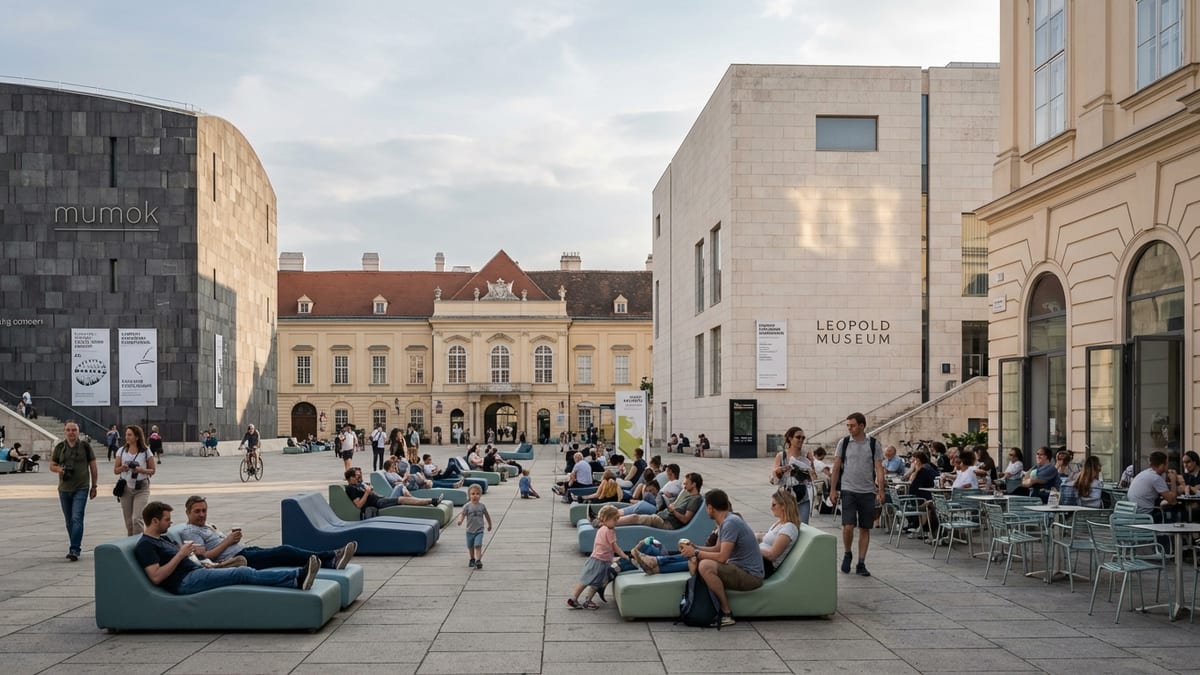
MuseumsQuartier Wien is one of Vienna’s great cultural powerhouses, but it can be confusing at first glance. It is not a single museum but an entire district of art spaces, performance venues and cafés set in the former imperial stables just behind Maria-Theresien-Platz.
For travelers trying to decide whether it belongs on their itinerary, the key questions are simple: which museums are actually inside, and what type of visitor will enjoy them most? This guide breaks down the major institutions, explains what each one offers and helps you match the MuseumsQuartier to your interests, energy level and travel style.
What Exactly Is the MuseumsQuartier?
The MuseumsQuartier, often shortened to MQ, is a self-contained cultural quarter occupying the extensive baroque complex that once housed the Habsburg court stables. Today, the horses are long gone and the courtyards are filled instead with bold modern architecture, outdoor sculptures and the now-iconic chunky loungers scattered across the paving stones. Inside the surrounding buildings you will find museums of modern and contemporary art, a national architecture center, exhibition halls, a renowned children’s museum and performance spaces for dance and theater.
Geographically, the MuseumsQuartier sits just west of Vienna’s historic center, immediately behind the twin Kunsthistorisches and Naturhistorisches museums on Maria-Theresien-Platz. Entering through the main gate in the Fischer von Erlach Wing, visitors step into one of Vienna’s largest enclosed courtyards. Straight ahead lies the former Winter Riding Hall, now the Halle E+G performance and event venue. To the left and right, slightly angled modern buildings house the Leopold Museum and the Museum moderner Kunst Stiftung Ludwig Wien, better known as mumok, creating a striking dialogue between imperial architecture and minimalist stone and basalt facades.
Unlike a single-purpose museum, the MQ is designed as a flexible cultural campus. Institutions share outdoor space, ticketing bundles and coordinated seasons, while cafés, bars and studios keep the area lively well into the evening. This makes it as much a place to linger as it is a checklist of exhibits. Even if you never buy a ticket, you can wander the courtyards, admire the architecture, attend free outdoor events in summer or simply sit among locals and students enjoying the open-air atmosphere.
For visitors planning their time in Vienna, it helps to think of the MuseumsQuartier in two layers. At the core are a handful of “anchor” museums known internationally for their collections, complemented by a series of specialized institutions, project spaces and children’s programs. Together they cover everything from Viennese modernism and 20th century architecture to cutting-edge installations and early childhood learning through play.
The Big Two: Leopold Museum and Mumok
For most art lovers, the main reason to enter the MuseumsQuartier is to visit its two heavyweight museums: the Leopold Museum and mumok. Both focus on roughly similar time periods yet approach them from very different angles. Seeing both on the same day gives a satisfying overview of how Austrian art moved from fin-de-siècle ornament to radical experimentation and how that story fits into a wider European context.
The Leopold Museum occupies a pale limestone block that seems to glow against the darker courtyard. Inside, it presents one of the world’s most important collections of modern Austrian art, built from more than 5,000 works originally assembled by collectors Rudolf and Elisabeth Leopold. Central to this collection is the largest Egon Schiele holding anywhere, with intense self-portraits, cityscapes and emotionally charged drawings that trace his short but influential career. Alongside Schiele, you will find key works by Gustav Klimt and other artists who bridged Vienna’s Secessionist elegance and the more expressive currents that followed in the early 20th century.
Beyond these famous names, the Leopold Museum offers rich context on Viennese Modernism. Decorative arts, furniture and design pieces show how artists and architects looked for new forms in everything from coffeehouse chairs to apartment interiors. For travelers interested in the cultural milieu that produced figures like Freud, Mahler and Wittgenstein, the museum’s rooms give visual substance to that era’s intellectual ferment. It is particularly rewarding for visitors already planning stops at the nearby Secession Building or Belvedere, where Klimt’s “The Kiss” resides, since the Leopold helps tie these sites into a coherent narrative.
Facing the Leopold across the courtyard is mumok, the Museum moderner Kunst Stiftung Ludwig Wien. Its dark basalt-clad cube houses a broad-ranging collection of 20th and 21st century art, including Pop Art, Fluxus, Viennese Actionism, conceptual works and contemporary installations. Where the Leopold provides a largely Austrian lens on modernism, mumok situates Vienna within international developments, juxtaposing local movements with works by major figures from elsewhere in Europe and the United States.
Visiting mumok is an ideal choice for travelers drawn to experimentation and conceptual play. Its exhibitions rotate regularly, and it is common to encounter immersive installations, multimedia works and provocative thematic shows that ask you to think as much as look. Those new to contemporary art need not be intimidated; wall texts are generally accessible, and the building’s clear vertical circulation makes it easy to dip in and out of floors according to your interest and time. If you tend to gravitate to cutting-edge biennials, artist videos or large-scale installations, mumok belongs at the top of your MuseumsQuartier list.
Architecture, Exhibitions and Urban Futures: Architekturzentrum, Kunsthalle & MQ Freiraum
Beyond its two marquee museums, the MuseumsQuartier also houses institutions that examine how we design and inhabit our built environment. Foremost among them is the Architekturzentrum Wien, often shortened to Az W. Conceived as Austria’s national architecture museum, it combines exhibitions, events and research devoted to 20th and 21st century architecture and urbanism. Its galleries explore topics such as postwar reconstruction, social housing, sustainable building and current debates about the future of cities.
For travelers with any interest in urban planning or how Vienna became internationally known for public housing and quality of life, the Architekturzentrum offers clear, engaging overviews. The permanent display traces the country’s architectural evolution with models, plans and photographs, while temporary exhibitions tackle more focused themes. Talks, guided walks and excursions extend the discussion into the streets beyond the MQ. Even visitors without a design background often find that the Az W adds depth to what they observe in Vienna’s streetscapes, from grand Ringstrasse facades to 20th century housing estates on the city’s edge.
Another key contemporary art venue within the MuseumsQuartier is Kunsthalle Wien, whose main exhibition spaces occupy the renovated former Winter Riding Hall and an extension behind it. Rather than maintaining a permanent collection, Kunsthalle Wien operates as a platform for changing exhibitions of contemporary art in various media. Curators often develop ambitious thematic shows or solo presentations that connect local practice to global discourses on politics, ecology, identity and technology.
Because its programming is entirely temporary, Kunsthalle Wien is particularly suited to repeat visitors who want to see what is currently at the forefront of contemporary art in Vienna. For first-time travelers, it can be a compelling complement to mumok, offering a more experimental or discursive angle. The fact that both institutions sit within the same complex makes it easy to combine them in a single visit, choosing which galleries to enter based on the day’s energy and the exhibitions that most appeal at the time of travel.
Rounding out this cluster is MQ Freiraum, a flexible exhibition space that hosts smaller-scale art and cultural projects with a strong educational and discursive component. Its own ticket and opening hours are distinct, and programming ranges from group shows involving emerging artists to collaborative projects with universities and cultural initiatives. For travelers eager to explore beyond the headline institutions, MQ Freiraum can offer a more intimate encounter with Vienna’s contemporary art scene.
Families and Young Travelers: ZOOM Kindermuseum and Child-Friendly Spaces
While the MuseumsQuartier is rich terrain for adult visitors, it is also one of the most family-friendly cultural complexes in Europe. The centerpiece for younger guests is ZOOM Kindermuseum, Austria’s leading children’s museum. Located within the MQ courtyards, it is designed as an interactive world where children from about eight months to 14 years can explore art, science, everyday culture and architecture through play. Rather than silent galleries, expect rooms where kids are encouraged to touch, build, test and invent.
ZOOM is divided into four main areas: a rotating hands-on exhibition, the ZOOM Studio, the ZOOM Animated Film Studio and the ZOOM Ocean. The exhibition space translates big ideas from disciplines like science and architecture into tactile experiences aimed at children roughly six to twelve years old. In the studio, younger visitors work with artists to experiment with techniques such as painting, felting, building and collage. The animated film studio lets older kids take on the roles of director, camera operator and sound engineer, producing short films that introduce them to digital storytelling and collaboration.
For the youngest visitors, ZOOM Ocean provides a soft, colorful environment dotted with inclined planes, water mattresses, tunnels and other structures that stimulate motor skills and sensory development. It is tailored to children between about eight months and six years and is particularly appreciated by parents who want a safe, engaging indoor space on cold or rainy days. Sessions throughout ZOOM are time-slotted and capacity-controlled, making advance booking highly advisable, especially during weekends and school holidays.
Families benefit from the broader MQ environment as well. The large main courtyard is car-free and populated with robust outdoor seating modules that double as climbing structures and play perches. Cafés open onto the open spaces, so adults can linger over coffee while children explore within easy view. Seasonal events, from film screenings to interactive installations, often include family-oriented programming. For travelers wanting to combine adult museum visits with downtime for kids, it is easy to alternate: one parent visits an exhibition while the other remains outside with children, then swap without leaving the complex.
Tickets, Passes and How to Plan Your Time
Because the MuseumsQuartier gathers multiple independent institutions under one umbrella, tickets are sold per museum rather than as a single entry fee for the whole complex. However, the MQ has developed combination products that make it easier and more economical to visit several institutions on the same trip. The most significant of these is the MQ FAB 5 ticket, which covers the Architekturzentrum Wien, Kunsthalle Wien, Leopold Museum, mumok and MQ Freiraum. It typically includes free entry to designforum Wien and discounts at ZOOM Kindermuseum and Tanzquartier Wien performances. For travelers intending to visit at least three of the included museums, this pass quickly pays off.
For longer stays or frequent cultural travelers, the MQ annual pass provides year-round entrance to all exhibitions at the same core institutions. It is especially attractive for expats, students based in Vienna or repeat visitors who value the ability to drop into exhibitions spontaneously. The pass is generally available at the MQ Point information and ticket center in the main courtyard, which also sells individual museum tickets, offers advice on current exhibitions and stocks maps and schedules for the quarter’s events.
Individual museum admission varies slightly, and concessions are widely available for students, seniors, young people, visitors with disabilities and Vienna City Card holders. Children and teenagers often enjoy free or reduced entry to many spaces in the complex, though ZOOM Kindermuseum uses a per-session ticket structure in line with its time-slotted programming. As with most major European museums, it is wise to check current prices and any temporary offers shortly before your visit, as seasonal campaigns or special events can affect ticket structures.
When planning your time, consider both the density of exhibitions and the physical layout. A thorough visit to either the Leopold Museum or mumok can absorb two to three hours, depending on your pace and interest in special exhibitions. Architekturzentrum Wien and Kunsthalle Wien generally require 60 to 90 minutes each, though design or architecture enthusiasts may stay longer. ZOOM sessions are typically fixed-length, so families should schedule these anchors first and fit adult-focused museum visits around them. Building in breaks at the cafés or simply resting in the courtyards helps avoid cultural fatigue and keeps the overall experience pleasant rather than overwhelming.
Who Will Love the MuseumsQuartier (and Who Might Not)
Not every traveler needs to devote an afternoon to the MuseumsQuartier, and understanding whether it suits your interests will help you make better use of limited time in Vienna. Art enthusiasts with a particular interest in modern and contemporary work are the visitors who benefit most. The Leopold Museum is essential for anyone drawn to Schiele, Klimt or the broader story of Viennese Modernism. Mumok and Kunsthalle Wien, in turn, reward those curious about postwar and contemporary developments, conceptual practice and cross-disciplinary installation art.
Design and architecture aficionados will find the Architekturzentrum Wien particularly compelling, especially in combination with walks through Vienna’s historic center and modern districts. The MQ’s own architecture, which juxtaposes imperial grandeur and stark modern forms, invites observation from those attuned to urban design. Coupled with the national architecture museum’s exhibitions, it offers a layered reading of Vienna as a living, evolving city rather than a preserved imperial monument.
Families and multi-generational groups are another clear audience for the MuseumsQuartier. ZOOM Kindermuseum stands out as a destination that allows children to take the lead in a largely adult-focused city, while the open courtyards provide a rare central space where kids can roam safely. For parents who enjoy art but worry about museum fatigue or restlessness among younger companions, the MQ’s combination of formal galleries and informal social space can be a welcome solution.
On the other hand, travelers with only a fleeting interest in modern and contemporary art, or those whose schedules in Vienna are very tight, may prefer to prioritize other nearby institutions such as the Kunsthistorisches and Naturhistorisches museums. These hold old master paintings, archaeology and natural history collections that speak more directly to certain visitors’ expectations of a European capital. Likewise, those seeking deeply historical immersion in baroque or medieval art might find the MQ’s focus too recent or conceptual for their tastes, in which case a brief stroll through the courtyards rather than full museum visits may suffice.
Practical Tips for Visiting
The MuseumsQuartier is straightforward to reach using Vienna’s public transport network. The closest hub is Volkstheater, served by the U3 underground line, tram 49 and bus 48A, placing the MQ just a short ride from the city center and major hotel districts. Multiple entrances lead into the complex, but most first-time visitors gravitate to the main gate between the twin museums on Maria-Theresien-Platz, which delivers you directly into the primary courtyard with the MQ Point information desk nearby.
Opening hours vary between institutions, and these can shift over time, so it is critical to verify them shortly before your visit. Many museums in the MQ operate on a Tuesday to Sunday schedule, often closing on Mondays, with hours commonly running from late morning to early evening. Special evening openings, events or seasonal late-night programs may extend these hours on particular days. Those traveling in winter should be mindful that shorter daylight and event-driven schedules can make late visits feel quieter, while summer evenings often see the courtyards buzzing late into the night.
From a practical standpoint, the complex is well-equipped with amenities. Cloakrooms, restrooms and seating areas are easily found inside the major museums, and the outdoor spaces provide ample spots to rest between exhibitions. The district is fully integrated into the surrounding city, meaning that cafés and restaurants both within and just outside the MQ serve everything from quick snacks to full meals. For travelers watching their budget, it is perfectly acceptable to bring a simple takeaway meal and sit in the courtyard, treating the MQ as a public square as much as a cultural venue.
Accessibility is an important consideration, and the MuseumsQuartier’s relatively recent transformation works in its favor. The primary museums feature elevators, step-free access routes and accessible restrooms, though individual layouts and elevator placements can vary. If mobility is a concern, it is sensible to allow extra time for internal navigation, particularly in multi-level institutions like mumok. Staff at MQ Point and museum reception desks are generally well-prepared to advise on accessible routes, quiet times and available seating, making it easier to tailor your visit to your needs.
The Takeaway
The MuseumsQuartier is not just another entry in Vienna’s long list of cultural institutions; it is a concentrated micro-city of art, architecture, performance and play. Understanding that it comprises multiple museums rather than a single entity helps travelers plan realistically and avoid both underestimating and overloading their schedules. Whether you spend an hour strolling through the courtyards, half a day immersed in the Leopold Museum and mumok, or a full day weaving in ZOOM sessions, architecture exhibitions and evening performances, the MQ can be shaped to fit a wide range of interests and travel styles.
If your idea of a memorable city break includes standing in front of Schiele’s self-portraits, puzzling over a contemporary installation, watching your children disappear into an interactive play landscape or simply people-watching amid bold urban design, the MuseumsQuartier deserves a significant place on your Vienna itinerary. Those whose tastes lean firmly toward older art or who are pressed for time might opt for a shorter, more atmospheric visit, letting the complex serve as a scenic pass-through between other landmarks. Either way, knowing what is inside and who each institution best serves ensures that your experience of this unique cultural district feels curated rather than accidental.
FAQ
Q1: Is the MuseumsQuartier one museum or several different museums?
The MuseumsQuartier is a cultural district that contains several independent museums and institutions, including the Leopold Museum, mumok, Architekturzentrum Wien, Kunsthalle Wien, MQ Freiraum and ZOOM Kindermuseum, along with performance venues and public spaces.
Q2: If I have limited time, which museum in the MuseumsQuartier should I prioritize?
If you are especially interested in Viennese Modernism and artists like Schiele and Klimt, prioritize the Leopold Museum. Travelers more drawn to international contemporary art and experimental installations may want to start with mumok instead.
Q3: Is the MuseumsQuartier suitable for children?
Yes. ZOOM Kindermuseum offers age-appropriate interactive exhibitions and workshops for children from about eight months to 14 years, and the open courtyards provide safe outdoor space for kids to explore while adults relax nearby.
Q4: Do I need a special ticket to visit the whole MuseumsQuartier?
No single ticket covers every institution automatically, but combination products such as the MQ FAB 5 ticket bundle entry to several key museums. Otherwise, you purchase tickets individually for each museum you wish to visit.
Q5: Can I enjoy the MuseumsQuartier without paying for any museum entries?
Yes. The courtyards, public art and many events are accessible without charge, and you can sit on the outdoor furniture, visit cafés and experience the architecture without entering any paid exhibition spaces.
Q6: How much time should I plan for a visit?
A quick atmospheric visit to the courtyards can take under an hour, while one major museum such as the Leopold or mumok usually requires two to three hours. A full day is ideal if you hope to visit multiple museums and include a break or family activities at ZOOM.
Q7: Is the MuseumsQuartier accessible for visitors with limited mobility?
Most major institutions in the MuseumsQuartier provide elevators, step-free routes and accessible restrooms. Surfaces in the main courtyards are generally even, but it is wise to ask at museum receptions or MQ Point for the most accessible routes and current information.
Q8: Do I need to book tickets in advance?
For the main art museums, same-day tickets are usually available except at especially busy times, although advance booking can save time. ZOOM Kindermuseum operates with time-slotted programs and limited capacity, so pre-booking is strongly recommended for families.
Q9: What is the best way to reach the MuseumsQuartier?
The easiest approach is by public transport, using the underground line U3 or tram 49 and bus 48A to the Volkstheater stop. From there, it is only a short walk to the main entrances of the MuseumsQuartier.
Q10: Is the MuseumsQuartier worth visiting if I am more interested in historical, classical art?
If your primary interest is in older art and artifacts, you might prioritize nearby institutions such as the Kunsthistorisches Museum. However, even in that case, a short walk through the MuseumsQuartier’s courtyards can still be rewarding for its architecture, atmosphere and outdoor social life.