


Mykonos sits at the heart of many Cyclades itineraries, and for most travelers the journey begins with a ferry. Between multiple Athens ports, competing ferry companies, tight connections from Santorini, Paros and Naxos, and the sometimes wild Aegean, it pays to understand how the system really works before you book. This guide pulls together current on-the-ground information so you can choose the right route, arrive at the correct port, and step off in Mykonos New Port ready to enjoy the island instead of wrestling your luggage in the summer heat.
Get the latest updates straight to your inbox!
Understanding Mykonos Ferry Routes and Ports
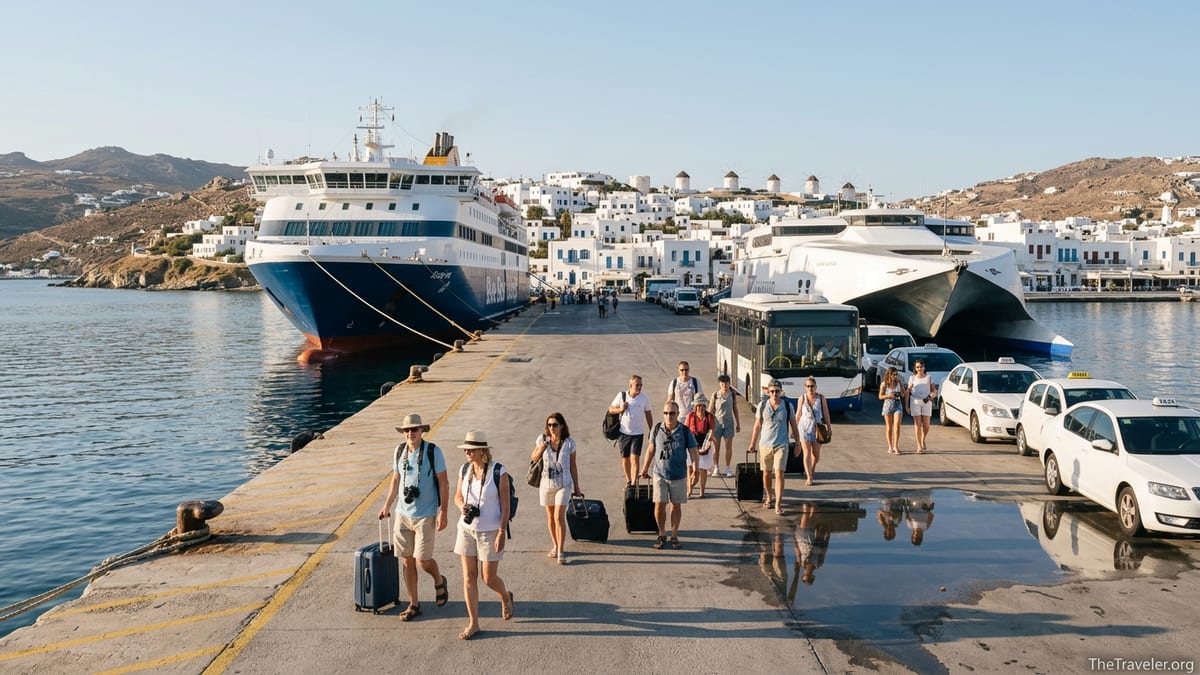
Almost all passenger ferries serving Mykonos today use the New Port at Tourlos, about 2.5 kilometers from Mykonos Town (Chora) and roughly 7 kilometers from the airport. Cruise ships and large high-speed ferries dock on the long outer quay, while conventional car ferries and some catamarans use inner berths. There is a small terminal building, basic shade, and a taxi and bus stand directly outside, but no need to navigate the tight alleys of the old harbor with luggage on arrival.
From Athens, Mykonos is served primarily from two ports: Piraeus and Rafina. Piraeus is the main port for Athens and the hub for many Blue Star Ferries routes that also call at Paros, Naxos and Santorini on the way. Rafina, northeast of central Athens and closer to the airport, has become a strong gateway for faster catamarans and some conventional ferries to Mykonos and onward to Paros and Naxos. When you search schedules in 2025 and 2026 on large consolidators, you will typically see a choice between slower, cheaper conventional ferries and more expensive high-speed vessels.
Within the Cyclades, Mykonos has frequent summer links to Santorini (Thira), Paros (Parikia) and Naxos. Conventional ferries such as Blue Star Paros and Blue Star Naxos generally follow the classic Piraeus–Syros–Tinos–Mykonos or Piraeus–Paros–Naxos–Santorini patterns, which makes them ideal for multi-stop island-hopping. High-speed operators like Seajets and Golden Star Ferries run seasonal point-to-point or limited-stop services that can cut journey times significantly but are more sensitive to rough seas and cancellations.
When planning, build your route around the fact that not every island pair has a direct ferry every day, especially outside July and August. For example, in September you may find that Mykonos to Santorini operates only once daily on a high-speed catamaran, while Paros to Mykonos runs several times a day on both high-speed and conventional ferries. Choosing your sequence as Athens – Mykonos – Paros – Naxos – Santorini (or the reverse) usually provides the most options and the smoothest connections.
Getting from Athens to Mykonos: Ports, Times and Prices
For most international visitors, the first big question is whether to sail from Piraeus or Rafina. Piraeus, reached in about 30 to 45 minutes from central Athens by metro or taxi, is the traditional gateway and offers the widest choice of year-round services. Here you will find large Blue Star Ferries and occasionally Minoan or Hellenic Seaways vessels that take around 4 to 6 hours to reach Mykonos, often stopping en route at Syros or Tinos. These ships are big, stable and comfortable, with plenty of deck space and indoor lounges, which many travelers appreciate if they are prone to seasickness.
Rafina, on the other hand, is closer to Athens International Airport, usually 20 to 30 minutes by taxi in light traffic. In summer it is the launch point for several fast services to Mykonos operated by companies such as Seajets, Golden Star Ferries and Cyclades Fast Ferries. On a recent high season timetable, high-speed catamarans on this route were making the trip in roughly 2 hours 20 minutes, with early morning departures aimed at passengers arriving on overnight flights to Athens and connecting straight to the islands.
Ticket prices vary by season, company and vessel type, but 2025–2026 data gives a good benchmark. For a standard economy seat, Piraeus to Mykonos on a conventional ferry typically starts in the range of about 38 to 53 euros one way. High-speed vessels on the same corridor often start around 80 to 90 euros for the fastest connections, especially in July and August. From Rafina, pricing is similar, though promotions can sometimes make a fast ferry from Rafina competitive with a conventional ship from Piraeus, particularly when booked a few months ahead.
For example, in early July, a family of four traveling from Athens to Mykonos might find a 7:30 a.m. Blue Star departure from Piraeus with four economy seats for roughly 45 euros per person and a total travel time of 4.5 hours. The same day, a Seajets high-speed from Rafina at 8:00 a.m. might reach Mykonos in about 2.5 hours at around 85 euros per person. The trade-off is time versus cost and comfort: the larger, slower ship offers outdoor decks and more freedom to move, while the catamaran is quicker but more enclosed.
Island-Hopping Between Mykonos, Santorini, Paros and Naxos
Many visitors pair Mykonos with Paros, Naxos and Santorini on a single trip, using the ferries as a rolling road trip through the Cyclades. The classic chain is Piraeus – Paros – Naxos – Santorini, but in practice you will see several of those Blue Star vessels and seasonal high-speeds either start or call at Mykonos along the way. Because schedules change each year, the key is to lock in an order that tends to have daily coverage in high season: Mykonos – Paros, Paros – Naxos, Naxos – Santorini and Mykonos – Santorini are all commonly operated from late May through September.
As a real-world example, in July you might sail Mykonos to Paros at midday in about 45 minutes to 1 hour on a Seajets catamaran, then continue Paros to Naxos on a late afternoon conventional ferry that takes just under an hour. Later in the week, you could catch a morning Blue Star from Naxos to Santorini that needs around 2 hours, including a stop at Ios. Tickets on these shorter island-to-island routes can be surprisingly affordable, often in the 25 to 45 euro range in standard economy for high-speed segments and sometimes under 30 euros on slower ships.
Connecting directly between Mykonos and Santorini can be more challenging, particularly outside July and August. In peak season, several high-speed services typically cover the journey in about 2.5 to 3 hours, with at least one departure in the morning that reaches Santorini before lunch and another in the afternoon. In shoulder months, you may find only one direct high-speed per day or none at all on certain weekdays, making it necessary to route via Paros or Naxos. That can add an extra hour or two but is perfectly feasible if you treat the connection as part of the trip rather than just a transfer.
When stringing together multiple islands, avoid booking same-day flights out of Athens after your last ferry. A common pattern is to end in Santorini or Mykonos and then fly to Athens the evening before your international departure. Alternatively, finish your ferry journey in Piraeus and stay one night in the city. The Aegean is famous for strong Meltemi winds in July and August, and even if outright cancellations are not common on the larger ships, delays of one to several hours on rough or windy days are not rare.
Arriving at Mykonos New Port: What to Expect on the Ground
Disembarking at Mykonos New Port can feel chaotic if you are not prepared, especially in high summer when several ferries and a cruise ship may dock within an hour. As the vessel approaches Tourlos, passengers with large suitcases will start to gather at the stairwells and vehicle ramps. You usually have only a few minutes to get off before the next wave of vehicles rolls out, so have your bag in hand and move briskly once the doors open. Port workers in high-visibility vests guide traffic and pedestrian flows, and you will typically be directed along a funnel-shaped corridor toward the terminal and parking area.
Immediately outside the disembarkation zone you will find a small terminal building, shaded waiting areas and a line of taxis and private transfer vans. In July and August, the taxi queue can back up quickly when a large ferry such as Blue Star Paros or WorldChampion Jet arrives. Many hotels in Mykonos Town and on popular beaches like Platis Gialos and Ornos offer pre-arranged transfers, often priced around 15 to 25 euros per person for shared shuttles and more for private cars. If your accommodation includes pickup, look for staff holding printed signs with property names just outside the exit.
For those heading independently into Chora, there is a local bus service between the New Port and the Fabrika or Old Port bus stations in town. In high season these buses often meet major ferry arrivals, with tickets sold either on board or at a kiosk near the stop. The ride into town usually takes 10 to 15 minutes, but traffic around Tourlos and the ring road can stretch that to 20 or more when several ferries and cruise passenger shuttles are moving at once. A taxi into central Mykonos Town typically takes about 10 minutes in light traffic.
If you are connecting straight onto another ferry the same day, be aware that Mykonos New Port has several different berths spread along the quay, and you may need to walk five to ten minutes between them with luggage. Information boards at the terminal and announcement screens on the ships themselves indicate the gate for your next departure. When in doubt, ask port staff or the agents at the ticket kiosks; they usually know where each company’s vessel will dock that day.
Luggage, Tickets and Onboard Experience
On most Greek ferries serving Mykonos, luggage is refreshingly straightforward. Economy passengers bring suitcases, backpacks and smaller bags onboard and leave larger pieces in open luggage racks near the vehicle deck or at the base of the stairwells. It is common to see entire families stacking rolling suitcases in a corner of the deck before heading upstairs to find seats. There is no formal weight limit enforcement in practice for foot passengers, but dragging very heavy or multiple large bags up gangways and stairs can be exhausting in summer heat, so pack with this in mind.
Once onboard, you can usually keep smaller cabin-size bags with you. High-speed catamarans often have dedicated luggage areas near the entrance doors, and staff may ask you to leave larger suitcases there rather than in the aisles. Conventional ferries have more flexibility: on a Blue Star ferry, for example, you might store a medium suitcase in a rack on Deck 5 and carry a backpack and daypack to your assigned airplane-style seat or one of the unassigned economy lounges. Theft is rare but possible, so avoid leaving valuables in checked bags; keep passports, electronics and medication in a small bag with you at all times.
Tickets for 2026 sailings are almost entirely electronic. When you book through a site or directly with a company, you will see whether the route supports e-boarding passes. For most Athens–Mykonos and Cyclades routes, you can check in online 24 to 48 hours before departure, download a QR code or boarding pass to your phone, and go straight to the ship. At the port, staff either scan your code from your device or from a printed boarding card if you prefer to print it. Allow extra time at Piraeus or Rafina if your particular sailing still requires picking up a physical ticket from an agency kiosk.
Onboard facilities vary by vessel and operator but generally include cafes or snack bars selling coffee, soft drinks, beer, simple sandwiches, salads and packaged pastries. Prices are higher than onshore but not extreme; for example, a cappuccino might be around 3 to 4 euros and a basic sandwich 5 to 7 euros. Many travelers bring their own water and snacks purchased at a bakery near the port to keep costs down and have exactly what they want. Dress in layers: air conditioning can be strong inside even on very hot days, while sitting on open decks can be breezy and cool once the ship reaches speed.
Rough Seas, Cancellations and Choosing the Right Vessel
Between June and early September, the northern Aegean is frequently whipped by the Meltemi, a strong north wind that can kick up significant waves. On calm days, even the smallest catamarans slice across a glassy sea from Mykonos to Paros or Naxos. On windy days, the same vessels can pound and sway enough to keep the onboard bar busy with seasickness bags. Larger conventional ferries, which carry trucks and cars in addition to foot passengers, tend to feel more stable in these conditions and are less likely to be canceled outright, even if they run slower than scheduled.
When winds exceed certain thresholds or national maritime authorities issue warnings, ferry companies are required to suspend some or all services. High-speed catamarans are usually the first to be stopped, while heavy blue-and-white conventional ferries are often allowed to sail at reduced speed. Travelers recount recent examples in which Seajets high-speeds between Naxos, Santorini and Mykonos were canceled during September storms while a Blue Star ferry still managed to operate later the same day, arriving several hours late but providing an essential link for stranded passengers.
If your itinerary includes tight connections or important flights soon after a ferry leg, consider prioritizing a large conventional ferry wherever possible. For instance, if you need to be in Athens for an international departure, choosing a morning Blue Star from Naxos or Paros that calls at Mykonos on the way to Piraeus may give you a better chance of sailing than a small catamaran if the weather deteriorates. On the other hand, if your dates are flexible and your main goal is to maximize time on each island, saving two or three hours by taking a high-speed from Rafina to Mykonos or Mykonos to Santorini can be worth the risk, as long as you avoid same-day flight connections.
To manage seasickness, choose a seat in the middle of the vessel and low down on conventional ferries, where motion is minimal. Avoid watching the horizon through small windows on fast catamarans if the sea is rough; many travelers feel better either staying on an open deck on large ships or closing their eyes and resting. Bringing basic motion-sickness tablets or wristbands from home is a sensible precaution, as onboard shops may have limited stock or close during rough segments.
Do You Need to Book Mykonos Ferries Early?
Availability and the need to pre-book depend heavily on season and route. In late July and August, the Athens–Mykonos corridor is one of the busiest in Greece. Popular departures, especially morning high-speed catamarans from Rafina and mid-morning conventional ferries from Piraeus, can sell out economy seats several days or even a week ahead. Cabins and business-class lounges on conventional ferries often book even earlier on Fridays and Sundays, when residents add to tourist traffic. On secondary legs between Paros, Naxos and Mykonos, demand is also strong but more spread across multiple daily sailings.
As a practical baseline, for travel in July and August it is wise to book Athens–Mykonos and Mykonos–Santorini legs at least two to three weeks in advance if your dates are fixed, and one to two weeks ahead for Mykonos–Paros–Naxos crossings. In May, June, September and early October, you might be able to secure tickets just a few days in advance, especially on the slower conventional ships. In April and late October, many services scale back or stop for the season, which makes monitoring schedules and booking early even more important.
For spontaneous travelers, there is still some room for flexibility, particularly on routes served by large ferries with big passenger capacities. A solo traveler in mid-June may find that even when online booking platforms mark certain high-speeds as sold out, there are still seats on Blue Star or another conventional ferry a few hours earlier or later. However, if you are traveling as a family or group of four or more with a tight hotel reservation pattern, locking in your main Mykonos legs early typically leads to a smoother trip and potentially better fares on promotional tickets.
Remember that it is usually easier to adjust ferry tickets than to find last-minute accommodation in peak periods. If winds force cancellations, companies often allow free rebooking to later sailings on the same or next day, although exact policies differ. Travel insurance that specifically covers missed connections due to weather can provide extra peace of mind, particularly if you have long-haul flights involved.
Transfers from Mykonos Port to Town and Beaches
Once you step onto the quay at Tourlos, your next task is getting yourself and your luggage to town or your beach hotel. The simplest option is a taxi, though the number of licensed taxis on Mykonos is limited relative to demand. In high season, a queue can build quickly when ferries and cruise ship tenders disgorge hundreds of people. A short ride to Mykonos Town might cost around 15 to 20 euros, while longer trips to beaches like Elia, Panormos or Super Paradise are higher, especially late at night when surcharges may apply.
Hotel transfers are common and worth considering if you are traveling with children or large suitcases. Many midrange and upscale hotels in areas like Ornos, Agios Ioannis and Platis Gialos bundle shared port transfers into room rates or offer them for a fixed fee. For example, a small boutique hotel near Ornos might charge 20 to 25 euros per person for a return port and airport shuttle, which can be competitive compared with two separate taxi rides each way. When booking accommodation, check whether pickup is included or can be arranged for your ferry’s arrival time.
Public buses provide a budget-friendly alternative, particularly if you are staying in or near Mykonos Town. Buses from the New Port typically terminate at the Old Port or the Fabrika bus station on the edge of Chora, where you can walk or connect to other routes heading to beaches such as Paradise, Paraga and Ano Mera. Fares are modest, often just a few euros, but buses can be crowded right after ferry arrivals. If you prefer to avoid the crush, you can let the first bus fill and wait for the next, or grab a cold drink at a nearby kiosk until the rush passes.
Car and ATV rentals are available near the port, though it is usually more relaxed to pick up vehicles in town or have them delivered to your accommodation. Driving straight off a ferry into an unfamiliar road network with summer traffic and pedestrians everywhere can be stressful. If you do rent near the port, inspect vehicles carefully and take photos of any existing damage before leaving, as you would anywhere else.
The Takeaway
Ferry travel to and from Mykonos is part of the adventure of visiting the Cyclades, but it rewards a bit of homework. Start by choosing the Athens port that fits your broader itinerary: Piraeus for maximum choice and large, steady ferries; Rafina if you are coming straight from the airport and want faster catamarans. When island-hopping with Santorini, Paros and Naxos, build your sequence around well-served links and allow margin for weather-related disruption, especially in July and August when strong Meltemi winds are common.
Book key legs such as Athens–Mykonos and Mykonos–Santorini early in high season, keep your last night before a long-haul flight on the mainland or on an island with an airport, and choose larger conventional ferries when reliability matters more than speed. On arrival at Mykonos New Port, know your plan for reaching town or your beach hotel, whether that is a pre-booked transfer, taxi or bus. Travel light enough to manage your bags in crowds and on stairwells, carry valuables with you, and treat delays as part of life in the Aegean rather than a disaster.
With realistic expectations and a flexible mindset, ferries become more than just transport between islands. Watching the white cube houses of Mykonos Town appear on the horizon, feeling the wind on deck, or sipping a coffee as trucks roll aboard in Piraeus are all part of the Greek summer experience. Understanding how the routes, ports, vessels and booking patterns fit together simply ensures that those moments are remembered for the right reasons.
FAQ
Q1. Which Athens port is best for traveling to Mykonos?
Piraeus offers the widest choice of year-round services and large conventional ferries, while Rafina is closer to the airport and often has faster catamarans in summer. If you are staying in central Athens, Piraeus is usually more convenient. If you land at Athens Airport and want to head straight to the islands, Rafina can save time.
Q2. How long does the ferry from Athens to Mykonos take?
On a conventional ferry from Piraeus, expect roughly 4 to 6 hours depending on stops at islands like Syros or Tinos. High-speed catamarans from Piraeus or Rafina typically make the trip in about 2 to 3 hours under normal conditions, though rough seas or strong winds can extend that.
Q3. Do I need to book Mykonos ferries in advance?
In July and August you should book Athens–Mykonos and key island-hopping legs at least one to three weeks ahead, especially for popular morning departures and high-speed ferries. In shoulder seasons like May, June and September, booking several days in advance is often enough, but do not wait until the last moment if your travel dates are fixed.
Q4. Is it better to choose a high-speed ferry or a conventional ferry?
High-speed ferries are faster and help you maximize time on the islands, but they are more expensive and more likely to be canceled in rough weather. Conventional ferries are slower but larger and generally more stable, with open decks and more space to move around. If you are prone to seasickness or have important connections, a conventional ferry is usually the safer choice.
Q5. What should I know about luggage on Mykonos ferries?
You can bring normal suitcases and backpacks onboard without strict weight checks. Larger bags are usually left in open luggage racks near the vehicle deck or stairwells, while smaller bags can stay with you. Keep passports, money and electronics in a small carry-on, as you will not have constant eyes on luggage left in racks.
Q6. How do I get from Mykonos New Port to Mykonos Town?
From Tourlos you can take a taxi, a pre-arranged hotel transfer or a public bus into Chora. The ride to town lasts about 10 to 15 minutes, depending on traffic. In high season, taxis can be scarce right after big ferry arrivals, so booking a transfer or using the bus is often more efficient.
Q7. Are ferries between Mykonos, Paros, Naxos and Santorini frequent?
In high season there are usually several daily connections between these islands, split between conventional ferries and high-speed catamarans. Mykonos–Paros and Paros–Naxos are especially well served. Mykonos–Santorini may have fewer options and sometimes only one direct high-speed per day in shoulder months, so plan that leg carefully.
Q8. What happens if my ferry is canceled due to bad weather?
When strong winds or storms make sailing unsafe, companies typically allow passengers to rebook on the next available departure or sometimes request a refund, depending on their policy. If you are stuck on an island like Naxos or Mykonos for an extra night, you are responsible for accommodation costs, so having a little budget and schedule flexibility helps.
Q9. How early should I arrive at the port for my ferry?
For major routes from Piraeus or Rafina, aim to be at the port 60 to 90 minutes before departure, especially if you need to collect physical tickets or are traveling with a vehicle. For inter-island ferries between Mykonos, Paros, Naxos and Santorini, arriving 45 to 60 minutes early usually provides enough time to find the correct gate and board without stress.
Q10. Can I rely on digital tickets, or do I need printed boarding passes?
Most ferries to and from Mykonos now support digital boarding passes that can be scanned from your phone after online check-in. However, some routes or companies still ask you to pick up a printed ticket at a port kiosk. Always read your booking confirmation carefully and, if in doubt, arrive early so you can print tickets if needed.