


More news on this day
Travel disruption across Europe intensified this week as the Netherlands joined a widening list of countries hit by large-scale flight delays and cancellations, with operational strain spreading across Amsterdam Schiphol, Vienna, Zurich and other key hubs that connect France, Germany, Austria, Italy, Spain, Portugal, Belgium and Switzerland.
Get the latest news straight to your inbox!
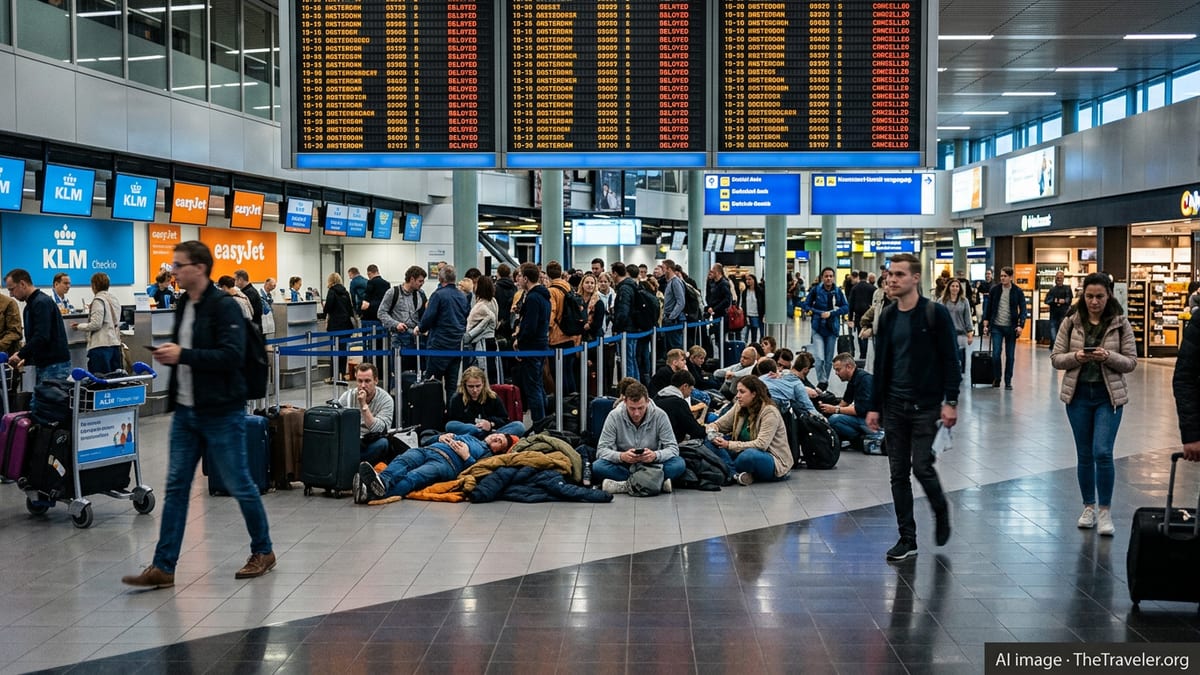
Amsterdam Schiphol Becomes New Epicenter of Disruption
Amsterdam Schiphol, one of Europe’s busiest transfer airports, has emerged as a central pressure point in the latest wave of aviation disruption. Publicly available airport and airline data indicate hundreds of delayed departures and arrivals within a short window, along with scores of outright cancellations. Aggregated figures from flight-tracking and airport information services suggest that more than 1,100 flight movements across the wider European network have been affected as delays in Amsterdam ripple outward to other hubs.
Schiphol’s role as a gateway for traffic between northern Europe, the Mediterranean and long haul destinations has amplified the impact. When operations slow in Amsterdam, connecting flows to France, Germany, Italy, Spain and Portugal quickly feel the strain, forcing airlines to consolidate services or trim frequencies to stabilize schedules. Reports indicate that cancellations have affected both intra-European routes and intercontinental services, with knock-on effects for passengers as far afield as North America and Asia.
KLM and its partner airlines have been adjusting timetables and offering rebooking options through their disruption portals. Information published by these carriers stresses that passengers on flights delayed for several hours or cancelled outright may be eligible for refunds, alternative routing or, in some cases, compensation under European passenger rights legislation. Travelers have been urged by airlines and airports to verify flight status repeatedly on the day of departure, as gate and timing changes are often occurring within hours of scheduled takeoff.
Vienna, Zurich and Regional Hubs Struggle With Knock-On Delays
The strain is not limited to the Netherlands. Operational data and airport reporting show that Vienna, Zurich and other important regional hubs are experiencing extensive knock-on delays as the disruption wave moves east and south through the Schengen network. Flight status tools for Vienna list clusters of late departures across the day, with multiple services arriving behind schedule from northern Europe and then departing late to onward destinations.
Zurich has faced recurring capacity constraints in recent months, and the latest congestion has added to that pressure. Network performance reports from European air traffic coordinators highlight how capacity bottlenecks at major hubs can quickly generate thousands of minutes of delay, especially when aircraft and crew rotations are tightly sequenced. When an aircraft reaches Zurich or Vienna late from Amsterdam or another congested airport, its next sectors depart behind schedule, extending the disruption into evening waves.
Published coverage notes that even relatively modest ground issues at one airport can trigger disproportionately large operational consequences once they intersect with adverse weather, staffing limits or technical restrictions elsewhere. In this case, high traffic volumes at the start of the summer peak, combined with earlier industrial actions and infrastructure challenges in countries such as Portugal and Germany, have left little margin to absorb additional delays.
France, Germany, Italy, Spain, Portugal, Belgium and Switzerland Pulled Into the Turbulence
Airlines across France, Germany, Italy, Spain, Portugal, Belgium and Switzerland are increasingly caught in a web of disruptions that is no longer confined to any single city or carrier. Network maps show that many of the flights now running late or being cancelled are short haul services that feed larger intercontinental banks in cities such as Paris, Frankfurt, Munich, Madrid and Lisbon. When these feeder flights are removed or delayed, long haul loads can drop and turnaround plans are forced to change at short notice.
In Germany, where recent months have already seen episodes of large-scale cancellations, continued schedule adjustments remain visible on routes to and from Amsterdam and other neighboring hubs. In Portugal, earlier nationwide transport strikes and biometric border processing difficulties created residual imbalances that are now being compounded by the broader European congestion. Spain and Italy, which rely heavily on summer tourism flows, are also reporting increased schedule volatility on routes that link key coastal and island destinations to central European hubs.
Belgium and Switzerland, though smaller aviation markets than their larger neighbors, are tightly interwoven into the same network through Brussels and Zurich. When large hubs experience irregular operations, aircraft and crews that should be positioned for flights in and out of these airports can end up out of place, prompting airlines to cancel frequencies or swap larger aircraft onto fewer departures. The result for travelers is a growing incidence of last minute changes, rebookings and unplanned overnight stays across multiple countries.
Passenger Rights and Compensation Rules Remain in the Spotlight
The latest disruption is once again drawing attention to the European Union’s passenger protection framework. Recent decisions at EU level, widely covered by European media, indicate that the existing compensation regime for long delays and cancellations will remain largely intact. Under these rules, passengers on eligible flights who face delays of several hours or outright cancellations may claim fixed-sum payments in addition to rerouting or refunds, depending on the circumstances and cause of the disruption.
Industry groups have argued that the cost of such compensation, estimated in the billions of euros annually, makes it more difficult for airlines to cope with operational shocks. Consumer advocates, by contrast, maintain that strong protections are necessary in a period when weather, infrastructure limits and labor disputes increasingly threaten schedule reliability. The current wave of delays and cancellations across Amsterdam, Vienna, Zurich and other hubs is likely to generate a new round of test cases as travelers seek compensation and airlines evaluate whether events qualify as extraordinary circumstances.
Airlines are actively directing passengers to online tools where they can review their rights, submit refund requests and apply for compensation. Public information from several major carriers notes that travelers whose flights are delayed beyond specific thresholds, or who experience forced rebookings that substantially alter their itineraries, should retain boarding passes, booking confirmations and receipts for any additional expenses in case they need to support future claims.
What Travelers Can Expect in the Coming Days
With the busy summer holiday season beginning, aviation analysts and operational data providers suggest that irregular operations may persist in the short term. Once a network as dense as Europe’s experiences a large-scale disruption event, the process of returning aircraft and crews to their intended positions can take several days, particularly when daily utilization is already high and turnarounds are tight. Additional local weather problems or renewed labor actions at even one major hub could prolong or deepen the current wave of travel chaos.
Travel guidance from airlines, airports and consumer organizations converges on a similar set of recommendations. Passengers are encouraged to build extra time into connections, travel with flexible itineraries where possible, and monitor flight status continuously from 24 hours before departure until boarding. Those departing from or connecting through Amsterdam Schiphol, Vienna and Zurich are being advised to allow more time at the airport for check in, security, and potential border checks, especially on flights touching the external Schengen frontier.
As the Netherlands joins France, Germany, Austria, Italy, Spain, Portugal, Belgium and Switzerland in grappling with a shared disruption, Europe’s aviation network is once again being tested at the very moment when demand is surging. The scale of delays and cancellations seen across more than 1,100 affected flights underscores how tightly coupled the continent’s hubs have become, and how quickly a problem in one corner of the network can spiral into continent-wide travel turmoil.