


More news on this day
New scientific research into Europe’s long-distance rail network is casting night trains in a new light, indicating they could play a far larger role in replacing short- and medium-haul flights than current services suggest.
Get the latest news straight to your inbox!
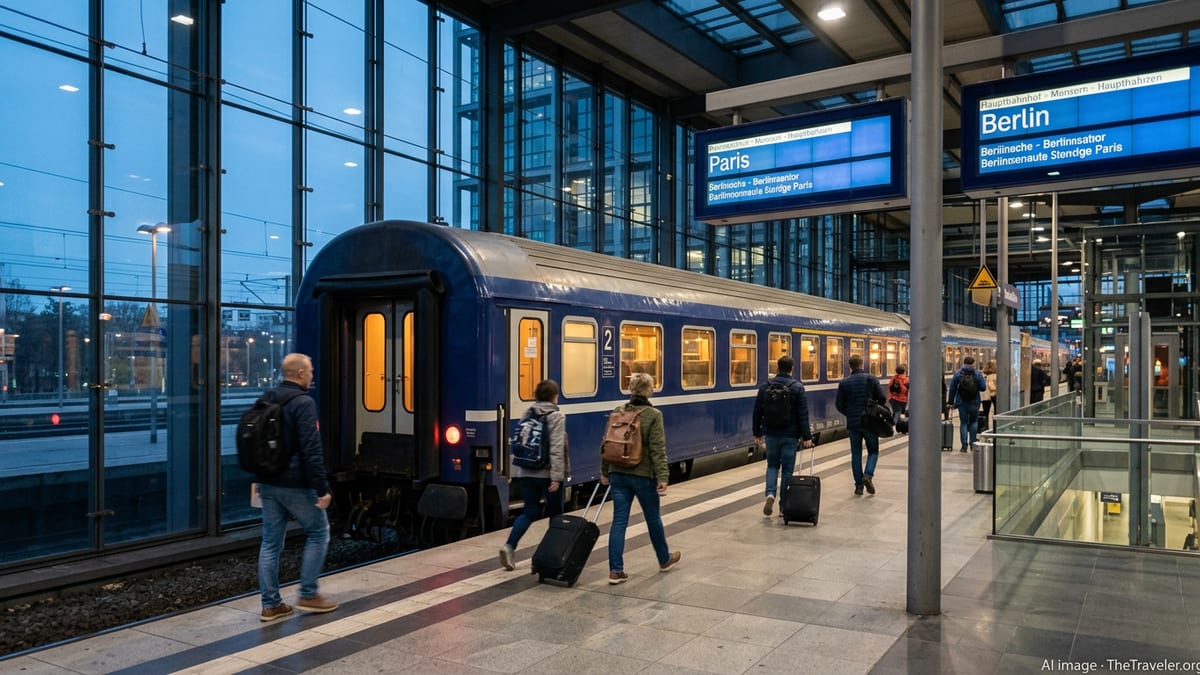
Fresh evidence from Europe’s rail corridors
A new peer-reviewed assessment of overnight rail services in Europe concludes that night trains could make a substantially greater contribution to low-carbon long-distance travel if existing lines were better used and cross-border barriers reduced. The study, published in a leading transport journal, models potential demand on key corridors and compares it with today’s limited night train offer, finding what researchers describe as significant “untapped potential” for rail-based overnight travel.
The analysis builds on a growing body of work examining how travelers choose between planes and trains. Recent surveys in countries such as Sweden, Austria and Switzerland show that a sizeable share of passengers would consider switching to night trains for journeys of 600 to 1,500 kilometers if services were reliable, reasonably priced and offered private or semi-private compartments. In several scenarios tested, rail could capture a meaningful proportion of trips now made by air, particularly on dense intra-European routes.
The resurgence of interest comes after decades of retreat. Historical overviews of European services document widespread closure of night routes between 1980 and the late 2010s, driven by competition from low-cost airlines, the rise of high-speed daytime trains, and the cost of maintaining sleeper coaches. The new research argues that this contraction has left a gap between what travelers would be willing to use and what the market currently provides.
Authors of the latest work stress that their results describe technical and behavioral potential rather than a forecast. Realizing that potential would depend on coordinated investment, regulatory support and cooperation between national railways that have often pursued divergent strategies. Nonetheless, the study positions night trains as a credible component of Europe’s long-distance transport mix if policy and infrastructure catch up.
Climate math favors overnight rail
Environmental calculations are central to the renewed focus on night trains. Research on Swedish and broader European travel patterns indicates that shifting holiday and business journeys from planes to overnight rail could produce substantial cuts in greenhouse gas emissions, especially on popular leisure routes linking Northern Europe with Mediterranean destinations. For many corridors within roughly 1,000 kilometers, rail services powered largely by electricity have a fraction of the emissions intensity of jet aircraft per passenger kilometer.
One recent scenario analysis of Swedish tourism examined the impact of replacing a portion of outbound and inbound flights with night trains. The results showed that even moderate levels of modal shift would reduce the overall carbon footprint of leisure travel, with larger reductions possible if travelers accepted slightly longer journey times and more indirect routes. The study also highlighted the knock-on benefits of reduced aviation-related climate impacts that extend beyond carbon dioxide, such as contrail formation.
Complementary research into traveler preferences suggests that environmental concern is becoming a meaningful driver of mode choice. Surveys in Austria and Switzerland have found that passengers who rate climate considerations highly are more willing to book night trains, even at a time penalty compared with flying. Some groups respond particularly well to messaging about emissions reductions, while others are more motivated by comfort or cost, underscoring the importance of tailored marketing and fare structures.
Researchers caution, however, that night trains are not a universal replacement for aviation. Very long intercontinental routes and trips where rail infrastructure is sparse are likely to remain dominated by air travel. Studies also note that the climate benefit of rail depends on continued decarbonization of electricity generation and, in some regions, the replacement of diesel locomotives with cleaner technologies. Even under conservative assumptions, though, the current evidence indicates that expanding overnight rail would align more closely with climate targets than relying solely on future aircraft efficiency gains or alternative jet fuels.
Who rides night trains, and what they want
New social science research is helping to clarify which travelers are most likely to adopt night trains. A mixed-method study of Swiss passengers, for example, identifies several distinct user groups, including climate-motivated travelers who actively seek out rail, pragmatic passengers who choose night trains when they are competitively priced, and occasional users attracted by the novelty or comfort of a rolling hotel room. Each group has different sensitivities to travel time, privacy, and price.
Parallel work in Austria and northern Europe finds that interest in night trains is particularly strong among younger and urban populations, where car ownership is lower and environmental awareness higher. University-based surveys and interviews at major rail hubs suggest that many respondents view overnight services as a practical way to avoid airport hassles while “reclaiming” time that would otherwise be spent sitting upright in a plane or making early-morning transfers.
Comfort and perceived safety emerge as critical determinants of repeat use. Technical studies on train interiors and ventilation have examined how berth design, noise levels and thermal comfort affect passenger satisfaction on long-distance journeys. Their findings point to specific design improvements, such as better sound insulation and adaptive climate control, that could make overnight trips more attractive compared with budget airlines where passengers often trade comfort for low fares.
At the same time, research into barriers highlights that complex booking systems, fragmented timetables and limited on-board services can deter first-time users. Travelers report confusion when trying to combine night trains with regional connections, or when comparing prices across borders where different operators apply different reservation rules and supplements. Scientists studying user behavior suggest that simplifying access to tickets and providing clear, multilingual information may be as important as upgrading rolling stock.
Operational and infrastructure hurdles
The new scientific literature is also frank about the obstacles facing a large-scale revival of night trains. Night operations occupy valuable capacity on busy mainlines that also carry freight and daytime passenger services, especially near major urban hubs. Infrastructure managers must balance these demands within fixed time windows, limiting the number of overnight paths that can realistically be offered without major upgrades.
Economic challenges loom just as large. Analyses of European night train networks point to high fixed costs for staffing and maintaining sleeper and couchette coaches, as well as track access charges that can make long cross-border runs expensive. Some studies argue that, in the absence of public-service contracts or targeted support, private operators may struggle to sustain routes that are socially and environmentally desirable but only marginally profitable, particularly outside peak holiday seasons.
Regulatory fragmentation between countries adds further complexity. Differences in signaling systems, rolling-stock standards, and labor rules can limit the ability to run through services across multiple borders, forcing operators to split trains or change locomotives at night. Research into the “Single European Railway Area” notes that, while legal frameworks for open access have expanded in recent years, practical interoperability still lags behind policy ambitions.
Nonetheless, case studies of recent route launches suggest that these hurdles are not insurmountable. Where governments have coordinated timetables, reduced access charges on climate-relevant corridors, or supported new rolling-stock investments, operators have reported rising occupancy and renewed interest from passengers. The latest study on overnight rail argues that such examples demonstrate what could be achieved if policy frameworks more systematically recognized night trains as a tool for delivering climate and transport goals.
Signals of a broader night-train renaissance
Beyond the core scientific literature, publicly available data on timetables and fleet orders points to a cautious but visible expansion of night train services across Europe. National operators in Austria, France and other countries have ordered new-generation sleeper trains with private cabins, modern seating cars and improved accessibility features, explicitly marketed as low-carbon alternatives to short-haul flights.
Pan-European political initiatives have also placed night trains on the agenda. The designation of 2021 as the European Year of Rail, followed by cross-border pilot projects, has encouraged collaboration among rail companies and infrastructure managers on new overnight routes linking major cities. Advocacy groups and think tanks track these developments and have argued that a coherent night train network could emerge if planned services are delivered and connected efficiently.
Researchers emphasize that such expansion would interact with wider transport trends. The growth of high-speed daytime corridors may complement overnight services on some routes while competing with them on others. Digital platforms that bundle rail, local transit and accommodation could make night trains more visible to travelers planning trips, potentially unlocking some of the latent demand identified in academic studies.
Taken together, the latest research signals that night trains are no longer a nostalgic curiosity but a serious candidate for reshaping Europe’s long-distance travel landscape. Whether their untapped potential is realized will depend on choices made over the coming decade about infrastructure, pricing and regulation, as railways and policymakers weigh how best to move people across the continent in a warming world.