


More news on this day
New York City–area airports were still grappling with rolling flight delays and cancellations on Wednesday after a major American Airlines technology outage the previous evening triggered a temporary nationwide ground stop and threw peak summer travel into disarray.
Get the latest news straight to your inbox!
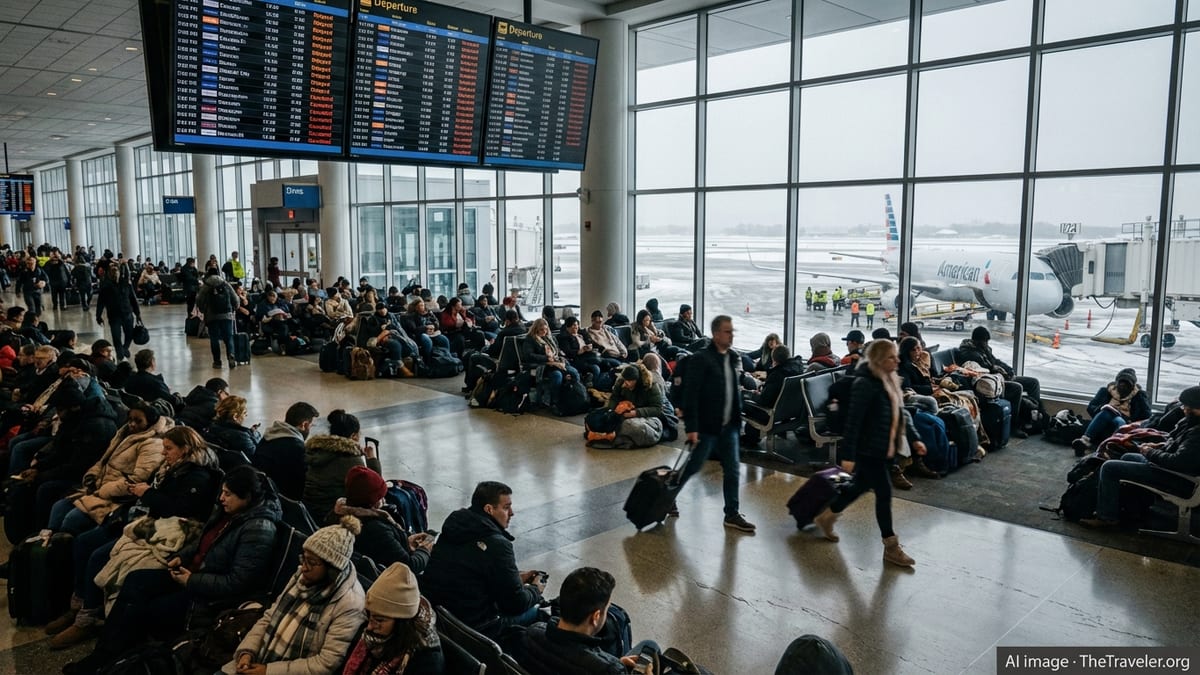
Ground Stop Fallout Lingers Across New York Hubs
Published coverage indicates that the Federal Aviation Administration briefly halted all American Airlines departures across the United States on Tuesday evening following an information technology disruption that severed connectivity for key airline systems. While the carrier reported that systems were restored later that night, knock-on effects continued into Wednesday across its network, including at New York’s busiest airports.
At John F. Kennedy International Airport, American’s transatlantic and long-haul operations faced a patchwork of delays as aircraft and crews remained out of position. Schedules showed late-arriving inbound flights compressing turnaround times, prompting gate holds and rolling departure pushes that stretched into the morning rush.
At LaGuardia Airport, where American operates a dense schedule of shuttle, business, and regional routes, the disruption translated into clusters of delayed departures rather than a uniform slowdown. Travelers reported early-morning flights departing nearly on time while midmorning and early afternoon services showed delays of an hour or more as the airline worked through Tuesday’s backlog.
Newark Liberty International Airport, where American has a smaller footprint than at JFK or LaGuardia, still felt the ripple. A limited bank of American flights experienced delays tied to downstream impacts from other hubs, compounding an already busy day for New York–area airspace during peak summer travel.
Technology Outage Exposes Operational Fragility
According to publicly available statements and media coverage, American Airlines attributed the disruption to a technology issue that briefly limited connectivity for some core systems, prompting the FAA to issue a ground stop for flights that had not yet departed. The episode underscored how quickly modern airline operations can falter when reservation, dispatch, and crew tracking platforms are interrupted.
Industry accounts describe aircraft that were ready to depart but unable to receive final clearances as staff lost access to updated flight plans and weight-and-balance data. Even after the airline began restoring systems, the process of revalidating flight information, reassigning crews, and restarting boarding processes added further delay.
Aviation analysts note that major carriers have invested heavily in technology redundancy following earlier high-profile outages, including a global software incident in 2024. Yet the latest disruption shows that complex, interconnected systems remain vulnerable to malfunction, whether due to internal glitches, software updates, or external infrastructure failures.
For passengers at New York airports, the technical nature of the failure mattered less than its practical effect. Screens showed shifting departure times in 15 to 30 minute increments, and day-of-travel plans were upended as seemingly modest delays accumulated into missed connections and overnight stays.
Travelers Confront Rolling Delays, Missed Connections
By Wednesday morning, published flight data showed American operating most of its schedule, but on-time performance remained uneven. At JFK, some long-haul departures appeared to leave close to schedule, while domestic and Caribbean flights showed ripple delays reflecting delayed inbound aircraft and crews reaching their legal duty limits.
At LaGuardia, the impact was particularly visible for travelers with tight itineraries. A 30 or 45 minute delay into New York could easily translate into a missed connection on a subsequent American or partner flight from JFK or another hub, forcing rebookings onto later departures that were themselves already heavily booked for summer.
Passenger accounts shared publicly described crowded gate areas, long lines at customer service counters, and extended waits on tarmacs as aircraft joined departure queues. Some travelers noted that their delay notifications updated multiple times overnight and into the morning, making it difficult to know when to leave for the airport or whether to attempt standby on alternative flights.
For New York–based travelers, the timing of the outage posed additional challenges. Many Tuesday evening flights were carrying business and leisure passengers planning short midweek trips. When those itineraries collapsed into cancellations or overnight delays, the viability of the trip itself came into question, leaving passengers to negotiate refunds, vouchers, or entirely new plans.
What Passengers Can Do if Their Flight Is Affected
Consumer advocates point out that, under current U.S. Department of Transportation rules, an airline-controlled technology outage typically places responsibility on the carrier to assist affected travelers. Public guidance from travel programs and legal resources indicates that travelers whose flights are significantly delayed or cancelled for such reasons can request rebooking at no additional cost, and in many cases may be eligible for meal vouchers or hotel accommodations if they are stranded overnight away from home.
Advisers recommend that passengers departing New York–area airports monitor their flight status across multiple channels, including the airline’s app and airport departure boards, rather than relying solely on initial delay estimates. Experience from recent technology incidents suggests that short incremental delays can extend into several hours as operations recover.
Travel specialists also encourage travelers to document all expenses related to disruptions, such as meals, ground transportation, and unused hotel nights, as receipts may strengthen later claims for reimbursement or travel credits. In some circumstances, travelers may request a refund instead of rebooking if the delay is substantial and they choose not to travel.
For those yet to depart, travel planning experts suggest building additional buffer time into connections, especially when connecting through other major American Airlines hubs that may still be working through residual delays. Flexible itineraries and travel insurance policies that specifically cover carrier IT disruptions can also soften the impact of future outages.
Broader Questions for Airlines and Regulators
The American Airlines outage and subsequent delays at New York airports arrive at a time when regulators, lawmakers, and consumer groups are increasingly focused on the resilience of aviation technology. Recent high-profile disruptions, including system failures tied to external software vendors, have renewed scrutiny of how airlines design, test, and back up their critical platforms.
Industry observers suggest that, while many carriers maintain contingency plans for localized weather or airspace restrictions, large-scale technology failures can be more difficult to model. When a core system fails, the resulting ground stops, crew displacements, and aircraft imbalances can cascade across the network for many hours after the immediate issue is resolved.
For travelers passing through New York’s airports, the broader policy debate is largely abstract. What matters most is whether flights depart close to schedule, whether information is timely and accurate, and whether assistance is available when plans fall apart. The latest episode involving American Airlines reinforces a familiar reality for summer flyers: even when technology problems are brief, their effects can reverberate for days across some of the nation’s busiest airports.