


Orlando International Airport (MCO) can be confusing at first glance. There is a North Terminal with two sides labeled A and B, plus a separate South Terminal known as Terminal C. Each side has its own check in areas, baggage claim and ground transportation. If you pick the wrong one, you can easily lose 20 to 30 minutes walking or driving in circles. This guide explains exactly how Terminals A, B and C work, which airlines use each one, and how to move between them smoothly.
Get the latest updates straight to your inbox!
Understanding the Overall Layout of Orlando International Airport
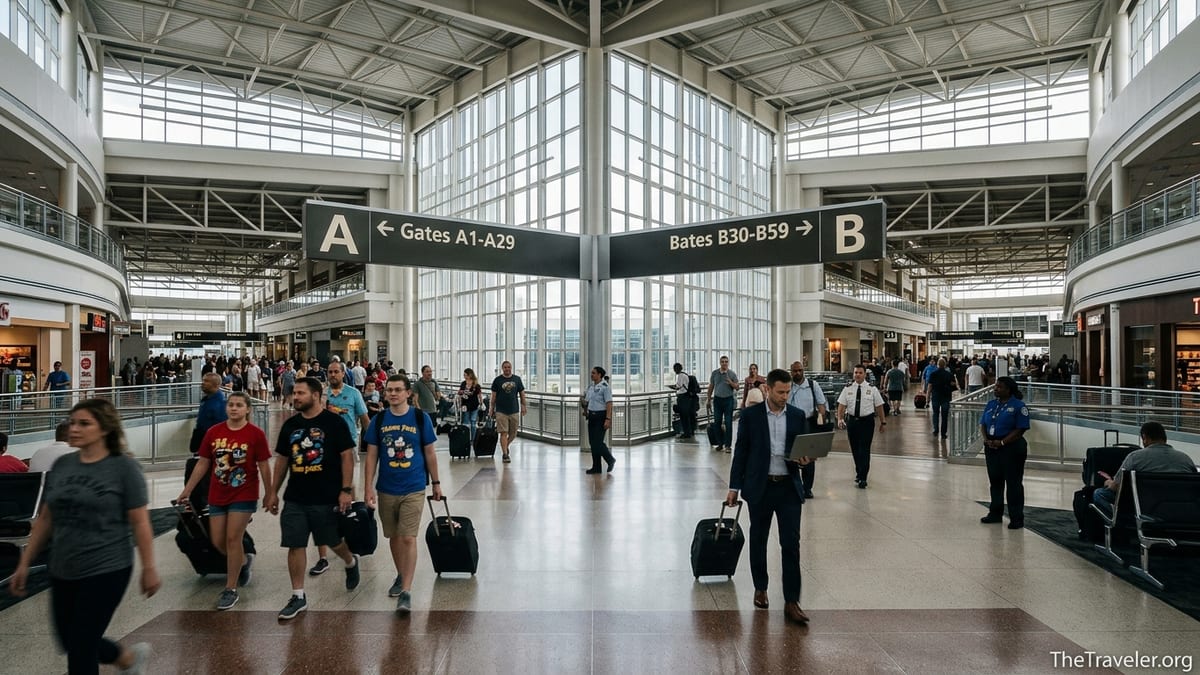
Orlando International Airport is really two terminal complexes that sit a short distance apart. The North Terminal Complex contains the main terminal building, which is split into Terminal A on the west side and Terminal B on the east side. Both A and B share the same building and security areas but have completely separate check in halls, baggage claims, parking garages and curbside drop off zones. From this main building, four satellite concourses known as Airsides 1, 2, 3 and 4 handle most of the gates.
South of the North Terminal sits Terminal C, also called the South Terminal Complex. This is a newer, stand alone facility with its own check in, security and a long concourse of international style gates numbered in the 200s. Between the North and South terminals is the airport’s Intermodal Terminal and train station, where Brightline intercity trains arrive from South Florida and where future rail connections such as SunRail are planned. An elevated people mover called Terminal Link connects Terminal C to the North Terminal and the train station, making it possible to transfer without going outside.
From a driver’s perspective, the airport roadway loop first passes the roadways and garages for Terminal A and Terminal B, then continues on to the roadways for Terminal C and the train station. Signs on the highway and airport approach will show “North Terminal A/B” and “Terminal C & Train Station.” Choosing the right fork matters because you cannot quickly cross from A to C by car without looping all the way back around. If you know which side your airline uses before you arrive, you avoid last minute lane changes and missed exits.
Inside the airport, the key thing to remember is that A and B are two sides of the same central building, while C is a separate building linked by train. All three terminals are connected landside by walkways and the people mover system, so if you do end up on the wrong side it is fixable, but you should allow extra time.
Which Airlines Use Terminal A, Terminal B and Terminal C?
The fastest way to figure out which terminal you need is to check your airline in your booking or app, then match it to the correct side. At the North Terminal, Terminal A generally handles Southwest, JetBlue, Frontier, Spirit, Alaska, Avianca and several other domestic and Latin American carriers. For example, a family flying on Southwest to Chicago Midway or a JetBlue flight to New York JFK will both check in on the A side and then ride the tram to Airside 1 or 2, depending on their gate assignment.
Terminal B tends to host Delta, American, United, and many major international carriers. A Delta flight to Atlanta, an American Airlines flight to Dallas Fort Worth and a United flight to Newark all check in on the B side and then continue to Airside 3 or 4. Several long haul international airlines such as LATAM and some European carriers also use B side check in with departures from the higher numbered gates in Airside 4. For example, a Brazilian traveler flying LATAM to São Paulo will check in at Terminal B, clear security and then ride the tram out to the Airside 4 concourse.
Terminal C houses a growing list of airlines, especially international and leisure focused carriers. Many Aer Lingus, British low cost, Caribbean and South American airlines now operate from Terminal C, and Orlando’s airport authority has been steadily moving wide body operations there to reduce congestion in the older North Terminal. As one recent example, Virgin Atlantic announced that it is shifting its Orlando flights to Terminal C, so a traveler heading to London or Manchester on Virgin will now check in and depart from the new South Terminal instead of the North side.
Airline assignments can and do shift over time, especially as the airport balances traffic between the older North Terminal and the newer South Terminal. Vacation travelers booked through package operators should not assume that last year’s terminal information still applies. Always verify your airline and terminal in your airline app or confirmation email the week of travel, and cross check with the airport’s live terminal information boards once you arrive.
Check In, Ticketing and Security: How Each Terminal Works
At the North Terminal, both A and B sides follow the same basic layout. You enter at Departures level, where long rows of check in counters line the hall. Overhead signs and large illuminated panels indicate which area belongs to each airline. For example, on A side you will see multiple Southwest and JetBlue check in zones, while B side will show Delta, American and United branding. Self service kiosks are common, but full service counters are available for baggage drop, special assistance and international documentation checks.
After you check in and drop bags at Terminal A or B, you proceed to one of the main security checkpoints in the center of the building. There are separate West and East security checkpoints that feed different Airsides, but both serve passengers from both A and B sides. For instance, a Southwest passenger who checked in at A side could pass through the West checkpoint to reach Airside 1, while a Delta passenger might use the East checkpoint to reach Airside 4. The Transportation Security Administration operates standard, PreCheck and some CLEAR lanes during busier periods, and during peak holiday mornings lines can easily reach 30 to 45 minutes.
Terminal C’s check in hall is more modern and open, with high ceilings, natural light and centralized security located just beyond the ticketing area. Airlines share long continuous banks of counters, and the digital signage above the desks shifts throughout the day to match the current flights. This allows the airport to allocate additional space to large international departures such as transatlantic services when needed. Security screening at Terminal C is directly ahead of the check in hall, so you do not have to navigate between different checkpoints. For international departures, airlines will verify passports and visas at check in, then passengers clear one main checkpoint before heading down the concourse to their gates.
Whether you are in A, B or C, the most important step is to confirm your gate and Airside in the airline app or on the overhead screens before you enter security. For example, a JetBlue flight might depart from Airside 2 in the 100 gate range, while a Spirit flight could leave from Airside 1. While you can transfer between Airsides only by returning to the main terminal and re clearing security, all gates within the same Airside are connected post security, so changing from gate 13 to gate 18 is a short walk.
Baggage Claim, Ground Transportation and Rental Cars
On arrival at the North Terminal, passengers first ride an automatic people mover tram from their Airside back to the main building. The Airside tram drops you into the central atrium, where overhead signs direct you clearly to “A side baggage claim” or “B side baggage claim.” This split is crucial for meeting arriving travelers. For example, if your friend is arriving on Southwest, you would go to A side baggage level. If they are arriving on Delta, you would head to B side baggage. Each side has its own numbered carousel zones, car rental counters and ride share pick up areas.
Ground transportation at Terminals A and B includes hotel shuttles, local buses, theme park transfers and ride share pick up zones. Major Orlando attractions such as Walt Disney World, Universal Orlando and the International Drive resort area run or contract buses and shuttles that pick up from designated spaces outside both A and B sides. For example, a family booked on a Disney cruise transfer bus would follow signs to “Ground Transportation A Side” or “B Side,” depending on their instructions, to find their motorcoach. Local Lynx buses, taxis and ride share services line up at the lower level curbs, with separate zones assigned for different services.
Most on airport car rental desks for companies like Alamo, National, Enterprise, Budget and Hertz are located inside the North Terminal on both A and B sides, with direct walkway access to the terminal parking garages. A traveler picking up a minivan for a theme park vacation can walk directly from baggage claim to the rental counter, then cross the street via pedestrian bridge to the rental car row in the adjacent garage. Off airport rental firms operate shuttle buses that pick up outside baggage claim and drive guests to their lots a few minutes away.
In Terminal C, baggage claim is located on lower levels beneath the main departures hall. International arrivals that clear customs and immigration in Terminal C collect their bags there before exiting to the public arrivals hall. Ground transportation zones sit just outside, with pick up areas for Brightline train passengers, hotel shuttles, taxis and ride share vehicles. A traveler arriving on a Virgin Atlantic flight from London and connecting to a Brightline train to Fort Lauderdale can collect bags, clear customs, exit the secure area and follow the clearly marked signs to the train station without needing to enter the North Terminal at all.
Parking Options for Each Terminal and Real World Costs
Parking at Orlando International Airport is divided between terminal garages directly next to A, B and C, and larger economy lots located a short shuttle ride away. At the North Terminal, Garage A is closest to Terminal A and Garage B is closest to Terminal B. These garages offer covered parking with pedestrian bridges straight into the terminal. Daily rates here are on the higher end, and recent public discussions among local travelers mention typical on airport garage rates in the high teens to low twenties per day. For a three day weekend trip, you might expect to pay roughly the cost of a mid range dinner for two in Orlando just to leave your car in Garage A or B.
Economy lots, sometimes called “Park Place” or “North and South Park Place,” sit further from the terminal buildings and are connected by frequent shuttle buses. These lots usually cost several dollars less per day than the terminal garages and can provide substantial savings on longer trips. Local flyers often mention that once their trip extends beyond four or five days, off airport parking companies and economy lots become significantly cheaper than the terminal garages, even after factoring in shuttle time. For example, a family leaving their car in an off airport lot at a nightly rate that is a third lower than the on airport garage can save enough over a weeklong vacation to pay for an extra meal at a theme park.
Terminal C has its own garage, connected to the terminal by bridge and escalators. Because Terminal C is newer and still ramping up traffic, its garage can fill quickly during peak seasons even though the terminal itself may feel less crowded than A and B. Travelers arriving for morning international departures are often advised to leave extra time in case the closest sections of the Terminal C garage are full and they must circle to higher levels or be redirected to another lot.
Off airport parking lots cluster along the nearby expressways and offer shuttle service to all three terminals. These lots typically operate 24 hours a day and shuttle times average around 10 to 20 minutes depending on traffic. Real world reports from regular Orlando flyers describe using off airport lots when the trip is five days or longer or when they want to avoid the risk of terminal garages filling up on peak holiday weekends. As with all parking choices, your decision should balance cost, convenience and your tolerance for shuttle buses versus walking straight from garage to check in.
Train Station Access, Brightline and Other Ground Transport Links
Orlando’s intermodal terminal and train station sit between the North Terminal A/B complex and Terminal C. This large glass fronted building houses the Brightline intercity rail platforms, future SunRail commuter platforms and the South Airport people mover station. If you are arriving by Brightline from Miami, Fort Lauderdale or West Palm Beach, your train will pull into this station, and you will then follow signage to either Terminal C via pedestrian bridge or Terminals A and B via the automated people mover.
Passengers whose flights depart from Terminal C have the simplest connection. After stepping off the train, they walk across the indoor pedestrian bridge that connects the station directly to Terminal C’s departures level. Rolling suitcases glide smoothly across the tiled floors, and in a typical connection you might move from train seat to airline check in within 10 to 15 minutes, assuming minimal congestion. This seamless link is one of the reasons many international carriers and premium leisure airlines are attracted to Terminal C.
Passengers heading to Terminals A or B from the train station take the South Airport people mover, known locally as the Terminal Link. This short elevated tram ride carries you across airport property to the North Terminal, where you disembark into the central atrium and then walk to the appropriate A or B check in side. For example, a traveler arriving by Brightline for a Delta flight to Atlanta would exit the train, follow signs to “A/B Terminals,” ride the people mover, then walk to B side ticketing for Delta check in.
In addition to rail, the intermodal complex supports planned or proposed bus and shuttle services to the surrounding region. However, most local hotel shuttles, cruise transfers and theme park buses still pick up and drop off at the North Terminal A/B curbs or directly at Terminal C. Rideshare services like Uber and Lyft and traditional taxis operate from signed pick up points outside each terminal. If you are connecting between rail and air, factor in at least 30 minutes between stepping off the train and reaching your airline check in desk, and more during peak holiday periods.
How to Transfer Between Terminal A, Terminal B and Terminal C
Transferring between A and B within the North Terminal is straightforward once you know they are two halves of the same building. If you arrive at the wrong side by car, you can follow the signs that loop you around to the other side of the main terminal, although this may consume 10 to 20 minutes in heavy traffic. On foot, you can walk inside the building from A side to B side by following overhead signage near the central atrium and food court area. For example, if a traveler mistakenly goes to A side to meet a friend arriving on Delta, they can simply follow the indoor signs across to B side baggage claim without exiting the building.
Transferring between the North Terminal (A/B) and Terminal C depends on whether you are landside or airside. There is no direct airside connection, so any passenger needing to change from a flight arriving at Airside 1, 2, 3 or 4 to a departure at Terminal C must exit to the public side, transfer by people mover and then clear security again at the new terminal. A common pattern is a family arriving on a domestic low cost carrier in Terminal A, collecting their bags, then transferring to an international leisure flight from Terminal C later that day. They would ride the tram from their Airside to the main terminal, proceed to baggage claim on A side, exit to the public arrivals hall, follow signs to “Terminal C & Train Station,” take the Terminal Link people mover to Terminal C and then re check bags and clear security.
For the reverse transfer, such as arriving on an international flight into Terminal C and continuing domestically on Delta or Southwest, you will clear customs if required, collect bags at Terminal C and then follow signs for the pedestrian bridge to the train station. From there, you board the people mover to the North Terminal, where you can check in again at B side for Delta or A side for Southwest. Because this involves several steps, airlines and the airport both recommend allowing a healthy connection window, particularly if you are on separate tickets.
Travelers who are simply escorting friends or family and not flying can also move between terminals this way. For instance, a person dropping off relatives at Terminal C could park in the Terminal C garage, walk them to check in, then later ride the people mover to the North Terminal to meet someone arriving on United at Terminal B. In all cases, following the overhead signage and giving yourself extra time is key, particularly if you are unfamiliar with the layout.
Choosing the Best Terminal Experience for Your Trip
While you cannot usually choose your terminal independently of your airline, it is useful to understand the general character of each side. Terminals A and B see the highest volume of domestic vacation traffic and can feel busy and sometimes chaotic during school holidays, major theme park events and long holiday weekends. Security lines can grow long in the morning, and baggage claim halls can be crowded when multiple large aircraft arrive within minutes of each other. On the other hand, A and B offer the widest range of shops, food courts and services in the central atrium, including familiar chains that families appreciate before or after a long day at the parks.
Terminal C tends to provide a calmer, more modern experience, at least while airline assignments are still ramping up. Its architecture features high glass walls, contemporary art installations and a more spacious gate area layout. International arrivals at Terminal C benefit from updated customs and immigration facilities that are designed to process large aircraft more efficiently than older setups in Airside 4. Travelers on carriers now moved to Terminal C often report smoother flows through security and passport control compared to their past experiences in the North Terminal.
If you care most about short walks and direct connections to rail, Terminal C has the advantage, especially for Brightline passengers and international travelers carrying heavy luggage. If you value a wider choice of restaurants, retail and lounges, the North Terminal’s combined A and B amenities may still offer more variety, especially in the central atrium area that connects all four Airsides. For example, a frequent business traveler flying Delta out of B side might appreciate access to a traditional airline club and a selection of sit down restaurants before an evening departure, whereas a leisure traveler on an Aer Lingus flight from Terminal C might value the quieter gate areas and easy rail connection.
Ultimately, you will go where your airline operates, but knowing what to expect at each terminal helps you decide when to arrive, where to park, and how to plan post flight connections, whether that means a hotel near the airport, a Brightline train to South Florida or a rental car road trip to the beaches.
FAQ
Q1. How do I find out whether I need Terminal A, B or C at Orlando?
Check your airline and flight details in your booking or airline app. Most Southwest, JetBlue, Frontier and Spirit flights use Terminal A, Delta, American and United generally use Terminal B, and many international and leisure carriers use Terminal C. Always confirm close to your travel date, as airlines can change terminal assignments.
Q2. Can I walk between Terminal A and Terminal B inside the building?
Yes. Terminal A and Terminal B are two sides of the same North Terminal building. Once you are inside the main atrium, you can follow overhead signs to walk from A side to B side without going outside, though it may take several minutes with luggage.
Q3. How do I transfer from Terminal C to Terminals A or B?
Use the Terminal Link people mover. From Terminal C, follow signs to the pedestrian bridge and train station, then board the tram to the North Terminal. Once there, walk to your airline’s side, A or B, and clear security again if you are catching a flight.
Q4. Is there a direct airside connection between Terminal C and the North Terminal?
No. There is no secure airside connection between Terminal C and the Airsides served from Terminals A and B. Any transfer between them requires exiting to the public area, riding the people mover and re clearing security at your departure terminal.
Q5. Where should I park if I am flying from Terminal A or B?
Garage A is closest to Terminal A and Garage B is closest to Terminal B. Both are attached to the terminal by pedestrian bridges and charge higher daily rates. For lower cost, you can use the airport’s economy lots or off airport parking with shuttle service, but you should allow extra time for the shuttle ride.
Q6. Does Terminal C have its own parking garage?
Yes. Terminal C has a dedicated parking garage connected by walkways and escalators to the departures and arrivals levels. This is the most convenient option for Terminal C flights, although it can fill during busy travel periods, so early arrival is wise.
Q7. How long should I allow to connect from a Brightline train to my flight?
If your flight departs from Terminal C and your timing is off peak, around 30 to 45 minutes from train arrival to reaching your check in desk is usually comfortable. If you are connecting from Brightline to a flight from Terminals A or B, or traveling at peak times like holidays or school breaks, plan at least an hour to include the people mover ride and possible security lines.
Q8. Where are the rental car counters at Orlando International Airport?
Most major on airport rental car counters are inside the North Terminal on both the A and B sides, just steps from baggage claim, with walkways leading to rental car areas in the adjacent garages. Terminal C arrivals can either use shuttle services to these facilities or book with companies that provide pick up at or near Terminal C.
Q9. I am meeting someone arriving at MCO. How do I know whether to go to A side or B side baggage claim?
Check the arriving passenger’s airline and flight information. For example, Southwest and JetBlue arrivals typically claim bags on A side, while Delta, American and United generally use B side. The airport’s flight information screens and the airline’s app will specify the correct side and carousel.
Q10. Are security lines shorter at one terminal than another?
It varies by time of day and season. Terminal C often feels less congested because it is newer and handles fewer flights than the combined A and B sides, but busy international departures can still create lines. At the North Terminal, early morning and late afternoon waves can lead to longer waits at security. Using programs like TSA PreCheck, arriving early, and checking real time updates in your airline app can help you avoid surprises.