


More news on this day
Peru has formally set in motion a 30‑year public‑private partnership to modernize the Huancayo–Huancavelica railway, the “Tren Macho,” in a project framed as a social lifeline for more than one million Andean residents and a potential long‑term boost to highland rail tourism.
Get the latest news straight to your inbox!
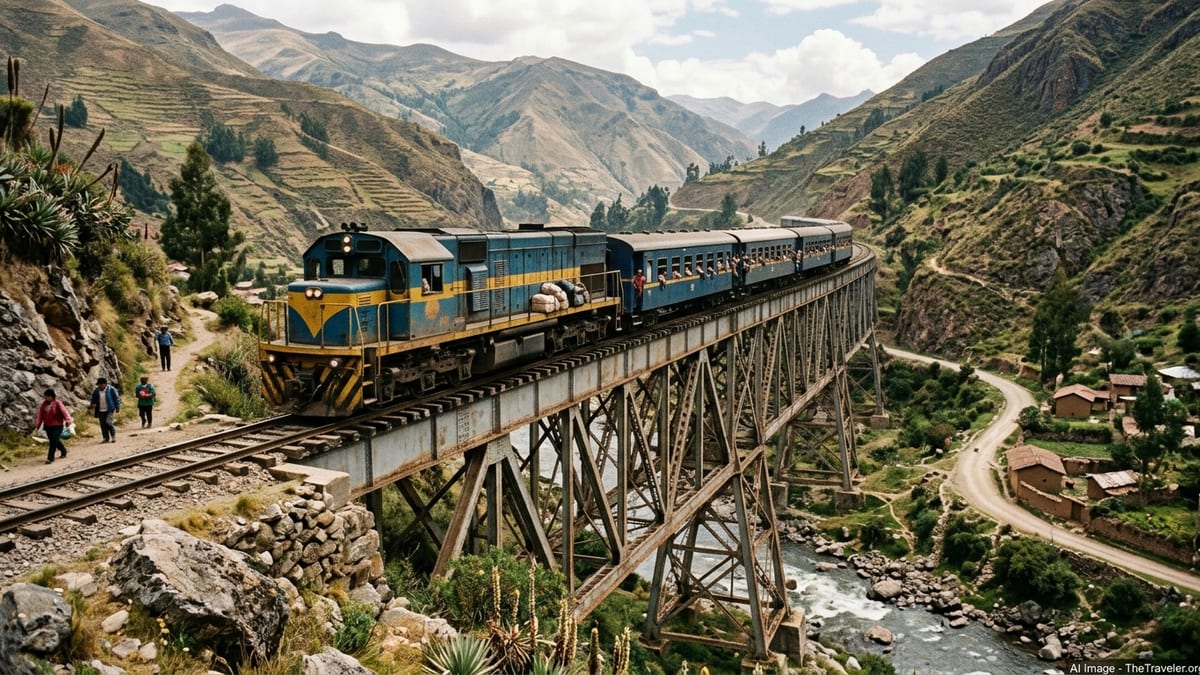
Contract launch confirms long-term PPP model
The Huancayo–Huancavelica railway, a 128.7 km standard-gauge line linking Chilca in Huancayo (Junín) with the city of Huancavelica, entered a new phase on 28 May 2025 when Peru’s transport ministry signed a 30-year concession contract with Concesionaria Ferroviaria del Perú (COFEPERU). The deal, awarded via a ProInversión tender on 28 August 2024 to the Consorcio Concesionaria Ferroviaria del Centro, commits the private partner to design, rehabilitate, operate and maintain the so-called “Tren Macho” as a co-financed public-private partnership.
Regional authorities in Huancavelica treated 3 June 2025 as the symbolic start of modernization, hosting a ceremony that combined formal delivery of the signed contract with announcements that the line would be rebuilt to provide what officials described as the country’s most secure and fastest regional passenger train once works are complete. While precise performance targets have not yet been publicly detailed, the contract structure follows the now-familiar pattern of five years allocated for studies, design and construction, followed by 25 years of commercial operation and maintenance.
The total nominal value repeatedly cited by central and regional governments is about 565 million US dollars over the life of the concession, although Ositran, Peru’s transport infrastructure regulator, specifies an initial investment commitment of roughly 340 million dollars before tax in its technical documentation. Both figures underline the scale of the project in a corridor that has historically relied on a slow, state-run service with limited departures.
A social lifeline before a tourist attraction
Official communications around the concession consistently stress that the modernized Ferrocarril Huancayo–Huancavelica is first and foremost a social service. The project is framed as benefiting around 1.2 million residents across Junín and Huancavelica, many of whom use the existing train and parallel road to reach jobs, markets, schools and medical care in Huancayo or Huancavelica. Current services are widely described as slow and irregular, with long journey times and occasional suspensions due to infrastructure constraints.
For now, fares remain anchored in the regime approved by Ositran. The regulator’s published annex to the new concession contract lists a direct-train passenger fare of 30 soles one way between Huancayo and Huancavelica, a reference that aligns with what travelers have typically paid on the existing direct service. Any future adjustments will flow through the regulated tariff framework rather than unilateral operator decisions, an important point for budget-conscious residents who depend on the line for everyday mobility.
Although promotional material from regional authorities highlights the scenic appeal of the route through high Andean valleys and viaducts, neither ProInversión nor COFEPERU currently markets the project as a luxury tourist product. Instead, the concession is designed to guarantee minimum public-service obligations, with tourism seen as a longer-term opportunity once reliability, safety and frequency improve for local passengers.
What travelers can expect during the transition
The concession’s early years are likely to be defined more by engineering work than by new passenger comforts. Ositran’s most recent project brief indicates that key engineering design documents are scheduled for approval in late 2026, followed by financial close targeted around April 2027 and the start of major physical works from May 2027. That sequencing means that, despite the June 2025 launch ceremony, large-scale on-track construction is not expected to begin immediately.
During this preparatory phase, the existing Huancayo–Huancavelica service is expected to continue in some form, although neither the transport ministry nor COFEPERU has yet published a comprehensive interim timetable covering the full five-year design and construction window. Authorities have signaled that partial closures and rolling blockades are likely once heavy works start, with replacement road transport to be organized where necessary, but detailed plans remain to be confirmed closer to each work stage.
For travelers, that uncertainty translates into a need to verify operational details close to departure. Timetables, temporary suspensions and any substitute bus services are typically communicated through the Ministry of Transport and Communications, Ositran and, once fully operational, COFEPERU’s own channels. Prospective riders should not assume that current frequencies or journey times will hold steady through the construction period, especially from 2027 onward, and should be prepared for slower trips or mode changes while the line is upgraded.
Longer-term implications for Andean mobility and tourism
If the concession proceeds as scheduled, the Huancayo–Huancavelica project could substantially reconfigure how people move between these highland regions. Government statements emphasize future gains in safety, punctuality and travel time, supported by new rolling stock to be procured internationally and modern signaling and track rehabilitation. Those improvements are expected to make the train more competitive with parallel road services for daily commuting and regional trips, though concrete performance indicators have not yet been published.
For domestic and international visitors, a more reliable “Tren Macho” could eventually become a practical overland link between the central Andes and broader itineraries that include Huancayo, nearby highland communities and Huancavelica’s historic mining heritage. Unlike Peru’s famous luxury trains to Machu Picchu or Lake Titicaca, however, this line is not being rebuilt primarily as a tourist attraction, so any tourism benefit will depend on how operators, local businesses and regional authorities integrate improved rail service into wider travel products.
In the meantime, travelers planning central highlands routes should treat the Huancayo–Huancavelica line as an evolving project rather than a fully predictable service. Before booking around the train, it is prudent to check for updated announcements on fare changes, service levels, construction milestones and any published target date for the start of modernized operations, and to have flexible plans in case rail segments are temporarily replaced by road transport during the modernization cycle.