


Few places in Europe condense so much beauty and culture into such compact lake shores as Lake Ohrid in North Macedonia and Lake Bled in Slovenia. Both are small-town bases with big reputations, yet they offer very different experiences: Ohrid revolves around a vast, ancient lake ringed by historic settlements and Orthodox monasteries, while Bled is an intimate alpine scene built around a single island church and a cliff-top castle. This guide compares them in depth to help you decide which fits your next trip, or how to combine both.
Get the latest updates straight to your inbox!
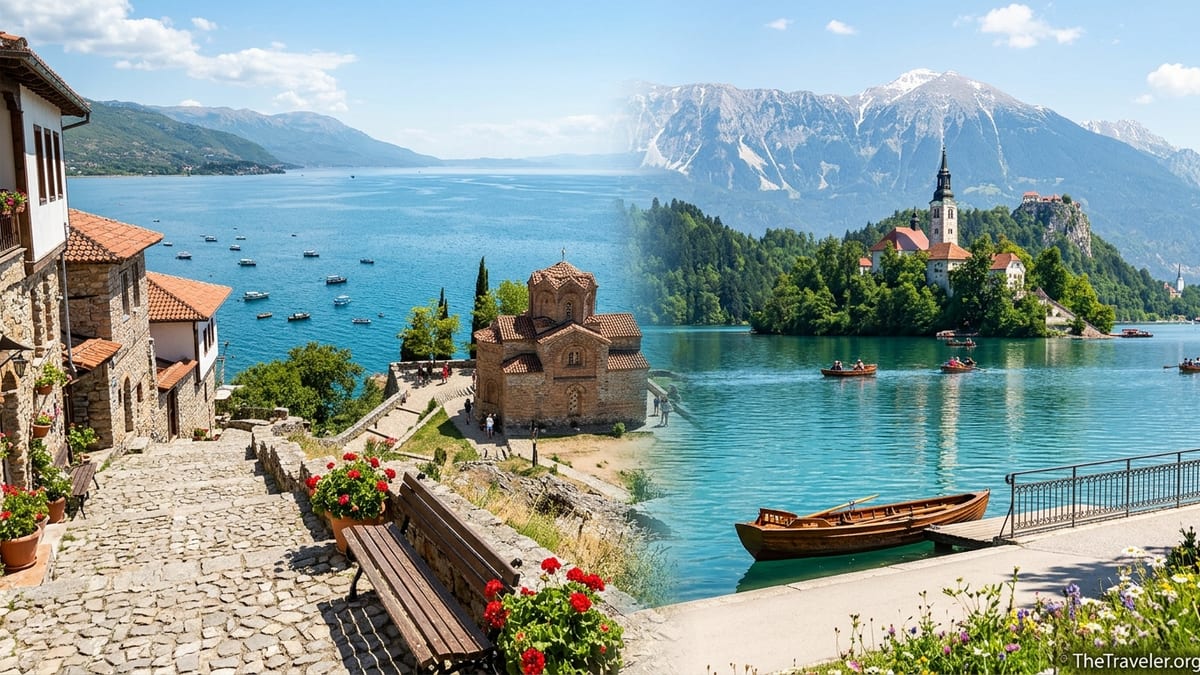
Big ancient lake vs intimate alpine postcard
Lake Ohrid is one of Europe’s oldest and deepest lakes, shared by North Macedonia and Albania. The water stretches roughly 30 kilometers along the Macedonian side and feels almost like an inland sea, with a chain of lakeside towns such as Ohrid itself, Struga and the monastery enclave of St Naum. The scale matters: when you look out from Ohrid’s promenade you see broad horizons, fishing boats and distant Albanian hills, not just the opposite shore a short swim away.
Lake Bled, by contrast, is compact and contained. The lake is about 2 kilometers long and 1.4 kilometers wide, encircled by foothills of the Julian Alps. The scene is dominated by Bled Island with its baroque church, and Bled Castle perched on a cliff. Rather than multiple villages, there is one main resort town and a near-continuous line of villas, small hotels and lakeside cafes. It feels like a self-contained resort where almost everything is within a 20 to 30 minute walk.
The heritage story also differs. Ohrid’s core is a UNESCO World Heritage site for both cultural and natural values. Cobbled streets climb past medieval churches, Byzantine frescoes and Samuel’s Fortress on the hill above the lake. Bled’s historic highlights are more concentrated: the castle museum and the island church with its bell, surrounded by a landscape protected mainly for its scenic rather than archaeological importance.
For travelers, this fundamental difference shapes how you spend time. Ohrid invites longer wandering, day trips along the shore and a sense of being in a living, layered town. Bled is about circling the lake, hiking to viewpoints and dipping into nearby alpine valleys such as Bohinj, often over a shorter stay.
Getting there: Skopje, Ohrid Airport, Ljubljana and Ljubljana Airport
Reaching Lake Ohrid typically involves Skopje or Ohrid’s small airport. From central Skopje, multiple daily buses run to Ohrid, operated mainly by companies such as Galeb Ohrid and Classic Company. Current schedules show around 13 departures a day with journey times of about 3 hours and one-way fares around 850 to 950 Macedonian denars per person, roughly 14 to 16 euros depending on operator and date. Buses leave from Skopje’s main bus station; from there you need a short taxi or city bus to reach hotels on the Ohrid waterfront.
From Skopje International Airport to Ohrid, there is no direct public bus. The common pattern is to take the airport shuttle into Skopje’s bus station, then connect to a Skopje–Ohrid coach. Factoring a 35 to 40 minute shuttle ride, some waiting time, and the 3 hour bus, door-to-door journeys to Ohrid Old Town realistically run around 4 to 5 hours. Private transfers from the airport or Skopje city shorten door-to-door time to about 3 to 3.5 hours and, based on current local operators’ offers, typically cost from about 120 to 150 euros per car for up to three or four passengers.
Ohrid’s own airport has seasonal flights from several European cities. When flights align, this is the most direct option: Ohrid Airport sits less than 15 minutes by taxi from the lakeside zones. However, services can be limited outside summer and may not run daily, so many travelers still route via Skopje. Importantly, there is no ordinary passenger rail connection to Ohrid, so anyone arriving by train to North Macedonia must still switch to bus or car for the last leg.
Lake Bled is anchored to Ljubljana. From Ljubljana’s temporary central bus station area, frequent buses reach Bled in around 1 hour 10 to 1 hour 30 minutes, depending on stops and traffic. Recent 2026 transport guides list standard adult fares in the region of 8 to 10 euros each way. Several bus companies serve the route, and departures are at least hourly in the daytime, often more frequent at peak tourist times.
There are also train options to Bled, but the stations are slightly detached from the lake. Trains from Ljubljana go to Lesce-Bled, which is a few kilometers from the shore and requires a short local bus or taxi, often another 10 to 15 minutes. A smaller Bled Jezero station on the Bohinj line sits on the opposite shore from the main town and involves walking or a quick taxi to reach most accommodation. From Ljubljana Airport, direct intercity buses run to Bled, though travelers report that in busy summer periods buses arriving from Ljubljana can reach the airport already quite full, so families and those with heavy luggage often prefer pre-booked shuttle transfers or taxis. Shared airport shuttles on this corridor commonly quote starting prices around 15 to 20 euros per person to Bled, while a private taxi from the airport typically costs 60 to 80 euros per car, depending on time of day.
Scenery and signature sights: Ohrid Old Town vs Bled Castle and Island
Ohrid’s Old Town climbs steeply above the lake, a mix of Ottoman-era townhouses, medieval churches and flowered stone alleys. One of the most photographed spots in the Balkans is the Church of St John at Kaneo, standing on a rocky promontory above the water. Reaching it from the main square involves a gradual climb up stepped lanes or a lakefront boardwalk. Further uphill, Samuel’s Fortress crowns the hill with long stone walls and views across almost the entire lake basin.
From Ohrid, the lakeshore road runs south past small coves and villages to the monastery of St Naum near the Albanian border. Here, church buildings and guesthouses overlook turquoise springs feeding the lake. Simple rowing boats offer short rides over the karst springs behind the monastery, usually for a modest per-boat fee that, based on recent local reports, remains under 20 euros for a small group. Other settlements, such as fishermen’s villages tucked between cliffs, give Ohrid’s shore a sense of variety that rewards several days of exploration.
At Lake Bled, the iconic view is tighter and more vertical. Bled Castle sits on a 130-meter cliff with a small but thoroughly arranged museum, courtyard cafe and dramatic terraces. Below it, the glassy lake surface reflects forested slopes and, in clear weather, snow-streaked alpine peaks in the distance. The central experience is the 6-kilometer lakeside walking circuit, a mostly easy path that loops past small beaches, boat piers and viewpoints and can be walked in about 1.5 to 2 hours at a gentle pace.
Bled Island is reached by rowing yourself or using the traditional pletna boats, wooden vessels operated by local rowers. Official tourist information lists typical pletna fares in the range of about 18 to 20 euros per adult for a round trip, with time on the island included. Once ashore, visitors climb a long flight of steps to the church, where there is a separate admission fee to enter and ring the bell. Just outside Bled, Vintgar Gorge offers a contrasting landscape of wooden walkways over a fast-flowing river, reached by local shuttle or taxi and subject to timed ticketing and separate entry charges. Many travelers also add an excursion to nearby Lake Bohinj, a larger, wilder alpine lake about 30 to 40 minutes by bus from Bled, for hiking or boating in a less developed setting.
Swimming, water temperatures and beaches
Both lakes are swimmable, but the conditions and rules differ. Lake Ohrid’s summer water temperatures generally range from the high teens Celsius in early June to low- to mid-20s in July and August. Recent measurements for June show average surface temperatures on the Macedonian and Albanian shores around 19 to 22 degrees Celsius, warming further later in summer. By July and August, on calm sunny days, shallow bays near Ohrid and Struga can feel pleasantly warm, especially in the afternoon, though deeper parts of this very deep lake stay cooler.
Ohrid’s lakeside has several informal beaches and established bathing areas. Around the town, there are pebbly stretches with cafes and rental deckchairs, plus longer beaches toward the southeast with simple beach bars. You can generally swim freely along much of the shore where it is safe and accessible, though lifeguards and facilities are concentrated on more popular beaches. Infrastructure is modest: sunbed sets might cost the equivalent of 5 to 10 euros for two beds and an umbrella in high season, according to recent visitor reports, and changing cabins or showers are not universal.
Lake Bled’s water is cooler and subject to more restrictions. In mid-summer, official data suggests surface temperatures typically reach the low 20s and can climb toward about 25 degrees Celsius in warm years, but the season is shorter and shoulder months can feel brisk. Municipal information stresses that swimming is allowed only in designated areas to protect water quality and safety. These include the public lido-style bathing area on the northern shore and a few smaller access points, some with lifeguards, slides and pool-style facilities.
In practice, this means you cannot simply jump in anywhere along Bled’s shore without potentially breaking local rules. Bathing areas usually charge admission in peak season, with day tickets for adults reported in recent summers in the approximate range of 10 euros, sometimes including access to changing rooms and platforms. For those who prefer warmer or more predictable conditions, several lakeside hotels in Bled offer indoor pools fed by local thermal water, where temperatures are kept in the low to high 20s Celsius and open year-round.
Boats and on-the-water experiences
On Lake Bled, pletna boats are the defining experience. These are operated by licensed local families and run throughout the main season, typically from spring through autumn and in winter on busy days if weather allows. Official price lists indicate that a standard shared pletna trip to the island and back costs around 18 to 20 euros per adult at current rates, with children usually discounted. The journey takes roughly 20 minutes each way, plus about 30 to 40 minutes free time on the island. Small rowing boats are also available for rent from several lakeside points, with recent rentals commonly quoting around 20 euros per hour for a basic wooden boat holding two to four people.
On Lake Ohrid, boat trips are more varied and often more informal. From Ohrid’s harbor and lakefront you can join scheduled excursion boats south toward St Naum, west toward Struga, or on shorter panoramic cruises. Current offers from local operators show prices for a full-day Ohrid–St Naum excursion by larger boat around 15 to 25 euros per adult, depending on boat size and included stops. Private charter of smaller boats for an hour or two of sightseeing along the cliffs beneath Samuel’s Fortress or out to Kaneo tends to be negotiable on the spot, with recent traveler reports mentioning rates starting around 30 to 40 euros per hour for a small group.
Operating periods on Lake Ohrid are seasonal, with the main fleet active from roughly May to late September and a reduced selection of boats running at weekends or on demand outside those months, especially if the weather is calm. On windy days, smaller vessels may not operate. Unlike Bled’s tightly regulated setup focused on a single island, Ohrid’s on-the-water scene has more of a relaxed, Mediterranean flavor, with a mix of tourist excursions and working fishing boats sharing the same harbor.
For families, pletna rides offer a predictable schedule, fixed prices and life jackets, while Ohrid’s boats reward those who enjoy bargaining and tailoring a route. Late-afternoon cruises in Ohrid, timed for sunset views of St John at Kaneo from the water, are a popular choice and often include music or commentary at no extra charge.
Accommodation, prices and visitor taxes in June and September
Both lakes have a wide range of accommodation, but price levels and value differ. In Ohrid, mid-range guesthouses and small hotels within a 10 to 15 minute walk of the Old Town typically advertise double rooms in June and September in the ballpark of 40 to 80 euros per night, often including breakfast. Simple family-run rooms or apartments a little further from the waterfront can undercut this, sometimes dropping under 40 euros per night in shoulder season. Lakeside boutique hotels with direct water views and on-site restaurants can rise above 100 euros even outside July and August, but overall costs remain relatively modest compared with Western Europe.
Visitor taxes in Ohrid are set per person per night and collected by accommodation providers. Official local documents indicate a structured tourist tax for 2025 and beyond, calculated in Macedonian denars and varying slightly by category of accommodation. For a foreign traveler in a standard hotel or licensed guesthouse, this usually equates to a small additional charge of a few euros per person per night added to the bill. Guests should confirm whether tax is included at booking to avoid surprises.
At Lake Bled, price levels are noticeably higher. Three-star hotels and well-rated guesthouses close to the lake often quote June and September double-room rates in the region of 120 to 180 euros per night, with breakfast. Apartments and rooms a 10 to 15 minute walk uphill from the shore might start closer to 80 to 110 euros in shoulder season, though particularly scenic or newly refurbished units can charge more. High-end lakeside hotels, especially those with spas and direct views of the island, easily exceed 250 euros per night even outside peak summer.
Slovenia levies a nightly tourist tax that varies by municipality and accommodation type, collected on top of the room rate. In Bled this is clearly itemized at check-in or check-out, typically amounting to only a few euros per person per night but noticeable on a longer stay or for a family. Because many Slovenian bookings are made through international platforms, it is important to check whether this tax is pre-paid or due on arrival. When comparing June vs September, Bled’s prices often ease slightly in late September, while Ohrid sometimes stays busy well into that month if the weather remains warm.
Sample itineraries and realistic trip budgets
For Lake Ohrid, a two-day stay lets you sample the main town and a highlight excursion. On Day 1, many visitors focus on walking the Old Town, climbing through the upper streets to Samuel’s Fortress, and following the boardwalk to St John at Kaneo in the late afternoon, finishing with dinner in a lakefront restaurant in the harbor area. Day 2 might be a boat excursion to St Naum, with time to explore the monastery, take a short rowboat trip on the springs behind it, and stop at one or two small beaches on the return journey if the schedule allows.
A realistic two-night budget for a couple in Ohrid in June or September could look like this: about 120 euros for two nights in a mid-range guesthouse, 60 to 80 euros for restaurant meals and cafe stops, around 40 to 50 euros for boat trips and site admissions combined, and perhaps 60 euros total for coach transport from Skopje and back. This brings the core cost for two adults to roughly 280 to 310 euros, plus a modest amount in tourist taxes and any extra activities. For a family of four sharing an apartment, accommodation might rise to around 160 to 200 euros for two nights, but savings on self-catering and children’s discounts on boats and attractions can keep the total in the broad range of 400 to 500 euros for two nights including bus transport, assuming mid-range choices.
At Lake Bled, a two-day visit works well for many travelers. Day 1 often starts with a full lap of the lakeside walking circuit, a pletna trip to Bled Island, and an afternoon at a lakeside cafe sampling the local cream cake. Day 2 could combine a morning visit to Bled Castle, followed by an afternoon excursion to Vintgar Gorge or Lake Bohinj, depending on preference and weather. Both days can be done using local buses or shuttles from a central base in Bled.
A two-night budget for a couple in Bled in June or September might include 260 to 320 euros for accommodation in a mid-range hotel or guesthouse, 120 to 160 euros for meals and drinks, 70 to 90 euros for pletna fares, castle and island admissions, and perhaps 30 to 40 euros for regional buses to and from Ljubljana and to nearby attractions. Together, this gives a working estimate of around 480 to 610 euros for two nights for two adults, plus tourist taxes. For a family of four sharing a family room or apartment, accommodation alone might reach 320 to 380 euros for two nights, while attraction and transport costs rise with extra tickets, pushing a realistic total in the region of 650 to 800 euros for two nights, again depending on restaurant choices and any indoor pool or spa visits.
When stretching to three days, Ohrid rewards a broader loop: add a third day exploring lakeside villages such as Trpejca, or crossing into Albania if border formalities and time allow, to see the lake’s character change. In Bled, a third day often goes to hiking in the Pokljuka plateau, a fuller day at Lake Bohinj with a cable car or boat ride, or even a quick train-and-bus day trip to Ljubljana’s old town. The incremental cost of that third day largely reflects one more night’s accommodation and meals, with marginal extra on local buses or a rental car if chosen.
Accessibility, walking terrain and seasonal crowding
Ohrid’s charm comes with some steep streets. The lower lakefront promenade and main squares are relatively flat and manageable, but the Old Town climbs sharply. Cobblestones, steps and uneven surfaces make parts of the upper church zone challenging for travelers with mobility issues. There are taxis that can drop visitors partway up near the fortress, but the final stretches to churches and viewpoints still involve walking. Lakeside walking paths outside the main town are less continuous than around Bled, with stretches confined to roadside shoulders.
Bled’s lakeside circuit, by contrast, is largely level and well surfaced, though not perfectly smooth everywhere. It suits prams and most wheelchairs with some care, particularly around small inclines near the castle side. Access to Bled Castle itself is steep; visitors either climb a set of switchback paths or arrive by car or taxi to a parking area above and still walk uphill to the entrance. The steps to Bled Island’s church are long and unavoidable for anyone wanting to reach the building, though simply staying by the shore or in a boat still brings much of the atmosphere.
In summer, both lakes can feel busy. Ohrid’s July and August bring a mix of domestic and regional tourists, especially along the central promenade at night, when cafes, bars and music venues fill up. Traffic along the narrow shore road to St Naum can be slow at weekends. Bled experiences dense daytime crowds around the lakefront, coach arrivals from Ljubljana and day-trippers touring castle and island in quick succession. The lakeside paths remain walkable, but finding quiet corners or spontaneous restaurant tables around midday can be difficult.
Shoulder seasons such as early June and late September can be ideal for both, though with different caveats. In Ohrid, many hotels and restaurants stay open as long as weather and local demand hold, and warm late-September days are not unusual. Some boat services may thin out, yet core routes still run. In Bled, most facilities stay open through autumn, but swimming becomes less attractive as water cools, and some seasonal shuttles to Vintgar Gorge and other nature sites cut back their timetables. Daylight hours also shorten more dramatically in the alpine setting, influencing hiking plans.
Which lake wins for different kinds of trips
For swimming, Lake Ohrid has the edge overall. Its larger volume and somewhat milder summer climate yield pleasantly swimmable water through much of July and August, and the freedom to enter from many beaches creates a classic lakeside holiday feel. Bled’s designated areas are clean and scenic but limited, with a shorter warm-water season and more formal rules.
For alpine scenery, Lake Bled clearly wins. The juxtaposition of lake, island, castle and distant snowy peaks delivers a unique postcard view, and easy access to Bohinj and nearby valleys adds depth for hikers. Ohrid’s setting is beautiful in a different way, with long horizons and mountain ridges rather than vertical alpine drama.
For heritage and historic character, Ohrid stands out. The density of medieval churches, hilltop fortress, traditional houses and the UNESCO-listed status combine with an active local community to give a strong sense of place. Bled’s castle and island are striking but more limited in number, and the modern resort fabric dominates much of the immediate lakeside.
In terms of value, Lake Ohrid is generally more budget-friendly. Lower average room prices, cheaper restaurant meals and modest lake excursion costs mean a multi-day stay, especially for families or longer holidays, stretches money further. Bled, while not extreme by Western European standards, sees higher nightly rates and attraction fees that add up quickly on a tight budget.
For families, the answer depends on priorities. Bled’s compact layout, predictable pletna services, well-managed bathing area and easy bus access from Ljubljana make logistics straightforward with children. Short walks, defined activities and nearby alpine outings are family-friendly, though costs are higher. Ohrid offers more flexible beach time, varied boat trips and a generally lower price level, but steeper streets, less strictly regulated beaches and more informal transport may suit slightly older children or families comfortable with a bit more improvisation.
For car-free travel and shorter breaks of two to three nights, Lake Bled is usually the smoother choice, especially if flying into Ljubljana Airport or arriving by train in Ljubljana. The direct, frequent bus link and small scale reduce transfer complexity. For relaxed multi-day holidays, particularly a week or more, Lake Ohrid shines: the combination of walkable Old Town, boat links to monasteries and villages, good swimming and relatively low costs encourages slower, more immersive stays.
Ultimately, both lakes repay the journey. If time and budget allow, many travelers find that pairing Bled’s alpine spectacle with Ohrid’s deep heritage and softer water provides one of the most satisfying lake-focused trips in Europe.