

Phnom Penh and Siem Reap are the two cities most travelers weigh up when planning a trip to Cambodia. One is the nation’s fast-changing, sometimes chaotic capital; the other is a smaller, temple-focused gateway that grew up around the ruins of Angkor.
Both now sit at the center of Cambodia’s tourism rebound, with new airports, improving infrastructure and growing hotel stock. Yet they deliver very different on-the-ground experiences. Deciding which city fits your trip better means thinking carefully about your travel style, time frame and priorities, from nightlife and food to history, budgets and onward connections. This comparison works best after understanding whether Phnom Penh is worth visiting on its own.
First Impressions: Atmosphere and Urban Layout
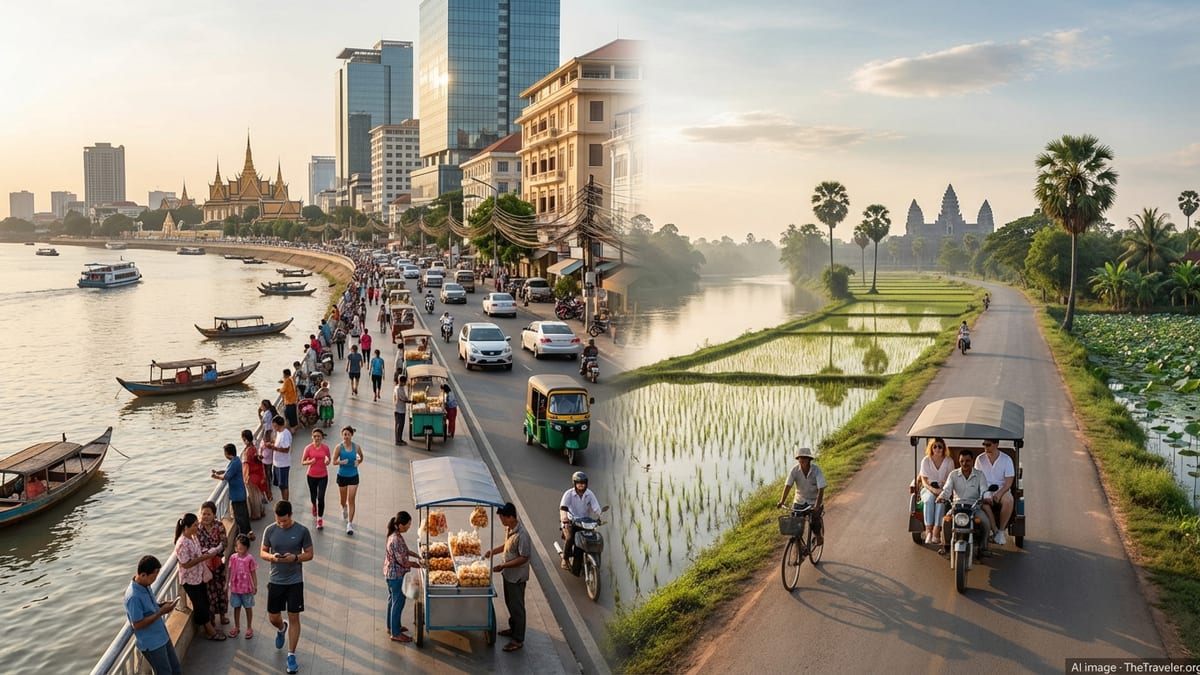
Phnom Penh is a big city experience by Cambodian standards. Spread along the confluence of the Mekong and Tonle Sap rivers, it feels urban the moment you arrive: multilane boulevards, dense traffic, high-rise hotels and glassy bank towers rising behind the spires of traditional pagodas and the Royal Palace. Reviewing the main things to do in Phnom Penh highlights how it differs from Siem Reap. The city’s growth has accelerated in the wake of Cambodia’s tourism recovery, and today Phnom Penh feels like a Southeast Asian capital on fast-forward, where new malls, sky bars and riverside promenades are reshaping the skyline while pockets of French colonial architecture still peek out from side streets.
Siem Reap, by contrast, reads as a compact regional town whose scale is set by tourism rather than government or finance. The center is walkable, with low-rise shophouses, small lanes and neighborhood markets radiating from the river and the Old Market area. You feel closer to the countryside here: rice paddies, lotus ponds and villages are a short tuk-tuk ride away, and evenings are shaped as much by the rhythm of sunrise and sunset at Angkor as by nightlife in town. Despite significant hotel and infrastructure investment around the new Siem Reap–Angkor International Airport, Siem Reap still feels more laid-back than the capital.
For travelers who thrive on big-city energy, Phnom Penh offers more intensity along with the challenges that come with it: congestion, noise and occasionally chaotic development. Those looking for a softer landing, slower pace and easy orientation often find Siem Reap more manageable, especially at the start or end of a longer Southeast Asia trip.
Signature Sights and Cultural Experiences
Phnom Penh’s leading attractions are tied to royal history, religion and the country’s more recent past. The Royal Palace and Silver Pagoda form a striking riverfront complex where you can see classical Khmer architecture, royal regalia and religious art. Nearby, the National Museum houses sculpture and artifacts from Angkor and earlier periods, offering important context if you are heading on to Siem Reap. Equally central to Phnom Penh’s story are the Tuol Sleng Genocide Museum and the Choeung Ek killing fields memorial, which confront the horrors of the Khmer Rouge era. Visiting these sites can be emotionally heavy, but for many travelers they are essential to understanding Cambodia today.
In Siem Reap, the focus is overwhelmingly on Angkor, the vast archaeological park that was the heart of the Khmer Empire from roughly the 9th to 15th centuries. The complex includes Angkor Wat, often called the largest religious monument in the world, as well as the walled city of Angkor Thom and dozens of other temples scattered through forest and countryside. Seeing sunrise over Angkor Wat, exploring the colossal faces of Bayon and walking through tree-tangled Ta Prohm are experiences that define most Cambodian itineraries. The park is large enough that many visitors spread their time over at least two days, often with a guide and tuk-tuk or car.
Beyond Angkor, Siem Reap has developed its own set of cultural offerings. Traditional dance performances, contemporary circus shows, craft workshops and social-enterprise galleries introduce visitors to modern Cambodian creativity and community initiatives. In recent years, more small museums and cultural centers have opened, giving greater insight into subjects from landmine clearance to rural life.
If your key goal is to see world-class temples and ancient architecture, Siem Reap is the obvious priority. If you want a deeper engagement with Cambodia’s modern history, political institutions and urban culture, Phnom Penh should be at least an equal partner in your time allocation.
Getting There, Getting Around and New Infrastructure
Both cities are now served by new international airports designed to support Cambodia’s rising visitor numbers. Siem Reap–Angkor International Airport, which replaced the older in-town facility, sits farther from the city center than its predecessor but offers a larger, more modern terminal and longer runway to accommodate heavier aircraft. Transfer times into town typically run 40 to 60 minutes by taxi or prearranged car, depending on traffic. For many regional travelers, Siem Reap is still the first point of entry into Cambodia, thanks to direct links with hubs in Thailand, Vietnam, South Korea and other Asian countries.
Phnom Penh’s new Techo International Airport has taken over from the city’s former airport and aims to handle tens of millions of passengers annually over the coming decades. Located well outside the core, it requires a longer drive into the center compared with the old facility, but gives the capital a much larger, more modern gateway. The opening comes amid wider efforts to upgrade roads and public works, which in practice means that some areas are under construction while others now enjoy smoother highways and new bridges.
Within each city, tuk-tuks remain the backbone of visitor transport. In Phnom Penh, tuk-tuks and ride-hail cars share crowded boulevards with motorcycles and trucks, so journeys can take longer than the distance suggests, particularly at peak times. The city is too spread out for most visitors to rely solely on walking. In Siem Reap, distances in town are short and traffic is less intense, making it realistic to walk between hotels, restaurants and the riverfront, and to use tuk-tuks mainly for Angkor and out-of-town excursions.
Overland connections between the two cities remain important. Buses and minivans link Phnom Penh and Siem Reap in roughly 5 to 6 hours depending on the route and traffic. There are also domestic flights, which cut travel time to under an hour but come at a higher cost. Border politics with Thailand have occasionally disrupted land crossings farther west, but for most visitors flying in and out of Phnom Penh or Siem Reap remains straightforward, provided you check the latest visa and entry regulations before travel.
Costs, Accommodation and Value for Money
Cambodia remains relatively affordable by global standards, and both Phnom Penh and Siem Reap offer a wide range of price points. Overall, Siem Reap can feel slightly better value in the midrange, especially outside peak seasons around major holidays and festival periods. Guesthouses and boutique hotels compete heavily for business, and many include extras such as pool access, airport pickup or breakfast as standard. Budget travelers will find hostels and simple hotels clustered around the town center and down smaller side streets, often with short walks to cafes and markets.
Phnom Penh’s hotel scene has expanded quickly, with an increasing number of upscale properties and international chains joining long-standing guesthouses. Riverfront and central neighborhoods command higher rates, especially where sky bars, rooftop pools and spa facilities are on offer. Budget options do exist, but they may sit farther from the river or main sights, trading convenience for lower nightly rates. The capital’s role as a business and political hub also means that prices can spike when major conferences or events are in town.
Day-to-day costs show a similar pattern. Street food and simple meals are inexpensive in both cities, but Phnom Penh’s growing high-end dining and cocktail bar scene can quickly add up if you spend most evenings in fashionable venues. Tuk-tuk rides are affordable in either destination, yet longer cross-town journeys in Phnom Penh can be noticeably more expensive simply due to distance and traffic. Entrance fees also shape budgets: Angkor passes are a significant line item in Siem Reap, while Phnom Penh’s main attractions, though not free, tend to involve smaller individual fees spread across several sites.
For travelers watching every dollar, Siem Reap often stretches the budget further once the cost of Angkor tickets is factored into a multi-day stay with reasonably priced food and lodging. Those looking to mix luxury stays, fine dining and nightlife might find Phnom Penh offers more ways to spend, but also more variety at the top end. Where you stay can influence the decision, especially when comparing Phnom Penh hotels.
Food, Nightlife and Everyday City Life
Phnom Penh has emerged as Cambodia’s culinary and nightlife laboratory. The city’s restaurant scene spans family-run noodle shops, traditional Khmer restaurants, international chains and chef-driven kitchens experimenting with modern Cambodian tasting menus. Cafes have multiplied, particularly in neighborhoods popular with expatriates and young professionals, and there is an active scene of cocktail bars, speakeasies and rooftop lounges overlooking the riverside and downtown. Nightlife can run late, and the mix of karaoke bars, clubs and informal beer gardens gives the capital a more overtly urban night-time character.
Siem Reap’s dining and drinking culture grew out of its role as a tourist hub. Pub Street and its neighboring alleys are lined with bars, open-fronted restaurants and small clubs that once catered heavily to backpackers and short-stay visitors. While these areas remain busy, the city has gradually diversified, with quieter riverside restaurants, contemporary Cambodian bistros, vegetarian and vegan cafes, and social enterprises that support local training and employment. The overall tempo is influenced by Angkor’s early starts: many travelers are in bed soon after dinner to catch sunrise at the temples, which keeps nights shorter away from the dedicated late-night zones.
Everyday life feels more visible in Phnom Penh, where morning and evening rush hours, school traffic and construction shape the rhythms of neighborhoods. Markets such as Central Market and Russian Market draw both locals and visitors, and the riverfront promenade fills with families, vendors and joggers at sunset. In Siem Reap, the town center is more skewed to tourism, but venture a few streets away from the busiest quarters and you see markets, small temples and residential areas that echo the slower cadence of provincial life, with children cycling home from school and food carts doing the rounds.
In short, if you are looking for a wider choice of restaurants, bars and after-dark options, Phnom Penh has the edge. If you prefer a scene that is lively yet more contained and easy to navigate on foot, Siem Reap will likely feel more comfortable.
History, Emotion and Ethical Travel Considerations
One of the starkest contrasts between Phnom Penh and Siem Reap lies in the emotional tenor of their most famous sites. In Phnom Penh, visits to the Tuol Sleng Genocide Museum, set in a former high school used as a prison by the Khmer Rouge, and to the Choeung Ek memorial, built on one of the regime’s killing fields, bring visitors face to face with Cambodia’s late 20th-century trauma. Audio guides, photographs and survivor testimonies make these experiences deeply moving and often harrowing. Many travelers leave with a sober understanding of how recent and raw this history still is for Cambodians.
Siem Reap and Angkor, by comparison, are more likely to inspire awe than grief. The temples celebrate the artistic and engineering achievements of the Khmer Empire, and their intricate carvings, grand bas-reliefs and massive stone structures evoke pride and fascination. Yet it is important to remember that Cambodia’s ancient glory and its more recent suffering are chapters of the same national story. Visiting both cities offers a fuller picture of resilience and continuity, from the stones of Angkor to the memorials and modern neighborhoods of Phnom Penh.
Ethical travel considerations come into play in both destinations. Cambodia has worked hard to rebuild tourism as a pillar of its economy, and many enterprises in Phnom Penh and Siem Reap are linked to social causes: training restaurants for marginalized youth, fair-trade craft shops, and tours that support local communities. Choosing these options can help ensure your spending benefits residents more equitably. At the same time, travelers should be cautious about certain activities, such as visits to orphanages or exploitative attractions, which have drawn criticism from child-protection advocates and development organizations.
Balancing temple visits in Siem Reap with time at responsible cultural centers, and pairing Phnom Penh’s heavier historical sites with interaction at ethical businesses and community-led projects, can deepen your understanding and make your trip more constructive for the people who live there.
Safety, Practicalities and Who Each City Suits Best
Both Phnom Penh and Siem Reap are generally welcoming to visitors, and millions of travelers pass through each year without serious incident. Petty crime such as bag snatching and phone theft can occur in crowded areas, particularly in larger cities; Phnom Penh’s busy boulevards and riverfront are typical spots where travelers are advised to stay alert and avoid displaying valuables. In Siem Reap, temple areas and nightlife districts can also attract opportunistic theft, but the smaller scale and lower traffic volume often make visitors feel more at ease.
Health and comfort considerations are similar in both cities. Temperatures are high for much of the year, and temple touring or urban sightseeing under a strong sun can be draining. Access to clean drinking water, air-conditioned indoor spaces and proper sun protection is crucial. Medical care in Cambodia remains limited outside major cities, but Phnom Penh in particular has more clinics and private hospitals used by expatriates and wealthier locals, which can be reassuring for some travelers.
In terms of traveler profiles, Phnom Penh tends to appeal to those interested in politics, history, urban change and a broader snapshot of contemporary Cambodian life. It rewards visitors who enjoy exploring varied neighborhoods, sampling different food scenes and engaging with art galleries, markets and everyday street life. Siem Reap, meanwhile, is especially attractive to first-time visitors to Cambodia, culture-focused travelers and photographers who prioritize Angkor and prefer a gentle city environment that is easy to navigate in a few days.
Families often favor Siem Reap for its manageable size and the clear structure that temple days provide, while solo travelers and long-term backpackers may split their time more evenly, using Phnom Penh as a transport and culture hub and Siem Reap as a base for exploring Angkor and nearby countryside. Both cities can be combined in a single trip of one to two weeks, with the balance between them determined by whether ancient ruins or contemporary city life is your main focus.
The Takeaway
Choosing between Phnom Penh and Siem Reap is less about which city is objectively better and more about which better matches your expectations and interests. Phnom Penh is the country’s political and economic heart, a place where Cambodia’s rapid transformation is most visible, and where you confront the country’s hardest history alongside royal heritage and a surging dining and nightlife scene. It suits travelers who want a capital city experience, who are prepared for urban intensity, and who value direct engagement with modern-day Cambodian life.
Siem Reap is the quieter gateway to Cambodia’s most iconic monuments. It centers your trip on Angkor’s temples, sunrise and sunset rituals and the rhythms of a town that still feels closely tied to nearby villages and rural landscapes. It is often the better fit if your time is short, if you prefer a walkable core with easy logistics, or if you are less comfortable negotiating heavy traffic and larger cities.
For many travelers, the ideal solution is not either-or but both. A few days in Phnom Penh followed by several in Siem Reap, or vice versa, lets you experience both Cambodia’s ancient splendor and its contemporary capital, adding layers of understanding that neither city can provide alone. If schedules and budgets force a choice, let your own travel style be the deciding factor: pick Phnom Penh for urban energy, history and nightlife, and Siem Reap for temples, slower streets and a softer landing in the Kingdom of Wonder.
FAQ
Q1. Is Phnom Penh or Siem Reap better for a first trip to Cambodia?
For a first short trip focused on iconic sights, many travelers prefer Siem Reap because it is smaller, easier to navigate and centered around Angkor’s temples. If you have more time or a strong interest in Cambodia’s modern history and city life, including Phnom Penh or even starting there can make your overall experience richer.
Q2. How many days should I spend in Phnom Penh versus Siem Reap?
A common pattern is two to three full days in Phnom Penh and three to four in Siem Reap. That allows time for the capital’s key sights and neighborhoods, plus at least two days at Angkor and one more day to explore Siem Reap town or nearby countryside. With less than a week in Cambodia, many visitors choose to focus on Siem Reap and add Phnom Penh only if schedules allow.
Q3. Which city is cheaper for accommodation and food?
Both cities are relatively affordable, but Siem Reap can feel slightly better value at the budget and midrange levels, especially outside major holidays and festivals. Phnom Penh offers more high-end options and a wider range of international dining and nightlife, which can increase daily spending if you take advantage of them frequently.
Q4. Is one city safer than the other?
Both Phnom Penh and Siem Reap are generally safe for visitors who take normal urban precautions. Petty theft such as bag snatching and phone grabbing can occur, more often in busy parts of Phnom Penh, so it is wise to keep valuables secure and avoid showing expensive items openly. In Siem Reap, the main risks tend to be opportunistic theft in crowded temple areas or nightlife zones, along with the usual concern of staying hydrated and protected from the sun.
Q5. Which city is better for nightlife?
Phnom Penh has a more diverse and locally oriented nightlife scene, with rooftop bars, cocktail lounges, clubs, beer gardens and late-opening restaurants spread across several neighborhoods. Siem Reap’s nightlife is more concentrated in and around Pub Street and a few other pockets, which can be lively but feel more overtly tourist-focused and tends to wind down earlier away from those districts.
Q6. Do I need a guide in Phnom Penh or Siem Reap?
In Phnom Penh, many visitors explore the Royal Palace, National Museum and markets independently, but choose guided visits for the genocide museum and killing fields to gain deeper context. In Siem Reap, a guide is highly recommended for Angkor, as distances between temples are significant and a knowledgeable guide can help you understand the art, history and symbolism, while also optimizing routes to avoid the worst of the crowds and heat.
Q7. How easy is it to travel between Phnom Penh and Siem Reap?
Travel between the two cities is straightforward, with multiple daily buses and minivans taking roughly five to six hours depending on traffic and road conditions. There are also domestic flights that cut the journey to under an hour but at a higher price. Booking transport through reputable operators or your hotel can make the process smoother.
Q8. Which city is better for families with children?
Many families lean toward Siem Reap because of its calmer traffic, walkable center and the clear focal point that Angkor provides for planning days. It is easier to schedule early temple visits, midday pool breaks and low-key evenings. Phnom Penh can still be rewarding for older children and teenagers, particularly those interested in history and city life, but it requires more care around busy roads and emotionally heavy sites.
Q9. Can I visit both cities in one week?
Yes, visiting both Phnom Penh and Siem Reap in a week is feasible if you plan carefully. A typical seven-day itinerary might include two full days in Phnom Penh, one travel day between the cities and three to four days in Siem Reap. This leaves time for major highlights in each place, though you will need to prioritize and keep your schedule efficient.
Q10. If I must choose only one, which should I pick?
If your primary goal is to see Cambodia’s most famous landmarks and you prefer a smaller, less intense city, choose Siem Reap for Angkor and its relaxed atmosphere. If you are more interested in understanding contemporary Cambodia, its recent history and its evolving urban culture, and you do not mind big-city traffic and noise, Phnom Penh will likely be the better choice.