


Phnom Penh can feel overwhelming at first glance. The Cambodian capital is dense, noisy, and emotionally heavy, yet it is also one of Southeast Asia’s most rewarding cities for travelers who make the time to understand it.
This guide ranks the best things to do in Phnom Penh by interest and time, so you can decide what to prioritize whether you have a single day, a long weekend, or more. It blends the city’s essential historical sites with food experiences, riverfront life, and under-the-radar neighborhoods that show how modern Phnom Penh is evolving.
How to Structure Your Time in Phnom Penh
Seeing the sights firsthand helps reset expectations about whether Phnom Penh is worth visiting overall. Before choosing specific sights, it helps to think about how much time you have. Phnom Penh’s top experiences naturally group into half-day blocks. With one full day, you can cover the most important historical sites. Add a second or third day and you can layer on river cruises, markets, and local neighborhoods without feeling rushed.
Most travelers base themselves around the riverside, BKK1, or the central business district around Vattanac Capital. These areas offer easy access by tuk tuk to the Royal Palace, National Museum, Tuol Sleng Genocide Museum, and the Choeung Ek memorial, as well as to the Mekong riverfront and emerging nightlife on Bassac Lane and Street 308. Plan to move mostly by tuk tuk; rides within the central city are short and inexpensive, and traffic can make walking less comfortable than it looks on a map.
One-Day Essentials
If you have only one full day in Phnom Penh, the non-negotiable experiences are the Tuol Sleng Genocide Museum (S-21), the Choeung Ek memorial, and a walk around the Royal Palace and riverfront. This combination gives you a coherent narrative of Cambodia’s modern history alongside a feel for the contemporary city.
Most visitors spend the morning at Tuol Sleng and Choeung Ek, then return to central Phnom Penh for the Royal Palace complex and a sunset stroll or cruise on the river. The emotional weight of the genocide sites is significant, so avoid packing the day with too many other obligations.
Two to Three Days
With a second or third day, you can slow the pace and explore Phnom Penh’s softer side. Add the National Museum of Cambodia, a food tour or cooking class, local markets like Russian Market or Central Market, and atmospheric neighborhoods such as Bassac Lane, Street 240, and the redeveloped waterfront at Sisowath Quay.
This is also the ideal amount of time to sample Phnom Penh’s growing contemporary culture scene, from independent galleries and street art to sky bars in towers like Vattanac Capital, and to take a sunset cruise on the Mekong or Tonle Sap rivers for a different perspective on the city skyline.
Four Days or More
Stay four days or longer and Phnom Penh becomes less about ticking off sights and more about getting to know the city’s rhythms. You can balance return visits to favorite cafes and bars with day trips to outlying temples, the newer Morodok Techo National Stadium complex, or villages along the Mekong. This is the ideal timeline for travelers interested in photography, food, or contemporary Cambodian life.
Heavy-Hitters: History, Memory, and Culture
Phnom Penh’s most powerful experiences pivot around Cambodia’s 20th-century traumas and its longer royal and religious traditions. These sites are essential for understanding the city and are ranked first because of their depth and significance rather than their light entertainment value.
Tuol Sleng Genocide Museum (S-21)
Tuol Sleng is the former high school converted by the Khmer Rouge into their notorious S-21 interrogation and torture center. Today it is preserved as the Tuol Sleng Genocide Museum, one of the most important historical sites in Cambodia. Visitors walk through former classrooms converted into cells, see photographs of prisoners, and hear recorded testimonies that bring the brutality of the period into sharp focus.
The museum can be emotionally overwhelming. Audio guides in multiple languages provide careful context, explaining how S-21 functioned within the Khmer Rouge security system and how the prison processed more than ten thousand people, of whom only a handful survived. Plan at least two hours here, more if you prefer to move slowly and read detailed exhibits. It is wise to visit earlier in the day, when temperatures are lower and the site is slightly less crowded.
Choeung Ek Genocidal Center (The Killing Fields)
About 20 to 40 minutes by tuk tuk from central Phnom Penh, Choeung Ek was one of the principal execution and mass grave sites during the Khmer Rouge era. Today it is a quiet, tree-shaded memorial that belies the horrors that took place here. An audio guide walks visitors through the grounds, marked by depressions where mass graves were unearthed and a stupa filled with the remains of victims.
Many travelers pair Tuol Sleng and Choeung Ek in a single half day, often starting at Tuol Sleng and continuing directly to Choeung Ek with the same driver. This makes historical sense, as the museum explains how prisoners were processed before being taken to the fields. The site has become even more prominent since Tuol Sleng and Choeung Ek were added to the UNESCO World Heritage List, underscoring Cambodia’s commitment to preserving and interpreting this history for future generations.
Royal Palace and Silver Pagoda
Back in the city center, the Royal Palace complex is the ceremonial heart of Phnom Penh and a striking contrast to the austerity of the genocide sites. Gilded roofs, manicured gardens, and ornate pavilions line walkways regularly used for royal ceremonies. Access can be restricted during major events, but on most days visitors can explore key sections open to the public.
The adjacent Silver Pagoda, named for the thousands of silver tiles covering its floor, houses important Buddhist and royal artifacts, including revered Buddha statues. A visit here adds essential context to how the monarchy and Theravada Buddhism shape Cambodian identity. Plan about 90 minutes to two hours for the palace and pagoda, and note that modest dress is required: shoulders and knees should be covered.
National Museum of Cambodia
A short walk from the Royal Palace, the National Museum of Cambodia is the country’s principal repository of Khmer art and archaeology. Its red terra-cotta buildings and central courtyard are an oasis of calm, while the galleries trace Cambodian history from pre-Angkorian times through the Angkor empire and beyond.
Statues from Angkor Wat and other temple complexes help connect Phnom Penh to Cambodia’s archaeological heartland in Siem Reap. Exhibits on ceramics, bronzes, and woodcarvings highlight the artistry that flourished long before the city’s modern upheavals. Combine the museum with the Royal Palace either in the morning or afternoon; together they create a strong cultural counterbalance to the darker history of Tuol Sleng and Choeung Ek.
Best Things to Do with Limited Time
Visitors deciding how to split their time often compare Phnom Penh vs Siem Reap. If you have only 24 to 48 hours in Phnom Penh, focus on experiences that give you the broadest sense of place in the shortest time. The following activities are arranged to help you build efficient half-day blocks that combine history, city life, and the riverfront.
Morning Circuit: Tuol Sleng and Choeung Ek
Start early at Tuol Sleng to avoid midday heat. After touring the museum, meet your tuk tuk driver and head straight for Choeung Ek. Depending on traffic, the journey takes less than an hour, and visiting both sites generally fits into a four to five hour window. Most drivers are familiar with this circuit and can wait while you visit.
This concentrated morning is heavy but historically coherent. Pack water and tissues, dress modestly, and give yourself mental space afterward. Many travelers find it useful to discuss what they have seen with travel companions or over a quiet lunch back in town rather than rushing into a packed afternoon schedule.
Afternoon Circuit: Royal Palace, Silver Pagoda, and Riverside Walk
Once you have had time to decompress, spend your afternoon around the Royal Palace and riverfront. Visit the palace and Silver Pagoda first; then, as the light softens, walk along Sisowath Quay, the main riverfront promenade that parallels the Tonle Sap River.
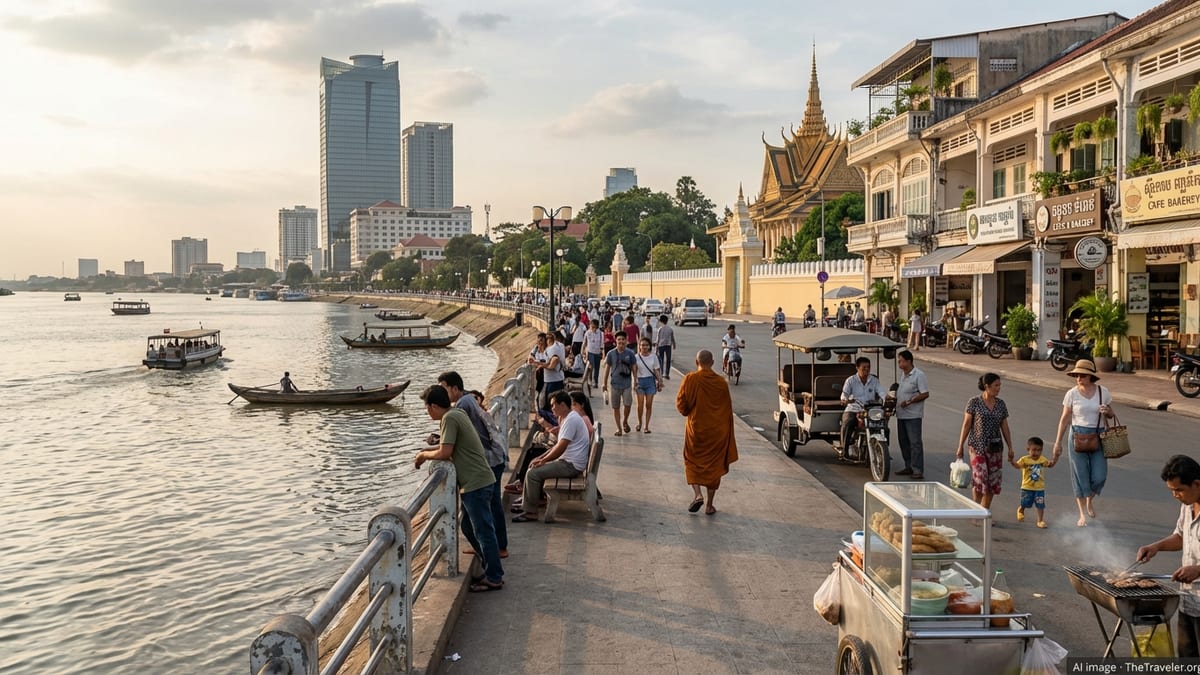
The riverside in late afternoon and early evening is one of the most atmospheric parts of Phnom Penh. Families gather, vendors sell snacks, monks pass by in saffron robes, and the skyline begins to glow. You can finish the day with a drink at one of the cafes or rooftop bars overlooking the water, or simply find a bench and people-watch as ferries and small boats ply the rivers.
Evening Highlight: Mekong and Tonle Sap Sunset Cruise
Sunset cruises have become one of Phnom Penh’s signature experiences. Short evening trips typically last 90 minutes to two hours and depart from piers along the riverfront. Many include free-flow soft drinks, beers, and light snacks, while premium options may offer cocktails and buffet-style dinners.
From the deck, the city unfolds in layers: the Royal Palace complex, low-rise shophouses, and newer glass towers like Vattanac Capital catch the last light while small fishing communities along the banks remind you that much of Cambodia still depends on the river. For travelers with limited time, this is one of the most efficient and enjoyable ways to see how old and new Phnom Penh coexist.
Food, Markets, and Nightlife
Phnom Penh’s dining scene is one of the most dynamic in the region, blending traditional Cambodian dishes with international influences and a strong cafe culture. Nightlife is energetic but more compact than in larger regional capitals, meaning you can sample a lot within walking distance or a short tuk tuk ride.
Street Food and Market Eating
For many visitors, the quickest route into Cambodian culture is through its food. Early-morning and evening are prime times to explore street stalls selling noodle soups, grilled meats, and snacks. Guided food tours have become popular, especially around central markets and older neighborhoods, and are an efficient way to try multiple dishes while learning about local ingredients and customs.
At markets like Russian Market and Central Market, you will find clusters of food stalls offering rice porridge, kuy teav (rice noodle soup), and fresh spring rolls. Hygiene and turnover tend to be good where locals are eating in large numbers. Bring cash, and remember that many vendors will understand basic English numbers or gestures even if they do not speak the language fluently.
Cafes and Brunch Spots
Phnom Penh has developed a sophisticated cafe scene, especially in expat-heavy neighborhoods like BKK1 and around Street 240. Here, you will find third-wave coffee bars, bakeries, and brunch spots serving both Western and Khmer-influenced dishes. Many double as co-working spaces and gallery venues, making them ideal stops between sightseeing blocks.
These cafes are not just for foreigners. A growing Cambodian middle class frequents them as well, and they have become informal meeting spaces for students, entrepreneurs, and creatives. If you plan to work remotely or catch up on travel planning, this is where the city feels most cosmopolitan and connected.
Bassac Lane, Street 308, and Small-Bar Nightlife
For nightlife on a compact scale, Bassac Lane and neighboring Street 308 are the city’s most atmospheric small-bar districts. Narrow alleys are lined with micro-bars, cocktail lounges, and small eateries, each with its own personality. Venues range from laid-back, vinyl-focused bars to more polished cocktail rooms and craft beer spots.
Even on weeknights, these streets see a steady mix of locals, expats, and visitors. It is easy to hop between places, sampling different atmospheres without long transfers. Noise levels are moderate compared with larger regional capitals, making this a good area for conversation as well as drinks.
Sky Bars and Rooftop Views
Phnom Penh’s skyline has changed dramatically over the last decade, and viewing it from above is a worthwhile experience. High-rise developments like Vattanac Capital and newer hotels host rooftop bars that look out over the Tonle Sap and Mekong rivers, the Royal Palace, and the patchwork of low-rise neighborhoods.
Dress codes vary, but smart-casual attire is generally recommended for upscale venues. Sunset and early evening are the best times to visit, when heat has eased but the city has not yet fully gone dark. Reservations are advisable on weekends and during major holidays when locals often celebrate in style.
Slow Travel: Neighborhoods, Temples, and Everyday Life
Once you have covered the core sights, the richest rewards in Phnom Penh come from wandering. Several neighborhoods and secondary sights are ideal for travelers with extra time or a taste for slow exploration.
Wat Phnom and the City’s Origin Story
Wat Phnom is a small but symbolically important temple on an artificial hill north of the city center. Local legend holds that Phnom Penh began when a noblewoman, Lady Penh, discovered sacred statues in the river and built a shrine on this hill to house them. The temple you see today is the latest iteration of that origin story, surrounded by a small park and busy traffic loops.
Visit in the early morning or late afternoon to see residents making offerings, lighting incense, and walking in the park. Fortune-tellers and flower vendors set up around the base, and the area is often included in city tours and evening tuk tuk circuits. Some highlights are best understood through guided Phnom Penh tours. From the top of the hill, you get a modest but instructive view of surrounding government buildings and commercial districts.
Independence Monument and Norodom Sihanouk Memorial
At the intersection of Norodom Boulevard and Sihanouk Boulevard stands the Independence Monument, a lotus-shaped stupa that commemorates Cambodia’s independence from France. Designed by architect Vann Molyvann, it has become one of the city’s defining landmarks. Nearby is the Norodom Sihanouk Memorial, honoring the late king and former head of state.
The monument is especially photogenic in the evening when fountains and lights are turned on. The surrounding park and wide boulevards give a sense of Phnom Penh’s mid-20th-century planning, a time when Cambodian modernist architecture flourished. While you will not spend long here, the site is a useful anchor in any city walk and is typically included in tuk tuk tours.
Street 240 and Creative Phnom Penh
Street 240, running behind the Royal Palace, has evolved into a quieter enclave of boutiques, small galleries, cafes, and social enterprises. Tree shade and restored shophouses make it pleasant for strolling, especially in the cooler hours of the day.
This area is ideal for travelers interested in design, fair-trade crafts, and small-scale Cambodian brands. Many shops specialize in textiles, homewares, and ethically produced souvenirs, offering an alternative to mass-market items found in larger markets. Combine Street 240 with a visit to nearby temples or the palace for a rewarding half day.
Experiences for Active and Curious Travelers
Beyond the main sights, Phnom Penh offers a growing range of activities for travelers who prefer to stay active or dig deeper into specific interests such as sports, faith, or contemporary culture. These experiences work best for travelers with three days or more in the city.
Guided Bike Rides and Island Escapes
Cycling tours explore quieter roads on the far side of the Mekong and Tonle Sap rivers, as well as nearby islands where life moves at a more rural pace. These rides often include ferry crossings, village visits, and stops in small pagodas or markets, offering a sharp contrast to the density of central Phnom Penh.
Distance and difficulty vary, so check details before booking. Morning departures are common to avoid peak heat, and most operators provide bikes, helmets, snacks, and water. For travelers who want to see how rapidly the city gives way to countryside, these tours are one of the most efficient and memorable options.
Morodok Techo National Stadium and Modern Cambodia
Opened in 2021 and renovated in 2024, the Morodok Techo National Stadium complex reflects a different Cambodia than the one most visitors expect. Built as the centerpiece of the national sports complex, it has hosted major regional events and symbolizes the government’s efforts to position Phnom Penh as a regional sports and events hub.
While the stadium is not on most first-time itineraries, sports fans and architecture enthusiasts may appreciate a visit, especially when events or matches are scheduled. It also illustrates how investment and ambition are reshaping the capital beyond the traditional tourism core.
St. Joseph’s Church and Faith after the Khmer Rouge
For travelers interested in religious history, the newly completed St. Joseph’s pro-cathedral in northern Phnom Penh offers insight into the revival of Catholicism after the devastation of the Khmer Rouge years. The modern church incorporates both Khmer and Latin architectural elements, signaling how minority faith communities are re-establishing themselves within predominantly Buddhist Cambodia.
Services are held in Khmer as well as other languages, and visitors who attend respectfully can observe how the congregation blends local and imported traditions. This stop pairs well with broader explorations of how different faiths and cultures coexist in today’s Phnom Penh.
Practical Tips: Getting Around, Etiquette, and Safety
Phnom Penh is relatively straightforward to navigate once you understand its grid system and traffic patterns. A bit of planning around climate, clothing, and etiquette can make your visit far more comfortable and rewarding.
Moving Around the City
Tuk tuks are the primary way travelers get around Phnom Penh. App-based ride services operate alongside street-hailed drivers, and fares are generally low by international standards. Journeys within the central area often take 10 to 20 minutes, depending on traffic and construction.
Walking is possible in certain districts, especially around the riverside, BKK1, and Street 240, but sidewalks can be uneven or blocked by parked vehicles. When crossing streets, move steadily and predictably so motorbikes and cars can anticipate your path.
Weather, Dress, and Temple Etiquette
Phnom Penh is hot and humid for much of the year, with a distinct rainy season. Lightweight, breathable clothing is essential, along with a hat, sunscreen, and water. Sudden downpours are common in the rainy months, so carrying a compact umbrella or rain jacket helps.
When visiting temples and the Royal Palace complex, shoulders and knees should be covered. Scarves thrown over tank tops may not always be considered sufficient; bring a light shirt or longer dress to avoid being turned away. Shoes are usually removed before entering key temple buildings, so wearing sandals or easily removable footwear is practical.
Money, Scams, and Staying Grounded
Cash remains king in Phnom Penh, though card payments are increasingly accepted in hotels, upscale restaurants, and some shops. Small bills are useful for tuk tuks, markets, and street food. As in any major city, keep valuables secured, be mindful of phones when close to the edge of the road, and agree on tuk tuk prices when not using an app.
Most visitors find Phnom Penh welcoming and manageable, but the emotional impact of visiting genocide-related sites should not be underestimated. Plan quieter interludes in cafes, parks, or along the riverfront after such visits, and give yourself time to process what you have seen rather than treating the city as just another checklist of attractions. Knowing where attractions are located directly affects which Phnom Penh hotels make sense.
The Takeaway
Phnom Penh is not a city of instant charm; its rewards deepen with context and time. The must-see experiences center on Cambodia’s traumatic 1970s history and on the royal and religious institutions that bookend that era. Around them, however, lies a living capital of riverside promenades, street food, independent cafes, creative neighborhoods, and emerging architectural icons.
Whether you have one day or a week, the key is to balance the gravity of places like Tuol Sleng and Choeung Ek with lighter, everyday scenes along Sisowath Quay, in the markets, or on a sunset cruise. Do that, and Phnom Penh becomes more than a stopover on the way to Angkor. It becomes a place where past and present confront each other in ways that are challenging, illuminating, and ultimately unforgettable.
FAQ
Q1. How many days do I need in Phnom Penh to see the main sights?
Most travelers can cover the essential historical and cultural sights in two full days, including Tuol Sleng, Choeung Ek, the Royal Palace, Silver Pagoda, National Museum, and a riverside or sunset cruise. With three days or more, you can explore neighborhoods, markets, and additional activities at a more relaxed pace.
Q2. Is it appropriate to visit Tuol Sleng and Choeung Ek with children?
Content at both sites is graphic and emotionally intense, including photographs and detailed accounts of torture and mass killings. Older teenagers with prior context and interest in history may benefit, but younger children can find it disturbing. Parents should research in advance and decide based on their children’s maturity and sensitivity.
Q3. What is the best way to get around Phnom Penh as a visitor?
Tuk tuks are the most practical and atmospheric way to move around the city. App-based services make pricing transparent, while street-hailed tuk tuks are widely available if you agree on a fare in advance. Walking works for short distances in central neighborhoods, but traffic and heat make long walks tiring.
Q4. When is the best time of day to visit the Royal Palace and National Museum?
The Royal Palace and National Museum are most pleasant in the morning or late afternoon, when temperatures are lower and light is better for photography. Check current opening hours before you go, and remember that the palace complex may close temporarily during major royal or state ceremonies.
Q5. Are sunset cruises on the Mekong and Tonle Sap rivers worth it?
Yes. Sunset cruises offer a relaxed way to see Phnom Penh’s skyline, river life, and the contrast between modern towers and traditional riverside communities. Many cruises include drinks and light snacks, and the early evening timing makes them easy to fit into a short itinerary after a day of sightseeing.
Q6. What should I wear when visiting temples and the Royal Palace?
Dress modestly, with shoulders and knees covered. Lightweight long trousers or skirts and short- or long-sleeved tops are ideal. Avoid sheer or overly tight clothing, and be prepared to remove shoes before entering temple buildings. Carrying a light scarf or shawl is useful but may not replace the need for a proper shirt.
Q7. Is Phnom Penh safe for solo travelers?
Phnom Penh is generally safe for solo travelers who take normal urban precautions. Petty theft and bag snatching can occur, especially near busy roads, so keep valuables secure and avoid displaying expensive items. At night, use tuk tuks rather than walking long distances, and stick to well-lit, frequented areas.
Q8. Can I visit Phnom Penh as a day trip from another city in Cambodia?
Travel times make same-day round trips challenging from most other destinations. Phnom Penh is several hours by road from Siem Reap, coastal towns, and border crossings, so it is better experienced with at least one or two nights in the city. If your time is limited, prioritize either Phnom Penh or another destination rather than rushing between them.
Q9. How should I pace visits to genocide-related sites to avoid emotional overload?
Plan Tuol Sleng and Choeung Ek in a single half day, followed by quieter, restorative activities such as a cafe stop, a walk along the riverfront, or time in a park. Avoid scheduling social or nightlife-heavy plans immediately afterward, and allow space to reflect on what you have seen before moving on to the rest of your itinerary.
Q10. What are the best souvenirs to buy in Phnom Penh?
Look for textiles, scarves, and clothing made from locally woven fabrics; contemporary crafts such as ceramics and woodwork; and responsibly sourced homewares from social enterprises, particularly along Street 240 and in selected shops near the central districts. Avoid purchasing antiques or items that may have been removed from heritage sites, and be cautious about wildlife products, which may be illegal or unethical.