


I had been to Southeast Asia several times before I finally made it to Phnom Penh. Friends were split about it. Some told me it was raw, chaotic and confronting in a way I might not enjoy. Others swore it was one of the most emotionally powerful stops on their whole trip.
I went in curious but cautious, especially with the recent headlines about border tensions with Thailand and online scam compounds, and I tried to keep my expectations realistic.
After spending several days in the city, talking with locals, visiting the major sights and walking far more than was sensible in the heat, I left with mixed feelings. Phnom Penh did not charm me in the easy way that some capitals do, but it left a mark that feels more important than pretty photos ever could. Once you decide to include the city, this comparison of Phnom Penh hotels helps you choose the right base.
First Impressions, Expectations and Reality
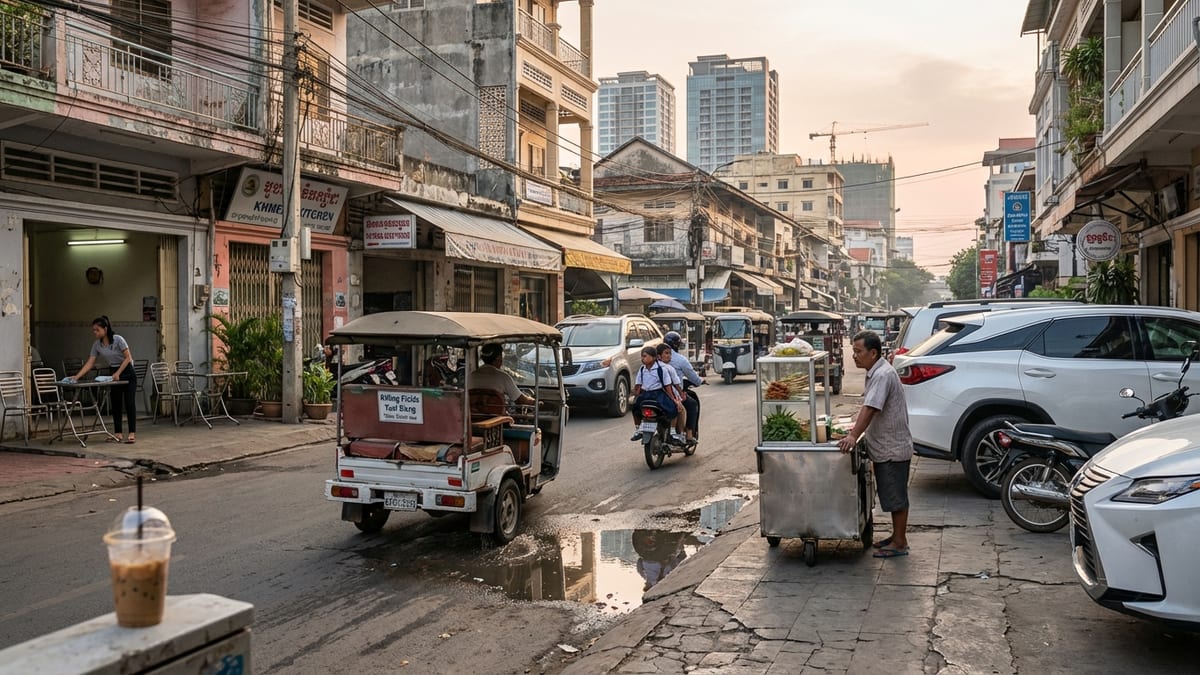
My first impression of Phnom Penh was not flattering. I landed at the small international airport, which still feels manageable and relatively straightforward, and took a taxi into town. Traffic was immediately intense: tuk tuks swarming between SUVs, motorbikes carrying entire families, everyone leaning on their horn. It is not the gridlock of Bangkok, but it felt aggressive and disorderly. I was prepared for developing world infrastructure, but the reality of uneven sidewalks, construction dust and the constant background of noise hit me harder than I expected after a long travel day.
At the same time, the scale of the city surprised me. I had half imagined a sleepy riverside capital, but Phnom Penh is sprawling, with distinct neighborhoods and construction cranes on the skyline. New malls and glass towers share streets with shophouses and crumbling colonial villas. The contrasts are sharp. I often found myself walking past a luxury condo sales office and then a minute later squeezing around a muddy pothole while tuk tuks splashed past. It created a sense of a city in fast transition, but not evenly or gracefully.
Emotionally, I felt off balance my first day. The city is not laid out for leisurely wandering in the way many travelers might hope. Zebra crossings mean little, sidewalks are often taken over by parked cars or food carts, and you have to constantly watch your step.
I had planned to do a relaxed self-guided walking tour along the river and through some old streets, but what looked like a short stroll on the map became a tiring obstacle course under the mid-day sun. If guided experiences interest you, this breakdown of Phnom Penh tours offers a balanced starting point. By the end of that first afternoon I was hot, slightly frazzled, and wondering if I had made a mistake coming here at all.
History, Trauma and the Emotional Weight of Phnom Penh
The reason I had pushed past my doubts and booked Phnom Penh anyway was its history. The city is the main gateway to understanding the Khmer Rouge era and the Cambodian genocide, and I felt that if I was going to visit Cambodia at all, I had a responsibility to learn about that chapter properly, not just pass through on my way to the temples of Angkor. That mindset shaped almost everything I did in Phnom Penh.
My visit to Tuol Sleng Genocide Museum, the former S-21 prison, was one of the most harrowing travel experiences I have ever had. The museum is open daily, and I went in the morning before the worst of the heat. I took the audio guide, walked through the former classrooms turned torture chambers, and stared at walls of black and white photos. It is clinical in its detail and unflinching in what it shows. I did not take many photos, and for long stretches I simply stood in silence, listening to survivors tell their stories. This is not comfortable tourism. I left emotionally exhausted, but I am glad I went. It contextualized the rest of my time in Cambodia in a way no book ever had.
Later that day I took a tuk tuk out to the Choeung Ek Genocidal Center, often called the Killing Fields. It is an easy day trip from the city, and the site is still open daily with an audio guide included in the entry fee. The ride out through the outskirts of Phnom Penh gave me a glimpse of rural life and the edges of urban sprawl, but once inside the grounds, the mood shifted completely. The audio tour carefully walks you through mass graves, the memorial stupa and the surrounding trees. There is minimal sensationalism, but the facts themselves are devastating. I noticed how quiet other visitors were. The combination of Tuol Sleng and Choeung Ek in a single day was heavy, maybe too heavy, and I would probably split them across two days if I did it again.
This historical weight is both Phnom Penh’s greatest strength and one of the reasons I hesitate to recommend it casually. It gave my trip meaning. It also meant that much of my time in the city was emotionally draining. If you are looking for lighthearted urban fun, Phnom Penh is probably going to be a poor fit. If you believe that travel is partly about confronting difficult histories, the city has a depth that few places can match.
Riverside Charm, Royal Palace and Everyday City Life
Phnom Penh is not all trauma and traffic, of course. There were moments when the city felt almost gentle. In the late afternoon, the heat eased and the riverside promenade along the Tonle Sap and Mekong came alive. Families strolled, kids kicked footballs, vendors sold sugarcane juice and grilled skewers, older people exercised in groups to loud pop music. I sat on a low wall one evening with an iced coffee, watching the sky turn pink over the river, and for a little while the city’s chaos softened into something almost romantic.
I also visited the Royal Palace and Silver Pagoda complex. Officially it keeps fairly regular daytime opening hours, but there are occasional closures for ceremonies, so checking locally is important. Architecturally, the palace is beautiful, with manicured gardens and elegant Khmer roofs. I will be honest though: it did not fully live up to my expectations, especially after paying what feels like a relatively high entry fee by local standards. Several buildings were closed, signage was limited, and I felt slightly rushed by the flow of visiting groups. It was pleasant, and I do not regret going, but it was not a highlight of my trip.
Outside the riverfront and palace area, Phnom Penh can be a tough city to simply wander. Street markets are lively, but pavements are chaotic and crossing roads takes nerve. I found it easier when I surrendered to tuk tuks for anything more than a few blocks. That did have the side effect of insulating me from some of the street-level life I normally enjoy when walking around a new city. When I did find quieter backstreets, with old villas and small cafes, they felt like little rewards for putting up with the rest.
Safety, Scams and After Dark Atmosphere
Before I came, I read plenty of warnings about petty crime in Phnom Penh, particularly bag and phone snatching from passing motorbikes. The official advisories and recent reports still highlight this as a problem, especially around areas where tourists tend to gather. On the ground, I never felt in direct danger, but I did feel the need to be more on guard than in many other cities in the region. I kept my phone zipped inside my bag when walking near roads, I avoided walking alone late at night and I took tuk tuks instead of long walks back to my guesthouse after dark.
Scams are part of the conversation too. There are well documented issues with fake tour operators, inflated prices for naive visitors and various hustles in nightlife areas. I avoided anything that sounded vague or too friendly, agreed on tuk tuk prices before getting in, and booked my Killing Fields transport through my guesthouse rather than a random driver. Those simple precautions kept me out of trouble, but I can see how less experienced travelers might have some rough encounters.
Nightlife in Phnom Penh is complicated. On one hand, there are now more polished rooftop bars and stylish cocktail spots than ever, and I did enjoy one evening sunset drink overlooking the river. On the other hand, there are also seedy bars, visible sex work and a darker undercurrent that is hard to ignore once you have read about human trafficking and exploitation in the country. It made me uncomfortable, and I chose to keep my nights fairly tame. If you are coming looking for a wild party scene, you will find it, but you may also see things that are hard to unsee.
There is also the wider context of Cambodia’s issues with scam compounds and human trafficking, which have drawn global attention in the last couple of years. While these operations are not something an average tourist directly encounters, knowing they exist, sometimes in city outskirts and secondary provinces, did color the way I viewed some shiny new developments and casinos. It is not a reason to avoid Phnom Penh entirely, but it is part of the reality behind the neon.
Costs, Food and Practical Annoyances
On a practical level, Phnom Penh is still cheaper than most Western capitals, but it is not as ultra-budget as some travelers imagine. Accommodation prices have crept up, especially for clean, well located guesthouses. I found a decent midrange room, but it cost more than similar quality in nearby countries. The city uses US dollars extensively alongside the local currency, and small change is often given in riel. It is convenient in some ways, but it can also make you less price sensitive if you mentally convert everything too generously. I overspent more than once because “just a few dollars more” added up quickly.
Food was a more positive surprise. I had heard mixed reviews of Cambodian cuisine, but I ate very well in Phnom Penh. Local spots served fragrant fish amok, simple rice and grilled meat dishes and fresh herb filled soups. Street food can be excellent if you pick busy stalls. At the same time, there are now plenty of modern cafes serving good coffee, pastries and Western brunch staples, which provided a welcome break when I was feeling overwhelmed by the heat and noise outside. Hygiene standards vary, so I stuck to busy places and bottled water, and I had no stomach issues.
The main annoyance for me was the heat and pollution. Depending on the season, Phnom Penh can be brutally hot and humid, and I found that by midday my energy evaporated. There is also a fair amount of dust and exhaust in the air, especially on busy roads and near construction sites. I ended up structuring my days around this: early morning outings, a long break in the middle of the day, and then a second wind later in the afternoon. If you try to power through all day on foot, the city will likely wear you down quickly.
Transport is a mixed bag. The closure of some land borders between Cambodia and Thailand due to the ongoing border tensions has made overland itineraries more complicated, and while air connections into Phnom Penh are functioning, the overall sense is that this is a city in flux. Within the city, ride hailing apps and tuk tuks make short journeys fairly easy and cheap, but traffic jams at peak times can be draining. There is no metro, and buses are not intuitive for short term visitors, so you end up relying heavily on small vehicles and your own patience.
Who Will Appreciate Phnom Penh and Who Might Not
After several days in the city, I realized that Phnom Penh is not one of those destinations that tries hard to seduce you. It does not have the manicured charm of many European capitals or the easy backpacker friendliness of some Southeast Asian beach towns. It can be rough around the edges, confronting and logistically awkward. If your idea of a good city break is elegant streets and effortless strolling, Phnom Penh will likely frustrate you more than it delights.
However, if you value understanding a place’s modern history, if you are willing to sit with discomfort and if you see travel as more than just consuming pretty views, Phnom Penh has a lot to offer. The genocide sites are difficult but essential, the museums and memorials are improving, and conversations with locals who lived through upheaval or its aftermath can be deeply moving. I left with a much more nuanced understanding of Cambodia as a whole, and that alone made the trip feel worthwhile to me.
Phnom Penh also works better, in my view, as part of a broader Cambodian itinerary than as a standalone city escape. A few days in the capital, followed by time in Siem Reap, Kampot or the islands, allows you to process what you see here and balance the intensity with lighter experiences. Trying to wring a full week of enjoyment out of Phnom Penh alone might be a stretch unless you have a particular interest in urban development or long term stays. How long you stay often depends on whether nearby day trips from Phnom Penh match the experience you want.
If you are an anxious traveler, new to Southeast Asia, or traveling with very young children, the combination of traffic, heat, uneven infrastructure and heavy subject matter might feel like too much. In that case, I would not say Phnom Penh is a must. If, however, you are reasonably travel seasoned, comfortable with imperfect conditions, and motivated to engage deeply with Cambodia’s story, I would still encourage a visit.
The Takeaway
So, is Phnom Penh worth visiting I left with a cautious yes, but with clear caveats. The city did not charm me in the usual sense. I did not fall in love with its streets, and there were days when I was more relieved to return to my guesthouse air conditioning than excited to be out exploring. Yet I also left feeling that skipping Phnom Penh entirely would mean missing a crucial piece of Cambodia’s puzzle. The most important experiences I had there were not enjoyable in a lighthearted way, but they were meaningful, and they changed how I thought about the country and its people.
If I did it again, I would plan my time more deliberately. I would give myself one day for Tuol Sleng, another separate day for the Killing Fields, and in between I would schedule low key activities: a riverside walk at sunset, a slow morning in a cafe, maybe a short boat ride. I would keep my evenings simple and my expectations around infrastructure modest. I would rely on tuk tuks instead of trying to walk everywhere, and I would accept that this is a city still rebuilding and redefining itself, not a polished showpiece.
Phnom Penh is worth it for travelers who are prepared, both logistically and emotionally. It is worth it if you want to understand Cambodia beyond Angkor Wat, if you can handle confronting sites with respect, and if you accept that the city will sometimes be uncomfortable, messy and imperfect. It is less worth it if you are just chasing pretty skylines and seamless convenience. For me, those few intense, sometimes exhausting days in Phnom Penh did not give me the easiest memories of my trip, but they gave me some of the most important ones.
FAQ
Q1. Is Phnom Penh safe to visit right now
Phnom Penh is generally considered safe for tourists in the main central areas, with normal precautions. Petty crime like phone and bag snatching does occur, especially near busy streets and nightlife zones, so I kept valuables out of sight and avoided walking alone late at night. The recent tensions with Thailand have affected border regions and some land crossings, but in the capital daily life and tourism activities continued normally during my visit.
Q2. How many days should I spend in Phnom Penh
I found that two to three full days was enough for a first visit. That gave me time to see Tuol Sleng, the Killing Fields, the Royal Palace and the riverside without rushing, while still allowing breaks to recover from the emotional and physical fatigue. More time could be useful if you like slow travel, but for most itineraries I would not plan a whole week here unless you have a specific reason.
Q3. Is visiting Tuol Sleng and the Killing Fields too disturbing
They are extremely disturbing, and you should be honest with yourself about your emotional limits. For me, Tuol Sleng was the hardest, because it takes place inside former classrooms and cells with very personal stories. The Killing Fields are more reflective but still heavy. I was glad I went, but I would not schedule anything demanding immediately afterward. If you are prone to anxiety or trauma triggers, consider spacing them out or reading detailed descriptions beforehand to decide.
Q4. Can I walk around Phnom Penh or should I use tuk tuks
You can walk short distances, especially along the riverfront, but I found the city tiring and sometimes stressful to navigate entirely on foot due to traffic, heat and uneven sidewalks. Tuk tuks are inexpensive and easy to find, and using them for anything more than a few blocks made my days far more manageable. I still walked where it felt pleasant, but I did not try to make the city a pure walking destination.
Q5. Is Phnom Penh suitable for families with children
It depends on the age of the children and your goals. The genocide sites are not appropriate for very young kids and can be intense even for teenagers. The traffic, heat and sometimes chaotic sidewalks also add stress for parents. If your main focus is family friendly fun, I would not put Phnom Penh at the center of a Cambodia trip. A short stop of a day or two might still make sense for older teens who are ready to learn about the history. This question becomes clearer after reviewing the main things to do in Phnom Penh.
Q6. How expensive is Phnom Penh compared to other Southeast Asian cities
Phnom Penh is still affordable, but I found it slightly more expensive than I expected in some areas. Midrange accommodation in central, safe neighborhoods can cost as much as or more than in neighboring countries. Food and tuk tuks remained good value, especially at local places. Because US dollars are widely used, it is easy to overspend without realizing it, so I had to pay attention to small charges adding up.
Q7. What is the best time of year to visit Phnom Penh
The cooler, drier months from roughly November to February are generally the most comfortable for sightseeing. I visited during a warm, fairly dry period and still found the midday heat draining. The wet season can bring heavy rains and some flooding, which may complicate getting around, but it also brings greener landscapes and fewer tourists. Whatever the season, planning your main activities for the morning and late afternoon helps a lot.
Q8. Is the Royal Palace in Phnom Penh worth visiting
I found the Royal Palace and Silver Pagoda complex visually appealing but not a standout highlight. The architecture and gardens are attractive, and it is a good way to see traditional design in an urban context. At the same time, the entry fee felt high compared to what was accessible, and some buildings were closed. If you are short on time or budget, I would prioritize Tuol Sleng and the Killing Fields over the palace, but it is a pleasant addition if you have a spare half day.
Q9. How does Phnom Penh compare to Siem Reap
For me, Siem Reap felt more relaxed and tourist oriented, with easier walking, more cohesive nightlife for travelers and of course the huge draw of Angkor nearby. Phnom Penh is more of a working capital city, with heavier traffic, fewer obvious postcard views and a stronger focus on recent history. If you only want one Cambodian city and you are interested mainly in temples and atmosphere, Siem Reap will likely appeal more. Phnom Penh adds depth and context rather than pure enjoyment.
Q10. Would I go back to Phnom Penh
I would, but with a clearer purpose. I would return if I wanted to explore some of the smaller museums, focus on food and cafe culture, or meet specific people working in history, journalism or development. I would not go back expecting a relaxing city break. For a first time traveler to Cambodia, I think Phnom Penh deserves a place on the itinerary, but as a short, focused stop rather than the main event. Travelers often weigh Phnom Penh vs Siem Reap when planning a Cambodia itinerary.