


More news on this day
Poland’s long-distance rail operator PKP Intercity has started the approval process for a new daily passenger service between Warsaw and Kyiv, with cross-border rail links set to deepen from the 2026 timetable year.
Get the latest news straight to your inbox!
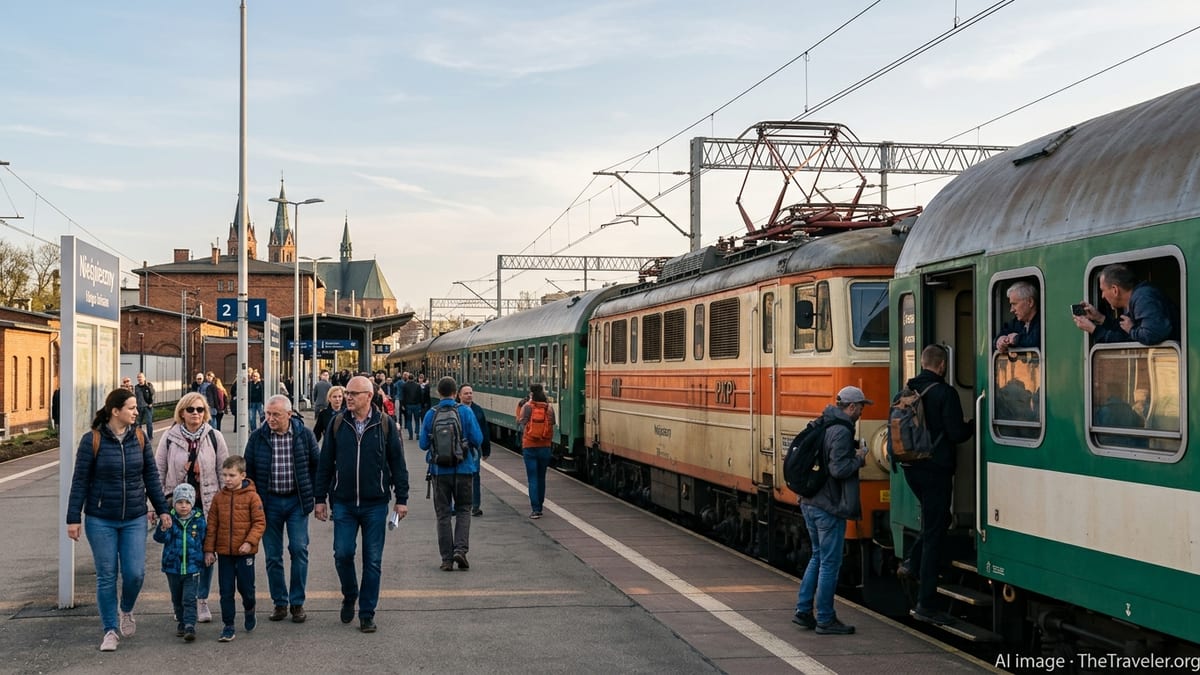
New daily capital-to-capital link targeted from December 2026
According to recent coverage citing official filings with Poland’s Office of Rail Transport, PKP Intercity has notified regulators of its plans to operate a commercial passenger service on the Warsaw West to Kyiv route from late 2026. The notification concerns trains running between Warsaw West and the Dorohusk border crossing as part of an international Warsaw West to Kyiv Passenger connection, signalling an intention to create a stable, scheduled corridor between the two capitals.
Reports indicate that the proposed service is planned as a daily operation, with a five-year window from December 13, 2026, to December 13, 2031. Within that period, the Warsaw–Kyiv train would appear in the regular European timetable, replacing today’s limited or seasonal options with a year-round, once-a-day connection in each direction.
Ukrainian media summarising Polish railway documents describe the project as a step toward making same-train travel between Warsaw and Kyiv more predictable for both Ukrainian citizens and international passengers. The move comes as rail continues to function as Ukraine’s most reliable international lifeline, providing an alternative to constrained air travel.
The planned service will add to existing cross-border operations that already link Poland and Ukraine, particularly night trains that currently run on a seasonal or restricted basis. While those trains offer important capacity, the new daily service is being framed in public coverage as a further consolidation of rail connectivity between the two countries.
Regulatory process underway with route details emerging
Publicly available information shows that the first concrete step is an open-access notification submitted by PKP Intercity to the Polish rail regulator. This notification sets out the carrier’s intention to run a commercial international service, enabling regulators to examine potential impacts on subsidised domestic trains and to verify compliance with European rail market rules.
The documentation describes a train operating from Warsaw West station through eastern Poland to Dorohusk, the main rail border crossing toward Ukraine on this corridor. From there, the service is expected to continue over Ukrainian infrastructure to Kyiv Passenger station, using existing broad-gauge tracks and border procedures that are already in place for current international traffic.
In line with typical European practice, the daily Warsaw–Kyiv train is expected to be integrated into the annual timetable change in December 2026, which is when most operators introduce new routes. The reference to the 2026–2031 window reflects the standard period for open-access approvals, providing a framework for long-term planning of rolling stock, crew and station capacity.
Timetables, journey time and onboard configuration have not yet been finalised in publicly available sources. However, existing Warsaw–Ukraine trains take around 16 to 20 hours depending on route, border processing and infrastructure conditions, offering a baseline for expectations once the new service begins.
From seasonal night trains to predictable year-round travel
Travelers between Warsaw and Kyiv currently rely on a patchwork of options that include night trains, daytime connections via border towns such as Chełm or Przemyśl, and a dense network of long-distance buses. Some rail connections operate only in certain seasons, while others are subject to irregular timetables and limited capacity, making advance planning difficult.
Independent timetable trackers show that seasonal night services on the Kyiv–Warsaw route run during the summer period in 2026, highlighting both demand and the temporary nature of current operations. These services are crucial for passengers who prefer rail over road, but they do not yet amount to a guaranteed daily, year-round offer between the two capitals.
The shift toward a daily scheduled train is therefore seen in transport commentary as a qualitative change. Instead of working around gaps in train availability or relying on overnight buses, passengers could have a fixed, once-daily rail option forming the backbone of their journey plans. This would be particularly significant for Ukrainians living or working in Poland, as well as for visitors, humanitarian workers and business travelers moving between the countries.
Observers of the region’s transport network note that a stable Warsaw–Kyiv rail link would complement other improvements, such as enhanced connections from Warsaw to other Central European hubs. This would gradually embed Kyiv more firmly into the wider European rail map, even before long-discussed high-speed projects materialise.
Strategic context of Poland–Ukraine transport cooperation
The move to formalise a daily Warsaw–Kyiv service aligns with broader transport and reconstruction plans proposed by Ukrainian and Polish institutions. Policy papers and infrastructure strategies in recent years have outlined ambitions for faster rail connections, including long-term ideas for a high-speed line that could cut journey times between the capitals to a fraction of today’s duration.
While such high-speed projects remain at the planning and feasibility stage, the new daily train represents a more immediate, incremental improvement, using existing conventional lines. It fits into a pattern in which both countries prioritise rail links for humanitarian, economic and security reasons, particularly given ongoing limitations on civil aviation to and from Ukraine.
Think-tank analyses have pointed out that cross-border rail capacity influences everything from refugee mobility to trade flows, especially for a country under wartime conditions. A reliable Warsaw–Kyiv service would therefore carry symbolic and practical weight, reinforcing Poland’s role as a key overland gateway between Ukraine and the European Union.
At the same time, the development emerges amid periodic political tensions between Warsaw and Kyiv. Analysts suggest that deepening infrastructure cooperation, including rail, can help anchor long-term strategic ties even when diplomatic relations face strains, as shared projects require practical coordination and sustained engagement.
What travelers can expect as launch approaches
For now, travelers planning journeys in 2026 and 2027 cannot yet buy tickets for the new Warsaw–Kyiv train, since seat sales typically open only after timetables are fully confirmed. However, the formal notification process provides an early signal that PKP Intercity intends to build a predictable daily offer on this corridor, subject to regulatory approval and operational arrangements with Ukrainian Railways.
As the December 2026 timetable change draws closer, more detailed information is likely to emerge on departure times, intermediate stops in Poland, ticketing channels and whether the new service will operate with seated coaches, couchettes, sleepers or a mix of comfort levels. Given current patterns on long-distance international trains in the region, observers expect at least some overnight or late-evening options to remain available.
Public discussion in traveler communities suggests that demand is strong and relatively price-insensitive for reliable rail travel between Poland and Ukraine, especially for those who prefer trains to long bus journeys or who are wary of multiple changes en route. A daily capital-to-capital link would give these passengers a new anchor option while leaving room for additional regional and seasonal services on other Polish–Ukrainian routes.
Until the new train enters service, passengers will continue to rely on existing combinations of rail and bus, as well as seasonal direct trains where available. If the approval and implementation process proceeds as outlined in current reports, the late-2026 launch could mark a turning point in how easily and predictably travelers move between Warsaw and Kyiv by rail.