


Portugal has emerged as a high-interest destination for internationally mobile families, combining relatively strong child outcomes with a moderate cost environment. For relocating households, however, the key question is not general lifestyle appeal but how suitable Portugal is for raising children when assessed against hard indicators: education, childcare coverage, child safety and wellbeing, and the ability of parents to balance work and caregiving. This briefing deconstructs these dimensions into a pragmatic "family suitability" view to support relocation decisions.
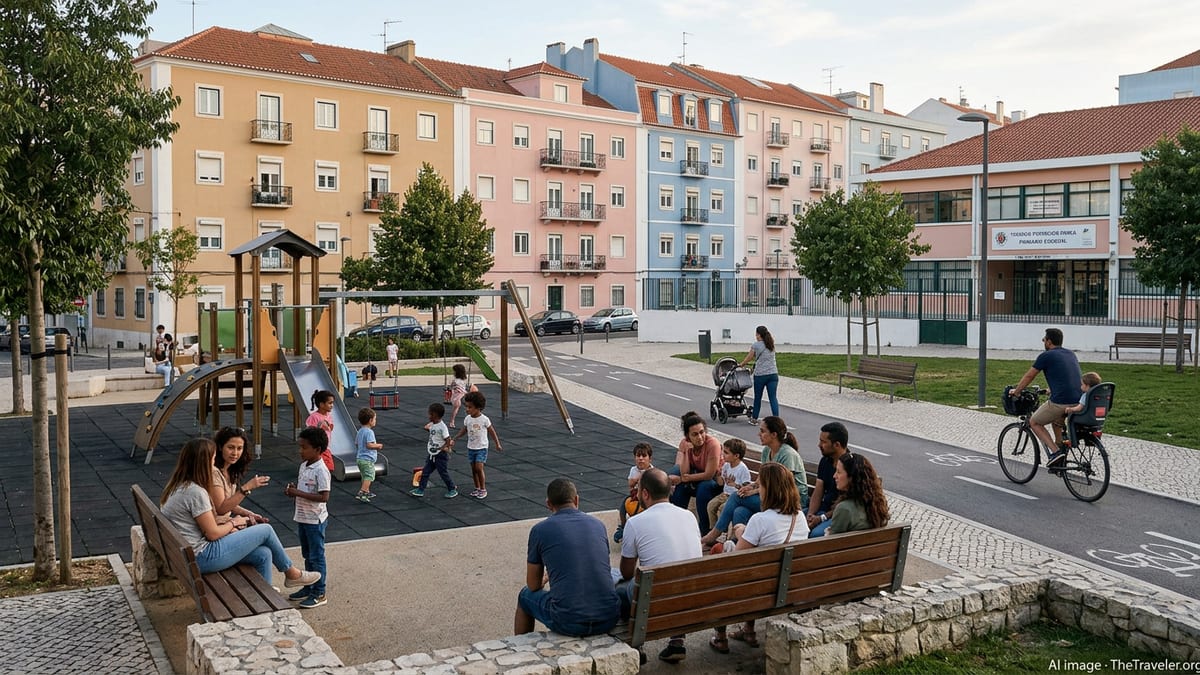
Defining a Portugal Family Suitability Score for Expats
For relocation analysis, a family suitability score consolidates how well a country supports children and parents across several policy and outcome pillars. For Portugal, the most decision-relevant pillars for expats are: child safety and security, schooling quality and continuity, early childhood education and childcare, work–family balance and leave, and broader child wellbeing outcomes. Housing, visas and taxation are excluded except where they indirectly influence these pillars.
Rather than a single numeric rating, it is more useful to think in terms of relative performance bands. On most international benchmarks Portugal rates as high on physical safety, medium-high on early childhood access, medium on schooling performance with some recent slippage, and medium on work–family balance with ongoing reforms to leave entitlements. These variations matter when weighing Portugal against alternative destinations in Europe or North America.
Expats should interpret the family suitability profile as a composite of structural factors and current performance trends. Structural elements such as compulsory schooling ages and leave entitlements are relatively stable. Performance indicators like standardized test scores, class sizes or waiting times for childcare can evolve faster and should be monitored by families planning a move one to two years ahead.
Child Safety and Security Environment
Portugal consistently ranks among the safer countries in Europe on physical safety indicators relevant to families. Comparative homicide data show that Portugal’s intentional homicide rate per 100,000 inhabitants sits well below the EU average and dramatically below rates in many non-European countries, placing it in the group of lower-violence societies in international comparisons.([en.wikipedia.org](https://en.wikipedia.org/wiki/List_of_countries_by_intentional_homicide_rate?utm_source=openai))
Beyond lethal violence, survey-based indicators from European quality of life datasets report relatively low shares of residents who perceive crime, violence or vandalism as a problem in their neighbourhood compared with higher-complaint countries in the bloc. While urban centers naturally have more visible petty crime and nightlife-related disorder, the general backdrop for families is a comparatively low-threat environment by global standards.([ec.europa.eu](https://ec.europa.eu/eurostat/web/products-eurostat-news/w/ddn-20250221-1?utm_source=openai))
For expat families, this translates into a safety profile that usually permits independent mobility for older children and lower levels of day-to-day vigilance than in many large metropolitan areas worldwide. However, localized risks such as road safety around schools, youth antisocial behavior near nightlife districts, and property crime (theft from vehicles or tourist-heavy zones) still require normal precautions. Families choosing specific neighbourhoods should still ground their decision in local crime statistics and school-area assessments rather than relying purely on national averages.
Schooling Structure, Quality and Stability
Portugal’s education system provides universal, state-funded compulsory schooling typically starting at age 6 and continuing to age 18, aligning with European norms on school duration and ensuring that school-age children of expats can integrate into a defined progression of basic and secondary education. International classifications place Portugal’s starting age of primary education and compulsory education in line with the bulk of OECD and EU systems, easing transitions for children arriving from many other developed countries.([oecd.org](https://www.oecd.org/en/publications/pisa-2022-results-volume-ii_a97db61c-en/full-report/component-11.html?utm_source=openai))
On quality, Portugal has experienced a long-term improvement trend in international assessments, with performance historically rising in mathematics, reading and science from the early 2000s to the late 2010s. The latest PISA 2022 cycle, however, recorded a decline in average scores, echoing a broader downturn seen in many OECD countries, and placing Portugal slightly above or around the OECD average depending on subject, rather than clearly ahead. The system still performs reasonably well relative to its expenditure per student, but the loss of earlier gains is a point of concern for families emphasizing academic competitiveness.([oecd.org](https://www.oecd.org/content/dam/oecd/en/publications/reports/2023/11/pisa-2022-results-volume-i-and-ii-country-notes_2fca04b9/portugal_b17a7e1d/777942d5-en.pdf?utm_source=openai))
Class sizes in public basic education are moderate by OECD standards, and recent policy initiatives emphasize diagnostic assessments and digital tools aimed at helping teachers adapt instruction to student needs. However, expat families should factor in language of instruction: mainstream public schools teach primarily in Portuguese, and integration pathways for non-Portuguese-speaking children vary in quality by municipality. International schools, mostly concentrated in metropolitan areas, offer foreign curricula but add significant private cost and often have waiting lists. Overall, on a qualitative scale, Portugal’s schooling contribution to family suitability can be rated medium, with positive equity trends but some recent academic volatility.
Early Childhood Education and Childcare Access
Early childhood education and care (ECEC) coverage is a central component of family suitability, particularly for dual-earner expat households. EU monitoring shows that participation of children aged 3 to the start of compulsory primary education in Portugal was a little over 94 percent in 2023, broadly aligned with the EU average and up substantially from mid-2010s levels. This indicates that most preschool-aged children are in some form of structured early education, which supports language acquisition, socialization and school readiness.([op.europa.eu](https://op.europa.eu/webpub/eac/education-and-training-monitor-2023/en/country-reports/portugal.html?utm_source=openai))
For children below age 3, enrolment rates are lower but have been rising gradually, supported by national programs to expand affordable creche places, such as initiatives targeting free or subsidized childcare for certain age groups and income brackets. Policy assessments describe these expansions as central to strengthening support for families, although implementation still faces regional bottlenecks and waiting lists in high-demand urban areas.([sgi-network.org](https://www.sgi-network.org/docs/2024/thematic/SGI2024_Strong_Families.pdf?utm_source=openai))
From an expat perspective, the childcare pillar scores medium-high on structural availability but medium on practical accessibility. Families relocating to larger cities are more likely to secure places in nurseries or preschools, but may encounter competition for spots in preferred institutions and a need to apply well ahead of the school year. Private childcare and nanny solutions are available yet can be relatively costly in relation to average Portuguese wages, though still often lower in absolute terms than in major Anglo-Saxon hubs. Parents should interpret Portugal’s childcare suitability as solid in coverage for ages 3 to 5, improving but variable for under-3s, and highly dependent on local market conditions.
Work–Family Balance and Parental Leave Framework
The ability of parents to reconcile employment with caregiving is another key element in a family suitability score. Portugal operates a contributory parental leave system that provides initial paid leave after childbirth, with shared entitlements between parents. In recent years, legislative changes have extended flexibility by allowing additional parental leave periods to be combined with part-time work, effectively lengthening the time parents can stay at home while maintaining partial labour-market attachment.([idealista.pt](https://www.idealista.pt/en/news/financial-advice-in-portugal/2023/05/19/5490-parents-in-portugal-who-work-part-time-to-receive-state-support-until?utm_source=openai))
A reform package entering into force in May 2023 introduced an extra 180 days of paid parental leave available when both parents share leave and combine it with part-time work, building on the existing initial parental leave scheme. While subsequent political debate has focused on further extensions and funding, the overall trajectory is toward longer total leave horizons and incentives for fathers to take a more substantial share. Some of the more ambitious extensions approved in parliament have faced implementation delays and may not fully apply until at least 2025, so relocating families should verify which specific entitlements are in force at the time of move.([global.lockton.com](https://global.lockton.com/us/en/news-insights/portugal-expands-parental-leave?utm_source=openai))
In comparative analyses, Portugal is typically positioned around the OECD middle on generosity of paid leave benefits but ahead of many countries in terms of encouraging paternal participation and allowing leave to be flexibly combined with reduced working time. For families where both adults expect to work, this framework supports a more gradual transition back to full-time employment. The suitability rating on work–family balance can therefore be considered medium-high on structure, tempered by the need for households to navigate complex rules and coordinate employer agreements around part-time arrangements.
Child Wellbeing, Inclusion and Demographic Context
National and international data on child wellbeing provide another lens for assessing family suitability. Portugal’s children benefit from a generally high life expectancy context, near-universal vaccination use and broad school participation, situating the country in the cluster of European systems with relatively favourable child health and development outcomes. Long-run improvements in material deprivation rates among families with children have also been recorded, though disparities persist between regions and socio-economic groups.([oecd.org](https://www.oecd.org/en/data/datasets/oecd-family-database.html?utm_source=openai))
Demographically, Portugal is a low-fertility society facing population ageing, with annual live births around 85,000 in recent years, down significantly from historical peaks. A growing share of these births now occur to foreign-born mothers, reaching roughly one-third of all births by 2024, which reflects increasing diversity and the rising role of immigrant families in sustaining the school-age population. This demographic reality has pushed family support policies higher on the policy agenda, including debates over enhancing child benefits, extending leave and expanding childcare capacity.([en.wikipedia.org](https://en.wikipedia.org/wiki/Demographics_of_Portugal?utm_source=openai))
For expats, this context has two implications. First, education and social services are generally accustomed to working with families from varied backgrounds, particularly in urban areas, which supports integration. Second, political momentum broadly favours strengthening supports for families, although fiscal constraints may slow the pace of change. Overall wellbeing indicators and policy focus place Portugal at a medium-high suitability level on this pillar, with a direction of travel that is positive for families.
Comparative Family Suitability Snapshot
Expats often weigh Portugal against other potential destinations, especially within the EU or compared with North America. On safety, Portugal tends to outperform many large non-European urban regions and sits among safer EU countries, representing a clear plus for families prioritizing low levels of violent crime. On schooling, the comparative picture is more nuanced: Portugal performs broadly around the OECD average in standardized assessments and has equity-focused policies, but does not currently belong to the highest-performing tier of systems.([oecd.org](https://www.oecd.org/content/dam/oecd/en/publications/reports/2023/11/pisa-2022-results-volume-i-and-ii-country-notes_2fca04b9/portugal_b17a7e1d/777942d5-en.pdf?utm_source=openai))
Childcare coverage from age 3 approaches EU targets, which is competitive by international standards, while under-3 provision and affordability still trail the most comprehensive Nordic models. Parental leave provisions show a similar pattern: stronger than in many English-speaking countries, but less generous than in the most family-oriented continental systems. For globally mobile professionals, this places Portugal as a balanced but not exceptional performer, with its main strengths in safety and inclusive social norms rather than in maximal material benefits.
When converted into a qualitative family suitability score, Portugal would generally be classified as high on safety, medium-high on early childhood access and wellbeing, and medium on schooling and work–family supports, producing an overall medium-high suitability profile. For families who value a low-risk environment and are comfortable engaging proactively with local institutions to navigate language and administrative aspects, Portugal presents a robust platform for raising children.
The Takeaway
Viewed through a relocation-focused lens, Portugal offers a solid, if not universally top-ranked, environment for expat families. Its strongest contributions to a family suitability score lie in personal and neighbourhood safety, widely available preschool education from age 3 upward, and an evolving parental leave system that increasingly supports shared caregiving. Child wellbeing indicators and demographic trends underscore a policy emphasis on sustaining and integrating families, including those from abroad.
At the same time, expats should approach schooling quality and childcare logistics with realistic expectations. Public education delivers broadly average OECD academic outcomes with recent declines from earlier highs, and language of instruction will be a central consideration. Childcare for under-3s, while expanding, still involves local capacity constraints and planning ahead. Parental leave frameworks are comparatively favourable but in flux, with some reforms still awaiting full implementation.
For globally mobile households, the implication is that Portugal can offer a high overall quality of upbringing and security for children, particularly when parents invest time in understanding local education options, enrolment timelines and benefit rules. Families that prioritize safety, social inclusion and access to early education are likely to view Portugal’s family suitability profile positively, while those whose primary criterion is top-tier academic performance or maximal financial support may treat it as one of several comparable options rather than an automatic first choice.
FAQ
Q1. Is Portugal considered a safe country for raising children?
Yes. International comparisons place Portugal among the safer countries in Europe, with low homicide rates and relatively low reported neighbourhood crime, though local conditions still vary by area.
Q2. At what age do children start compulsory schooling in Portugal?
Compulsory education generally starts at age 6 and runs until around age 18, aligning with European norms and ensuring a clear progression through basic and secondary education.
Q3. How strong is the quality of Portugal’s public schools for expat children?
Public schools achieve around OECD-average results in international assessments. The system offers reasonable quality and equity but is not among the very highest performers globally.
Q4. How available is preschool and childcare for children under 6?
Preschool participation from age 3 to school start is very high, above 90 percent. For children under 3, enrolment and capacity are improving but can be constrained in some urban areas.
Q5. Can expat families expect affordable childcare options?
Public and subsidized options exist and are relatively moderate in cost, but availability is location-dependent. Private nurseries and nannies are costlier yet often still cheaper than in major Anglo-Saxon cities.
Q6. What parental leave can parents expect in Portugal?
Portugal offers an initial period of paid parental leave shared between parents, with additional months available when combined with part-time work. Specific entitlements depend on current law and social security contributions.
Q7. Is Portugal’s education system suitable for non-Portuguese-speaking children?
Many public schools have experience with foreign pupils and provide language support, especially in cities. However, integration quality differs, and some families opt for international schools where available.
Q8. How inclusive is Portugal for families from diverse backgrounds?
With a growing share of births to foreign-born parents and increasing immigration, schools and services are accustomed to diverse families, and policy discourse generally favours integration and support.
Q9. Are there significant regional differences in family suitability within Portugal?
Yes. Large urban areas offer more school and childcare options, including international schools, but also greater competition for places. Smaller cities may offer more stability but fewer specialized choices.
Q10. Overall, how does Portugal score as a family destination for expats?
On a qualitative basis, Portugal can be rated medium-high for family suitability, with strong safety, solid early education access and evolving work–family policies, balanced against average academic performance and localised childcare constraints.