


Landing at Prague’s Václav Havel Airport can be surprisingly simple, but only if you know one crucial thing in advance: whether you need Terminal 1 or Terminal 2. The airport is physically compact, yet its split between Schengen and non-Schengen flights affects everything from which door you enter to where you clear passport control and how you make a tight connection. This guide breaks it all down in practical terms so you can head straight to the right place, avoid last minute terminal panic, and move confidently through Prague’s main international gateway.
Get the latest updates straight to your inbox!
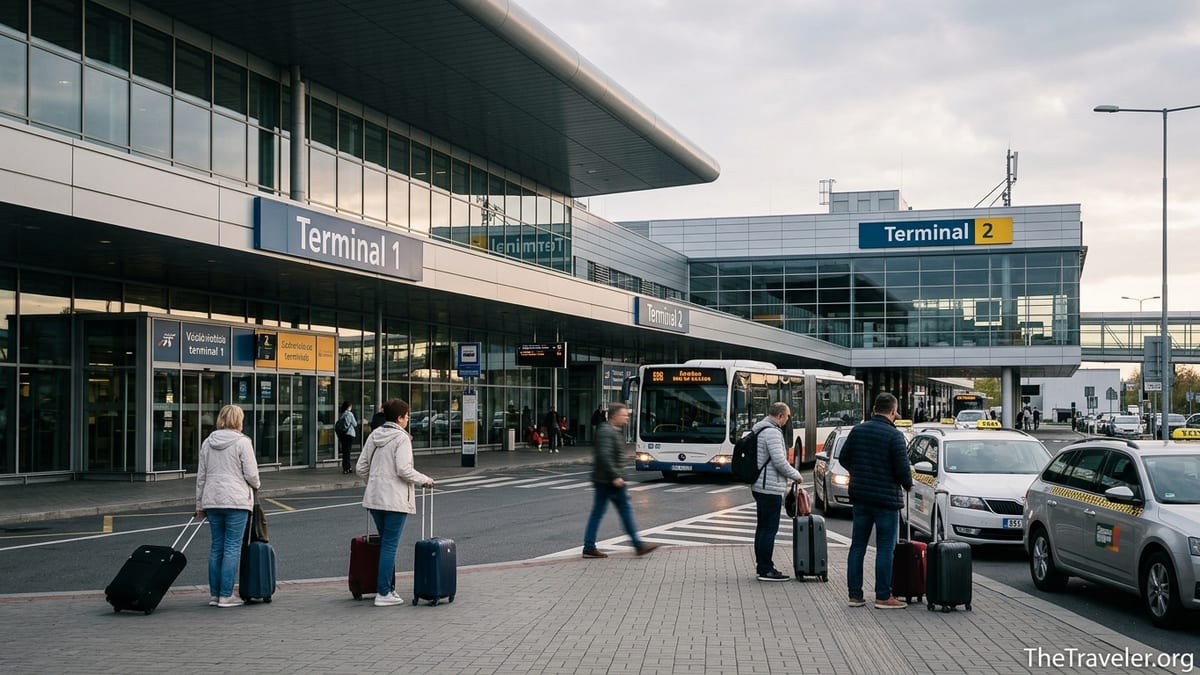
Terminal 1 vs Terminal 2 in One Sentence
At Prague’s Václav Havel Airport, Terminal 1 handles flights to and from countries outside the Schengen Area, while Terminal 2 is for flights within the Schengen Area. In most cases, that single rule will tell you which terminal you need. If you are flying from Prague to New York, London, Dubai or Istanbul, you will use Terminal 1. If you are flying to Paris, Rome, Vienna, Amsterdam or Barcelona, you will use Terminal 2.
The airport itself confirms this split: Terminal 1 is dedicated to non-Schengen traffic, and Terminal 2 is dedicated to Schengen flights. In practice there are occasional edge cases, such as charter operations or rare route changes, but for ordinary scheduled flights the Schengen rule is reliable. Always double check your booking confirmation and boarding pass, which will explicitly show “T1” or “T2” next to your departure airport information.
Importantly, both terminals sit next to each other in one building complex. You are not dealing with separate remote terminals. If you mix them up, it usually means an extra 10 minutes of walking, not a long shuttle ride across the city. That said, when you are jet-lagged, dragging a suitcase and watching the clock, those 10 minutes can matter, so it pays to get it right the first time.
The airport also uses color coding on road signs leading to the terminal forecourts: blue for Terminal 1 and red for Terminal 2. If you arrive by taxi or rideshare and the driver asks “T1 or T2?”, answering correctly based on Schengen vs non-Schengen will save you circling back around the terminal loop.
Understanding Schengen vs Non-Schengen in Real Terms
The Schengen Area is a group of European countries that have removed routine passport checks at their mutual borders. The Czech Republic is part of Schengen, along with popular destinations like Germany, Austria, France, Italy, Spain and many others. This is why flights between Prague and Vienna or Prague and Paris feel more like domestic flights within a single travel zone: you clear security but not passport control when you depart, and you arrive straight into the regular baggage hall.
Non-Schengen flights are those to countries that are not in the Schengen Area, even if they are still in Europe. For example, the United Kingdom, Ireland and most of the Balkans are outside Schengen. Destinations like London Heathrow, Dublin or Belgrade will therefore use Terminal 1 in Prague. Long-haul flights to the United States, Canada, the Middle East or Asia also depart from and arrive into Terminal 1.
For a concrete example, imagine you are flying Prague to Amsterdam with KLM, then connecting onward to New York. The Prague to Amsterdam leg is a Schengen flight and will normally depart from Terminal 2. Once you reach Amsterdam, you go through passport control there before boarding your long-haul to the United States. By contrast, if you fly Prague to London Heathrow on British Airways, you start in Terminal 1, because the United Kingdom is outside Schengen, even though the flight might be shorter than some of your intra-Schengen options.
The easiest way to decide is to think not in terms of “EU vs non-EU” but “Schengen vs non-Schengen.” Some EU countries, such as Ireland, are not in Schengen, and some non-EU countries, like Switzerland and Norway, are. From Prague’s perspective, Zurich, Oslo and Geneva are Schengen and therefore use Terminal 2, while Dublin and London are non-Schengen and therefore use Terminal 1.
Which Airlines Use Terminal 1 and Which Use Terminal 2
At Prague, airline terminal use depends on the destination rather than the brand alone. Many airlines operate from both terminals depending on the route. For example, Czech carrier Smartwings runs holiday flights within Schengen from Terminal 2 and routes to Turkey or Egypt from Terminal 1. This is why your boarding pass is more reliable than simply knowing the airline name.
That said, you will see patterns. Typical Terminal 1 users include carriers operating long-haul or non-Schengen European routes. In normal schedules, you can expect airlines such as Emirates flying to Dubai, Qatar Airways to Doha, or United Airlines and Delta Air Lines to their US hubs to depart from Terminal 1. British Airways flights to London Heathrow, Ryanair flights to non-Schengen destinations like the United Kingdom or Morocco, and many charter flights to countries around the Mediterranean also use Terminal 1.
Terminal 2 is home to most of the everyday European Schengen traffic. Lufthansa flights to Frankfurt and Munich, Austrian Airlines to Vienna, Air France to Paris Charles de Gaulle, KLM to Amsterdam and LOT Polish Airlines to Warsaw generally use Terminal 2 when operating Schengen routes. Low-cost carriers such as Ryanair or Eurowings will also use Terminal 2 for flights to Schengen destinations like Milan, Brussels or Cologne, while the same brands may use Terminal 1 for flights to non-Schengen points.
The airport’s official guidance stresses that terminals are allocated based on the countries served, with Terminal 2 dedicated to Schengen Area flights. When in doubt, check the “which terminal will my airplane depart” function or consult your airline confirmation. If you arrive in Prague and need to meet someone flying out later, you can usually predict their terminal by their destination city and then confirm against the online departures board on the day of travel.
Check-in Areas, Security and Passport Control by Terminal
Both Terminal 1 and Terminal 2 have large, bright check-in halls with rows of counters for traditional check-in and bag drop. Self-service kiosks are available in both terminals, and many airlines allow you to print or reprint boarding passes there if you could not check in online. The airport reports around 70 check-in desks in Terminal 1 and close to 100 in Terminal 2, so there is ample capacity for busy morning and evening waves.
In Terminal 2, used for Schengen flights, the process feels similar to a domestic airport in a large country. You go to your airline’s check-in island, drop any hold luggage, then proceed directly to central security. There is no passport control on departure for Schengen flights, so once you clear security you are released straight into the airside departure concourse, with shops, cafes and seating areas near your gate. For example, a mid-morning Lufthansa flight to Frankfurt might close check-in about 45 minutes before departure, with security queues varying according to the time of day but often moving steadily.
Terminal 1 is different because it handles border formalities. After check-in for a flight to a non-Schengen destination, you pass through exit passport control first and then reach your gate, where in many cases security screening still takes place directly at or near the gate rather than in one central checkpoint. Travelers on flights to London, Tel Aviv or New York often report that they leave the public side, have their passports stamped, enter the non-Schengen concourse, and then pass through a lane of security just before the seating area of their assigned gate.
On arrival, the split is just as visible. If you land from a Schengen city like Paris, Helsinki or Vienna, you step off the plane at Terminal 2 and walk straight to baggage claim without seeing passport booths. If you land from a non-Schengen point like Dubai or Toronto, you follow the signs to passport control in Terminal 1, queue for border checks and then continue to baggage claim after your passport is stamped. During peak times, new European entry systems can add a little waiting at Terminal 1, so build in extra time if you are connecting onward.
Arrivals, Ground Transport and Meeting Points
From an arrivals perspective, the two terminals are almost mirror images. Each has a public arrivals hall, car pick up area, and direct access to public transport. If someone is collecting you by car or taxi, it is important that they know whether to go to the blue-signed Terminal 1 forecourt or the red-signed Terminal 2 forecourt. The flight information screens in both halls clearly display arriving flights, including terminal and belt numbers, so it is easy to adjust if a meeting plan changes at the last minute.
Official city buses stop outside both terminals. Daytime routes typically include a line linking the airport to the green metro line at Nádraží Veleslavín and another to the brown metro line at Zličín, plus a dedicated airport express bus that runs between Terminal 1 and Prague’s main railway station. Ticket machines in the arrivals halls and at the bus stops sell standard Prague public transport tickets, which at the time of writing are valid for a set period of time rather than a single ride, giving you plenty of flexibility if you need to change to the metro.
Inside the arrivals halls, you will find ATM machines, currency exchange counters, tourist information desks, car rental offices and small convenience shops in both terminals. For example, a traveler landing from New York into Terminal 1 can use the public transport desk in the arrivals area to buy a 72-hour transit pass, then follow signs out to the bus stop. A friend landing from Paris into Terminal 2 can do exactly the same on their side of the building. The services are broadly similar, so you do not need to worry that one terminal is “better” for arrivals.
If you are meeting someone arriving into a different terminal from yours, you can either agree to meet in their respective arrivals hall or in a neutral location such as the indoor walkway that connects the two terminals. For elderly relatives or families with small children, the simplest plan is often to stay put in the arrivals hall of the terminal where they land and let the other party walk across from the neighboring terminal to find them.
How to Walk Between Terminal 1 and Terminal 2
The walking distance between Terminal 1 and Terminal 2 at Prague Airport is short by international standards. Various airport maps and traveler reports indicate that it takes roughly 8 to 10 minutes at a normal pace to walk between the main entrances of the two terminals. They are connected by a covered indoor corridor in the public area, as well as by outdoor pavements along the terminal forecourts.
In practical terms, if you arrive by bus at Terminal 2 but discover your flight actually leaves from Terminal 1, you can simply follow the overhead signs for “Terminal 1” and walk along the concourse. With a rolling suitcase and no mobility issues, most people make the journey in well under 10 minutes. The walking route is flat, with clear signage, and you remain inside the secure airport complex the entire time, so there is no need for a special ticket or shuttle.
For some passengers, there is also a semi-airside transfer option. If you land at Terminal 1 from a non-Schengen country and have a checked-through boarding pass for an immediate Schengen connection from Terminal 2, you can often follow transfer signs without going fully landside, passing an additional security checkpoint that leads toward the Schengen area. However, the exact procedure can change depending on current regulations and whether your bags are checked through, so you should always follow the directions given by airline staff on arrival.
There are occasional mentions of local buses that effectively act as one-stop rides between the two terminal forecourts, but because the walking route is short, most travelers simply go on foot. If you are traveling with someone who has difficulty walking or heavy luggage, standard airport services such as wheelchair assistance, arranged through the airline in advance, can help them navigate the distance comfortably.
Connecting Flights: Terminal Combinations You Are Likely to See
Because one terminal is Schengen and the other is non-Schengen, your connection pattern will usually be one of three types: Terminal 2 to Terminal 2, Terminal 1 to Terminal 1, or a cross-terminal transfer between Terminal 1 and Terminal 2. Understanding which you have affects how much time you should allow and where you will clear passport control.
A straightforward example is a Schengen to Schengen connection, such as Helsinki to Prague to Vienna on Finnair plus a partner airline. Both flights are within the Schengen Area, so you remain entirely in Terminal 2. You land, walk to your next gate, clear security if needed, and board. These are usually the easiest connections, and with luggage checked through, they can often be comfortable with around 60 to 90 minutes of layover, depending on your airline’s recommendation.
For non-Schengen to non-Schengen, think of a route like New York to Prague to London. You arrive into Terminal 1 from the United States, pass through passport control, and then remain on the non-Schengen side for your onward flight to the United Kingdom. Some airlines will check your bags all the way through and issue both boarding passes at your origin, which means all you need to do in Prague is follow transfer signs, re-clear security near your onward gate, and wait to board in the same terminal area.
The more complex scenario is cross-terminal. An American traveler might fly Chicago to Prague with a US carrier into Terminal 1, then connect onward to Munich with Lufthansa from Terminal 2. In this case you will usually enter the Schengen Area in Prague, which means completing passport control and then following signs to Terminal 2. If your bags are checked through, you may be able to remain on the secure side and reach a dedicated transfer security checkpoint leading into the Schengen concourse. If not, you will exit to the public arrivals area, walk to the neighboring terminal and re-check your baggage before clearing security for your Schengen flight.
The Takeaway
The key to navigating Prague Airport is to think in terms of Schengen vs non-Schengen, not just domestic vs international. Terminal 1 is for flights to and from non-Schengen countries, ranging from London and Dublin to Dubai and New York. Terminal 2 is for Schengen routes, covering the bulk of short-haul European city pairs like Paris, Vienna, Frankfurt and Amsterdam. This distinction controls where you check in, where you clear passport control and how you move between flights.
For most travelers, the airport feels manageable and logically laid out. The two main terminals are side by side, with a walking time of under 10 minutes between them in the public area. Both have comprehensive facilities, similar arrivals halls and straightforward access to Prague’s city buses, express services and taxis. If you double check your terminal on your booking and allow a little extra time for passport control in Terminal 1 during busy periods, you are unlikely to run into serious trouble.
When connecting through Prague, understand whether your itinerary keeps you within Schengen or moves you across the border line between Schengen and non-Schengen, and plan your layover time accordingly. Use your boarding pass, the airport’s departures board and simple cues like your destination country to confirm whether you need Terminal 1 or Terminal 2. With that small piece of homework done, Václav Havel Airport generally functions as a pleasant and efficient gateway to both Central Europe and the wider world.
FAQ
Q1: How do I know if my flight uses Terminal 1 or Terminal 2 at Prague Airport?
You can usually tell by whether your destination is inside the Schengen Area. Schengen countries use Terminal 2 and non-Schengen countries use Terminal 1. Your booking confirmation and boarding pass will also state “T1” or “T2” next to the Prague airport code.
Q2: I am flying from Prague to London. Which terminal do I use?
Flights from Prague to London normally use Terminal 1, because the United Kingdom is outside the Schengen Area. This applies whether you fly with a full service airline or a low cost carrier.
Q3: I am arriving from Paris and connecting to Vienna. Will I need to change terminals?
Probably not. Both France and Austria are Schengen countries, so flights from Paris and to Vienna typically use Terminal 2. In many cases you can remain airside and go directly from one gate to another after any required security checks.
Q4: How long does it take to walk between Terminal 1 and Terminal 2?
The walk between the main public areas of Terminal 1 and Terminal 2 usually takes around 8 to 10 minutes at a normal pace. The route is flat, covered for most of the way and clearly signposted inside the terminal complex.
Q5: Can I arrive in one terminal and depart from the other on a connecting ticket?
Yes. Many itineraries involve arriving into Terminal 1 from a non-Schengen country and departing from Terminal 2 to a Schengen destination, or the reverse. If your bags are checked through, you can often follow transfer signs and pass an additional security checkpoint without fully exiting the secure area.
Q6: Where do airport buses and public transport stop at Prague Airport?
Standard city buses and the airport express service stop outside both Terminal 1 and Terminal 2. Ticket machines and public transport counters are available in the arrivals halls of both terminals, so you can buy tickets as soon as you exit customs.
Q7: Are the facilities very different between Terminal 1 and Terminal 2?
No. Both terminals offer check-in desks, self-service kiosks, security checkpoints, shops, cafes, ATMs and information desks. Terminal 1 has passport control and more gate area security because it handles non-Schengen flights, while Terminal 2 focuses on Schengen traffic, but the overall comfort level is comparable.
Q8: How early should I arrive at Prague Airport before my flight?
Airlines generally suggest arriving around two hours before a short haul European flight and around three hours before a long haul departure. For non-Schengen flights from Terminal 1, it is wise to allow extra time during peak seasons for passport control and gate area security.
Q9: Is Prague Airport easy to use for elderly travelers or families with children?
Yes. The layout is compact, the distance between terminals is modest, and there are elevators, escalators and flat walkways throughout. For travelers with mobility issues, airlines can arrange wheelchair assistance to help with the walk between check-in, security and the gate.
Q10: If my taxi driver asks “Terminal 1 or Terminal 2,” what should I answer?
Check your booking or boarding pass to see whether your flight is from T1 or T2. If you are still unsure, think about your destination: non-Schengen cities like London or New York usually mean Terminal 1, while Schengen cities like Paris, Vienna or Amsterdam usually mean Terminal 2.