


Schooling is often the single most important non-financial variable for families assessing a move to Mexico. Understanding how public, private, and international schools differ is essential for determining whether the country can support a child’s educational trajectory in a way that aligns with home-country standards and long-term plans.
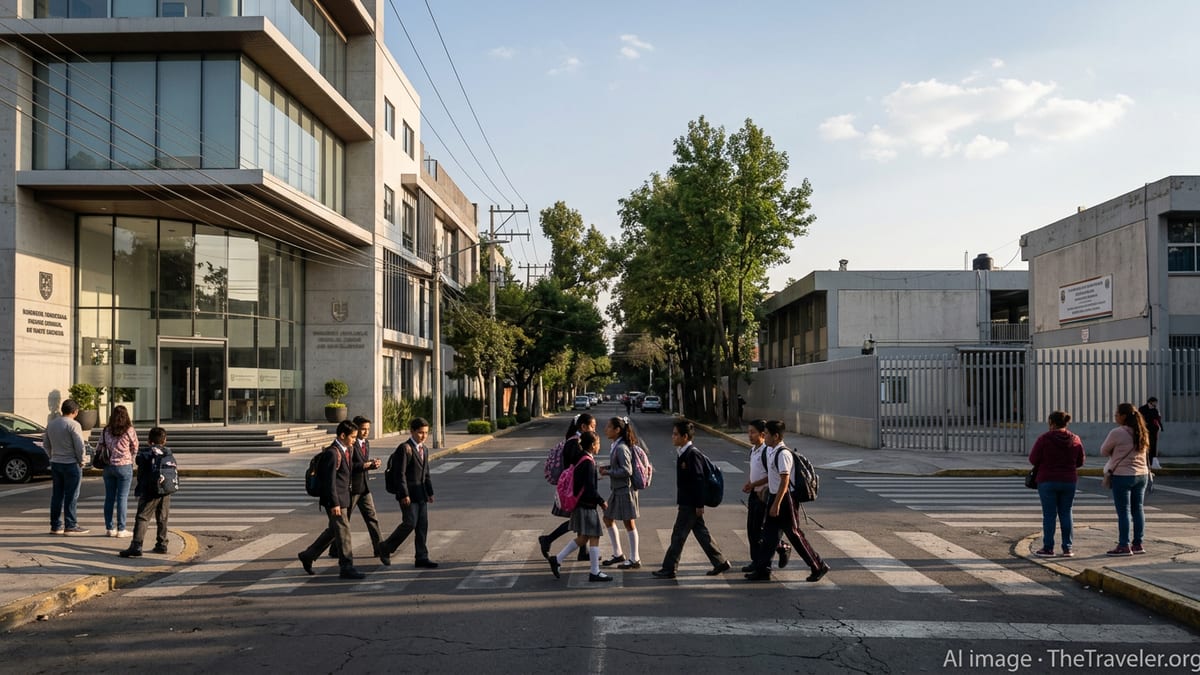
Structure of the Mexican School System Relevant to Expats
Mexico’s education system is regulated nationally and applies to both public and private institutions incorporated into the system. Compulsory basic education typically spans from preschool through lower secondary, with most children entering preschool at age 3 to 4, primary at 6, lower secondary around 12, and upper secondary around 15. For expat families, the critical choice is rarely about entering or exiting levels, but rather which type of institution at each level is most appropriate.
Public schools operate under the authority of the federal and state education ministries. They follow a national curriculum and calendar, and are tuition-free from preschool through the end of upper secondary. Private schools, including bilingual and international schools, must also be authorized by the education authorities to issue recognized Mexican certificates, but they have greater flexibility in instructional approaches, additional languages, and parallel international programs.
Within the private sector, a further distinction matters for expats: domestic private schools that primarily serve local middle-class families, and international schools that align with US, Canadian, British, or International Baccalaureate (IB) frameworks. These international schools are more likely to provide continuity with curricula and qualifications familiar to globally mobile families.
Because the same ministry supervises both public and authorized private schools, most expat children who complete basic education in Mexico can obtain Mexican certificates recognized nationally. The real differences lie in day-to-day experience, language of instruction, teaching quality, and how easily the student can transition back to another national system later.
Public Schools: Advantages and Constraints for Expat Families
Public schools in Mexico offer free tuition at the point of use from preschool through the end of high school. For families with multiple children or limited employer education support, this is a significant financial advantage, particularly in large metropolitan areas where private tuition can reach the equivalent of several thousand US dollars per year per child. However, families should anticipate ancillary expenses such as uniforms, voluntary parent contributions, school supplies, and some local activity fees.
For young children in particular, the public system offers strong Spanish immersion and local integration. Daily interaction with local peers and exposure to the national curriculum can accelerate fluency and cultural adaptation. This is most attractive for families planning a long-term stay, or where one or both parents are Spanish-speaking and strongly engaged with the school community.
The constraints are substantial for many expat families. Public schools typically operate almost entirely in Spanish, with limited formal English instruction and few staff capable of sustained academic support in English or other foreign languages. Class sizes can be large, and resources such as classroom technology, libraries, and science labs vary considerably by region and neighborhood. In some states, schools operate in shifts, which can mean shorter contact hours and an early-morning or mid-afternoon schedule that may not align well with dual-career expat households.
Consistency of academic standards is another consideration. While there are excellent public schools, especially in some urban areas, overall performance and learning outcomes are uneven. For students who may return to a more competitive school system abroad or who need to maintain a specific academic standard for later international moves, parents must carefully assess the specific public school, not just the system in general.
Private and International Schools: Profile and Typical Offerings
Private schools in Mexico range from modest neighborhood institutions to high-end international schools with extensive facilities and global accreditation. Many mid-tier private schools position themselves as bilingual or bicultural, offering daily English classes or partial instruction in English while still delivering the full Mexican curriculum required for local certification.
International schools, particularly those following US, Canadian, British, or IB programs, often provide a dual-track structure. Students may work toward both a Mexican high school certificate and an international qualification such as the US high school diploma, A-levels, or the IB Diploma. This dual recognition is important for expat families that may need qualifications accepted in multiple countries for university entry.
Curriculum breadth is usually wider in the private and international sector, with more emphasis on foreign languages, arts, technology, and extracurricular activities such as sports and music. Facilities like science laboratories, libraries, and sports fields are typically better resourced than in most public schools, especially in larger cities. Teacher language skills are stronger, and it is more common to find native or near-native English-speaking staff in international schools.
Nonetheless, quality remains heterogeneous. “Bilingual” labeling is not always a guarantee of high-level instruction in both languages. Families should look beyond marketing and examine graduation outcomes, university placements, and external accreditations when comparing private options.
Language of Instruction and Academic Continuity
Language is the single most decisive factor for many expat families choosing between public and private schools in Mexico. Public schools typically deliver all core subjects in Spanish, treating English as a foreign language taught a few hours per week. This can be sufficient for young children who will remain long-term in Mexico, but it can be a barrier for older students arriving with limited Spanish and facing complex subjects such as mathematics, science, and history.
Private domestic schools may offer a bilingual model where some subjects are taught in English and others in Spanish. Actual language exposure can vary widely, from a few hours of English weekly to a genuinely balanced 50–50 split. International schools are more likely to teach a majority of subjects in English while ensuring enough Spanish instruction to satisfy Mexican curriculum requirements and facilitate local certification.
For academic continuity, families must consider the direction of future moves. Children who will eventually enter university in the United States, Canada, Europe, or other English-speaking systems benefit from sustained academic work in English to build discipline-specific vocabulary and writing skills. Those who may stay in Mexico or elsewhere in Latin America may prioritize full Spanish proficiency and familiarity with regional content.
Mixed-language households often seek environments where both Spanish and English literacy develop in parallel. In these situations, a carefully chosen bilingual or international private school can provide structured progression in both languages, whereas a public school may require parents to supplement English literacy heavily at home.
Cost Profiles and Hidden Financial Considerations
The cost differential between public and private schools in Mexico is substantial. Public schools do not charge tuition for basic education, but families typically budget for uniforms, school supplies, and occasional contributions to parent associations or class activities. While these costs vary by region and school, they are modest compared with private tuition and are usually seen as manageable for most households.
Private school tuition in major cities often ranges broadly from the equivalent of several tens of thousands to over one hundred thousand Mexican pesos per year per child, depending on location, reputation, and grade level. International schools in top metropolitan areas may exceed this range, with additional one-time enrollment or capital fees, annual re-enrollment charges, and separate fees for transportation, meals, extracurriculars, and examinations.
An important consideration for expat families is whether the employer provides an education allowance and what parts of the total cost it covers. Some corporate relocation policies reimburse only tuition, leaving parents responsible for registration, uniforms, books, transport, and activity fees. Others cap reimbursement at a fixed annual amount per child, which may require trade-offs between a flagship international school and a more moderately priced bilingual private school.
Families should also evaluate medium-term financial exposure. If multiple children will progress into costly upper-secondary grades or if the assignment might extend unexpectedly, the cumulative financial commitment to private or international schooling can significantly affect the overall attractiveness of a posting in Mexico relative to other countries.
School Calendars, Hours, and Operational Differences
Public and private schools in Mexico share a common national academic calendar when they are formally incorporated into the system. The basic pattern runs for roughly 185 instructional days per academic year, with classes beginning around early September and ending in mid-July, with shorter holiday periods in December and during the spring. This calendar structure applies to both state-run and most private and international schools that issue Mexican-recognized certificates.
Within that framework, operational details diverge. Many public schools operate single or double shifts. In a double-shift model, one group attends in the early morning and another in the afternoon, which can shorten the daily schedule for each group to accommodate building capacity. This arrangement may complicate logistics for working parents and can limit the time available for extracurricular activities within the school day.
Private and international schools are more likely to run a single, longer school day, often including built-in time for sports, arts, and clubs. Some offer extended-day or after-school programs tailored to families where both parents work full-time. Transportation services, such as organized school buses, are also more common in the private sector, particularly in congested urban areas where commuting time is a material factor in daily routines.
In terms of operational standards, private and international schools often implement additional policies in areas such as nutrition, technology use, and campus security. For example, some schools have moved aggressively to restrict unhealthy foods on campus and invest in digital learning infrastructure. Public schools increasingly adopt similar measures, but implementation can vary depending on local budgets and administrative capacity.
Admissions Processes and Placement Challenges
Enrollment in local public schools is generally straightforward for resident families living within the catchment area, provided documentation such as birth certificates, vaccination records, and proof of address can be supplied. However, placement at the most sought-after public schools in major cities can still involve waiting lists or lottery mechanisms, especially at the preschool and primary levels.
Private and international schools typically follow more structured admissions processes that may include entrance exams, interviews, language assessments, and review of previous school records. For mid-year arrivals or placements into higher grades, some schools may require demonstrated proficiency in the language of instruction and evidence that the student can cope with the academic level. Highly regarded international schools may fill key grades months in advance.
From a relocation planning perspective, the main risk is timing. Corporate transferees who receive late confirmation of an assignment may find that spaces in preferred private or international schools are already allocated, especially in gateway cities such as Mexico City, Monterrey, or Guadalajara. In such cases, families may need to consider alternative private options, temporary homeschooling, or short-term enrollment in a public school while waiting for a place to open.
Because school placement has such a strong influence on the perceived success of a posting, early engagement with admissions offices, collection of academic transcripts, and clear communication of language abilities are essential. Families should treat school search and application timelines as parallel and equally critical to housing searches rather than secondary to them.
The Takeaway
For expat families, the choice between public and private schools in Mexico is rarely binary. It is a decision about educational objectives, language priorities, budget constraints, and length of stay. Public schools provide cost-free access and deep immersion in Spanish and local society, which can be highly beneficial for long-term residents with younger children and strong parental engagement in Spanish.
Private and international schools, by contrast, tend to offer more consistent academic continuity with Anglophone or international systems, better-resourced facilities, and structured bilingual or English-language programs. They are usually the preferred route for families on time-limited assignments, those without Spanish proficiency, or those whose children are at critical transition points such as middle or high school.
Decision-grade planning requires assessing specific schools rather than relying on broad assumptions about public or private sectors. Key evaluation points include language of instruction by subject, accreditation and diplomas offered, class sizes, facilities, admissions capacity in the relevant grade, and total cost of attendance over the expected duration of the posting. When approached systematically, Mexico can provide workable and often attractive schooling solutions for a wide range of expat family profiles.
FAQ
Q1. Can expat children attend public schools in Mexico?
Yes. Expat children with valid residency documentation can generally enroll in local public schools, subject to space and standard administrative requirements such as identification and vaccination records.
Q2. Are public schools in Mexico completely free?
Public schools do not charge tuition for basic education, but families should expect to pay for uniforms, school supplies, and occasional class or parent-association contributions.
Q3. How much does private schooling typically cost in Mexico?
Costs vary widely by city and school. Many private schools charge the equivalent of several tens of thousands of pesos per year, while top international schools in major cities can charge significantly more, plus additional registration and service fees.
Q4. Is it realistic for a non-Spanish-speaking child to enter a public school?
It may be realistic for very young children who can acquire Spanish quickly, especially with parental support. For older students facing complex academic content, the language barrier in public schools can be challenging without intensive supplementary support.
Q5. Do private schools in Mexico follow international curricula?
Some do, particularly international schools, which may offer US, British, or IB programs alongside the Mexican curriculum. Many domestic private schools focus primarily on the Mexican curriculum with added English instruction.
Q6. Will a Mexican school diploma be recognized abroad?
Mexican high school certificates are recognized in many countries but may require additional steps for university admission, such as standardized tests or foundation programs. International programs like IB or A-levels generally facilitate smoother recognition.
Q7. When should families start the application process for private or international schools?
Ideally 6 to 12 months before the intended start date, especially for popular grades and high-demand cities, as spaces at top schools can fill quickly.
Q8. Do private schools in Mexico provide transportation?
Many private and international schools offer bus services, particularly in large cities. Availability, routes, and cost differ by institution and should be confirmed directly during the admissions process.
Q9. Are school days shorter in public schools than in private schools?
In some areas, public schools operate in shifts, which can shorten the school day. Private and international schools are more likely to run a single, longer day with integrated extracurricular activities.
Q10. Can an employer’s relocation package cover school fees?
Many corporate relocation packages in Mexico include an education allowance, but coverage varies. Some policies reimburse only tuition up to a cap, while others cover a broader range of fees. Families should review policy details before committing to a specific school.