


School choice is a critical variable for any family considering relocation to Thailand. The country offers a wide spectrum of options, from Thai-language public schools to elite international campuses charging fees comparable to Western capitals. Understanding how public and private school streams differ in access, language, curriculum, expectations and outcomes is essential for expat parents making medium to long term decisions about their children’s education.
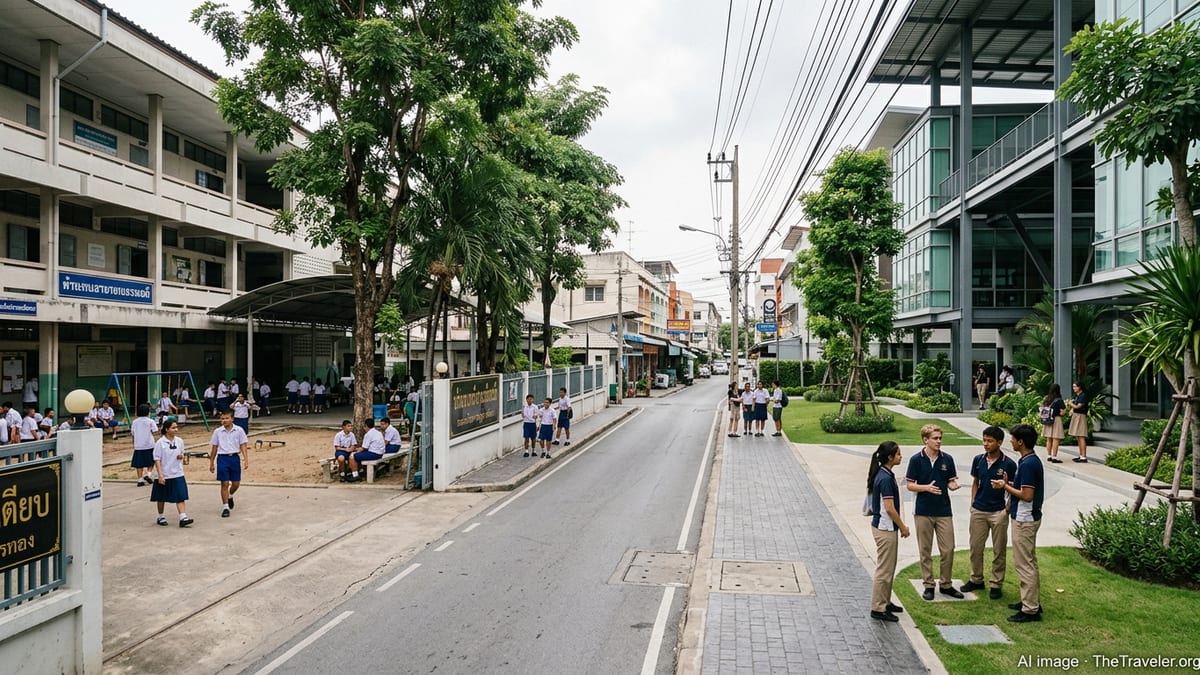
Overview of Thailand’s School System for Expat Families
Thailand’s basic education system runs from kindergarten through upper secondary, under the supervision of the Ministry of Education. Compulsory education covers nine years, and public schooling is theoretically open to all children residing in the country, including non-Thai nationals. Recent policy directives have reaffirmed that public schools must accept foreign and undocumented children, broadening formal access for expat families who wish to enter the state system.
Alongside the public sector, Thailand has a large and diverse private school market. This includes Thai private schools following the national curriculum, bilingual programs that combine Thai and English instruction, and fully international schools teaching foreign curricula such as the English National Curriculum, US-style programs, International Baccalaureate, or hybrid models. These private options are the default choice for many corporate expatriates and mobile professionals.
For relocation planning purposes, the practical decision is usually between enrolling children in Thai public schools with minimal fees, or paying for one of the many private alternatives concentrated in Bangkok, Chiang Mai, Phuket, Chonburi (Pattaya) and a few other urban centers. Each pathway has implications for language development, academic alignment with future study destinations and integration into Thai society.
Expat families must also consider that education choices in Thailand are strongly stratified. Differences in classroom language, teaching style, assessment, facilities and peer profile are more pronounced between public and private schools than in many Western systems. These structural contrasts make school selection one of the most consequential relocation variables for families with school-age children.
Access and Admissions: Public vs Private Schools
Public schools in Thailand are geographically distributed and designed to serve local catchment areas. Foreign children can in principle enroll in many public schools, particularly in urban districts that are accustomed to migrant and non-Thai students, although practices vary by province and by individual school. Documentation requirements are being simplified, and authorities have implemented systems allowing schools to register children even when civil registration documents are incomplete. This has made public schools more accessible to non-Thai families residing long term in the country.
However, public schools rarely conduct outreach to expatriate communities, and the admissions process is typically handled in Thai. Enrolment is driven by residence and classroom space rather than by international mobility considerations. Families that do not speak Thai will normally require local support to manage application paperwork, placement discussions and ongoing communication with teachers and administrators.
Private schools operate on a fee-paying basis and actively market themselves to domestic and international parents. Application processes are usually available in English, with dedicated admissions offices, online forms and scheduled school tours. Many international schools conduct placement assessments in English, mathematics and sometimes the child’s first language, and may request previous school reports and references. Waiting lists for highly sought-after schools in central Bangkok can be significant, especially in early years and key entry points such as Grade 1 or Year 7.
Unlike public schools, private and international schools are not bound to neighborhood catchment rules. School transport services and private bus networks allow students to commute from a wide area, which lets relocation planners prioritize school choice first and then select housing within an acceptable commute. For short-term corporate assignments, this flexibility often outweighs the higher financial cost of private education.
Language of Instruction and Integration Implications
Language of instruction is one of the clearest dividing lines between public and private schooling in Thailand. Public schools teach almost all subjects in Thai, with English introduced as a foreign language at a basic level. Exposure to conversational English may be limited and heavily grammar-focused. For children who do not already speak Thai, this produces a significant adaptation challenge and can delay academic progression for one or more years.
Some public schools, especially in major cities, offer special English Program (EP) or Mini English Program (MEP) tracks where selected subjects are taught in English and foreign teachers are employed. Fees for these programs are higher than standard public schooling but still substantially lower than full international school tuition. These can represent a compromise route for mixed-nationality families seeking Thai literacy and local integration while maintaining more robust English-medium academic instruction.
Private bilingual schools explicitly split instructional time between Thai and English. The exact ratio varies, but core academic content such as mathematics and science is often available in English, while Thai language, social studies and culture remain in Thai. For expat children with a Thai parent, or for families planning long-term residence, this model can support functional literacy and social integration in both languages.
International schools deliver almost all academic content in English or another foreign language, depending on the curriculum. Thai language is offered as a subject, but the overall school culture, peer communication and academic assessment are structured for international mobility rather than deep immersion in Thai. This environment eases transition for children arriving from Western systems and supports continuity if the family later relocates, but tends to limit full integration into mainstream Thai society and deeper Thai language competence.
Curriculum, Standards and Academic Pathways
Thai public schools follow the national curriculum defined by the Ministry of Education. Content is centrally prescribed, with a strong emphasis on rote learning, examinations and national standardized tests. The system is geared toward progression to Thai universities and technical colleges. Instructional materials, assessment rubrics and guidance counseling are generally not oriented to foreign higher education systems, although top Thai public schools in major cities may have some experience with students applying abroad.
Quality within the public sector is uneven. Urban magnet schools and selective public institutions enjoy relatively strong reputations and competitive entrance exams, while rural schools can face resource constraints, large class sizes and limited foreign language capability. For expat families located in provincial areas, the gap between the best and average public schools can be significant, with direct implications for academic outcomes.
Private bilingual schools typically combine the Thai national curriculum with elements of foreign curricula such as the English National Curriculum, US standards or Singaporean mathematics schemes. Many prepare students for international examinations such as IGCSE or standardized English tests, while still meeting Thai graduation requirements. This hybrid approach can open both Thai and overseas university pathways, provided the school has credible accreditation and a track record of graduates entering reputable institutions.
International schools in Thailand offer an array of international curricula, including International Baccalaureate, English A-levels, Advanced Placement or US-style high school diplomas. These schools usually maintain external accreditation from regional or global bodies and design guidance services around university admissions in North America, Europe, Australia and elsewhere. For expat families expecting future relocations or targeting higher education outside Thailand, the predictability and recognizability of these curricula are major advantages.
Cost Structures and Financial Planning Considerations
Public schooling in Thailand is heavily subsidized. For Thai citizens, tuition is free at the point of use, and many non-Thai students in public schools also pay minimal or no core tuition. However, families should anticipate ancillary expenses for uniforms, textbooks, transport, lunches and special programs. English Program tracks within public schools generally charge annual tuition that remains modest by international standards, but can be material when compared with local incomes.
Private school fees vary widely. Thai private schools and some mid-range bilingual schools may charge annual tuition in the lower hundreds of thousands of baht, with incremental fees for registration, building funds and activities. At the highest tier, international schools in Bangkok and other major hubs can charge from the mid-hundreds of thousands to close to or above one million baht per year per child for upper grades, before additional charges for registration, capital fees, examinations and optional services. For many expat families, international school tuition becomes one of the largest recurring relocation expenses.
Many international schools apply a non-refundable application fee, a one-time enrollment or capital fee and a refundable deposit in addition to annual tuition. For example, a leading Bangkok international school may require an application fee in the low thousands of baht, a registration or capital levy in the low hundreds of thousands of baht and a security deposit, resulting in a significant initial outlay even before annual tuition is paid. Some schools also differentiate tuition by grade level, with fees increasing in secondary years as specialized facilities and examination preparation are added.
From a relocation planning perspective, these cost structures create a clear financial divergence between public and private education. Public schools and lower-fee bilingual options can keep annual costs relatively low, but may not offer the curriculum continuity or linguistic profile needed for future moves. Top-tier international schools provide globally portable education at a price point comparable to Western capitals. Employers may subsidize fees for senior expatriate packages, but self-funded families must model multi-year costs carefully, including the impact of multiple children, currency movements and periodic fee increases.
Classroom Environment, Teaching Style and Student Experience
Classroom conditions differ substantially across Thai public and private schools. Public schools, especially outside major cities, often operate with larger class sizes and more traditional teacher-centered instruction. Lessons may rely heavily on textbooks, copying from the board and preparation for standardized tests. While some public schools are innovating with project-based learning and technology, systemic constraints limit the pace of change in many areas.
Private bilingual and international schools typically advertise smaller class sizes, more individualized attention and modern pedagogical methods. These can include inquiry-based learning, extensive use of digital tools, differentiated instruction and a strong extracurricular program. Facilities at higher-fee schools often include science laboratories, sports complexes, performing arts centers and dedicated learning support departments, which can be important for students with particular interests or additional needs.
For expat children entering the Thai public system without prior Thai language skills, the initial classroom experience can be challenging. Limited English proficiency among peers and some teachers may restrict social interaction and academic participation. Over time, immersion can produce strong Thai language acquisition, but the transition period requires resilience and, ideally, supplementary support. By contrast, in international schools, most peers and staff speak English or another shared language, easing social integration for foreign students but sometimes creating a social bubble removed from the broader Thai community.
Discipline norms and expectations can also differ. Public schools may emphasize conformity, uniformity and respect for hierarchy, while international schools tend to prioritize student voice, critical thinking and collaborative learning, depending on their guiding ethos. Families should assess how these cultural and pedagogical differences align with their children’s personalities and past schooling experiences when comparing public and private options.
Geographic Distribution and Practical Availability
Public schools are present in virtually every Thai district, including remote rural areas. For families relocating to provincial towns or industrial zones without a developed expat infrastructure, the local public school may be the only realistically accessible option within a short commute. Quality will depend heavily on local leadership and resources, and there may be little experience with foreign students, particularly outside border regions that serve large migrant populations.
Private bilingual and international schools are heavily concentrated in Bangkok and its metropolitan surroundings, with secondary clusters in Chiang Mai, Phuket, Chonburi and a few other economic centers. Within Bangkok, schools are distributed along major transport corridors and in residential suburbs favored by expatriates. School transport services extend reach, but commute times can still be substantial in peak traffic, influencing where families choose to live.
For relocation assignments in smaller cities or specialized industrial zones, the absence of high-quality private schools can be a constraint on family placement. Some companies respond by funding weekly commuting arrangements, boarding options or remote schooling solutions when suitable local options are not available. Families considering non-metropolitan postings should map the real-world location of schools, typical commute times and grade-level offerings before finalizing decisions.
Where high-quality bilingual or international schools exist in provincial areas, they may have more limited grade coverage, with particular strength in early years and primary levels and evolving secondary programs. Expat families planning full secondary education in Thailand should verify whether local private schools offer recognized upper secondary qualifications and established university counseling, or whether a later move to a major city school is likely to be necessary.
The Takeaway
For expat families relocating to Thailand, the choice between public and private schooling is a strategic decision that will shape children’s language profile, social networks, academic pathways and the overall cost of the assignment. Thai public schools offer very low direct costs and deep immersion in Thai language and local society, but they typically operate in Thai, follow the national curriculum and may have limited experience supporting students who expect to re-enter foreign education systems.
Private bilingual and international schools, particularly in Bangkok and other large cities, provide education that aligns more closely with Western pedagogical norms and global academic standards, with instruction primarily in English and recognized international qualifications. These advantages come at a substantial financial cost and tend to surround children with a more internationally oriented peer group that may be socially and economically distinct from the broader Thai population.
Families with a Thai parent or a long-term commitment to remaining in Thailand may find bilingual or English Program tracks within Thai schools to be a workable compromise, balancing Thai literacy and cultural integration with stronger English-medium academics. Mobile expat families planning onward moves or overseas university entry often prioritize fully international schools despite the cost, viewing tuition as an investment in educational continuity.
Ultimately, there is no single correct choice. A realistic assessment of children’s language abilities, prior schooling, resilience, long-term academic goals and the family’s financial and geographic constraints is essential. Conducting school visits, speaking with other parents and examining actual graduate outcomes can provide critical insight. Within Thailand’s diverse and stratified education landscape, informed comparison of public and private pathways enables expat families to align schooling decisions with their broader relocation strategy.
FAQ
Q1. Can foreign children attend Thai public schools?
Yes, foreign children can generally enroll in Thai public schools, especially in urban areas, although procedures vary by school and most administration and teaching are in Thai.
Q2. How much do international schools in Thailand typically cost?
Annual tuition at established international schools commonly ranges from the mid-hundreds of thousands to close to or above one million baht per child, plus one-time registration and other fees.
Q3. Are Thai public schools suitable for children who do not speak Thai?
Non-Thai-speaking children can attend, but they usually face a difficult adjustment period, as instruction is mainly in Thai and structured language support may be limited.
Q4. What are bilingual schools, and how do they differ from international schools?
Bilingual schools combine the Thai national curriculum with significant English instruction, while international schools use foreign curricula and are primarily designed for international mobility and overseas university pathways.
Q5. Will a Thai public school diploma be recognized abroad?
A Thai public school diploma is valid in Thailand, but recognition abroad depends on the destination country and institution, so additional examinations or bridging programs may be required.
Q6. Do international schools in Thailand follow the same curricula as in Western countries?
Many international schools follow widely recognized programs such as the International Baccalaureate, English National Curriculum or US-style systems, which are similar to those offered in Western countries.
Q7. Are there lower-cost private options between public and top international schools?
Yes, Thai private and mid-range bilingual schools often charge significantly less than top-tier international schools while still offering smaller classes and more English-medium instruction than public schools.
Q8. How important is school location when choosing between public and private options?
Location is critical, particularly in large cities where traffic can be heavy. Families often choose housing based on school commute times, especially when using private or international schools.
Q9. Can children transfer from Thai public schools to international schools later?
Transfers are possible, but children may need extra support to adjust to English-medium instruction and different teaching styles, and placement will depend on assessments and space availability.
Q10. What factors should expat families prioritize when choosing between public and private schools?
Key factors include language of instruction, long-term university plans, child temperament, desired level of local integration, geographic location and the family’s budget for multi-year tuition commitments.