


More news on this day
Qatar Airways has extended a sweeping suspension of services to at least twenty two cities worldwide, adding Nigeria, Italy, Iran, Turkey, Australia, the Philippines, India and others to a growing list as ongoing Middle East airspace closures upend global travel patterns and send shockwaves through tourism markets.
Get the latest news straight to your inbox!
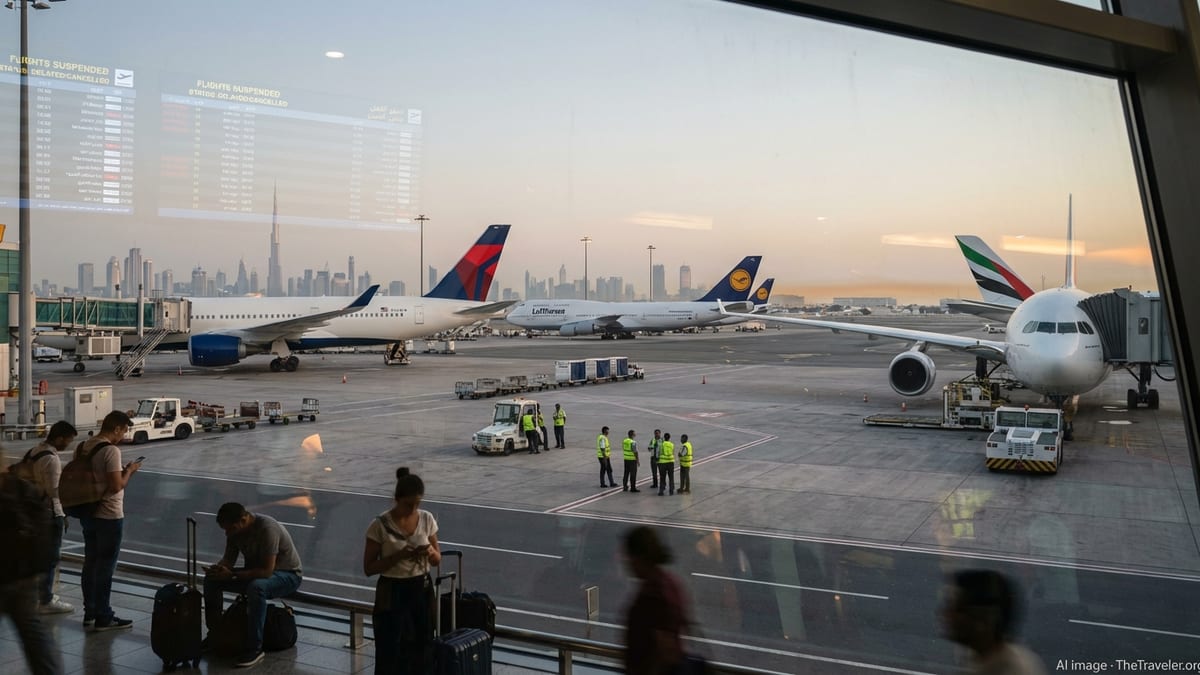
Network Freeze Spreads From Doha to Lagos, Rome and Beyond
Publicly available schedules and travel alerts show that Qatar Airways has sharply reduced flying since Qatari and surrounding airspace were partially closed from late February 2026, forcing the carrier to ground or reroute much of its global network. While some limited services have resumed, a core group of at least twenty two destinations remains suspended, affecting links across Africa, Europe, Asia and Oceania.
Among the affected cities are key gateways in Nigeria, including Lagos and Abuja, which have seen Doha services halted alongside cuts affecting major markets such as Italy, Iran, Turkey, Australia, the Philippines and India. Industry analyses indicate that many of these suspended routes were previously high-volume connecting corridors funnelling passengers between Europe, Asia and Africa via Doha, magnifying the impact of each cancellation.
Specialist aviation coverage notes that Qatar Airways, Emirates and Etihad collectively handled around 90,000 connecting passengers per day before the crisis, underscoring how the effective throttling of Doha’s hub reverberates far beyond the Gulf. With widebody aircraft now parked at Hamad International Airport or redeployed only sparingly, the suspension of 22 city pairs represents a significant contraction of one of the world’s most geographically influential airline networks.
Travel industry bulletins indicate that these suspensions are being reviewed on a rolling basis, often in short increments tied to evolving airspace restrictions and security guidance. That approach has left passengers and tourism operators struggling to plan ahead, as routes may disappear from timetables with only days of notice.
Airspace Closures Turn the Gulf From Global Hub to Bottleneck
The root of Qatar Airways’ network turmoil lies in the unprecedented closure and restriction of key Middle Eastern flight information regions following the latest escalation in the Iran conflict and related regional tensions. Notices to air missions have, at various points since late February, limited civilian overflights across Iran, Iraq, Qatar, Bahrain, Kuwait, parts of the United Arab Emirates and neighbouring states, according to operational briefings and conflict-zone advisories.
For Gulf super-connectors, whose business models rely on unconstrained access to nearby skies, these closures have proved uniquely disruptive. When portions of Qatari airspace were temporarily shut, Doha-based traffic effectively lost its primary corridors to Europe and Asia, forcing large-scale groundings and making a full long-haul operation technically and commercially unviable.
Independent route-tracking and consultancy reports suggest that while some airlines can still thread narrow corridors via the Caucasus or more distant southerly routings, the added time, fuel burn and safety margins make many long-haul itineraries uneconomical. Jet fuel price spikes since the start of the conflict have compounded the problem, turning already thin margins on ultra-long-haul sectors into sizable losses if flown with significant detours.
As a result, Qatar Airways and several peers have chosen to maintain broad suspensions until a more predictable and cost-effective airspace picture emerges. The 22-city figure reflects a compromise between preserving a skeleton network on certain strategic routes and pausing operations on others where indirect routings would be too complex or expensive.
Tourism and Business Travel Reeling From Capacity Shock
The knock-on effects of Qatar Airways’ route cuts are being felt most acutely in tourism-dependent economies that relied on Doha’s hub to feed visitors from Europe, the Americas and Asia. Available tourism board data and trade commentary from Nigeria, for example, highlight concerns over lost arrivals and conference traffic after the pause in direct Qatar Airways services from Lagos and Abuja, which previously provided a popular one-stop access to destinations across Asia and the Pacific.
In Europe, suspended or significantly reduced links from cities in Italy and Turkey have narrowed options for travellers heading to Southeast Asia, Australia and New Zealand. Tour operators report that passengers who once routinely booked Italian or Turkish departures via Doha are now being steered through alternative hubs in Southeast Asia or via longer routings on European carriers, often at higher fares and with limited seat availability.
Australian and Philippine markets are likewise grappling with a sudden loss of capacity. Prior to the crisis, Qatar Airways offered multiple daily services from Australian cities into Doha, feeding onward traffic to Europe and Africa, while its Manila and Cebu operations connected Filipino workers and leisure travellers to the Gulf and beyond. The removal of these one-stop options has increased pressure on remaining carriers, pushing up prices and lengthening journey times for millions of travellers.
Corporate travel has not been spared. Business hubs in India and the wider South Asia region, once heavily served by Qatar Airways’ dense schedule, now face fewer premium seat options and longer transit times. Analysts note that multinational companies are revising travel policies, favouring virtual meetings or consolidating trips to cope with the reduced connectivity and unpredictable disruption risk.
Global Aviation Network Scrambles to Reroute
With Doha’s hub sharply curtailed, airlines and passengers are rerouting around the Gulf, dramatically reshaping global flight maps. Flight-data providers tracking traffic flows between Europe and Asia report a surge in routings via Southeast Asian gateways such as Singapore, Bangkok and Kuala Lumpur, as well as increased use of Central Asian and northern polar corridors when geopolitically feasible.
European legacy carriers have adjusted scheduling to capture displaced demand, adding capacity where possible on select Asia and Africa routes. However, aircraft and crew availability remain limiting factors, and many routes that once benefited from Qatar Airways’ extensive feeder network simply cannot be replicated on short notice. This has left some secondary destinations in Africa, Central Asia and the Indian subcontinent with sharply reduced international access.
Low-cost and hybrid carriers in regions outside the conflict zone have also moved to exploit the capacity gap, selectively launching new point-to-point routes that bypass the Gulf entirely. While these additions help, they cannot fully offset the connectivity once provided by a high-frequency hub-and-spoke operation from Doha, where passengers previously enjoyed multiple daily banks of connections in each direction.
Industry analysts caution that the longer the Middle East airspace crisis persists, the more likely it is that temporary workarounds harden into permanent shifts. Competing hubs that gain traffic during the disruption may retain at least part of that volume even after Gulf operations normalize, introducing a structural challenge for Qatar Airways and its partners.
What Travelers Need to Know Right Now
For individual travelers, the suspension of Qatar Airways flights to 22 cities translates into a more fragmented and less predictable booking environment. Publicly available advisories from travel management companies and consular services stress the importance of checking flight status frequently, as schedules remain subject to change with limited warning while airspace restrictions evolve.
Passengers originating in impacted markets such as Nigeria, Italy, Turkey, Australia, the Philippines, India and Iran are being encouraged by consumer advocates to build in longer connection times, consider alternative routings via Europe or Southeast Asia, and ensure that any itineraries involving the Gulf provide flexible rebooking options. Many are also advised to verify that travel insurance policies cover war-related disruptions and extended delays.
Reports from stranded travelers over recent weeks have underscored the value of maintaining direct contact with both airlines and booking intermediaries where possible, and of keeping digital copies of all travel documents, rebooking confirmations and receipts. In situations where flights are cancelled outright, guidance from aviation consumer groups suggests that passengers should request written confirmation of their options for refunds, vouchers or alternative transport.
Looking ahead, much depends on how quickly regional security conditions improve and regulators reopen key segments of airspace. Until then, Qatar Airways’ continued suspension of flights to a broad slate of cities, now prominently including Nigeria, illustrates how a conflict-centred airspace crisis can cascade into a global aviation and tourism shock that touches travellers far from the Middle East.