


Landing at Queen Beatrix International Airport in Aruba is usually quick and friendly, but those first 30 minutes after immigration are when smart travelers quietly set themselves up for a smooth trip. This guide walks you through exactly what to do about SIM cards, eSIMs, cash, cards and money exchange from the moment you enter the arrivals hall until you step into a taxi or transfer.
Get the latest updates straight to your inbox!
Know the Basics: Currency, Cards and Connectivity in Aruba
Aruba’s official currency is the Aruban florin, but U.S. dollars are widely accepted across the island. ATMs commonly dispense both florins and U.S. dollars, and most hotel, restaurant and supermarket prices are easily payable in either currency. For a short resort stay, many visitors never touch florins at all and simply use dollars plus a credit card for larger purchases.
Mobile data is provided mainly through local carriers such as Setar and Digicel, with good 4G coverage around Oranjestad, Eagle Beach and Palm Beach. Many visitors now skip physical SIM cards entirely and arrive with a prepaid eSIM from global providers like Airalo or Holafly, which sell Aruba data packages you can activate as soon as you land. These eSIMs are data only, but they are usually more than enough for maps, ride-hailing-style transfer apps, messaging and email.
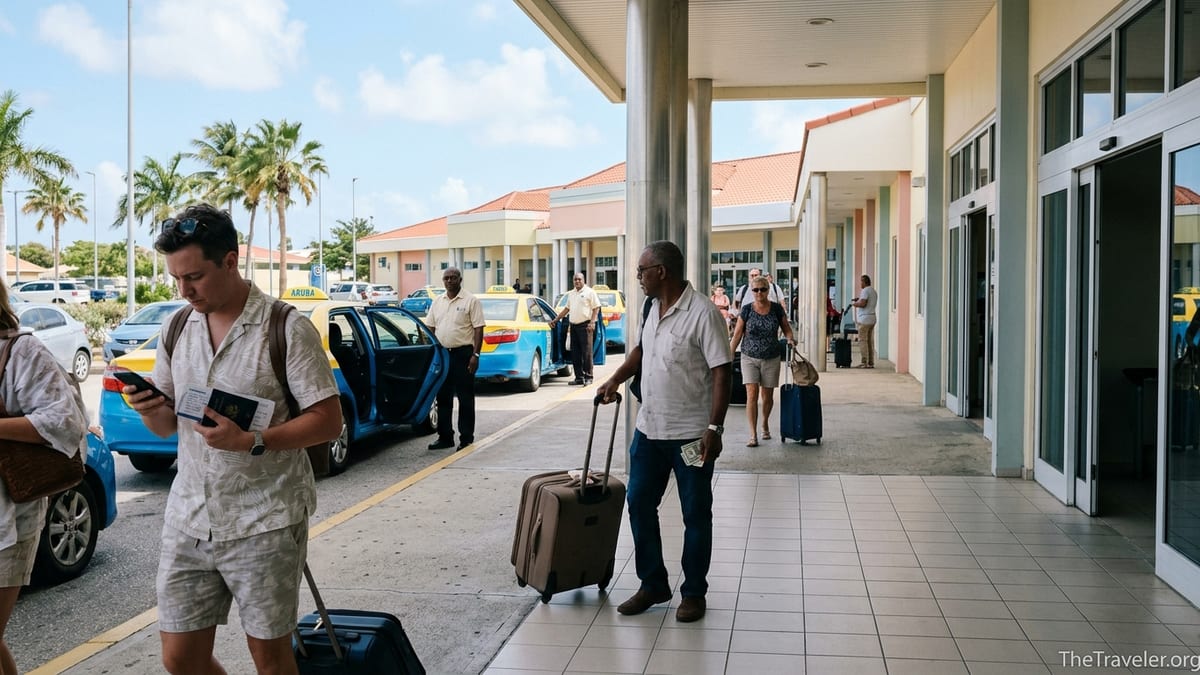
Taxi drivers at Queen Beatrix Airport are used to visitors arriving with a mix of cash and cards. Official fares from the airport to the major hotel zones are fixed by the government; for example, a ride to the high-rise Palm Beach area typically lands in the mid 30 U.S. dollar range before surcharges, depending on time of day and luggage. Many drivers still prefer cash in U.S. dollars or florins, and a few charge a small premium if you insist on paying by card.
Aruba is generally card friendly, particularly in resorts, bigger restaurants, car rental desks and supermarkets. That said, smaller beach bars, local food trucks and some independent tour operators may prefer or require cash, so it is wise to arrive at your hotel with at least enough cash for the airport taxi plus a small buffer for tips or snacks.
SIM and eSIM Options: What Really Works on Arrival
There is no large, branded telecom store inside the secure arrivals corridor at Queen Beatrix International Airport, but travelers report occasionally seeing small kiosks or desks from local providers in or just beyond the public arrivals hall. These desks may sell tourist SIM packs from Setar or Digicel, sometimes bundled with a set number of data gigabytes and local minutes valid for 7 to 30 days. Opening hours can follow flight banks rather than strict business hours, so late arrivals may find them closed and should have a backup plan.
Because of this uncertainty, many frequent visitors now rely on eSIMs that they buy before travel and activate on touchdown. Services such as Airalo, Holafly and other specialist travel eSIM brands sell Aruba-specific data packages that can be installed with a QR code at home. For example, you might buy an Airalo Aruba package with a few gigabytes for a week or a Holafly Aruba eSIM that offers unlimited data for a flat daily price. Prices change regularly, but Aruba data eSIMs typically fall somewhere between the cost of one or two airport cocktails and a casual dinner for two, which is usually cheaper than paying daily roaming charges from a North American carrier.
If your phone is eSIM capable, the most reliable strategy is to install and test the eSIM before flying. You can typically download the profile and keep it dormant until you land, then switch mobile data to the eSIM in your phone’s settings as the plane taxis to the gate. That way, by the time you enter the arrivals hall, you already have data for navigation, messaging your accommodation and checking live taxi or transfer details.
Travelers with older phones that do not support eSIMs still have options. You can either enable an international roaming package with your home carrier for the first day or two, then visit a Setar or Digicel store in Oranjestad or near the hotel zones to buy a physical prepaid SIM. Another workaround is to travel with an unlocked mobile Wi-Fi hotspot that accepts a local SIM once you reach town. All of these require a bit more effort than an eSIM, but they remain workable if you plan ahead.
Where and How to Get Mobile Data Before Leaving Arrivals
Your first decision point comes as you walk from immigration to the baggage carousel. If you already installed an Aruba eSIM, take a moment while waiting for your suitcase to enable data roaming on that eSIM and check that you can load a basic website or map. If it connects, you are set and can use your phone to coordinate everything else at the airport.
Once you pass customs and enter the public arrivals hall, look around for any small telecom desks or general service counters. Staff there sometimes sell prepaid SIMs or can at least point you toward the nearest location to buy one in town. If you are landing during the day, it can be worth asking if they have a current tourist package, for example a 7-day, several‑gigabyte SIM that includes some local calling credit. Expect to show your passport when registering a local SIM, even as a tourist.
If no SIM option is visible or open, do not worry. The airport has free Wi-Fi in public areas, although performance can vary at peak times. You can use this Wi-Fi to finalize an eSIM purchase through an app like Airalo or Holafly if you did not buy one in advance. Many travelers arrive, connect to the airport Wi-Fi for ten minutes, purchase and install a data plan on their phone and walk out with working coverage.
Before you leave the terminal, make sure every device that needs data is properly connected. That might mean setting up a personal hotspot on your phone so family members or a laptop can use your data plan, or quickly downloading offline maps of Aruba through your preferred navigation app. These small steps at the airport save frustration if your signal briefly weakens later in more remote parts of the island.
ATMs, Cash Needs and Exchanging Money at the Airport
Inside Queen Beatrix International Airport there are a small number of bank ATMs, typically located in or near the arrivals hall and sometimes close to the baggage claim area. Airport information pages explain that there are at least two ATMs on site, operated by local banks, which can dispense cash to international cards bearing major network logos. These machines usually allow withdrawals in either Aruban florins or U.S. dollars, though exact options can vary by bank and by machine.
For most visitors, withdrawing U.S. dollars is simplest, since those dollars are easily used for the taxi and at resorts. Using a bank ATM generally provides a better exchange rate than a dedicated airport currency exchange desk, especially once commission and margins are factored in. As a rough practical example, if you withdraw the equivalent of around 150 to 200 U.S. dollars at the airport, that is often more than enough to cover a return taxi to the hotel zone, some tips and small incidental purchases for the first day or two, while you pay most big expenses by card.
Airport currency exchange counters in Aruba, when open, are convenient but typically carry less favorable rates than ATMs or banks in town. If you arrive with U.S. dollars, you rarely need to use them at all. Even if you are coming from Europe or elsewhere and hold euros or another currency, it can still be cheaper in many cases to withdraw dollars or florins from an ATM using your debit card rather than exchanging cash at a counter. The exception is when your bank charges unusually high overseas ATM fees, in which case exchanging a moderate amount of cash might work out similarly overall.
Before you travel, notify your bank that you will be in Aruba and check your card’s daily ATM withdrawal limit. On arrival, use a machine located inside the secure part of the terminal or in clear public view, shield the keypad carefully, avoid “dynamic currency conversion” offers that bill you in your home currency and keep both card and cash out of sight once you complete the transaction.
Paying for Taxis, Transfers and First-Day Expenses
After you exit customs at Queen Beatrix, the official taxi rank is easy to find outside the terminal. Aruba’s taxi fares from the airport to major hotel zones are fixed by distance bands and regulated by the Department of Public Transportation, which keeps pricing transparent. Visitors frequently report paying around 30 to 40 U.S. dollars for a one‑way trip from the airport to large resorts in the Palm Beach or Eagle Beach areas, with small extras for late‑night surcharges or additional luggage.
Cash is still the default expectation for airport taxis. Drivers usually accept either U.S. dollars or Aruban florins and often carry change for typical tourist amounts like 50 or 100 dollar bills, although it is smoother to have some smaller notes ready if you can. Some cabs have portable card readers and will accept Visa or Mastercard, but it is common for those drivers to add a few dollars to cover processing fees. Travelers regularly describe situations where the driver quoted one fare in cash and a slightly higher fare if paying by card.
If you strongly prefer to pay by card and do not want to carry much cash, consider pre‑booking a private transfer or shuttle through your hotel or a local transfer company. These services normally accept card payment online in advance and meet you just outside arrivals with a sign. Prices are often similar to or a little higher than taking a taxi, but the certainty of pre‑payment and a waiting driver can be attractive for late‑night or family arrivals.
For your first 24 hours on the island, it is sensible to assume that small purchases will be easier in cash. Examples include tipping airport porters, grabbing a quick snack or drink at a kiosk on the way to the hotel, or paying a small local eatery near your accommodation. Larger expenses, such as resort check‑in deposits, rental cars and organized excursions, almost always accept major credit cards, though American Express acceptance can be patchier than Visa or Mastercard.
Card Use, Safety and Budgeting After You Leave the Airport
Once you are checked in at your hotel, card use in Aruba is straightforward. Most mid‑range and upscale hotels and resorts, as well as international chain restaurants and supermarkets, accept major credit cards for bills and room charges. Local tourism authorities and banks advise travelers to let their card issuers know about their Aruba trip beforehand, since some U.S. banks still treat Caribbean transactions as higher risk and may otherwise decline a first purchase as suspicious.
Outside resort areas, you will find a mix of cash‑only and card‑accepting businesses. Local snack shacks on beaches, independent souvenir stalls and smaller bars often prefer cash, while sit‑down restaurants, larger beach clubs and tour operators increasingly adopt card readers. A practical approach is to keep the equivalent of around 50 to 100 U.S. dollars in small bills in your day bag for incidentals, while using a credit card for anything above that.
Several Aruban and international banks operate branches and ATMs around Oranjestad and the hotel zones, so topping up your cash supply later in the trip is simple. ATMs attached to banks in busy, well‑lit locations are safer choices than isolated machines. For longer stays, some visitors choose to withdraw florins for smaller local purchases because change is then given in the same currency and small coins can be handy for tips and vending machines.
To keep fees under control, it often pays to travel with at least one debit card that has low or no foreign ATM fees and one credit card that charges no foreign transaction fees on purchases. This combination lets you rely on ATMs for occasional cash while paying almost everything else by card at a near‑interbank exchange rate. Always decline any store or terminal that offers to “convert” your purchase into your home currency on the spot, since those conversions typically cost more than letting your bank handle the exchange.
What to Arrange Before You Land in Aruba
Much of your arrival stress can be eliminated by setting up a few things before your flight. First, decide how you will get mobile data. If your phone supports eSIMs, choose an Aruba package from a reputable provider like Airalo, Holafly or another well‑reviewed travel eSIM brand and install the eSIM profile at home. Test that your phone recognizes it, but only switch mobile data to that eSIM once you have landed. If your handset does not support eSIMs, check that it is network unlocked so you can buy a local SIM card in Aruba if needed.
Next, review your bank and card situation. Inform your primary bank and credit card issuer of your Aruba travel dates, make sure your cards have reasonable daily withdrawal limits and ask about foreign ATM and transaction fees. If fees are high, you might bring a modest amount of U.S. cash from home to cover the first taxi and a meal, then limit your overseas ATM use to one or two larger withdrawals instead of many small ones.
Think through your airport‑to‑hotel transfer. If you are comfortable paying the taxi fare in cash, plan to withdraw that amount from the airport ATM. If you want to avoid cash, research private transfer companies or hotel‑arranged transfers that can be prepaid by card before you fly. Note your hotel’s address and phone number in both digital and paper form, since a working data connection is not guaranteed until your SIM or eSIM is up and running.
Finally, save important documents offline. Take screenshots or offline copies of your eSIM QR code, booking confirmations, travel insurance and any transfer vouchers. If an app fails to load on arrival due to crowded Wi‑Fi or a temporary network issue, these backups ensure you can still show your reservations, contact your accommodation from an airport phone if necessary and quickly get oriented in the terminal.
The Takeaway
Arriving at Queen Beatrix International Airport is the start of an easy, relaxed island stay, and a little planning around SIM cards and money makes it even smoother. In practice, most visitors combine a prepaid eSIM or local SIM with a small stock of U.S. dollar cash from the airport ATM and a no‑foreign‑fee credit card for the bulk of their spending.
Before leaving the arrivals hall, check that your phone data works, withdraw enough cash for the taxi and first day, and confirm whether your chosen ride accepts cash only or also takes cards. With these essentials covered, you can walk out of the terminal knowing that maps, messages and payments will all work the way you expect, leaving you free to focus on Aruba’s beaches instead of your phone signal or wallet.
FAQ
Q1. Do I need cash on arrival at Queen Beatrix International Airport?
It is strongly recommended. While you can sometimes pay taxis or transfers by card, cash in U.S. dollars or florins makes the airport taxi, tips and small first‑day purchases much easier.
Q2. Are there ATMs at Queen Beatrix International Airport?
Yes. There are bank ATMs in or near the arrivals area where you can withdraw Aruban florins or U.S. dollars using international debit and credit cards, subject to your bank’s fees and limits.
Q3. Is there a SIM card shop in the arrivals hall?
There may be small telecom or service desks that sell local SIMs, but availability and opening hours vary. Many travelers now rely on eSIMs bought in advance or visit a full Setar or Digicel store in town after check‑in.
Q4. Should I buy an Aruba eSIM before I fly?
Yes if your phone supports it. Buying and installing an Aruba eSIM from providers like Airalo or Holafly before departure lets you activate data as soon as you land, avoiding any hunt for a physical SIM at the airport.
Q5. Can I pay my airport taxi fare by card?
Some taxis have card readers, but many prefer cash and may add a small surcharge for card payments. Plan to pay in cash unless you have pre‑booked a transfer that clearly confirms card payment.
Q6. Do I need Aruban florins, or are U.S. dollars enough?
U.S. dollars are widely accepted across Aruba, including for taxis and at most hotels and restaurants. Florins can be handy for small local purchases, but many short‑stay visitors manage fine with dollars and cards.
Q7. Is the airport Wi‑Fi good enough to buy an eSIM on arrival?
Usually, yes. You can connect to the airport Wi‑Fi, purchase an eSIM through an app, download the profile and activate it. Performance can slow at peak times, so having an eSIM installed in advance is still the easier option.
Q8. Are card payments widely accepted on the island?
Major hotels, resorts, supermarkets and many restaurants accept Visa and Mastercard. Smaller beach bars, food trucks and some independent operators may be cash only, so it is wise to carry some cash each day.
Q9. How much cash should I withdraw at the airport?
For most short stays, withdrawing the equivalent of around 150 to 200 U.S. dollars is enough to cover a return taxi, tips and small expenses, while you pay larger costs by card. Adjust this up or down based on your plans.
Q10. What should I arrange before leaving the arrivals hall?
Confirm that your SIM or eSIM data is working, withdraw any needed cash from an ATM, note down your hotel details, and verify how you will pay for your taxi or transfer. Once these are set, you are ready to start your Aruba stay.