


More news on this day
Global travel in 2026 is being reshaped by a volatile mix of geopolitics, fuel shocks and evolving security risks, as airlines, airports and passengers confront higher costs, tighter capacity and increasingly fragile schedules across key routes.
Get the latest news straight to your inbox!
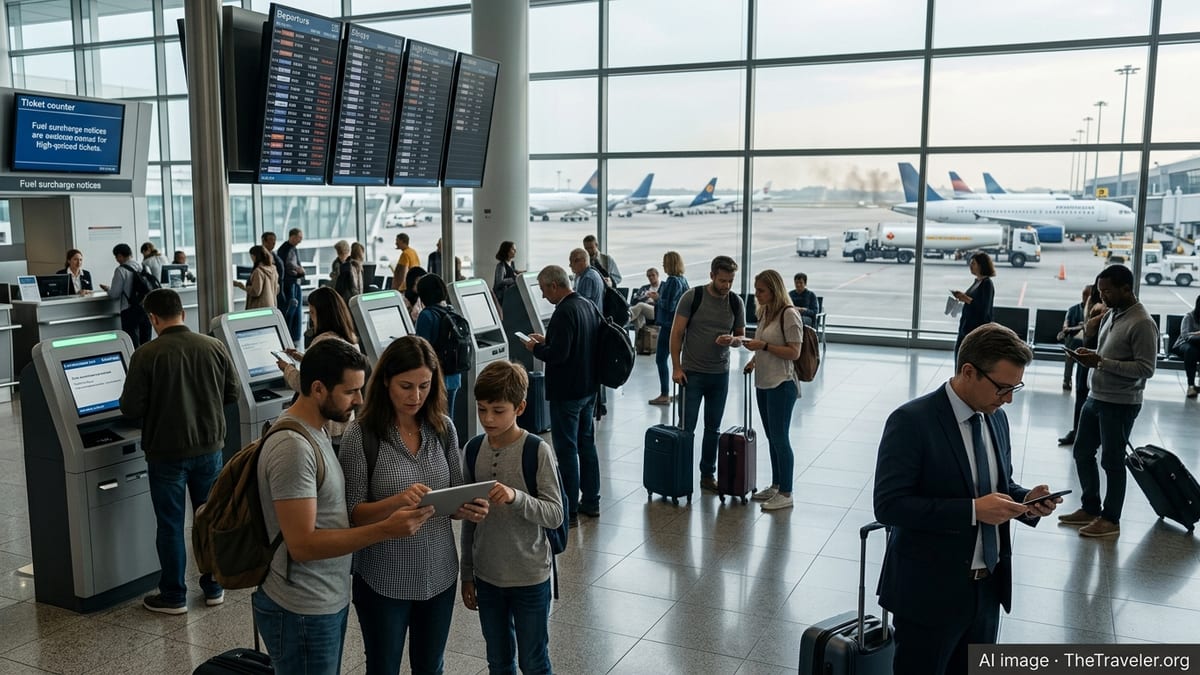
Strait of Hormuz crisis drives fuel shock and fragile networks
Global aviation is feeling the ripple effects of the 2026 Strait of Hormuz crisis, which has disrupted one of the world’s most critical energy chokepoints. Published accounts describe major container lines and energy exporters diverting flows away from the strait and related Red Sea routes, tightening oil and refined product supply worldwide. This has translated into sharp increases in energy benchmarks and created sustained pressure on jet fuel markets.
According to industry and analytical summaries of the unfolding fuel crisis, crude prices pushed above 100 dollars per barrel in the spring while jet fuel prices in some cases more than doubled from the previous month, significantly increasing airline operating costs and compressing already thin margins. Reports from the International Air Transport Association indicate that, outside the extraordinary rebound period after the pandemic, the current spike in jet fuel prices is comparable only to the run-ups of 2008 and 2010, underscoring the severity of the shock for carriers globally.
The disruption is particularly acute for hubs and airlines in and around the Gulf, which sit at the crossroads of long-haul traffic between Europe, Asia and Africa. Analysis by logistics and risk consultancies highlights how airlines have had to reroute or reduce frequencies through parts of the Middle East, while cargo operators report longer sector lengths and contingency routings to avoid higher-risk airspace. This has added fuel burn even as fuel itself becomes more expensive, amplifying the financial strain.
Broader forecasts for 2026 from aviation economic bodies suggest that rising fuel costs, weaker global trade growth and softer macroeconomic conditions could collectively halve industry profitability compared with 2025. At the same time, airlines are absorbing higher costs for sustainable aviation fuel blends, which remain a small fraction of total fuel use but carry a substantial price premium, limiting the scope for fare relief.
Summer of disruption as capacity tightens and delays mount
The fuel shock is feeding directly into passenger experience through tighter capacity and more frequent disruption. Business travel researchers project that elevated fuel prices will keep airfares and associated travel costs higher through the remainder of 2026, with only gradual easing expected in 2027. Their latest global forecast notes that many of the forces now driving prices, from fuel to infrastructure bottlenecks, appear to be structural rather than temporary.
In North America and Europe, this has coincided with a busy summer travel season marked by full flights, constrained spare capacity and fragile operations. A recent analysis of U.S. aviation disruption trends found that the frequency of large-scale delays and cancellations has increased notably since 2010 and especially since the pandemic era, with staffing limitations, weather volatility and air traffic control constraints compounding fuel-driven capacity cuts.
European network data compiled by the region’s air traffic organization for mid-2026 show that while total flight numbers are close to or above 2019 levels on many days, punctuality remains under pressure. Average network arrival delays of several minutes per flight and congested airspace in certain corridors indicate that even modest weather or technical issues can cascade quickly when schedules are dense and fleets are flying near their utilization limits.
Travel management companies and logistics providers report that the combination of rerouted flights around conflict zones, intermittent airspace restrictions and airport infrastructure constraints has lengthened transit times on some key corridors. For time-sensitive cargo, especially pharmaceutical and high-value shipments that once relied heavily on Gulf and Red Sea hubs, contingency plans now routinely factor in longer routings, multimodal options and higher overall transport costs.
Evolving security environment reshapes airspace and airport operations
Security risks are adding another layer of unpredictability to global travel. In early 2026, sudden temporary flight restrictions over parts of Texas and New Mexico led to the first unannounced closure of U.S. airspace for security reasons since 2001. Publicly available incident chronologies describe how the initial shutdown effectively halted operations at El Paso International Airport and warned that deadly force could be used against aircraft deemed an imminent threat, highlighting how quickly routine travel can be disrupted by opaque security concerns.
Internationally, the conflict involving Iran and regional actors has produced a series of aviation-related incidents, from strikes that damaged aircraft on the ground at major Gulf airports to attacks on fuel storage infrastructure near Dubai. Security and risk assessments emphasize that vulnerabilities now extend beyond overflight risks to include the fuel systems and logistics networks that underpin global hubs, raising complex questions about resilience and redundancy.
Airport-level events have also exposed gaps in day-to-day security practices. Coverage of a fatal runway incursion at Denver International Airport in 2026, for example, prompted renewed scrutiny of perimeter security and access control at large facilities. While experts cited in that reporting framed the incident as a rare event, it contributed to a broader debate over how airports balance the probability of such intrusions against the cost of enhanced surveillance and fencing.
Security agencies are simultaneously confronting unconventional threats at passenger checkpoints. Transportation security bulletins from the United States in June documented the discovery of a realistic replica pipe bomb and a training anti-tank mine at Ohio airport checkpoints within the same week. While neither item was an active device, such incidents underline the need for continuous training and technology upgrades to distinguish inert objects from genuine threats without bringing screening lines to a standstill.
Drones, cyber risks and hybrid warfare complicate the threat picture
Beyond traditional terrorism and physical intrusion, aviation and border agencies are tracking a growing range of hybrid and technology-enabled threats. The latest annual security assessment from IATA highlights how military conflict, cheap unmanned aircraft systems and suspected state-backed hybrid operations are creating sporadic airport closures and airspace restrictions, particularly in parts of Europe proximate to the war in Ukraine and other flashpoints. The report notes that small drones, often designed to evade conventional radar, have already triggered temporary shutdowns of airports and imposed new operational constraints.
Recent large events have demonstrated both the scale of the challenge and the capacity for coordinated response. During the FIFA World Cup 2026 in North America, the U.S. Federal Aviation Administration coordinated what it described as the most comprehensive airspace security and drone mitigation effort in the country’s history, establishing nearly 250 no-drone zones around stadiums, fan festivals, hotels and training sites. Authorities reported seizing more than 700 unauthorized drones during the tournament, an indication of how ubiquitous such devices have become around mass gatherings.
Cross-border law enforcement operations are also targeting the misuse of smaller aircraft. A June 2026 operation coordinated by the World Customs Organization across Latin America, the Caribbean and parts of Africa focused on general aviation, deploying risk-analysis teams and open-source intelligence to identify suspicious flights. The operation underscored concerns that lightly regulated aircraft can be exploited for illicit trafficking, potentially intersecting with commercial aviation networks at smaller airports and shared airspace.
Cybersecurity has emerged as an equally pressing dimension of aviation risk. A 2026 academic review of airport cyber threats mapped recent incidents and vulnerabilities against the MITRE ATT&CK framework, arguing that increasingly digitalized airport systems face heightened exposure to ransomware, denial-of-service attacks and supply chain compromises. The paper calls for wider adoption of zero-trust architectures and dedicated cyber risk management for critical airport functions such as passenger processing, baggage handling and airside operations.
What travelers can expect for the rest of 2026
With fuel markets still unsettled and security risks evolving, industry forecasts point to a period of elevated uncertainty for travelers over the remaining months of 2026. Economic and security outlooks from aviation bodies anticipate continued geopolitical friction, rising inflation and slower trade growth, all of which are likely to weigh on airline performance and keep pressure on fares. At the same time, regulatory initiatives are pushing carriers to invest more in sustainable fuels and emissions reduction, costs that will need to be recovered over time.
Travel management companies advise corporate clients to budget for higher airfares and to build greater flexibility into itineraries, especially for routes intersecting the Middle East, Eastern Europe and other regions affected by conflict or energy supply disruption. For leisure travelers, analysts suggest that earlier booking, longer connection times and closer monitoring of airline notifications can help mitigate the impact of rolling schedule changes or airspace restrictions.
In parallel, airports and regulators are ramping up investment in surveillance, drone detection, passenger screening and cyber defenses. While these measures are intended to reduce the likelihood and impact of high-consequence events, they can also introduce new friction into the travel experience in the form of longer security lines, more frequent ID checks and sporadic ground delays when security alerts are triggered.
The emerging picture is of an aviation system that remains fundamentally robust yet increasingly exposed to shocks from outside the traditional realm of airline operations. For passengers, the practical implication is that geopolitical developments, energy markets and security policy decisions far from the check-in desk are now more closely linked than ever to the reliability and cost of a single trip.
Sources: IATA Jet Fuel Price Monitor; Global Business Travel Association 2027 Global Business Travel Forecast; EUROCONTROL European Aviation Overview 2026; IATA Annual Security Report 2025/2026; FAA World Cup 2026 counter-drone briefing