

More news on this day
A rail worker has been killed in Munich after two freight trains collided on a railway bridge, sending wagons plunging onto a city street and adding to a troubling series of recent rail incidents across Europe.
Get the latest news straight to your inbox!
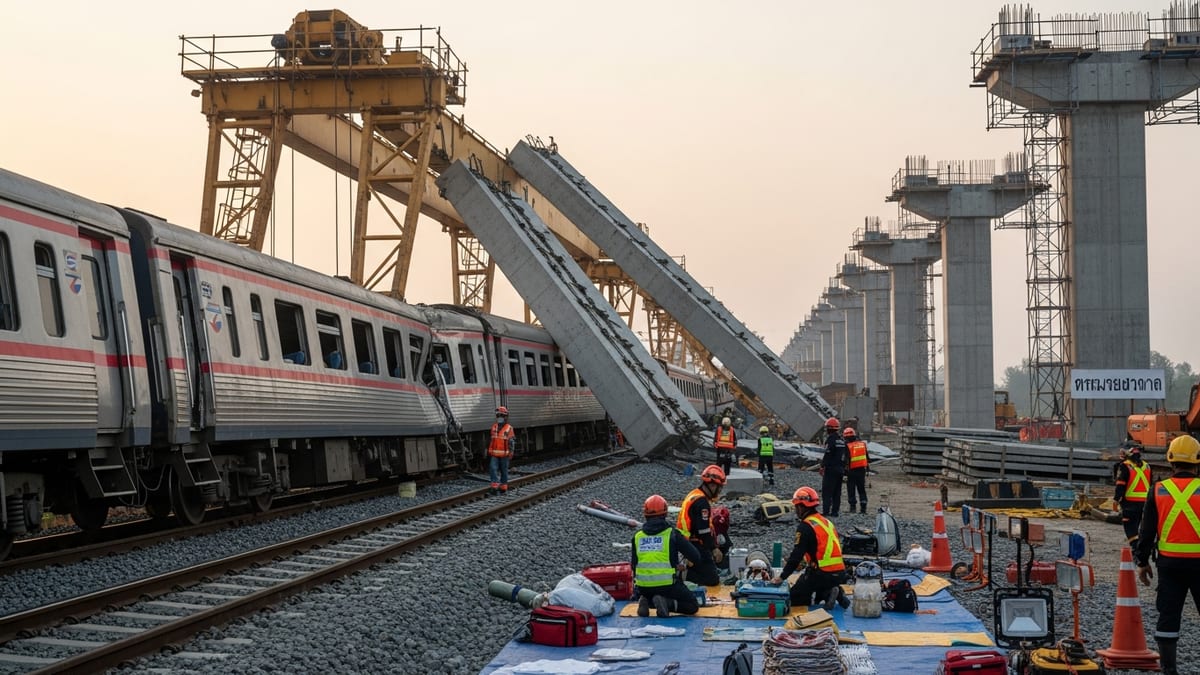
Overnight collision sends wagons off bridge
Reports from Germany indicate that the crash occurred overnight between Friday and Saturday on a freight corridor in the northern part of Munich. Two freight trains operating on the same line collided on a bridge, derailing several wagons. At least two cars left the tracks entirely, falling around five meters from the elevated structure onto the road below.
According to publicly available information, the wagons that plunged from the bridge were not carrying cargo at the time, which limited the risk of hazardous spills or fire. Images shared by German media show crumpled rolling stock resting on the closed roadway, surrounded by emergency vehicles and heavy lifting equipment brought in for the recovery operation.
The collision took place in an urban district where rail lines run through a mix of residential and commercial areas. Local coverage notes that the incident occurred during the night, which meant relatively little traffic was on the road underneath the bridge when the wagons fell.
Initial reports state that no road users or nearby residents were injured, with the impact confined to railway personnel and freight equipment. However, structural inspections of the bridge and overhead lines are ongoing, prolonging disruption to rail operations in the area.
Rail worker killed during impact
German outlets report that one rail worker was fatally injured in the collision. Early accounts describe the person as part of the railway workforce involved with the freight operation on the line where the crash occurred. The individual has not been publicly identified, pending notification of relatives.
Details about the worker’s role at the time of the crash remain limited. Published coverage does not yet clarify whether the victim was on board one of the freight trains or working trackside when the trains collided. The incident has nonetheless reignited debate over occupational safety for staff in Europe’s freight sector, where long night shifts and complex traffic patterns are common.
There are no reports so far of additional serious injuries among crew members. Emergency services on site focused initially on locating and stabilizing railway staff before beginning the technically demanding task of lifting the derailed wagons back toward track level and clearing the road beneath.
Rail unions and industry observers are closely watching the investigation, highlighting the need to understand how protections for workers functioned during the incident and whether additional safeguards are required on busy freight routes in and around major cities.
Severe disruption to Munich freight and local traffic
Publicly available information from local authorities and railway operators shows that the street under the bridge has been closed in both directions while heavy equipment removes the wagons and engineers assess the bridge structure. Drivers have been urged to avoid the area and follow diversions around the affected junction.
On the rails, the line involved is an important freight artery linking industrial areas in southern Germany with wider European networks. Rail traffic has been significantly disrupted, with freight services rerouted or suspended while the damaged section is secured. Some regional passenger connections that share nearby infrastructure have also faced knock-on delays.
The complexity of lifting derailed wagons back to bridge level and repairing track and overhead systems suggests that full normal operations may not resume immediately. Experience from previous European rail incidents indicates that a thorough structural review of the bridge and signaling equipment will likely be required before any return to regular speeds on the affected section.
For travelers passing through Munich, the incident adds further strain to a rail network already coping with maintenance projects and capacity bottlenecks. Passengers are being advised through operator channels to check journey planners carefully and allow extra time, particularly for routes intersecting major freight corridors.
Investigators focus on cause and safety systems
Railway experts in Germany are expected to examine multiple possible causes for the collision, including human error, scheduling conflicts, or technical issues within the signaling and control systems. Published coverage so far indicates that the precise sequence of events remains unclear, with no immediate evidence of severe weather or obstacles on the line.
The crash involved two freight trains on a bridge section where track layout, train speeds, and signal positioning will all form part of the analytical work. Investigators are likely to review traffic management data, onboard recording systems, and communication logs between trains and control centers to determine why both trains occupied the same stretch of track.
In recent years, Germany has been modernizing parts of its rail infrastructure, including the expansion of digital signaling and automated protection technologies. The Munich collision is expected to intensify scrutiny of how consistently such systems are deployed across the freight network, and whether any local limitations or maintenance issues might have contributed to the incident.
Safety specialists note that freight operations can be particularly vulnerable to scheduling pressure on busy corridors that also handle passenger traffic. Nighttime operations, while reducing interference with daytime passenger services, place heavier reliance on robust procedures, clear communication, and reliable technical safeguards to protect workers along the line.
European rail safety under renewed attention
The fatal collision in Munich comes shortly after a separate high profile rail crash north of London, where passenger trains collided near Bedford, causing one death and many injuries. That event, combined with the Munich freight accident, has pushed rail safety back into public debate across Europe.
For travelers and tourism businesses, these incidents raise concerns about reliability and resilience in a transport mode that is widely promoted as a low carbon alternative to short haul flights and long distance driving. Rail travel in Europe continues to hold a strong overall safety record, but clusters of serious events often trigger calls for accelerated investment in infrastructure and safety technology.
Travel industry analysts point out that disruptions of this type can have broader repercussions for logistics chains, city break tourism, and cross border itineraries that rely on tight connections. Freight incidents, in particular, can block critical junctions used by long distance and overnight passenger services, leading to cancellations and missed onward links.
In the wake of the Munich collision, attention is likely to focus on how quickly the affected corridor can be restored, and whether lessons from the inquiry lead to changes in operating rules on mixed use routes. For now, the death of a rail worker in the freight crash stands as a stark reminder that behind Europe’s dense train schedules are staff whose safety depends on systems that must function flawlessly, even in the quiet hours of the night.